Choosing the right mobile gaming ad format often feels overwhelming when studio budgets and timelines are tight. User acquisition specialists across Europe, Asia-Pacific and the Americas are under pressure to deliver greater engagement while keeping production lean. Finding cost-effective, no-code solutions for implementing interactive ad formats gives global studios a practical way to achieve higher user participation without sacrificing speed or resource efficiency. This article offers clear guidance for making ad format decisions that drive stronger results for your games.
Table of Contents
- Defining Mobile Gaming Ad Formats Globally
- Key Types: Playable, Video, Banner, Native
- How Interactive Ad Formats Increase Engagement
- Balancing Cost, Speed And Resource Efficiency
- Mistakes To Avoid And Making The Right Choice
Key Takeaways
| Point | Details |
|---|---|
| Understanding Ad Formats | Familiarise yourself with various mobile gaming ad formats like Interstitial, Playable, and Native Ads, as each serves unique strategic objectives. |
| Prioritising User Experience | Ensure that advertisements integrate seamlessly into gameplay to enhance rather than disrupt player experience. |
| Embracing Interactive Features | Leverage interactive ad formats to increase user engagement by allowing hands-on gameplay previews before installation. |
| Avoiding Common Pitfalls | Steer clear of disruptive ad placements and irrelevant content to maintain user retention and build positive player relationships. |
Defining Mobile Gaming Ad Formats Globally
Mobile gaming ad formats represent sophisticated digital advertising strategies designed to engage and acquire users across diverse global markets. Understanding these formats requires examining their unique characteristics, technological capabilities, and regional variations that drive user interaction and conversion rates.
Globally, mobile gaming ad formats can be categorised into several primary types, each serving distinct strategic objectives:
- Interstitial Ads: Full-screen advertisements displayed at natural transition points within mobile games
- Banner Ads: Small graphic displays typically positioned at screen edges or during gameplay pauses
- Rewarded Video Ads: Video advertisements offering players in-game rewards for complete viewing
- Playable Ads: Interactive advertisement formats allowing users to preview game mechanics before installation
The global mobile games marketing landscape demonstrates significant regional differences in ad format adoption. Asian markets, particularly in China and South Korea, tend to be more aggressive in implementing complex, multi-layered advertising strategies compared to Western markets.
Technological innovation continues driving ad format evolution, with emerging trends focusing on increased user personalisation and seamless gameplay integration. Machine learning algorithms now enable more precise targeting, allowing advertisers to deliver contextually relevant advertisements that feel less intrusive and more engaging.
Pro tip: Prioritise user experience when selecting mobile gaming ad formats, ensuring advertisements complement rather than disrupt gameplay dynamics.
Key Types: Playable, Video, Banner, Native
Mobile gaming advertisement formats represent a sophisticated ecosystem of digital engagement strategies, each designed to capture user attention and drive meaningful interactions across diverse gaming environments. Interactive ad formats have revolutionised how marketers approach user acquisition and retention in the competitive mobile gaming landscape.
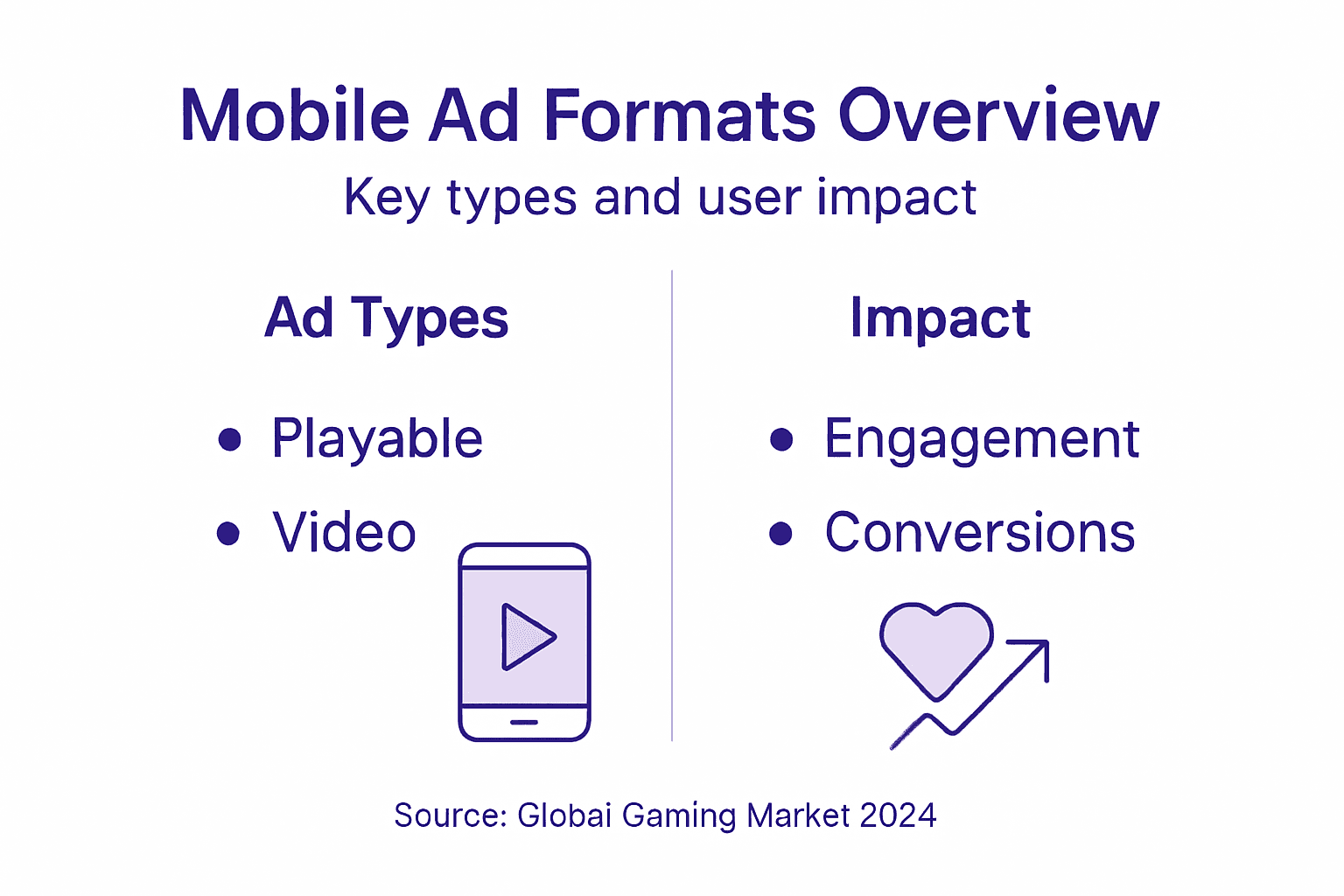
The primary mobile gaming ad formats can be categorised into four distinct types, each with unique characteristics and strategic advantages:
- Playable Ads: Interactive mini-game experiences allowing users to preview gameplay mechanics
- Video Ads: Immersive storytelling advertisements showcasing game features and narrative elements
- Banner Ads: Compact graphic displays providing continuous brand visibility
- Native Ads: Seamlessly integrated advertisements matching the visual design of the gaming environment
Each ad format serves specific marketing objectives, targeting different stages of user engagement and conversion. Playable ads offer the most interactive experience, enabling potential users to directly engage with game mechanics before downloading. Video ads leverage compelling narrative techniques to create emotional connections, while banner ads provide consistent brand presence with minimal disruption.
Native ads represent the most sophisticated approach, blending contextually into the gaming experience to minimise user resistance. These advertisements are designed to feel like natural extensions of the gameplay, reducing perceived intrusiveness and improving overall user receptivity.
Here’s a comparison of key mobile gaming ad formats and their strategic advantages:
| Ad Format | User Experience Impact | Conversion Potential | Best Usage Scenario |
|---|---|---|---|
| Playable Ads | Highly engaging, interactive | Strong for new games | Game previews before install |
| Video Ads | Immersive and narrative-driven | Moderate to high | Launch campaigns, storytelling |
| Banner Ads | Subtle, minimally disruptive | Low to moderate | Continuous brand presence |
| Native Ads | Seamless integration | High in mature markets | Blending with game environments |
Pro tip: Experiment with multiple ad formats and track performance metrics to identify the most effective strategy for your specific mobile gaming audience.
How Interactive Ad Formats Increase Engagement
Interactive ad features have transformed mobile gaming advertising by converting passive viewing into active user participation. These sophisticated formats fundamentally reshape how players engage with promotional content, turning advertisements from interruptions into genuine entertainment experiences.
The primary mechanisms through which interactive ad formats drive engagement include:
- Direct Gameplay Preview: Allowing users to experience game mechanics before downloading
- Reduced Perceived Advertising Friction: Creating enjoyable interactions instead of traditional disruptive ads
- Immediate Value Demonstration: Showcasing game features through hands-on mini-experiences
- Enhanced User Motivation: Providing tangible rewards or gameplay snippets
Interactive advertisements leverage psychological engagement triggers by enabling users to physically interact with the promotional content. This approach transforms advertising from a unidirectional communication model to a participatory experience where potential players can assess game quality and entertainment value in real-time.

Moreover, these formats address critical user retention challenges. By offering genuine gameplay experiences within advertisements, developers can significantly reduce user acquisition costs and improve conversion rates. The immersive nature of interactive ads means players develop an immediate connection with the game’s core mechanics, increasing the likelihood of subsequent download and long-term engagement.
Pro tip: Design interactive ads that provide genuine value and entertainment, focusing on showcasing unique gameplay elements rather than generic promotional messaging.
Balancing Cost, Speed and Resource Efficiency
Mobile gaming ad production strategies demand sophisticated approaches that simultaneously optimise creative output, financial investment, and development resources. Modern user acquisition specialists must navigate complex trade-offs between production speed, advertising quality, and budgetary constraints.
Key strategies for maintaining resource efficiency include:
- Automated Creative Generation: Utilising no-code platforms to reduce development time
- Templated Ad Design: Creating reusable frameworks for multiple game advertisements
- Performance-Based Iteration: Rapidly testing and refining ad formats based on real-time metrics
- Cross-Platform Asset Repurposing: Maximising existing creative assets across different advertising channels
Advertising technology has evolved to provide scalable solutions that dramatically reduce traditional production bottlenecks. By leveraging data-driven optimization techniques, mobile game developers can create high-quality interactive advertisements without requiring extensive manual intervention or significant upfront investment.
Regional variations further complicate resource allocation, with different markets presenting unique cost structures and performance expectations. Successful studios develop flexible frameworks that can quickly adapt creative strategies across global territories, ensuring consistent messaging while maintaining cost-effectiveness.
Below is a summary of resource efficiency strategies for mobile gaming ad production:
| Strategy | Primary Benefit | Typical Implementation |
|---|---|---|
| Automated Creative Generation | Rapid content creation | No-code design platforms |
| Templated Ad Design | Consistency and speed | Pre-built layout frameworks |
| Asset Repurposing | Maximised resource use | Multi-platform adaptation |
| Performance-Based Iteration | Data-driven optimisation | Real-time metric analysis |
Pro tip: Implement modular ad design principles that allow rapid reconfiguration of creative assets, minimising production complexity and maximising adaptation potential.
Mistakes to Avoid and Making the Right Choice
Mobile gaming advertising strategies must carefully navigate potential pitfalls that can dramatically undermine user acquisition and engagement efforts. Understanding common mistakes helps developers create more effective, user-centric advertising approaches.
Critical mistakes to avoid in mobile gaming ad formats include:
- Disruptive Ad Placement: Interrupting gameplay at critical moments
- Unclear User Controls: Providing confusing or non-intuitive ad interaction mechanisms
- Forced Redirections: Automatically moving users away from their gaming experience
- Irrelevant Content: Displaying advertisements unrelated to user interests or game genre
- Excessive Frequency: Overwhelming users with repetitive or constant advertising
Successful mobile game marketers understand that user experience remains paramount. Poorly designed advertisements can cause immediate user churn, potentially destroying carefully cultivated player relationships. The most effective strategies prioritise seamless integration, providing value through interactive, contextually relevant ad experiences that feel like natural extensions of gameplay.
Regional and demographic variations further complicate ad strategy selection. What works in Asian markets might fail completely in European territories, requiring nuanced, data-driven approaches that adapt to specific user preferences and cultural expectations.
Pro tip: Conduct continuous A/B testing across different ad formats and monitor user retention metrics to refine your advertising strategy dynamically.
Unlock Seamless Playable Ad Creation to Skyrocket Your Mobile Game User Acquisition
Mobile gaming ads often face challenges like high production costs, slow development times and intrusive user experiences as outlined in the discussion on mobile gaming ad formats. If you aim to boost engagement through interactive playables without draining your development resources or budget, it is crucial to adopt a solution that makes playable ads easy, fast and cost-effective. The concepts of playable ads and interactive ad formats show immense potential for user retention and acquisition but creating them manually is often complex and expensive.
At PlayableMaker, we solve this pain point with a no-code platform that empowers your team to build captivating playable ads instantly and effortlessly. Backed by efficient automation and templated designs, you can produce high-quality ads optimised for global markets without sacrificing speed or quality. Explore insights and tips on smart ad production in our Publishing Archives and get comprehensive support from our Help Archives. Do not let costly or complicated playable ad creation hold back your growth. Visit PlayableMaker now and start transforming your mobile gaming user acquisition strategy today.
Frequently Asked Questions
What are the main mobile gaming ad formats?
The primary mobile gaming ad formats include interstitial ads, banner ads, rewarded video ads, and playable ads. Each format serves different strategic objectives and caters to various user engagement levels.
How do interactive ad formats increase user engagement in mobile games?
Interactive ad formats transform passive viewing into active participation by allowing users to experience gameplay mechanics and earn rewards, leading to a stronger connection with the game and higher conversion rates.
What are the benefits of using playable ads in mobile gaming?
Playable ads provide a highly engaging, interactive experience, enabling users to preview game mechanics before installation. This increases user interest and significantly boosts the chances of conversion.
What mistakes should I avoid when implementing mobile gaming ads?
Common mistakes include disruptive ad placements, unclear user controls, irrelevant content, and excessive ad frequency. Prioritising user experience is essential for maintaining player engagement and retention.
Recommended
- What Two Main Ad Formats Can Be Used in Mobile Gaming? – playablemaker.com What Two Main Ad Formats Can Be Used in Mobile Gaming?
- Conversions Advertising: Maximising Mobile Game Installs – playablemaker.com Conversions Advertising: Maximising Mobile Game Installs
- Master User Acquisition Ad Strategies for Mobile Games – playablemaker.com Master User Acquisition Ad Strategies for Mobile Games
- User Acquisition News June 2025 – playablemaker.com User Acquisition News June 2025