
Over 60 percent of mobile gaming advertisers say getting users to interact with Facebook ads is their top challenge. For many british marketers, understanding click-through rate becomes the key to measuring real engagement and campaign value. Knowing what drives a strong CTR helps you tailor ads that draw attention—and learning industry benchmarks can guide your next move to stand out in the crowded social feed.
Table of Contents
- Defining Facebook Ad Click-Through Rate
- Typical CTR Benchmarks In Mobile Gaming
- Factors Influencing Facebook Ad CTR
- Optimising Playable Ads For Higher CTR
- Common Pitfalls When Evaluating CTR
Key Takeaways
| Point | Details |
|---|---|
| Understanding CTR | Click-through rate (CTR) is a key metric for measuring ad effectiveness, indicating user engagement through the ratio of clicks to impressions. |
| Benchmark Variations | CTR varies significantly across platforms and game genres, with iOS typically outperforming Android in mobile gaming ads. |
| Influencing Factors | Critical elements such as ad relevance, audience targeting, and creative design drastically affect CTR performance. |
| Data Integrity in Evaluation | Evaluating CTR requires a comprehensive approach, factoring in potential manipulations and monitoring for accurate performance insights. |
Defining Facebook Ad Click-Through Rate
A click-through rate (CTR) represents the fundamental metric measuring user engagement with digital advertisements, specifically calculating the proportion of viewers who actively click on an ad after seeing it. In the context of Facebook ad performance, CTR provides critical insights into how effectively your advertisement captures audience attention and motivates potential users to take action.
Precisely, CTR is mathematically calculated by dividing the total number of ad clicks by the total number of ad impressions, then multiplying the result by 100 to express it as a percentage. This means if your Facebook ad receives 50 clicks from 1,000 total impressions, your CTR would be 5%, representing a direct measurement of ad engagement and relevance. Higher CTR values typically indicate that your advertisement resonates more strongly with your target audience, suggesting compelling creative design, targeted messaging, and strategic audience selection.
For mobile gaming marketers, understanding CTR goes beyond simple mathematics. It serves as a crucial performance indicator that reflects how well your ad connects with potential players. Low CTR might signal the need to reassess your creative approach, targeting strategy, or overall ad design. The nuanced interpretation of CTR requires understanding contextual factors like ad placement, audience demographics, and competitive landscape. Mobile game developers and user acquisition specialists must continuously monitor and optimise their CTR to ensure maximum user acquisition efficiency and cost-effective marketing campaigns.
Typical CTR Benchmarks in Mobile Gaming
In the dynamic world of mobile gaming advertising, click-through rates (CTR) vary significantly across different platforms and game genres. Research reveals fascinating insights into mobile gaming ad performance, with performance metrics playing a crucial role in understanding market trends. Recent data shows that platform differences substantially impact ad engagement rates across mobile ecosystems.
According to comprehensive industry research, CTR benchmarks demonstrate notable variations between iOS and Android platforms. Mobile gaming CTR statistics indicate that iOS games consistently achieve higher click-through rates compared to their Android counterparts. Specifically, iOS gaming apps experienced a CTR of 4.27%, significantly outperforming Android’s 3.34% average. Furthermore, genre-specific variations emerge, with casino gaming apps showing remarkable performance, recording a 6.5% CTR on iOS platforms during the February 2024-2025 period.
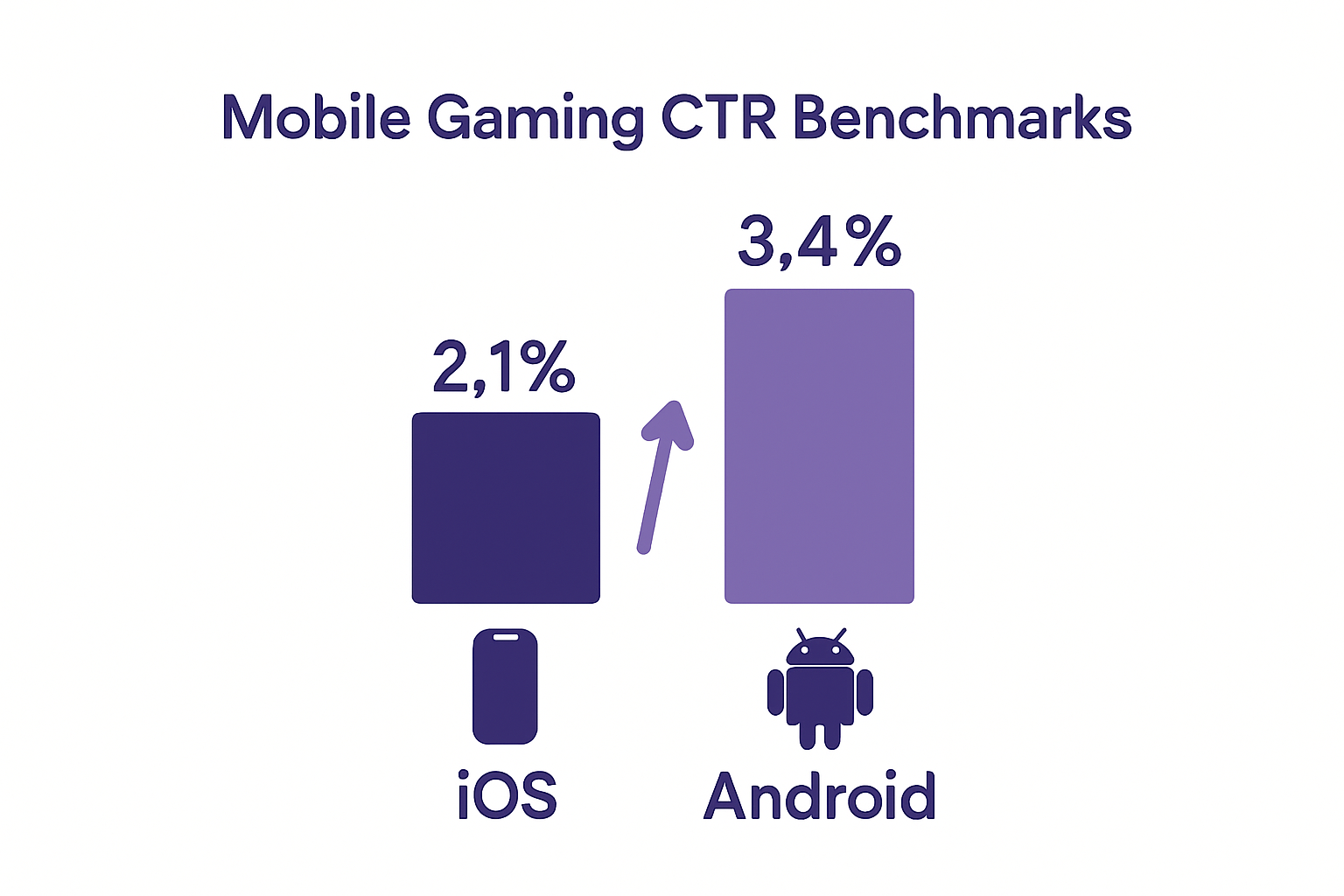
Understanding these benchmarks is critical for mobile gaming marketers and user acquisition specialists. Game developers must recognise that CTR isn’t uniform across platforms, game genres, or device types. Strategy games, for instance, demonstrate particularly interesting engagement patterns, with Android platforms showing notably higher interaction rates compared to other game categories. These nuanced insights underscore the importance of tailored advertising approaches, platform-specific strategies, and continuous performance monitoring to optimise user acquisition and marketing effectiveness in the competitive mobile gaming landscape.
Factors Influencing Facebook Ad CTR
Understanding the complex dynamics of Facebook ad click-through rates requires a multifaceted approach that goes beyond simple metrics. Ad relevance, audience targeting, and creative design emerge as critical factors that significantly impact user engagement. Facebook ad performance strategies demonstrate that successful advertising hinges on understanding the intricate relationships between these key elements.

Research into online advertising systems reveals that CTR prediction involves more than evaluating individual ads in isolation. Advanced ad targeting techniques suggest that contextual relationships between advertisements play a crucial role in determining click-through potential. Semantic embeddings and deep learning architectures have shown remarkable potential in predicting the likelihood of user interaction, highlighting the complexity of modern digital advertising strategies.
Mobile gaming advertisers must consider multiple nuanced factors that influence CTR. These include audience demographics, ad placement, visual creativity, compelling copy, precise targeting algorithms, and the psychological triggers that motivate user engagement. The most successful campaigns leverage a sophisticated understanding of user behaviour, combining data-driven insights with creative storytelling. By continuously analysing and refining these elements, marketers can develop more responsive and effective advertising strategies that resonate with their target audience and drive meaningful interaction rates.
Optimising Playable Ads for Higher CTR
Optimising playable ads requires a strategic approach that combines technological innovation with deep user psychology. Predictive modelling and user interaction design emerge as critical components in developing high-performing mobile game advertisements. Ad optimization techniques provide mobile gaming marketers with sophisticated tools to enhance click-through rates and user engagement.
Research into online advertising platforms suggests that CTR prediction involves complex algorithmic approaches that go beyond traditional metrics. The ability to mathematically model potential user interactions allows marketers to create more targeted and compelling ad experiences. Semantic analysis and machine learning techniques can help predict which combinations of visual elements, gameplay snippets, and interactive components are most likely to generate user interest.
Successful playable ad optimisation demands a holistic approach that integrates multiple strategic elements. Mobile game developers must focus on creating concise, engaging interactive experiences that provide immediate value. Key optimization strategies include crafting compelling initial gameplay moments, ensuring smooth and intuitive user interactions, implementing clear value propositions, and continuously testing different creative variations. By adopting a data-driven approach that combines technical insights with creative storytelling, marketers can develop playable ads that not only capture attention but also effectively convert potential players into active game users.
Common Pitfalls When Evaluating CTR
Evaluating click-through rates requires a nuanced understanding that goes beyond simple numerical analysis. Data integrity and contextual interpretation are critical aspects that mobile gaming marketers must carefully consider when assessing advertisement performance. Facebook ad performance metrics reveal multiple complex factors that can distort authentic CTR measurements.
One significant challenge in CTR evaluation involves the potential for artificial manipulation. Click fraud mechanisms represent a substantial risk to accurate performance tracking, where low-paid workers or automated systems can artificially inflate click numbers. These deceptive practices can create misleading impressions of ad effectiveness, causing marketers to make strategic decisions based on fundamentally corrupted data.
Beyond direct manipulation, mobile gaming advertisers must navigate subtle measurement nuances that can skew CTR interpretations. Different tracking methods, such as view-through rates which account for delayed user responses, provide alternative perspectives on ad performance. Marketers should adopt a multi-dimensional approach, considering not just immediate clicks but also long-term user engagement, conversion rates, and qualitative interaction metrics. By developing sophisticated, holistic evaluation frameworks, mobile game developers can move beyond simplistic CTR measurements and gain deeper insights into the true effectiveness of their advertising strategies.
Boost Your Facebook Ad CTR with Easy No-Code Playable Ads
Struggling to improve your Facebook ad click-through rate is a common challenge for mobile gaming marketers. This article highlights how factors like creative design, targeting precision and ad engagement shape your CTR. Achieving a strong CTR means your ads truly connect with players and drive action. However, traditional playable ads often demand valuable developer time, company resources and high costs—which can stall optimisation efforts.
At PlayableMaker, we understand your need for fast, budget-friendly ad solutions that maximise user engagement without the usual complexity. Our no-code platform lets you build interactive playable ads quickly and easily so you can test creative variations and optimise CTR without wasting precious resources. Explore our Publishing Archives for expert tips on launching successful campaigns and dive into our Uncategorized Archives for fresh insights about ad strategies. Start transforming your Facebook ad performance today by trying PlayableMaker at https://app.playablemaker.com and unlock higher CTR with ads that truly capture your audience.
Frequently Asked Questions
What is a click-through rate (CTR) in Facebook advertising?
A click-through rate (CTR) measures the proportion of users who click on a Facebook ad after viewing it. It is calculated by dividing the total number of ad clicks by the total number of ad impressions and multiplying by 100 to express it as a percentage.
What is considered a good CTR for Facebook ads?
A good CTR for Facebook ads can vary by industry and ad type. Generally, a CTR above 1% is considered average, while a CTR of 2-3% is viewed as good. However, gaming ads may see higher benchmarks, often exceeding 4%.
How can I improve the CTR of my Facebook ads?
To improve your CTR, focus on creating engaging and relevant ad content. Use targeted messaging, eye-catching visuals, and optimise your audience settings. Additionally, consider testing different ad formats and placements to find the most effective combination.
What factors can affect my Facebook ad CTR?
Several factors can influence your Facebook ad CTR, including ad relevance, audience targeting, creative design, and the competitive landscape. Continuous monitoring and optimisation of these elements are crucial for improving engagement rates.
Recommended
- Complete Guide to FB Ad Metrics for Mobile Gaming – playablemaker.com Complete Guide to FB Ad Metrics for Mobile Gaming
- Facebook Ad Performance: Complete Guide for Mobile Gaming – playablemaker.com Facebook Ad Performance: Complete Guide for Mobile Gaming
- What Is Frequency in Facebook Ads? Complete Guide – playablemaker.com What Is Frequency in Facebook Ads? Complete Guide
- What Is Facebook Ad Frequency? Complete Guide – playablemaker.com What Is Facebook Ad Frequency? Complete Guide
- Post | Tulip Films