
More than two billion people use Facebook every month, yet reaching the right audience often feels like searching for a needle in a haystack. For mobile gaming marketers, choosing who sees your ads can mean the difference between wasted spend and real growth. Detailed targeting gives you the power to focus on users most likely to play, spend, and stay engaged, offering data-driven precision that boosts campaign results.
Table of Contents
- Defining Detailed Targeting In Facebook Ads
- Types Of Targeting Options Available
- How Facebook’s Targeting Algorithm Operates
- Setting Up Detailed Targeting For Mobile Gaming
- Common Mistakes In Detailed Targeting Setup
- Maximizing ROI With Best Practice Strategies
Key Takeaways
| Point | Details |
|---|---|
| Detailed Targeting | Facebook Ads provide a detailed targeting feature that allows advertisers to reach specific customer segments based on demographics, interests, and behaviors, enhancing ad relevance and effectiveness. |
| Targeting Options | Advertisers can choose from Core Audiences, Custom Audiences, and Lookalike Audiences to maximize audience precision and re-engagement. |
| Algorithm Operation | Facebook’s sophisticated targeting algorithm utilizes machine learning to match ads with users, but marketers must be aware of demographic biases that may skew targeting results. |
| Common Pitfalls | Over-targeting and simplifying demographics can hinder ad effectiveness; thus, it’s crucial to maintain diversity in audience selection strategies. |
Defining Detailed Targeting in Facebook Ads
Detailed targeting in Facebook Ads represents a sophisticated audience segmentation strategy that enables advertisers to precisely define and reach their ideal customer base. According to research from eminds.lk, this feature allows marketers to refine audience selection by leveraging demographic information, interests, and user behaviors shared within the platform.
The core mechanism of detailed targeting revolves around granular audience selection. Advertisers can segment potential customers using multiple parameters such as age, gender, ethnicity, household income, and even specific behavioral characteristics. As documented by ejbmr.org, this approach transforms advertising from a broad, generalized strategy into a precision-driven targeting mechanism.
Key components of Facebook’s detailed targeting include:
- Demographic filtering (age, gender, location)
- Interest-based segmentation
- Behavioral tracking and analysis
- Custom audience creation
When implemented effectively, detailed targeting allows mobile gaming marketers to connect with users most likely to engage with their specific app or game. By narrowing the audience based on precise characteristics, advertisers can dramatically improve ad relevance, reduce wasted ad spend, and increase overall conversion rates.

For mobile gaming professionals looking to dive deeper into audience targeting strategies, understanding audience targeting in mobile gaming can provide additional insights into maximizing ad performance.
Types of Targeting Options Available
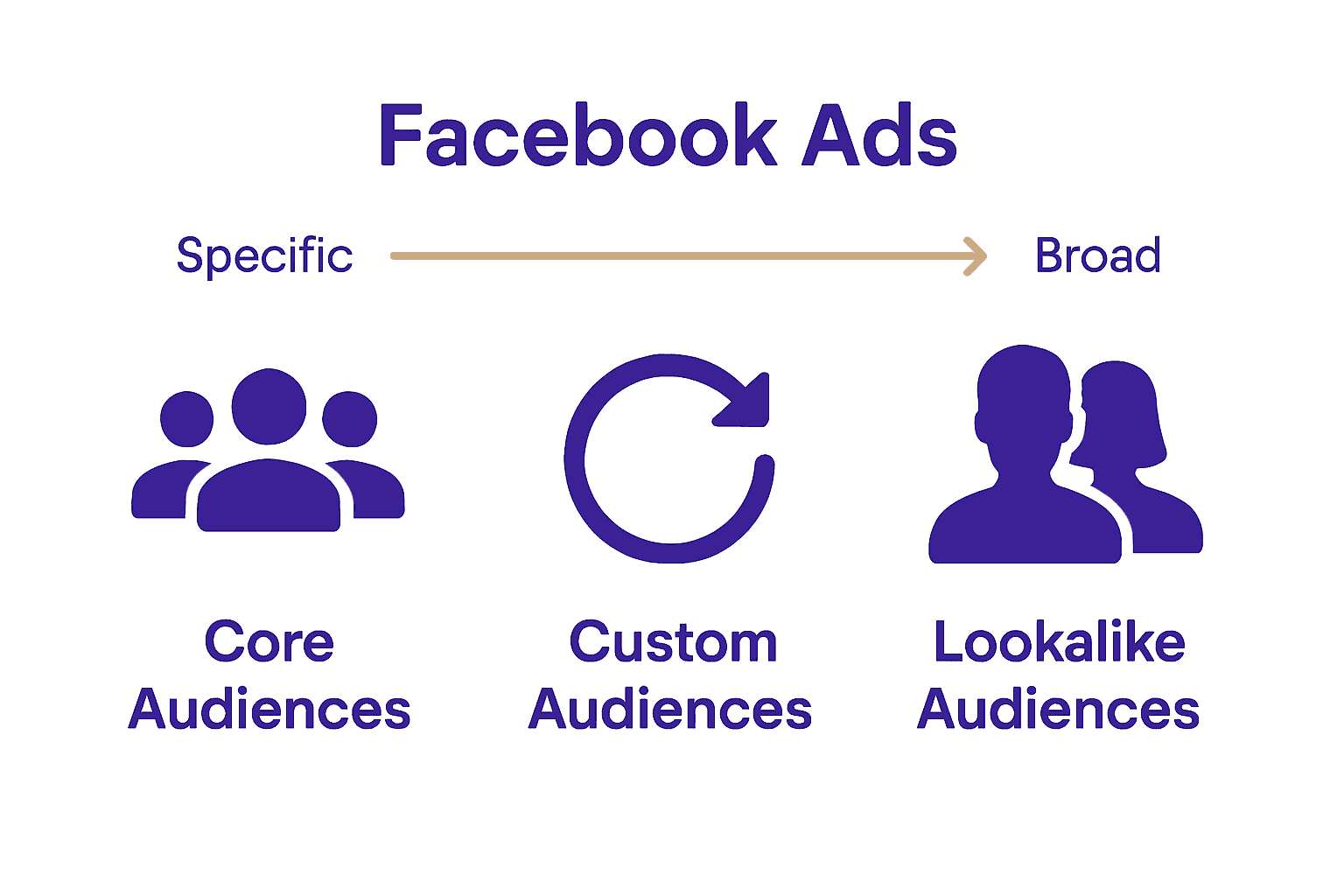
Facebook offers advertisers a comprehensive suite of targeting options designed to help mobile gaming marketers reach their most relevant audiences with precision and efficiency. According to research from courseweb.eminds.lk, these targeting strategies can be broadly categorised into three primary types: Core Audiences, Custom Audiences, and Lookalike Audiences.
Each targeting option provides unique capabilities for audience segmentation. Core Audiences enable advertisers to define potential customers using demographic data, interests, and behaviours. Custom Audiences allow marketers to reconnect with individuals who have previously interacted with their brand, while Lookalike Audiences help expand reach by finding new users similar to existing customers. As documented by bia.com, Lookalike Audience Targeting specifically helps brands discover potential users who share characteristics with their current high-performing customer base.
Here’s a summary of Facebook’s main ad audience targeting options:
| Targeting Type | Audience Definition | Key Advantages |
|---|---|---|
| Core Audiences | Demographics, interests, location, behaviour | High granularity Precise segmenting |
| Custom Audiences | Past brand interactions (website, app, email) | Re-engage warm prospects Personalisation |
| Lookalike Audiences | Similar to existing customers | Scale reach Find high-potential users |
Detailed breakdown of targeting options:
- Core Audiences
- Age targeting
- Gender selection
- Location-based filtering
- Interest and behaviour tracking
- Custom Audiences
- Website visitor retargeting
- App user re-engagement
- Email list matching
- Lookalike Audiences
- Percentage-based similarity matching
- Demographic mirroring
- Behavioural pattern replication
Mobile gaming marketers can leverage these targeting options to create highly specific ad campaigns that maximize user acquisition and minimise wasted ad spend.
 For deeper insights into crafting effective targeting strategies, understanding Facebook targeted ads for mobile gaming offers comprehensive guidance on optimising audience selection.
How Facebook’s Targeting Algorithm Operates
Facebook’s targeting algorithm represents a sophisticated machine learning system designed to match advertisers with the most relevant potential users. According to research from arXiv, the platform has developed a unique capability called nanotargeting, which enables advertisers to deliver ads to extremely specific user segments using non-personally identifiable information.
The algorithmic process involves multiple complex layers of data analysis and prediction. Machine learning models continuously evaluate user interactions, historical engagement patterns, and demographic characteristics to predict the most likely candidates for a particular advertisement. Notably, research highlights potential challenges in this approach. As documented by arXiv, the ad delivery system can inadvertently produce skewed outcomes due to optimization processes that consider factors like advertiser budget and ad content, which might lead to unintended demographic biases.
Key components of Facebook’s targeting algorithm include:
- User Interaction Tracking
- Click-through rates
- Engagement metrics
- Historical behaviour patterns
- Predictive Modeling
- Machine learning classification
- Probability-based matching
- Real-time audience segmentation
- Contextual Analysis
- Ad relevance scoring
- User interest mapping
- Behavioral prediction
For mobile gaming marketers seeking to understand the nuances of digital advertising targeting, what is ad targeting provides comprehensive insights into the mechanics behind audience selection strategies.
Setting Up Detailed Targeting for Mobile Gaming
Creating an effective detailed targeting strategy for mobile gaming advertisements requires a nuanced approach to audience segmentation. According to research from ejbmr.org, advertisers can strategically select demographics such as age, gender, and specific gaming-related interests to ensure their ads reach the most engaged potential users.
The process of setting up detailed targeting involves multiple strategic considerations. As documented by bia.com, Custom Audience Targeting emerges as a powerful technique, enabling advertisers to reconnect with users who have previously engaged with similar mobile gaming apps or content. This approach dramatically increases the probability of user acquisition by focusing on individuals with demonstrated gaming interests.
Key steps for setting up detailed targeting in mobile gaming:
- Demographic Precision
- Select specific age ranges
- Choose relevant gender segments
- Define geographic targeting
- Interest-Based Targeting
- Gaming genre selection
- Platform preference mapping
- Gaming behaviour tracking
- Audience Refinement
- Custom audience creation
- Lookalike audience expansion
- Behavioural exclusion techniques
Mobile gaming marketers looking to dive deeper into audience targeting strategies can explore our audience targeting guide for mobile gaming, which provides comprehensive insights into maximising ad performance and user engagement.
Common Mistakes in Detailed Targeting Setup
Mobile gaming marketers often encounter subtle yet significant pitfalls when configuring Facebook ad targeting strategies. Research from arXiv reveals a critical insight: the platform’s ad delivery optimization can inadvertently introduce demographic biases, potentially skewing audience reach in ways advertisers might not anticipate.
One of the most prevalent errors is over-targeting, which can dramatically reduce ad effectiveness. According to research from arXiv, marketers frequently make the mistake of creating overly narrow audience segments through nanotargeting. This approach, while seemingly precise, can significantly limit an advertisement’s potential reach and impact, essentially creating an echo chamber that restricts user acquisition potential.
Common targeting mistakes to avoid:
- Demographic Oversimplification
- Ignoring intersectional audience characteristics
- Relying on single-dimension targeting
- Failing to consider audience complexity
- Targeting Scope Errors
- Creating audiences that are too narrow
- Overlooking potential user diversity
- Misunderstanding interest correlation
- Technical Configuration Mistakes
- Incorrect exclusion settings
- Improper interest category selection
- Neglecting audience size recommendations
For mobile gaming professionals seeking to refine their targeting approach, our audience targeting guide for mobile gaming offers comprehensive strategies to navigate these complex targeting challenges.
Maximizing ROI with Best Practice Strategies
Maximizing return on investment in Facebook ad targeting requires a strategic and nuanced approach to audience segmentation and performance monitoring. Research from arXiv emphasizes the critical importance of understanding and mitigating potential demographic biases within the platform’s ad delivery system, which can significantly impact overall campaign effectiveness.
Successful ROI optimization demands a multi-faceted strategy that goes beyond simple audience selection. According to research from arXiv, marketers must implement sophisticated countermeasures against nanotargeting, such as broadening targeting criteria and diversifying ad content to enhance overall reach and engagement. This approach helps prevent the creation of overly narrow audience segments that can limit potential user acquisition.
Key strategies for maximizing Facebook ad ROI:
- Audience Diversification
- Expand targeting parameters
- Test multiple audience segments
- Avoid over-restrictive criteria
- Performance Monitoring
- Track demographic engagement rates
- Analyze cross-segment performance
- Continuously refine targeting approach
- Budget Optimization
- Implement dynamic budget allocation
- Use performance-based scaling
- Balance reach with precision targeting
Mobile gaming marketers seeking comprehensive insights can explore our mobile ad best practices guide, which provides actionable strategies for improving campaign performance and maximizing return on investment.
Streamline Your Detailed Targeting with Easy Playable Ads Creation
Navigating the complexities of Facebook’s detailed targeting can quickly become overwhelming with the need for precision and avoiding common targeting mistakes. This challenge can drain your resources and budget, especially when crafting playable ads that truly engage your ideal gaming audience. You want to deliver highly targeted, interactive ads without the usual delays and high costs that come with traditional development.
PlayableMaker offers a no-code solution designed specifically to help you build playable ads fast and affordably. Our platform empowers you to create interactive ads that enhance your targeting strategies by boosting engagement and maximising conversion rates. Ready to take control of your ad campaigns and avoid over-targeting pitfalls highlighted in the detailed targeting guide? Explore practical advice in our Uncategorized Archives and get hands-on with your next campaign at PlayableMaker. Need more help publishing your ads? Visit our Publishing Archives for additional support.
Start creating playable ads that work smarter, reach your exact audience faster, and keep your budget intact. Join PlayableMaker today and transform the way you target mobile gamers.
Frequently Asked Questions
What is detailed targeting in Facebook Ads?
Detailed targeting is an audience segmentation feature that allows advertisers to define and reach their specific customer base by utilizing demographic information, interests, and user behaviors within Facebook’s platform.
How does Facebook’s targeting algorithm work?
Facebook’s targeting algorithm employs machine learning to analyze user interactions, historical engagement patterns, and demographic details to predict which users are most likely to respond positively to specific advertisements.
What types of audiences can I create using Facebook Ads?
Advertisers can create Core Audiences, Custom Audiences, and Lookalike Audiences. Core Audiences allow targeting based on demographics and interests, Custom Audiences enable re-engagement with previous customers, and Lookalike Audiences help find new users with similar traits to existing customers.
What are common mistakes to avoid when setting up detailed targeting?
Common mistakes include over-targeting, which limits potential reach, demographic oversimplification, and misconfiguring technical settings like exclusion criteria. Avoiding these errors can enhance the effectiveness of your ad campaigns.
Recommended
- Understanding Facebook Targeted Ads for Mobile Gaming – playablemaker.com Understanding Facebook Targeted Ads for Mobile Gaming
- Complete Guide to FB Ad Metrics for Mobile Gaming – playablemaker.com Complete Guide to FB Ad Metrics for Mobile Gaming
- Understanding Interest Facebook Ads for Mobile Gaming – playablemaker.com Understanding Interest Facebook Ads for Mobile Gaming
- Audience Targeting Explained: Boost Mobile Gaming Ads – playablemaker.com Audience Targeting Explained: Boost Mobile Gaming Ads
- Facebook Ad – Unique Solutions to IRS Tax Problems