
TL;DR:
- No-code development allows marketing teams to create, test, and implement playable ads without coding, significantly reducing time and costs. It improves key performance metrics like IPM, CTR, and CPI while enabling rapid creative iteration and differentiation through simplified workflows. However, no-code is best suited for simple, genre-specific ads and may face limitations with complex mechanics or high-volume needs.
Building a playable ad used to mean pulling a developer off their roadmap, waiting weeks, and spending thousands before a single user tapped the screen. That assumption is now outdated. No-code development has shifted the balance of power toward marketing and user acquisition teams, enabling them to build, test, and publish interactive ads without writing a single line of code. This article covers what no-code actually means in the context of playable ads, how the creation process works step by step, what the data says about performance, and where the genuine limitations lie.
Table of Contents
- What is no-code development?
- Core mechanics of no-code playable ad creation
- Business impact: speed, cost, and performance benchmarks
- Limits, edge cases, and best practices
- Why the future of playable ad creation is a hybrid approach
- Accelerate your mobile ad campaigns with no-code tools
- Frequently asked questions
Key Takeaways
| Point | Details |
|---|---|
| No-code empowers marketers | Visual tools allow non-developers to build and iterate cost-effective, engaging playable ads freely. |
| Rapid iteration boosts results | No-code platforms cut production time and enable frequent testing, driving higher IPM and conversion rates. |
| Best for simple playables | Three-to-five step mechanics are ideal—complex features may need hybrid or exportable solutions. |
| Watch for limitations | Vendor lock-in, debugging challenges, and scaling issues must be managed proactively for long-term success. |
What is no-code development?
The term “no-code” is used loosely across the technology industry, so it is worth being precise. No-code development enables non-technical users to build applications using visual interfaces, drag-and-drop tools, pre-built templates, and configurable logic. There is no syntax to learn, no compiler to run, and no pull request to submit. The platform handles the underlying code automatically, based on the choices a user makes in a visual editor.
For mobile game marketers, this distinction matters enormously. Traditionally, a playable ad required a developer to write JavaScript or WebGL, manage asset compression, test across dozens of device configurations, and then hand the file to a network for compliance review. Each revision meant another developer sprint. No-code removes that bottleneck entirely.
The core building blocks of a no-code system for playable ads include:
- Visual editors: Drag-and-drop canvases where marketers place game assets, buttons, animations, and overlays without touching code.
- Pre-built templates: Genre-specific starting points (match-3, idle, puzzle, runner) that encode common interaction patterns and reduce setup time dramatically.
- Logic and trigger engines: Rule-based systems that define what happens when a user taps, swipes, or completes an action, without requiring conditional programming knowledge.
- Device optimisation layers: Automatic scaling and resolution handling so the ad renders correctly on both a budget Android handset and the latest iPhone.
“No-code is not a shortcut to a lesser product. It is a structural shift in who controls the creative process and how quickly ideas reach audiences.”
This shift has direct implications for user acquisition teams. Rather than queuing creative requests through a development backlog, UA managers can now prototype a new concept in an afternoon, gather performance data within days, and iterate based on real install signals. The ability to explore playable ad techniques rapidly, without developer dependency, changes how teams allocate both time and budget.
The no-code model also democratises creative testing. Smaller studios and indie publishers, who cannot afford a dedicated ad development team, gain access to the same interactive ad formats as major publishers. That competitive levelling is one of the more significant structural changes no-code has introduced to mobile game marketing.
Core mechanics of no-code playable ad creation
Understanding the definition is one thing. Knowing how the process actually unfolds is what allows UA teams to plan campaigns effectively. No-code platforms let marketers use drag-and-drop UI, configurable logic, and pre-built templates for rapid ad creation, and the workflow typically follows a clear sequence.
The standard creation process:
- Choose a template aligned to your game genre. A match-3 template, for instance, already includes tile swap logic, a move counter, and a win condition.
- Import assets such as character sprites, background images, sound effects, and UI elements directly from your game’s existing art files.
- Configure interaction logic using the trigger engine. Define what happens on a correct tap, a failed move, or a timer expiry, without writing conditional statements.
- Preview across devices within the platform’s built-in simulator, checking behaviour on different screen sizes and operating systems.
- Publish and distribute by exporting to the required ad network format (MRAID, HTML5, or network-specific SDKs), often with a single click.
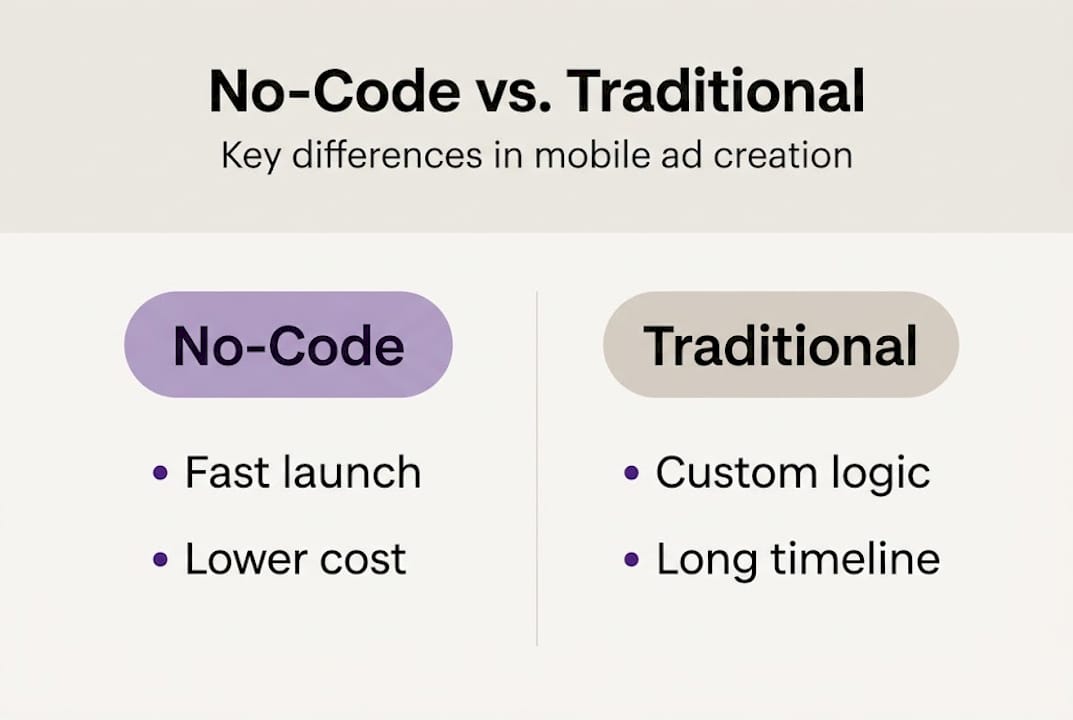
This contrasts sharply with traditional code-based creation, as the table below illustrates.
| Factor | No-code creation | Traditional code-based |
|---|---|---|
| Production time | 2 to 5 days | 3 to 6 weeks |
| Developer involvement | None required | Full-time developer needed |
| Iteration speed | Hours per revision | Days to weeks per revision |
| Cost per creative | Low (platform subscription) | High (developer hourly rates) |
| A/B variant creation | Self-service | Requires separate builds |
The mechanics that make no-code playable ads effective go beyond speed. Trigger systems allow marketers to build feedback loops that feel responsive and satisfying, which is central to engagement. A tap that produces an immediate visual reward, a progress bar that fills with each correct action, or a subtle haptic cue at the moment of success all contribute to the psychological pull that makes playable ads outperform static or video formats.
The mobile ad design guide reinforces a principle that experienced UA teams already know: simplicity is not a compromise, it is a strategy. Ads with three to five interaction steps consistently outperform those with more complex flows, because they respect the user’s attention window and deliver a satisfying loop within it.
Pro Tip: Keep your playable loop under 30 seconds and refresh creative variants every six to eight weeks. Audiences habituate quickly to repeated experiences, and even minor visual changes can restore engagement rates significantly.
For teams exploring no-code ad tips, the most actionable advice is to treat each ad as a hypothesis. Build it fast, measure it honestly, and replace it without sentiment when the data signals fatigue.
Business impact: speed, cost, and performance benchmarks
The operational case for no-code is compelling on its own. The performance case makes it decisive. No-code playable ads cut costs by 60 to 90%, reduce production time to 2 to 5 days, increase CTR and retention, and reduce CPIs. These are not marginal improvements. They represent a fundamental change in the economics of mobile game user acquisition.

To understand why, consider what those numbers mean in practice. A UA team running ten creative concepts per month under a traditional development model might spend 40 to 60 developer hours per concept, plus QA, compliance, and network submission time. Under a no-code model, the same team can produce ten concepts in a fraction of the time, with zero developer dependency, and begin gathering performance data within the same week.
The key performance indicators that improve most consistently with no-code playable ads include:
- Installs per mille (IPM): Playable ads routinely deliver two to three times the IPM of video ads, because users who complete an interactive experience have already demonstrated intent.
- Click-through rate (CTR): Interactive formats generate higher CTR than static banners or unskippable video, as engagement is active rather than passive.
- Cost per install (CPI): Lower production costs and higher conversion rates combine to reduce effective CPI, often by more than a third compared to video-only campaigns.
- Day-1 and Day-7 retention: Users acquired through playable ads tend to retain better, because the ad itself functions as a pre-qualification filter. Players who enjoy the mini-experience are more likely to enjoy the full game.
The no-code performance trends data also highlights a less obvious benefit: volume. When creative production is fast and affordable, UA teams can test more hypotheses simultaneously. Instead of committing a large budget to one or two creatives, they can run six to eight variants, identify the top performer within days, and scale spend behind proven concepts. This approach reduces wasted budget and accelerates learning cycles.
Statistic: Mobile game campaigns using no-code playable ads report average CPI reductions of 30 to 40% compared to equivalent video campaigns, with IPM scores two to three times higher across comparable audience segments.
One consideration worth noting is creative fatigue. Even the highest-performing playable ad will see declining engagement over time as audiences are repeatedly exposed to the same experience. The advantage of no-code is that refreshing a creative variant, changing colours, swapping a character, or adjusting the win condition, takes hours rather than weeks. Teams that build a cadence of regular creative refreshes into their UA workflow sustain performance far longer than those treating each ad as a fixed asset.
For a detailed look at cost-effective ad creation, the principles of no-code align directly with lean UA strategy: move fast, measure everything, and reinvest in what works.
Limits, edge cases, and best practices
No-code is genuinely powerful, but it is not without boundaries. Understanding those boundaries is what separates teams that use no-code strategically from those that encounter its limitations unexpectedly.
No-code solutions can hit an 80% feature ceiling, face vendor lock-in and debugging limitations, and may not scale for very complex or high-volume campaigns. The practical implications of this are worth unpacking carefully.
The most common edge cases where no-code shows strain include:
- Complex interaction logic: If your game’s core mechanic requires multi-step conditional branching, real-time physics simulation, or procedurally generated content, most no-code platforms will not support it natively.
- Custom network integrations: Some ad networks require proprietary tracking pixels, custom event schemas, or SDK-level integrations that no-code export functions cannot accommodate without manual intervention.
- High-volume creative pipelines: Studios running hundreds of creative variants simultaneously, with dynamic personalisation per audience segment, may find no-code platforms slow or limited in batch processing capability.
Beyond feature ceilings, vendor lock-in is a risk that deserves honest attention. When your entire creative library is built within a single platform’s proprietary format, migrating to a different tool or exporting to a custom environment can require rebuilding assets from scratch. This is a genuine operational cost that should factor into platform selection decisions.
No-code platform limits also extend to debugging. When something breaks in a code-based environment, a developer can inspect the error log, identify the precise line causing the issue, and fix it. In a no-code environment, error messages are often generic, and the visual abstraction that makes the platform accessible also makes it harder to diagnose subtle behavioural problems.
Three best practices help UA teams navigate these realities effectively:
- Start with your simplest, highest-volume creatives. No-code is ideal for standard genre templates and iterative variants. Reserve developer time for genuinely novel formats.
- Audit your platform’s export options before committing. Ensure the tool supports the ad network formats you actually use, and test the export process with a real campaign before building a large creative library.
- Build A/B testing for playables into your workflow from day one. No-code’s speed advantage is only realised if you are systematically testing and learning, not just producing.
Pro Tip: When repurposing ad creatives across formats, no-code platforms make it straightforward to adapt a playable into a video capture or a static banner, extending the value of each creative concept without additional production cost.
The honest summary is this: no-code is the right tool for the majority of playable ad production, and a poor fit for a minority of highly specialised use cases. Knowing which category your campaign falls into before you begin is the most valuable planning decision you can make.
Why the future of playable ad creation is a hybrid approach
The most effective UA teams we observe are not choosing between no-code and traditional development. They are using both, deliberately and in sequence. No-code handles the volume work: rapid prototyping, iterative testing, and standard creative variants. Custom development handles the exceptions: novel mechanics, complex integrations, and flagship formats that justify the investment.
This hybrid model reflects a mature understanding of resource allocation. No-code dramatically lowers the cost of creative experimentation, which means teams can afford to test more ideas and identify winners faster. When a concept proves itself in no-code, it may warrant a more polished, custom-built version for high-spend campaigns. That is not a failure of no-code. It is no-code fulfilling its proper role in the creative pipeline.
The advanced ad techniques that drive the best results in 2026 are built on this principle. Start simple, iterate fast, and plan for flexibility. Do not build your entire UA infrastructure on a single platform’s proprietary ecosystem. Maintain the ability to move, adapt, and scale without being held hostage by a vendor’s roadmap.
Accelerate your mobile ad campaigns with no-code tools
If you are ready to move beyond the theory and start building, the practical resources are already available. Understanding the psychology of playable ads will help you design interactions that convert, not just engage. For a broader view of the format’s potential, playable ads explained covers the strategic case in full. When you are ready to build, the PlayableMaker builder gives UA and marketing teams a no-code environment designed specifically for mobile game advertisers, with templates, logic tools, and network-ready export built in.
Frequently asked questions
What makes no-code development ideal for playable ads?
No-code enables marketers to iterate and launch engaging playable ads quickly, with 60 to 90% lower costs and faster turnaround than traditional methods, removing the need for developer involvement on every creative revision.
How complex can no-code playable ads get before issues arise?
No-code suits simple 3 to 5 step playables well; complex logic, custom features, or high-volume campaigns may require switching to hybrid solutions, as no-code approaches are best for simple, genre-focused interactions but may hit a ceiling for advanced use cases.
Which metrics improve most with no-code playable ads?
Marketers see higher install rates (IPM), CTR, conversion lift, and significant CPI reduction, as no-code playables outperform video in IPM and reduce CPI by over a third across comparable campaigns.
How often should playable ads be refreshed to avoid audience fatigue?
Experts recommend refreshing creative versions every 50 days to maintain engagement, as regular ad refreshes combat fatigue and sustain performance across active campaigns.
What is the biggest risk of using no-code for mobile game ads?
Vendor lock-in and limited export options can create migration or maintenance challenges if your campaign grows large, as vendor lock-in can require costly rebuilds and hinder scaling when complex features become necessary.
Recommended
- Master Effective Playable Ad Techniques for Mobile Gaming – playablemaker.com Master Effective Playable Ad Techniques for Mobile Gaming
- Popular Ad Formats – Unlocking User Acquisition Value – playablemaker.com Popular Ad Formats – Unlocking User Acquisition Value
- How to Make Engaging Game Ads for Mobile Success – playablemaker.com How to Make Engaging Game Ads for Mobile Success
- Ad A/B Testing Guide for Higher Mobile Game ROI – playablemaker.com Ad A/B Testing Guide for Higher Mobile Game ROI