
TL;DR:
- Hybrid video+playable formats lead to 92.5% of successful mobile creatives.
- Structured, data-driven testing ensures scalable and predictable ad performance.
- No-code tools enable fast, cost-effective creation and iteration of playable ads.
Most mobile game campaigns look the same. Static banners, 15-second video loops, and recycled creative assets dominate the average ad feed, and users have learned to ignore them entirely. Meanwhile, hybrid video+playable formats now account for 92.5% of successful new creatives in top-performing mobile campaigns. The gap between what most teams produce and what actually works has never been wider. This guide offers practical, evidence-based strategies for building interactive ad experiences that genuinely engage users without exhausting your development budget.
Table of Contents
- Why creativity matters in mobile advertising
- Innovative creative strategies for playable ads
- Systematic testing and scaling of creative variants
- Cost-effective solutions for creative production
- Our perspective: why systematic creativity, not ‘wild ideas’, wins in mobile advertising
- How Playablemaker accelerates your creative journey
- Frequently asked questions
Key Takeaways
| Point | Details |
|---|---|
| Hybrid playables lead | Hybrid video+playable ad formats engage users and outperform standard ads. |
| Simple core mechanics | Focusing on authentic, easy-to-understand interactions drives better ad outcomes. |
| Systematic testing wins | Data-driven, iterative creative testing is more effective than producing many variants randomly. |
| No-code means speed | No-code creation tools reduce costs and accelerate learning for smaller marketing teams. |
| Emotional hooks matter | Playables using psychological/emotional triggers achieve higher engagement than those with only relaxing themes. |
Why creativity matters in mobile advertising
With the stage set, let’s examine why creativity is not just a buzzword but a true performance lever in mobile ads.
The mobile advertising ecosystem has matured significantly. Audiences are sophisticated. Attribution tools are sharper. And the competition for user attention is relentless. In this environment, creative advertising approaches have shifted from being a branding consideration to becoming a direct driver of acquisition performance. The creative itself now accounts for a substantial share of campaign variance, often outweighing targeting decisions.
Playable ads sit at the centre of this shift. Unlike passive video formats, playables invite users to interact with a simplified version of the game mechanic before installing. This hands-on experience generates richer engagement signals and gives advertisers granular data on where users drop off, what hooks resonate, and which mechanics convert.
“Playables thrive because authentic, simple mechanics deliver immediate engagement for users while providing valuable metrics for advertisers.”
Understanding why creatives matter in mobile user acquisition means recognising that the ad is no longer just a trailer. It is a product sample. And like any product sample, quality and relevance determine whether the user wants more.
Key principles that separate high-performing playable creatives from average ones:
- Core loop authenticity: The mechanic shown in the ad must reflect the actual game experience. Misleading mechanics erode post-install retention.
- Simplicity over spectacle: Overly complex interactions introduce friction that reduces completion rates. A single, satisfying interaction often outperforms elaborate multi-step sequences.
- Emotional hooks that create urgency: Campaigns built around pressure, time constraints, or puzzle-solving anxiety consistently outperform those centred on relaxed progression or purely aesthetic reward.
- Immediate feedback loops: Visual and audio feedback after each user action reinforces engagement and signals competence, which drives continued play within the ad.
These principles are not abstract. They are measurable, testable, and directly tied to the metrics that matter most to user acquisition managers: install rate, cost per install, and day-one retention.
Innovative creative strategies for playable ads
Now that we understand the why, it’s time to explore practical ways marketers are pushing creative boundaries.
The most effective teams do not simply produce more creatives. They produce smarter ones. This means understanding the structural differences between ad formats and selecting the right approach for each campaign objective.
| Format | Production cost | Engagement depth | Data richness | Best use case |
|---|---|---|---|---|
| Traditional video | Low | Passive | Limited | Brand awareness |
| Legacy playable | Medium | Interactive | Moderate | Core mechanic showcase |
| Hybrid video+playable | Medium-high | Deep | High | Acquisition and retention |
The hybrid format combines the narrative pull of video with the tactile engagement of a playable mechanic. Users watch a short contextual sequence, then interact directly. This structure reduces cognitive load while maximising emotional investment. It is currently the benchmark format for competitive mobile gaming campaigns.
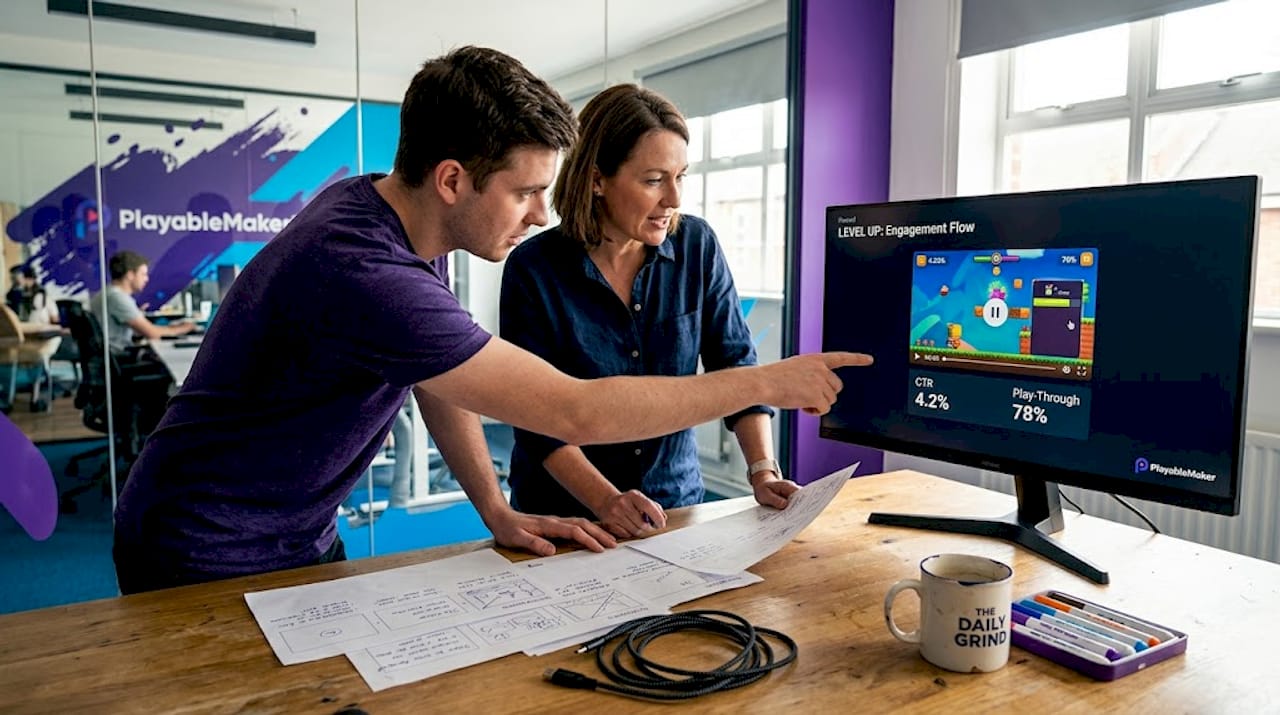
Repurposing ad creatives is another underutilised strategy. Rather than building each playable from scratch, experienced teams extract core mechanic modules from existing creatives and recombine them with new hooks, visual themes, or onboarding sequences. This approach dramatically reduces production time while maintaining creative freshness.
Building innovative playable creatives in a structured way involves the following steps:
- Define the emotional hook first. Before any visual or mechanic design begins, identify the emotional state you want to trigger. Anxiety, curiosity, and competitive pressure are consistently strong performers. Relaxation and passive reward tend to underperform.
- Isolate the single core mechanic. Choose one interaction that represents the game’s most satisfying moment. Strip everything else away. The ad is not a tutorial; it is a highlight.
- Design the onboarding sequence. Users need to understand what to do within two seconds. Use visual cues, animated arrows, or brief text prompts. Avoid voice-over instructions, which many users have muted.
- Build a reward moment. Every playable needs a clear payoff. Whether it’s a level clear, a satisfying match, or a score reveal, the reward moment is what drives install intent.
- Iterate using no-code tools. Tools for high-impact ad creatives now allow teams to build and modify playable ad variants without writing a single line of code. This accelerates the creative cycle substantially.
As the evidence confirms, teams should prioritise simple, authentic core loops and leverage no-code tools for rapid creative iteration.
Pro Tip: Shorten your playable loop to under 20 seconds and run it with five to ten real test users before any paid traffic. You will catch friction points that internal teams consistently miss because they are too familiar with the mechanic.
Systematic testing and scaling of creative variants
Once you’ve sketched out innovative concepts, structured creative testing is the key to unlocking scale and longevity.
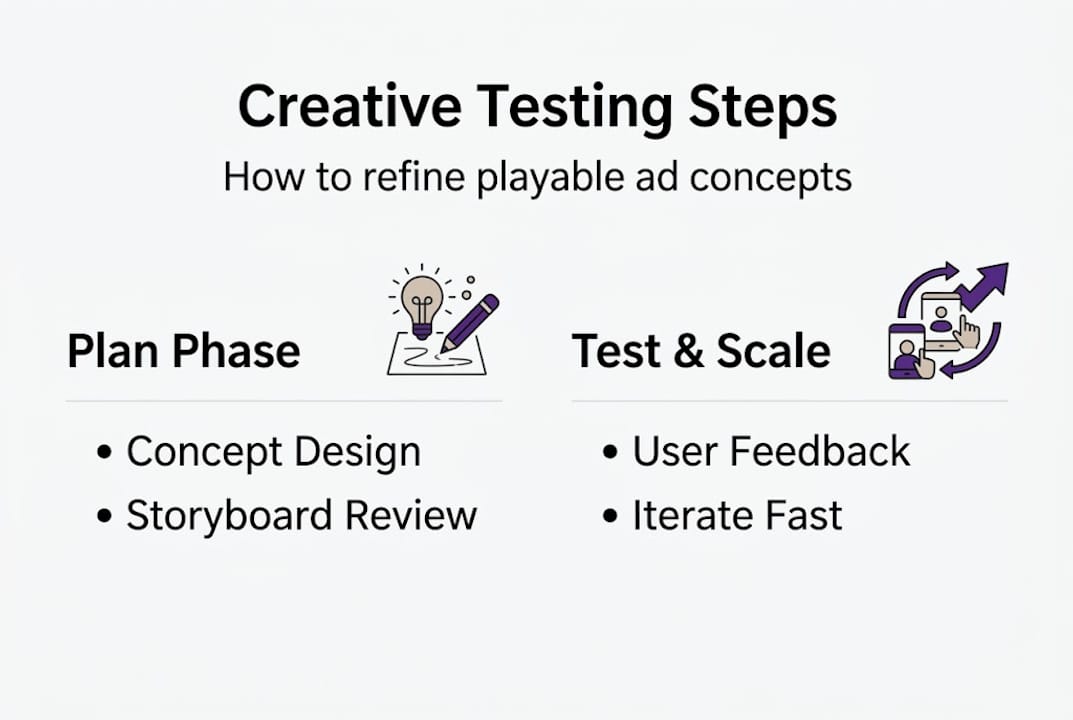
Creative volume without structure is expensive and unreliable. The teams that consistently outperform their benchmarks are those that treat creative testing as a scientific process, not a creative lottery. As the data confirms, systematic variant testing outperforms brute-force volume. Testing hooks, loops, and interaction points methodically is what separates scalable programmes from one-hit campaigns.
The four core elements to test systematically are:
- Core mechanic: Does swipe, tap, drag, or tilt produce better engagement for your specific game genre?
- Emotional hook: Compare anxiety-driven scenarios against curiosity or competition-based hooks. Measure both click-through rate and post-install day-one retention.
- Onboarding friction: Test the number of instructional steps. Fewer is usually better, but some genres benefit from a brief guided moment.
- Reward feedback: Test visual reward intensity, sound design, and the timing of the install prompt relative to the reward moment.
Here is a simplified example of how variant data might look across a structured test:
| Variant | Hook type | Avg. session length | Install rate | D1 retention |
|---|---|---|---|---|
| A | Anxiety/puzzle | 18 sec | 4.2% | 38% |
| B | Cosy progress | 14 sec | 2.9% | 31% |
| C | Competitive timer | 21 sec | 5.1% | 41% |
| D | Aesthetic reward | 11 sec | 2.1% | 27% |
The pattern is clear. Emotionally pressured hooks produce longer sessions, higher install rates, and better early retention. This is not coincidental. It reflects a psychological principle: users who feel mild urgency are more motivated to resolve it, and installing the full game becomes the natural resolution.
Common testing pitfalls that undermine otherwise solid creative programmes:
- Changing multiple variables simultaneously. If you alter the hook, the mechanic, and the visual theme in a single variant, you cannot identify which change drove the result.
- Not segmenting traffic by audience. A creative that performs well with lapsed gamers may perform poorly with new-to-category users. Segment your test audiences before drawing conclusions.
- Ending tests too early. Statistical significance takes time. Pulling data after 48 hours often produces misleading results, particularly for lower-volume campaigns.
- Ignoring post-install metrics. Install rate is only one signal. A creative that drives installs but produces poor day-seven retention is costing you money, not making it.
Understanding creative testing practices in depth helps teams avoid these traps. A well-structured creative testing guide and a firm grasp of A/B testing essentials are both worth reviewing before scaling any campaign.
Pro Tip: Use low-cost traffic sources such as broad audience social placements for initial creative tests. Reserve premium inventory for creatives that have already demonstrated statistical lift in early-stage testing.
Cost-effective solutions for creative production
The final piece is execution. How can teams innovate rapidly without exhausting the marketing budget?
The traditional playable ad production model is slow and expensive. Briefing an external development studio, waiting for builds, reviewing technical QA, and iterating on feedback can take four to six weeks per creative. For teams running fast-paced acquisition campaigns, that timeline is simply incompatible with market realities.
No-code platforms fundamentally change this equation. No-code tools significantly lower cost and accelerate creative iteration for playable ads. Rather than commissioning bespoke builds, marketing teams can use drag-and-drop interfaces to assemble, modify, and publish playable ad variants in hours rather than weeks. This shift has two compounding benefits: it reduces production costs and it increases the volume of testable concepts, which improves the probability of finding a high-performing creative.
Smart cost management in playable ad production involves several concrete practices:
- Use template libraries as starting points. Rather than building each creative from a blank canvas, begin with a proven structural template and customise the mechanic, hook, and visual theme. This preserves creative flexibility while eliminating redundant production work.
- Integrate automated testing tools early. Some no-code platforms include built-in analytics that track interaction heatmaps, drop-off points, and completion rates. Using these from the first build means you collect learning data without additional tooling costs.
- Prioritise technical QA before scaling. A playable that crashes on specific device configurations or loads slowly on older handsets will produce misleading performance data. Systematic QA across device types is not optional; it is a prerequisite for reliable test results.
- Avoid over-investing in visual polish at the testing stage. High-fidelity animation and premium sound design are valuable in a proven creative. In an unproven concept, they add cost without improving the reliability of your test data.
Reviewing cost-effective ad creation frameworks and a dedicated budget playable ads guide can help teams structure their production workflows more efficiently. The goal is to reach a high volume of tested, data-backed concepts without the overhead of traditional development cycles.
Pro Tip: Prioritise investment in creative data analysis over visual production quality during early-stage tests. A rough but fast-loading playable with a sharp emotional hook will consistently outperform a polished creative with a weak mechanic. Use the drag-and-drop playable ad builder to build and iterate quickly, then invest in polish only once the concept has proven its value in live testing.
Our perspective: why systematic creativity, not ‘wild ideas’, wins in mobile advertising
Looking across the industry, here is our direct take on what really moves the needle today.
There is a persistent myth in mobile marketing that creative breakthroughs come from inspiration. From a single brilliant idea that someone had in a brainstorm. In practice, the most consistent creative wins come from structure. From pairing iterative frameworks with targeted emotional drivers and testing them methodically until the data reveals what works.
We have observed this pattern repeatedly. A mobile gaming team producing 30 creatives per month with no systematic framework will occasionally stumble onto a strong performer. But they cannot replicate it, because they do not understand which specific element drove the result. Contrast this with a team producing 15 creatives per month with a disciplined testing structure. They identify their winning mechanic within the first two cycles, scale it confidently, and build on it systematically. The second team acquires users more cheaply and more predictably.
The uncomfortable truth is that volume without structure is a form of creative waste. It burns budget, exhausts teams, and produces inconsistent results. As the evidence consistently shows, hybrid video+playable formats, emotional anxiety hooks, and structured testing keep outperforming old volume strategies. The winning teams are not the most prolific. They are the most disciplined.
This does not mean creativity is unimportant. It means creativity is most powerful when it operates within a framework that allows it to be measured, refined, and scaled. Wild ideas are valuable inputs. Systematic process is what turns them into reliable outputs.
Exploring creativity explained from a structured, process-driven perspective reinforces why the most effective campaigns are built on methodology, not inspiration alone.
How Playablemaker accelerates your creative journey
Ready to translate creative insight into action? Here is how Playablemaker can speed up your next big win.
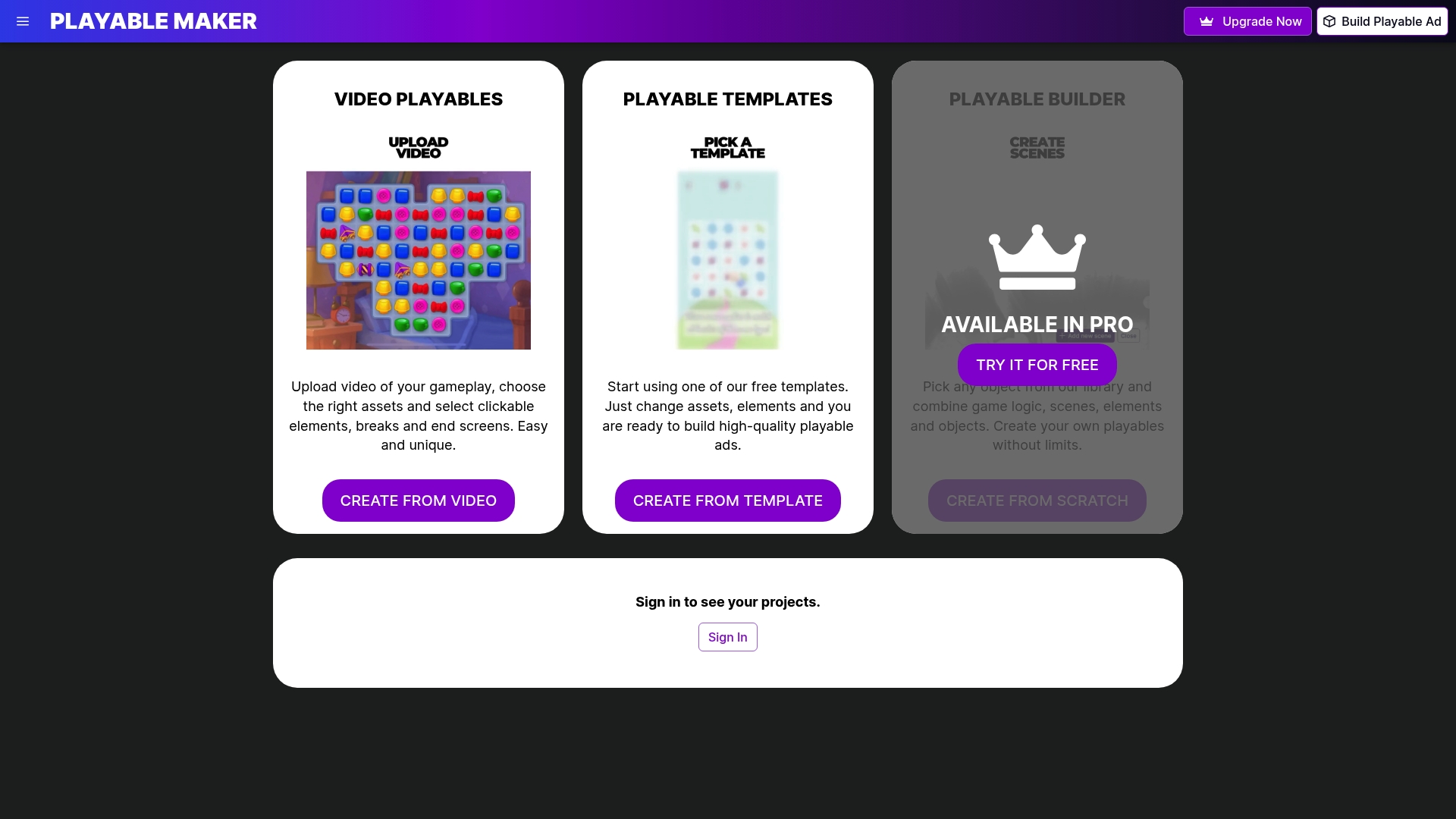
Playablemaker is built specifically for user acquisition and marketing teams who need to move fast without sacrificing quality or blowing their production budget. The platform provides a no-code environment for building, testing, and iterating playable ad creatives, so your team is not waiting on developers to bring concepts to life. Understanding playable ad essentials is the foundation, and Playablemaker gives you the tools to act on that knowledge immediately. The drag-and-drop builder makes it straightforward to assemble and modify interactive ad variants, while built-in analytics help you understand the psychology behind what engages users. For a deeper look at why playable ads work, the platform’s resource library offers practical guidance grounded in real campaign data.
Frequently asked questions
What makes playable ads more engaging than standard videos?
Playable ads foster hands-on interaction and deeper involvement, which increases both user engagement and ad recall. Hybrid video+playable formats consistently outperform static and video-only ads across engagement metrics.
How can small teams create playables efficiently on a budget?
No-code drag-and-drop platforms enable fast, cost-effective production and testing of interactive playable ads without developer involvement. No-code tools help create and iterate playables with high velocity and lower overall costs.
Which creative hooks drive the best results in mobile ad campaigns?
Emotional pressure and anxiety hooks consistently outperform simple progression or relaxation themes in mobile playable campaigns. The data shows that anxiety-driven hooks produce longer session times, higher install rates, and stronger early retention.
Is it better to test lots of creative variants or focus on a few?
Systematic, targeted creative testing delivers better results than brute-force high-volume variant creation. Systematic variant testing allows teams to isolate what works and scale it reliably, rather than relying on chance.
What are common mistakes in mobile playable ad creation?
Over-complicating mechanics and skipping systematic testing are the two most common pitfalls that reduce engagement and inflate acquisition costs. Authentic, simple mechanics combined with structured testing are central to consistent playable ad success.
Recommended
- 5 mobile ad creative types to boost user acquisition – playablemaker.com 5 mobile ad creative types to boost user acquisition
- 7 Best Examples of Mobile Game Ads and Why They Work – playablemaker.com 7 Best Examples of Mobile Game Ads and Why They Work
- 7 Creative Ad Concepts for Mobile Game User Acquisition – playablemaker.com 7 Creative Ad Concepts for Mobile Game User Acquisition
- Why Creatives Matter for Mobile Game Ad Success – playablemaker.com Why Creatives Matter for Mobile Game Ad Success