
TL;DR:
- Playable ads deliver higher engagement and lower CPIs when produced efficiently on a budget.
- Using no-code platforms and simple prototypes accelerates ad creation and reduces production costs.
- Agile testing and iterative improvements optimize ad performance without large upfront investments.
Budget pressure is one of the most persistent frustrations facing mobile gaming user acquisition teams. Creative production costs keep climbing, yet performance benchmarks remain just as demanding. Playable ads offer a genuine competitive edge, delivering higher engagement and stronger post-install metrics than static formats, but only when produced efficiently. This guide walks you through every stage of cost-effective playable ad creation, from setting objectives and choosing the right tools to testing and optimising for results. Whether you manage a lean in-house team or work with external partners, you will find practical, actionable steps here.
Table of Contents
- Defining your goals and setting your budget
- Essential tools and resources for affordable ad creation
- Step-by-step guide: Creating playable ads on a budget
- Testing, optimisation, and measuring success
- Our perspective: Why agile creative thinking saves money
- Level up your playable ads with affordable solutions
- Frequently asked questions
Key Takeaways
| Point | Details |
|---|---|
| Set clear goals and budget | Defining your objectives and knowing your spending limits enables smarter, more effective ad creation. |
| Choose cost-saving tools | No-code platforms and affordable assets help keep production costs down without sacrificing quality. |
| Follow a structured workflow | A clear, repeatable process ensures you produce engaging ads efficiently on any budget. |
| Test and optimise every step | Continuous testing and data-driven tweaks maximise performance and stretch each pound further. |
| Embrace agile iteration | Being flexible and learning quickly from small tests delivers better value than slow, expensive launches. |
Defining your goals and setting your budget
With the big picture in mind, the first step is to clarify what you want from your playable ad campaign and how much you are willing to invest. Without clear goals, even a modest budget can be wasted on creative work that misses its mark.
Start by identifying your primary KPIs. Common objectives for mobile gaming UA campaigns include:
- Cost per install (CPI): How much you pay to acquire each new player
- Day-1 and Day-7 retention: Whether players who install actually stay
- Return on ad spend (ROAS): The revenue generated relative to your ad investment
- Click-through rate (CTR): How often users engage with the ad before installing
Your creative concept must reflect the actual game experience. A playable ad that misrepresents the core loop will attract low-quality installs and inflate your CPI. Aligning the ad mechanic with what players encounter on day one is not just good practice; it is essential for sustainable campaign performance. Playable ads deliver lower CPIs and higher engagement when targeted correctly, which makes this alignment even more valuable.
When budgeting playable ad creatives, it helps to break costs into distinct categories so nothing is overlooked.
| Cost category | Typical range | Notes |
|---|---|---|
| Concept and planning | £100–£300 | Internal time or freelance brief |
| Design and assets | £200–£800 | Can use existing game assets |
| Build and development | £300–£1,500 | Reduced significantly with no-code tools |
| Testing and QA | £100–£400 | Device testing and feedback rounds |
| Iteration and updates | £100–£500 | Budget for at least two revision cycles |
The total range above spans from roughly £800 to £3,500 depending on complexity and approach. No-code platforms sit firmly at the lower end.
Pro Tip: Use a phased budget structure. Allocate a smaller initial amount to build and test one creative variant, then release additional budget only when early data confirms the concept is working. This approach minimises upfront risk and keeps your team focused on what performs.
Essential tools and resources for affordable ad creation
Once you have set your objectives and budget, the next challenge is choosing resources that deliver value without inflating costs. The market offers three broad approaches, each with distinct trade-offs.
In-house development gives you full creative control and keeps institutional knowledge inside the business, but it requires developer time that is often in short supply. Agencies offer specialist expertise and speed, but costs can escalate quickly, particularly for revisions. No-code platforms sit in the middle ground, offering speed and flexibility at a fraction of traditional development costs. No-code platforms reduce development costs for playable ads significantly, making them the preferred choice for budget-conscious UA teams.

| Approach | Estimated cost | Speed | Flexibility | Best for |
|---|---|---|---|---|
| In-house dev | High (staff time) | Slow | High | Studios with spare dev capacity |
| Agency | £2,000–£10,000+ | Medium | Medium | One-off premium campaigns |
| No-code platform | £50–£500/month | Fast | Medium-High | Ongoing UA creative production |
For visual and audio assets, there are several low-cost or free sources worth considering:
- Repurpose existing game art, animations, and sound effects directly from your build
- Use open-licence asset libraries such as OpenGameArt for supplementary visuals
- Source royalty-free music from platforms like Free Music Archive
- Commission short-run assets from freelancers on platforms like Fiverr or Upwork
When deciding between freelancers and internal teams, consider the volume of creative work. For ongoing production, an internal team or a no-code subscription is more cost-effective. For a single high-stakes campaign, a specialist freelancer may offer better value. Understanding the full ad creative process steps helps you identify where external support adds the most value versus where it simply adds cost. Browsing ad creative inspiration can also help your team generate concepts faster, reducing planning time.
Pro Tip: Before committing to any paid platform, use the free trial or lite version to test your workflow. Most no-code tools offer enough functionality in their trial tier to validate whether the platform suits your production style.
Step-by-step guide: Creating playable ads on a budget
Having selected the right tools and team, you are ready for a practical, hands-on walkthrough of budget-sensitive ad development. The key is to keep each stage lean without sacrificing the engagement quality that makes playable ads effective.
- Define the core mechanic. Choose one interaction that represents the most satisfying moment in your game. Tap, swipe, drag or aim. One mechanic is enough. Complexity adds cost and rarely adds conversion.
- Sketch a wireframe. Before touching any tool, map out the ad flow on paper or in a simple slide deck. Define the opening hook, the interactive moment, and the call to action. This saves significant revision time later.
- Build a prototype using a no-code tool. Drag-and-drop builders empower UA teams to iterate creatives without developers, which is a genuine time and cost advantage. Import your game assets, assemble the interaction, and produce a working prototype within hours rather than days.
- Run an internal review. Share the prototype with two or three colleagues who were not involved in building it. Ask them to complete the interaction and note any confusion or friction. This informal feedback loop costs nothing and often surfaces the most important issues.
- Refine the CTA. Your call to action should be visible, direct, and timed to appear immediately after the most satisfying moment in the interaction. Phrases like “Play now” or “Install free” consistently outperform vague alternatives. Keep button design simple and high contrast.
- Prepare for external testing. Export the ad in the formats required by your target networks and confirm it meets their technical specifications before launch.
For a structured approach to building interactive ads, following a defined workflow prevents costly rework. Reviewing an ad creative checklist before finalising your build is also a practical safeguard.
Caution: Adding too many features to a playable ad is one of the most common and expensive mistakes in mobile UA. Each additional mechanic, animation layer, or screen adds build time, testing time, and potential failure points. Simplicity is not a compromise; it is a deliberate strategy.
Testing, optimisation, and measuring success
Once your playable ad is live, robust testing and smart optimisation are vital for squeezing maximum value from every pound spent. Data gathered in the first 48 to 72 hours can tell you a great deal about whether your creative is working.
The most important metrics to track are:
- CPI: Is the cost per install within your target range?
- CTR: Are users engaging with the ad or scrolling past?
- Playtime: How long do users spend interacting before they either install or exit?
- Post-install retention: Are users who came through this ad staying in the game?
- Conversion rate: What percentage of users who start the interaction complete it and install?
Tracking engagement metrics ensures ad spend efficiency and drives meaningful campaign improvement over time.
A structured testing plan does not require a large budget. Even modest allocations can generate statistically useful data.
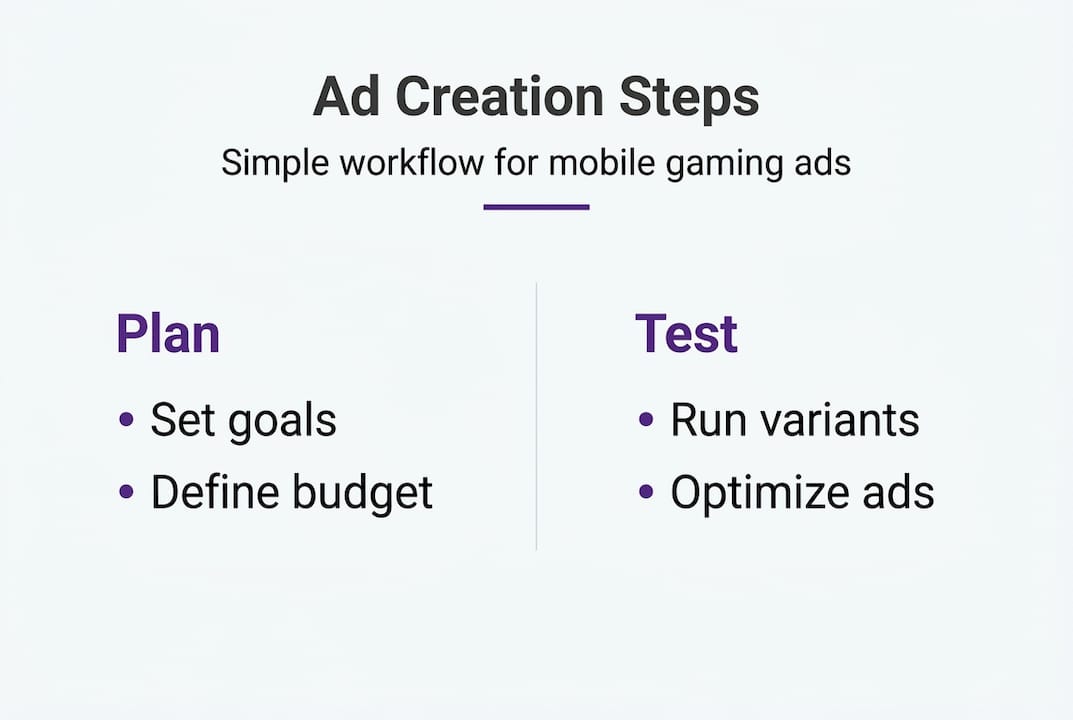
| Test phase | Budget allocation | Duration | Goal |
|---|---|---|---|
| Initial launch | £150–£300 | 48–72 hours | Establish baseline CPI and CTR |
| A/B creative test | £200–£400 | 5–7 days | Identify best-performing variant |
| Optimisation round | £150–£300 | 3–5 days | Refine winner and retest |
| Scale phase | Variable | Ongoing | Increase spend on proven creative |
For A/B testing, change only one element at a time. Test the opening screen first, then the CTA, then the core mechanic sequence. Changing multiple elements simultaneously makes it impossible to identify what drove a performance shift. Reviewing your interactive ads workflow and following established mobile ad best practices will help you structure tests that yield clear, actionable results.
Common ROI warning signs include a high CTR paired with a low conversion rate, which often indicates a mismatch between ad promise and install experience, and a high CPI relative to your game’s average revenue per user.
Pro Tip: Automate routine A/B testing wherever your platform allows. Freeing your team from manual reporting gives them more time to generate new creative concepts, which is where human judgement genuinely adds value.
Our perspective: Why agile creative thinking saves money
The studios that consistently achieve strong UA results at low cost are rarely the ones with the biggest creative budgets. They are the ones that treat every creative as a hypothesis rather than a finished product. Traditional high-budget production cycles, where a single ad takes weeks to build and months to evaluate, are fundamentally misaligned with how mobile advertising actually works. Platforms reward fresh creatives. Audiences respond differently across segments. What works in one geography may underperform in another.
Quick, lightweight test-and-learn approaches generate more actionable learnings per pound spent than polished but untested assets. One well-tested simple creative, built in a day and refined over a week of live data, will frequently outperform an expensive production that was never properly validated. Adaptability is the real competitive advantage. Browsing budget-friendly ad inspiration regularly keeps your team generating ideas quickly and prevents the creative stagnation that inflates costs. The goal is not perfection before launch; it is learning fast enough to reach performance before your budget runs out.
Level up your playable ads with affordable solutions
Ready to make the most of low-cost creative tools? The PlayableMaker platform is built specifically for UA and marketing teams who need to produce interactive ads quickly, without developer dependency and without overspending. The drag-and-drop playable builder lets you go from concept to working prototype in hours, using your existing game assets. Flexible playable ads pricing means there is an option to suit every team size and production volume, from independent studios running lean campaigns to larger publishers managing multiple titles simultaneously. Start with a free trial and see how much faster your creative pipeline can move.
Frequently asked questions
How much should I budget for a basic playable ad?
A simple playable ad can be produced for as little as £500–£2,000 using no-code platforms and existing game assets, making them accessible even for smaller studios with limited creative budgets.
What are the best tools for creating playable ads affordably?
No-code ad builders and open-source creative resources are the most cost-effective options for rapid production, with drag-and-drop tools supporting low-cost ad creation without requiring developer involvement.
How can I measure if my playable ads are cost-effective?
Track your CPI, CTR, and post-interaction retention to assess whether performance meets your budget targets, as tracking engagement metrics helps evaluate ROI accurately.
What is the fastest way to iterate playable ad creatives on a budget?
Use agile workflows with small creative tests and quick feedback loops to learn and optimise rapidly, following an agile iteration approach that enables rapid improvements without large spend commitments.
Are no-code tools suitable for complex game ads?
No-code tools are best suited to simple to moderately complex playables; for advanced features, the PlayableMaker builder offers flexibility, though highly bespoke interactions may still require low-code or custom development.
Recommended
- How to Repurpose Ad Creatives for Mobile Gaming Success – playablemaker.com How to Repurpose Ad Creatives for Mobile Gaming Success
- How to Make Engaging Game Ads for Mobile Success – playablemaker.com How to Make Engaging Game Ads for Mobile Success
- Master Effective Playable Ad Techniques for Mobile Gaming – playablemaker.com Master Effective Playable Ad Techniques for Mobile Gaming
- 7 Creative Ad Concepts for Mobile Game User Acquisition – playablemaker.com 7 Creative Ad Concepts for Mobile Game User Acquisition
- Mobile game development trends: Top innovations in 2026