
TL;DR:
- Automation significantly accelerates mobile gaming ad creation by enabling rapid variant generation, testing, and deployment. It reduces costs, improves campaign responsiveness, and offers strategic headroom, giving teams a competitive edge. Modern tools ensure quality control through templates and live monitoring, making automation accessible for both small and large teams.
Speed matters enormously in mobile gaming campaigns. Yet many user acquisition specialists still hesitate to automate their ad creation, worried that machines will churn out generic assets that dilute their carefully built brand. That concern is understandable, though advertisers who resist automation often cite quality or approval concerns as the main barrier. This article examines whether those fears hold up under scrutiny, how automation actually reshapes campaign performance, and what practical steps you can take to adopt it confidently.
Table of Contents
- The challenges of traditional ad creation
- How ad automation transforms mobile gaming campaigns
- Balancing quality and control in automated ad creation
- Scaling growth and performance with automation
- Putting ad automation into action: steps and success metrics
- What most marketers miss about ad automation
- Ready to automate your ad creation?
- Frequently asked questions
Key Takeaways
| Point | Details |
|---|---|
| Faster launch times | Automating ad creation lets you deploy new creatives in hours, not days. |
| Improved campaign performance | Recent studies show automated ads often outperform manually created versions in click-through rates. |
| Quality and control balance | Modern tools offer both automation efficiency and strong oversight for brand consistency. |
| Scalable creative testing | User acquisition teams can quickly test, learn, and iterate with more ad variants than manual approaches. |
The challenges of traditional ad creation
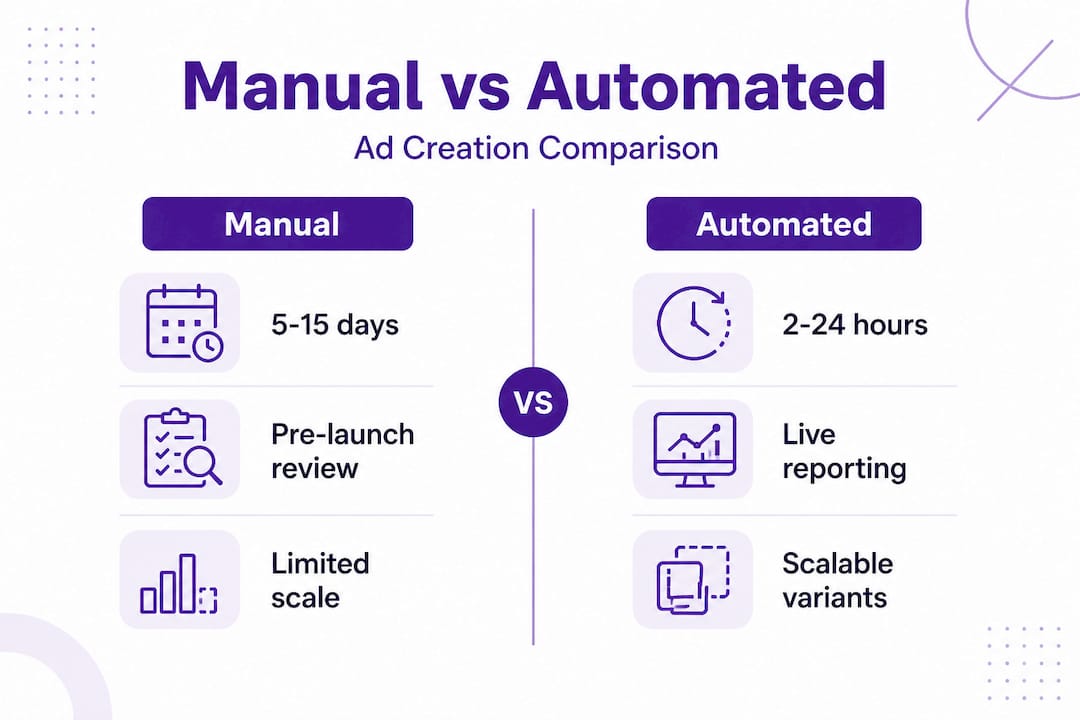
Anyone who has run mobile game campaigns manually knows the feeling. You brief the creative team, wait for concepts, cycle through feedback rounds, send assets for legal and brand review, and finally launch, only to discover that the market shifted while you were busy polishing pixels. The process can take anywhere from five to fifteen working days for a single batch of creatives, and that delay compounds across every campaign.
The core problems in manual workflows tend to cluster around a few persistent pain points:
- Time delays: Design, copy, review, and revision cycles consume days that should be spent on live optimisation.
- Limited scale: Manually producing dozens of variants for split testing is resource-intensive and often unrealistic for smaller teams.
- High production costs: Hiring designers, animators, and copywriters for each creative refresh adds up quickly, especially when assets need localising across multiple markets.
- Slow reaction to data: When performance drops overnight, manual review processes slow the response, meaning you burn budget on underperforming creatives for longer than necessary.
- Bottlenecks in approval: Legal, compliance, and brand reviews create queues that block launches even when the creative itself is ready.
“Every day a new creative sits in review is a day your competitors are acquiring the users you should be reaching.”
Following ad creative best practices helps, but even the best manual process cannot fully escape these structural constraints. The bottleneck is not always the people involved. It is the architecture of the workflow itself. And without real-time insight from ad performance dashboards, teams often lack the visibility needed to prioritise which assets to produce first.
These inefficiencies highlight something important: the problem is not creative talent. Most mobile gaming marketing teams are skilled and motivated. The problem is that the traditional pipeline was designed for a slower era, one where ad formats were simpler and campaign volumes were manageable by hand. Neither of those conditions describes the mobile gaming landscape today.
How ad automation transforms mobile gaming campaigns
Automation does not replace creative thinking. It removes the operational drag that prevents good creative thinking from being acted upon quickly. The distinction matters, because it reframes automation not as a threat to quality, but as infrastructure that supports it.
Here is what automation makes genuinely possible in a mobile gaming context:
- Instant variant generation: Automation tools can produce dozens of creative variants from a single brief in minutes. Swap headline copy, adjust colour palettes, reorder gameplay footage, and output formatted assets for every placement simultaneously.
- Sophisticated split testing: Because variants cost almost nothing to generate, you can test audiences, messages, and mechanics in parallel rather than sequentially. This accelerates learning significantly.
- Reduced launch time: What previously took days can now take hours or even minutes. A team that could launch two creative batches per week can now launch ten or more.
- Lower production costs: Fewer manual design hours means more budget available for media spend, market expansion, or experimenting with riskier creative concepts.
The data backs up these benefits more strongly than many expect. A 2025 study found better CTR for auto-generated ads compared with traditional creatives, reversing the assumption that automation inevitably trades quality for speed. That finding is counterintuitive but worth sitting with. Automated systems can test and select creative elements at a scale humans cannot match, meaning the published output often reflects far more iterative optimisation than a single hand-crafted asset.
| Metric | Manual workflow | Automated workflow |
|---|---|---|
| Average creative launch time | 5 to 15 days | 2 to 24 hours |
| Variants per campaign | 3 to 10 | 50 to 500+ |
| Cost per creative variant | High (design hours) | Low (template-based) |
| Split test frequency | Monthly | Daily or continuous |
| Response time to data signals | Days | Hours |

Understanding mobile game ad trends in 2026 reveals that automation is not an emerging option. It is fast becoming the baseline expectation for competitive campaigns. Teams still running purely manual pipelines risk falling behind not just on speed, but on the quality of insight their campaigns generate. Modern image and video ad tools now integrate directly with automation workflows, reducing friction further.
Pro Tip: Start automation with your highest-frequency creative formats first. Display banners and short video pre-rolls are ideal entry points because they have well-defined templates and predictable performance benchmarks. Playable and interactive formats can follow once your team is comfortable with the workflow.
Balancing quality and control in automated ad creation
The hesitation around automation is not irrational. It stems from genuine historical concerns. Early automated creative tools produced noticeably generic outputs: wrong fonts, clunky copy, off-brand colour combinations. Those experiences left lasting scepticism in the industry, and it is worth acknowledging that directly rather than dismissing it.
The good news is that the tools have changed significantly. Modern automation platforms offer several mechanisms to protect quality without reintroducing the manual bottlenecks you are trying to remove:
- Custom templates: Lock in brand-approved layouts, typography, and colour palettes so that every auto-generated variant starts from a compliant foundation.
- Brand consistency checks: Some platforms run automated compliance scans before output, flagging assets that deviate from guidelines.
- Manual override controls: Automation does not mean full hands-off. You can define which creative elements are variable and which are fixed, giving you precise control over what the system can and cannot change.
The shift in best practice here is meaningful. Rather than seeking approval before launch, monitoring quality via live reporting is now the recommended approach for automated campaigns. This is a genuine change in how ad creative quality is managed. Post-launch monitoring with clear performance thresholds allows teams to pause underperforming or off-brand variants quickly, without holding up the entire launch pipeline.
| Approach | Pre-approval review | Live reporting monitoring |
|---|---|---|
| Speed to launch | Slow (days added) | Fast (same day) |
| Brand risk management | Frontloaded | Continuous |
| Flexibility | Low | High |
| Cost impact | High (review labour) | Low |
| Recommended for automation | No | Yes |
Knowing when to keep processes manual is equally important. High-stakes brand moments, such as major game launches or seasonal campaigns tied to tentpole events, may still warrant human review at key checkpoints. The goal is not to automate everything indiscriminately. It is to identify which stages of your interactive ads workflow genuinely benefit from human judgement and protect those, while automating the rest.
Pro Tip: Create a “guardrail document” before switching on automation. List every element that must remain fixed (logo placement, legal text, brand colours) and every element that can vary freely (headlines, background images, call-to-action phrasing). Share this with your automation tool’s template settings and review it quarterly.
Scaling growth and performance with automation
Beyond speed and cost savings, automation introduces something more strategic: the ability to run genuinely ambitious creative programmes that would be physically impossible to manage manually. This is where the real competitive advantage lies for user acquisition teams in mobile gaming.
Consider the practical difference. A manual team might test three creative variants per week across two audience segments, giving you six data points per week. An automated system running the same campaign can test fifty variants across ten segments simultaneously, generating five hundred data points in the same period. The quality of strategic decision-making you can make from that data is fundamentally different.
Key benefits at scale include:
- Instant market responsiveness: When a platform algorithm changes or a competitor launches a disruptive campaign, automated systems can generate and deploy new creatives within hours rather than days.
- Stress-free variant testing: Creative teams are no longer bottlenecked by production volume. They focus on strategic direction while automation handles execution.
- Budget precision: Every design iteration is cheap, meaning you stop paying for creatives that never get tested. Budget shifts from production to media spend, where it generates direct return.
- Data-led iteration: Integration with analytics platforms means creative changes can be triggered automatically by performance thresholds, not by someone remembering to check a dashboard.
A 2025 study observed better CTR for auto-generated ads, which carries a significant implication for scaling: more variants, tested faster, against real audiences, produces better-performing output than smaller volumes of hand-crafted assets. This is not a marginal gain. It is a structural advantage for teams willing to adopt the approach.
Reviewing ad trends for scaling alongside detailed mobile ad trend analysis confirms that 2026 is the year automation moves from optional experimentation to operational necessity for serious mobile gaming advertisers.
Putting ad automation into action: steps and success metrics
Understanding the case for automation is one thing. Implementing it effectively is another. The following framework gives you a structured path from decision to deployment.
-
Define your goals and KPIs: Before touching any tool, clarify what you are optimising for. User acquisition teams typically prioritise install cost, click-through rate, and day-one retention. Retention campaigns might weight engagement rate and session frequency more heavily. Your KPIs determine which creative elements are worth automating and which performance signals trigger creative changes.
-
Select the right tools and set guardrails: Not every automation platform is built for mobile gaming. Look for tools that support playable and interactive formats alongside static and video. Define your creative guardrails in the tool’s template settings before generating a single asset.
-
Integrate with your analytics stack: Automation without analytics feedback is just faster guessing. Connect your creative production system to your dynamic ad creative process and performance dashboards so that data flows back into creative decisions automatically.
-
Launch, monitor, and refine: Deploy your first automated batch, monitor performance in real time, and set clear thresholds for pausing or replacing underperforming variants. The cadence should be weekly at minimum, daily if campaign budgets are significant.
-
Repurpose and iterate: High-performing creatives from automated runs are valuable raw material. Use learnings to inform your next template generation, and consider repurposing ad creatives across formats to maximise the return on each winning concept.
The strongest operational shift here is the emphasis on control via live reporting rather than pre-launch review. Teams that embrace this shift move faster, iterate more, and spend less time in review queues.
Pro Tip: Set a “creative fatigue threshold” in your dashboard. Define the performance drop percentage (for example, a 20% decline in CTR over 48 hours) that automatically flags a creative for replacement. This removes the manual monitoring burden and ensures you catch fatigue before it significantly damages your campaign efficiency.
What most marketers miss about ad automation
Here is the part that most guides on this subject gloss over. The debate about automation almost always centres on quality risk. Will the ads look good enough? Will they pass brand review? These are valid questions, but they are not the most important ones.
The deeper opportunity that automation creates is strategic headroom. When your team is no longer consumed by production logistics, they have capacity to think harder about creative strategy, audience segmentation, and product positioning. That is where the real gains live, and manual workflows quietly steal that capacity every week without anyone noticing.
There is also a discovery dimension that surprises most teams. When you allow automated systems to generate and test a wide range of variants, you frequently encounter winning combinations that no human designer would have chosen deliberately. Unusual colour pairings, unconventional copy structures, unexpected gameplay moments, these sometimes outperform polished hand-crafted assets because they stand out in a crowded feed. You cannot plan for that. You can only create the conditions that allow it to happen, and automation is exactly those conditions.
It is true that approval and brand safety worries remain common even among advertisers who have seen better marketing outcomes from automation. That is a normal part of adoption, not a signal to halt progress. The right response is structured risk management: defined guardrails, live monitoring, and clear escalation protocols for anything that falls outside acceptable parameters.
Exploring affordable ad tech trends in 2026 makes clear that the cost of experimentation has dropped dramatically. There has never been a lower-risk moment to trial automation in your campaigns.
Ready to automate your ad creation?
At PlayableMaker, we built our platform specifically for mobile gaming marketers who need to move fast without burning through development budgets or waiting weeks for creative approvals. Our no-code solution lets you build playable and interactive ads in minutes, not days, with templates designed for mobile game campaigns and built-in brand guardrails that protect consistency at scale. Whether you are a solo growth marketer or managing a large acquisition team, you can launch, test, and iterate automated ad creatives without writing a line of code. Visit PlayableMaker to explore the platform, review our tools for interactive ad creation, and see how your team can start running smarter, faster campaigns today.
Frequently asked questions
Does automating ad creation decrease creative quality?
No. Recent studies found that auto-generated mobile ads can deliver better click-through rates than traditionally produced creatives, partly because automated systems enable far more iterative testing at scale.
How does automation speed up launching ad campaigns?
Automation removes manual design and review stages, meaning marketers can launch new creative batches in hours rather than the days or weeks a typical manual pipeline requires.
Can you maintain control over branding with automated tools?
Yes. Modern platforms provide custom templates, fixed brand element controls, and automated compliance checks so that every generated variant stays within your defined brand parameters without requiring individual human review.
Is automation only for large user acquisition teams?
Not at all. Smaller teams often benefit most because automation removes the production bottleneck that limits how much a lean team can test and learn, enabling them to compete at a scale their headcount would not otherwise support.
Recommended
- How to Scale Playable Ads Efficiently and Budget-Friendly – playablemaker.com How to Scale Playable Ads Efficiently and Budget-Friendly
- Playable Ad Trends 2025: Build Engaging Ads Without Coding – playablemaker.com Playable Ad Trends 2025: Build Engaging Ads Without Coding
- Master the Dynamic Ad Creative Process for Mobile Gaming – playablemaker.com Master the Dynamic Ad Creative Process for Mobile Gaming
- How to Repurpose Ad Creatives for Mobile Gaming Success – playablemaker.com How to Repurpose Ad Creatives for Mobile Gaming Success