Every mobile gaming campaign faces the challenge of capturing real player attention without draining the budget. For teams aiming to scale user acquisition, choosing platforms that support interactive mini-game ads not only widens reach but also improves conversion rates by driving genuine engagement. Learn how to harness no-code tools, compare top ad platforms like Facebook Audience Network and Unity Ads, and follow proven creative strategies to optimise every ad placement while keeping your workflow lean and effective.
Table of Contents
- Step 1: Identify Suitable Ad Platforms And Integrations
- Step 2: Set Up Scalable Workflows With No-Code Tools
- Step 3: Optimise Creative Assets For Interaction And Performance
- Step 4: Deploy Ads Across Targeted Markets Efficiently
- Step 5: Test Campaign Effectiveness And Refine Strategies
Quick Summary
| Essential Insight | Detailed Explanation |
|---|---|
| 1. Select the Right Ad Platforms | Choose networks with proven success in mobile gaming to maximise efficiency and effectiveness in your ad campaigns. |
| 2. Implement No-Code Tools for Creation | Utilise no-code platforms to streamline ad production, reducing technical barriers and speeding up creative processes. |
| 3. Focus on User Engagement in Design | Craft ads that engage users with intuitive mechanics and minimal load, ensuring a seamless and enjoyable experience. |
| 4. Deploy Ads with Precision in Markets | Tailor your ad deployment strategy to target specific demographics and regions to optimise spending and increase conversion rates. |
| 5. Test and Refine Campaign Effectiveness | Continuously monitor ad performance and utilise systematic testing to adjust strategies based on data-driven insights. |
Step 1: Identify suitable ad platforms and integrations
Selecting the right ad platforms is crucial for scaling your playable ads efficiently and budget-friendly. Your goal is to find networks that support interactive ad formats and offer robust targeting capabilities for mobile gaming audiences.
When evaluating ad platforms, focus on those with proven track records in mobile gaming. Playable ad networks typically include major social media platforms and specialised mobile app networks. Consider these strategic factors:
- Performance metrics like click-through and conversion rates
- Audience demographics matching your game’s target market
- Cost per install (CPI) and overall budget requirements
- Integration complexity and technical support
- Geographic reach and localisation capabilities
Top-tier platforms for mobile game playable ads include Facebook Audience Network, Google AdMob, Unity Ads, and AppLovin. Each offers unique advantages for interactive ad experiences. Prioritise platforms that provide:
Here is a concise comparison of leading mobile ad platforms for playable ads:
| Platform | Targeting Strength | Analytics Quality | Price Model |
|---|---|---|---|
| Facebook Audience Net. | Extensive social data | Granular real-time stats | Competitive, auction-based |
| Google AdMob | Broad app network | Custom reporting tools | CPM, CPC flexible options |
| Unity Ads | Game-focused audience | Detailed game engagement | Dynamic CPI & CPA rates |
| AppLovin | Genre-based targeting | Automation & benchmarking | Variable price, app-centric |
- Detailed analytics tracking
- Flexible creative controls
- Seamless SDK integration
- Competitive pricing models
Platform selection directly impacts your playable ad campaign’s success and return on investment.
Pro tip: Always run small-scale test campaigns across multiple platforms to compare real-world performance before committing significant budget.
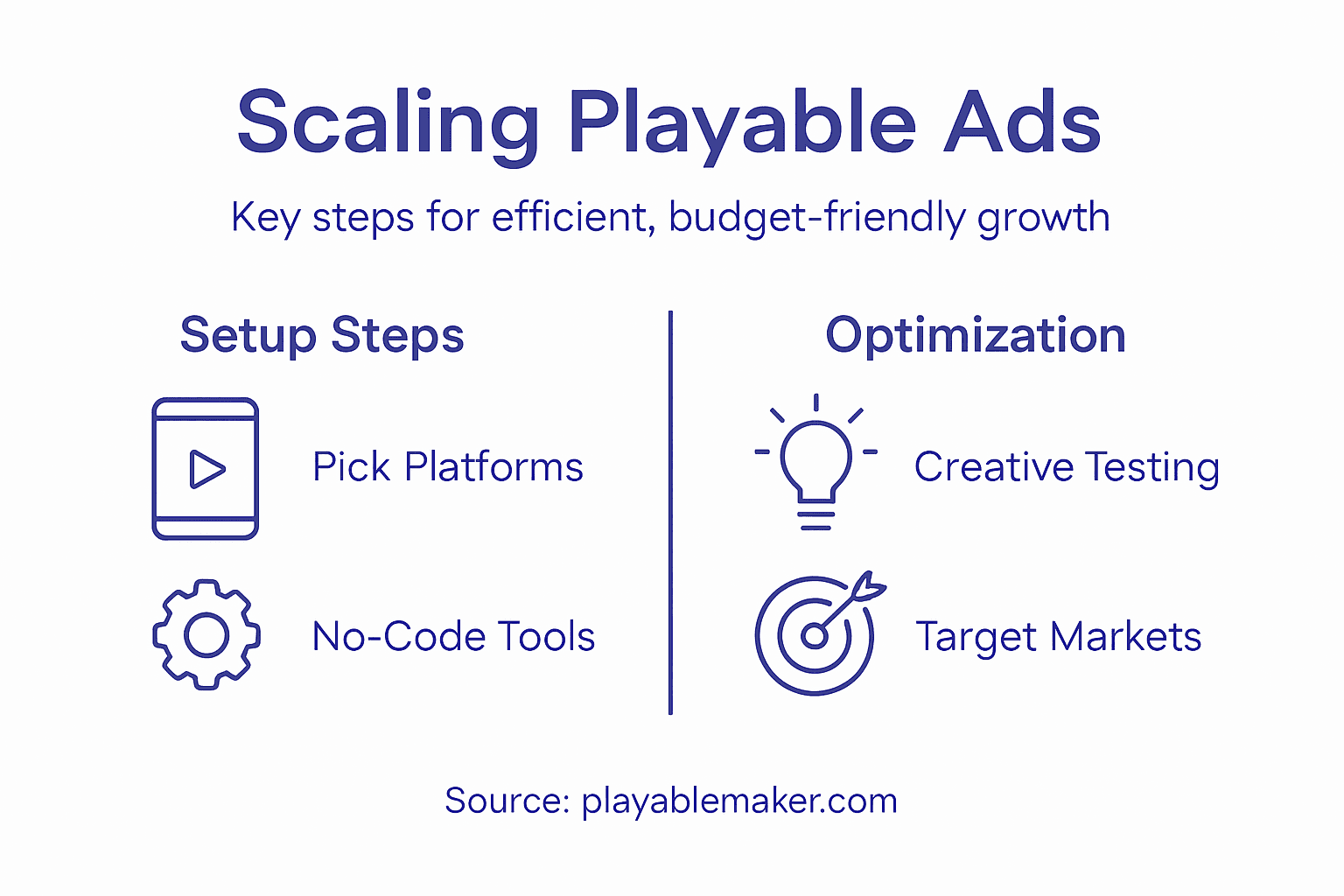
Step 2: Set up scalable workflows with no-code tools
Streamlining your playable ad creation process requires adopting efficient no-code workflows that minimise technical barriers and accelerate production. No-code platforms enable game developers and marketers to create interactive ads without extensive programming knowledge.
When establishing your scalable workflow, consider these essential components:
- Centralised creative management systems
- Intuitive drag-and-drop interface design tools
- Automated asset generation capabilities
- Built-in performance tracking mechanisms
- Seamless integration with existing marketing platforms
Effective no-code tools should provide:
- Rapid prototype development
- Template-based ad creation
- Dynamic variation generation
- Comprehensive analytics dashboards
Selecting the right no-code platform can dramatically reduce production time and technical complexity.
Pro tip: Invest time in learning your chosen no-code platform’s advanced features to maximise workflow efficiency and creative potential.
For quick reference, here is an overview of scalable workflows enabled by modern no-code ad creation tools:
| Workflow Feature | Business Impact | Typical Platform Example |
|---|---|---|
| Drag-and-drop builder | Accelerates ad production timeline | PlayWorks, Adalo |
| Asset auto-generation | Reduces manual creative labour | Creatopy, Bannerflow |
| Analytics dashboard | Informs rapid iteration decisions | Unity PlayWorks, Playable |
| Template library | Ensures brand consistency and speed | Canva, Snap Ad Kit |
Step 3: Optimise creative assets for interaction and performance
Designing compelling playable ads requires a strategic approach that maximises user engagement and conversion potential. Creative optimisation guidelines emphasise focusing on user experience and interaction design to create memorable ad experiences.
When crafting your playable ad assets, prioritise these key design principles:
- Minimal cognitive load with clear visual hierarchy
- Intuitive game mechanics that demonstrate core gameplay
- Engaging tutorial elements with minimal text
- Quick, seamless interaction paths
- Visually appealing and representative game snippets
To enhance user interaction and performance, implement these strategic approaches:
- Limit Areas of Interest (AOIs) to 2-3 per screen
- Use visual cues instead of lengthy instructions
- Create concise, compelling end-card call-to-actions
- Ensure smooth, responsive interactive elements
Successful playable ads transform advertising from an interruption to an experience users genuinely enjoy.
Pro tip: Continuously A/B test your creative variations to identify the most engaging interactive elements and refine your ad performance.

Step 4: Deploy ads across targeted markets efficiently
Expanding your playable ad reach requires a strategic approach to market deployment that maximises audience engagement and minimises wasted ad spend. Demand-side platforms enable precise targeting and real-time optimization across diverse digital landscapes.
When deploying playable ads across different markets, focus on these critical strategies:
- Geographic targeting with region-specific creative variations
- Platform-specific ad configuration
- Audience segmentation by game genre and player interests
- Programmatic buying mechanisms
- Performance tracking and rapid iteration
Implement a comprehensive deployment approach through these key steps:
- Identify compatible mobile platforms
- Configure localised ad creatives
- Utilise advanced audience filtering
- Implement real-time performance monitoring
- Continuously refine targeting parameters
Strategic ad deployment transforms global marketing from a scattered approach to a precision-driven mechanism.
Pro tip: Develop granular audience personas for each target market to create hyper-relevant ad experiences that dramatically improve conversion rates.
Step 5: Test campaign effectiveness and refine strategies
Validating the performance of your playable ad campaigns requires a systematic approach to data collection and strategic analysis. Effective ad testing frameworks provide critical insights into campaign optimisation and audience engagement.
To comprehensively evaluate your playable ad performance, implement these robust testing methodologies:
- Audience segmentation for targeted insights
- Multivariate creative testing
- Statistical significance verification
- Performance metric tracking
- Continuous iterative refinement
Execute your testing strategy through these structured steps:
- Define clear performance benchmarks
- Allocate experimental budget segments
- Implement controlled variation testing
- Monitor key performance indicators
- Document and analyse comprehensive results
Systematic testing transforms unpredictable marketing spend into a precision-driven growth mechanism.
Pro tip: Leverage AI-powered automation tools to accelerate your testing cycles and generate statistically robust insights with minimal manual intervention.
Scale Your Playable Ads Faster and Smarter with PlayableMaker
The challenge of scaling playable ads efficiently without draining your budget is real. You want to avoid spending excessive developer time and company resources while maintaining outstanding creative quality and user engagement. This article highlights the importance of streamlined workflows, targeted deployment, and no-code solutions to overcome these hurdles. If you are looking to simplify your playable ad creation with flexible tools that cut production time, reduce costs and boost campaign performance, then you are in the right place.
Explore our Publishing Archives at playablemaker.com for expert insights and discover how our no-code platform empowers you to build interactive ads fast without complex coding. Ready to transform your playable ad strategy for quick scalability and maximum impact? Start creating today at PlayableMaker and unlock a budget-friendly solution tailored for your growth.
Frequently Asked Questions
What are the best ad platforms to use for scaling playable ads?
The best ad platforms for scaling playable ads include Facebook Audience Network, Google AdMob, Unity Ads, and AppLovin. Evaluate these platforms based on their performance metrics, audience demographics, and integration complexity to ensure they align with your mobile gaming goals.
How can I streamline my playable ad creation process without coding?
You can streamline your playable ad creation process by using no-code platforms that offer intuitive drag-and-drop interfaces and centralised creative management systems. Start by selecting a no-code tool that enables rapid prototype development and has template-based ad creation features to enhance your workflow efficiency.
What design principles should I follow for optimal playable ad performance?
To optimise playable ad performance, focus on minimal cognitive load, intuitive game mechanics, and visually appealing content that effectively demonstrates core gameplay. Implement design principles such as limiting Areas of Interest to 2-3 per screen and using visual cues instead of lengthy instructions to engage users effectively.
How can I ensure I deploy my playable ads effectively across different markets?
To deploy your playable ads effectively, set up geographic targeting tailored to each market and configure region-specific creative variations. Continuously monitor the performance of your campaigns and adjust your targeting parameters to maximise audience engagement and minimise ad spend.
What methods can I use to test and refine my playable ad campaigns?
Use audience segmentation and multivariate creative testing to evaluate your playable ad campaigns thoroughly. Define clear performance benchmarks, allocate experimental budget segments, and implement controlled variation testing to continuously refine your strategies for improved results.
Recommended
- Role of Ad Networks in Playable Ad Success – playablemaker.com Role of Ad Networks in Playable Ad Success
- Master the Playable Ad Optimisation Process for Success – playablemaker.com Master the Playable Ad Optimisation Process for Success
- Cost Conversion Google Ads: Maximising Playable Ad ROI – playablemaker.com Cost Conversion Google Ads: Maximising Playable Ad ROI
- Master Effective Playable Ad Techniques for Mobile Gaming – playablemaker.com Master Effective Playable Ad Techniques for Mobile Gaming
- Création & Publicité – IA pour la Créa – AI Makers- Votre partenaire en IA, Audit & Formation IA pour accélérer votre performance.