
TL;DR:
- Audience segmentation for playable ads involves dividing users based on behavior, demographics, and genre preferences to enhance targeting. Proper segmentation improves reach efficiency by over 30% and reduces cost per install by 20-40% with accessible platform tools. Prioritizing honest creative representation and proactive rotation optimizes user quality and campaign performance.
Audience segmentation for playable ads is the process of dividing your mobile user base into distinct groups based on behaviour, demographics, and genre preferences to deliver more precise, cost-efficient ad experiences. When applied correctly, behavioural and genre-based segmentation can improve reach efficiency by over 30% and cut cost per install by 20–40% compared to static creatives. Platforms such as Meta, Google UAC, and tools like Playablemaker make this level of targeting accessible without requiring a large engineering team. The result is lower wasted spend, higher-quality installs, and measurably better retention.
What are the main types of audience segments for playable ads?

Segmentation in mobile gaming user acquisition, sometimes called audience targeting or user cohort analysis, divides potential players into groups that respond differently to ad stimuli. Understanding which dimensions matter most for playable ads is the foundation of any effective campaign.
The four most commonly used segmentation types are:
- Demographic targeting. Age, location, and device type remain the baseline. A mid-core RPG targeting 25–34-year-old Android users in Tier 1 markets will set a very different CPI benchmark than a hyper-casual title targeting broad 18–45 demographics globally.
- Behavioural targeting. Session frequency, in-app purchase history, and engagement patterns reveal intent. Genre affinity and behavioural traits such as purchase propensity create meaningful segments without infringing privacy laws, and they directly influence CPI and lifetime value.
- Genre affinity targeting. Players of puzzle games respond differently to playable mechanics than RPG or hyper-casual audiences. Matching your playable ad’s core mechanic to the genre preferences of your segment produces higher click-through rates and stronger post-install engagement.
- Lookalike audiences and value-based bidding. Platforms like Meta and Google UAC build lookalike cohorts from your highest-value existing players. Value-based bidding then allocates spend towards users most likely to make in-app purchases, not just installs.
Each approach has trade-offs. Demographic targeting is simple to set up but lacks precision. Behavioural targeting is powerful but requires sufficient data volume to function. Genre affinity is highly relevant for playable ads specifically, because the interactive mechanic must resonate with the player’s existing preferences. Lookalike audiences depend on the quality of your seed data, so feeding them with high-LTV users rather than all installs is critical.
How to implement audience segmentation for playable ads
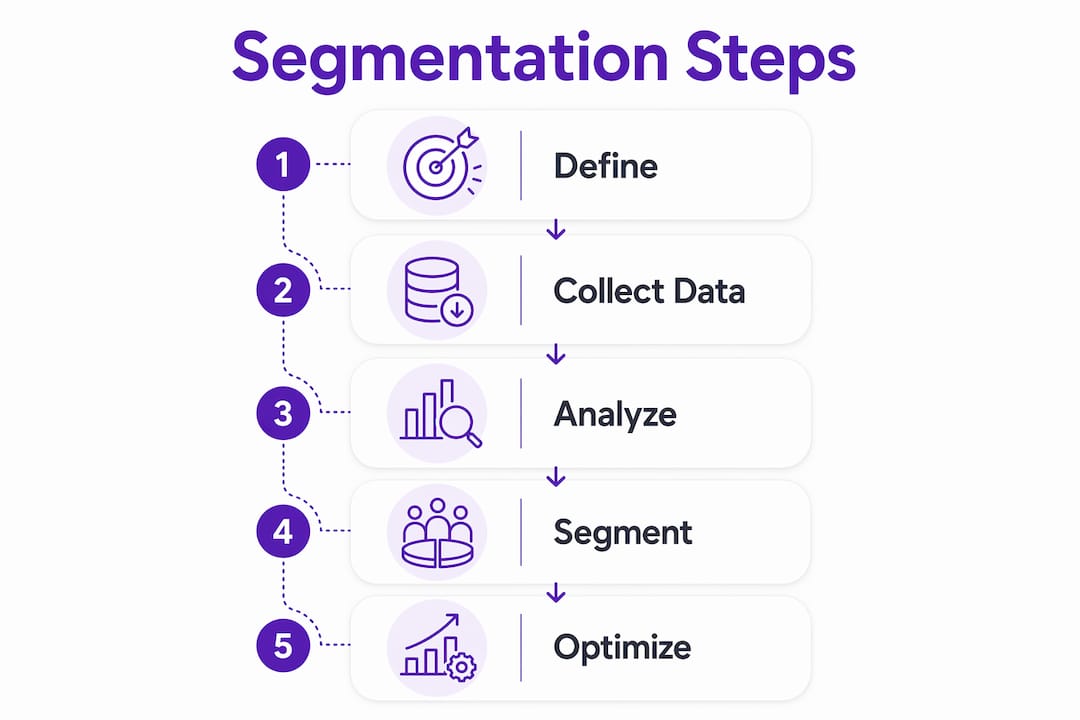
A structured approach to segmentation prevents wasted budget and gives platform algorithms the data they need to optimise effectively. Follow these steps to build a segmentation framework that scales.
- Define your campaign objectives and KPIs first. Decide whether you are optimising for CPI, day-7 retention, return on ad spend, or in-app purchase rate. Your KPI determines which segmentation dimensions matter most and how you will measure success.
- Build your playable ad creatives before segmenting. Use a no-code tool like Playablemaker to produce multiple creative variants quickly. Having three to five variants ready before launch gives the algorithm enough material to test across segments without exhausting your budget on a single creative.
- Start with broad targeting. Starting broad with multiple creative variants allows platform AI to discover high-value audience cohorts organically. Restricting targeting too early fragments your data and reduces algorithmic efficiency.
- Layer in behavioural and genre signals after the first two weeks. Once you have sufficient impression and conversion data, introduce behavioural filters. Prioritise session frequency and genre affinity over demographic filters at this stage, as they correlate more directly with playable ad engagement.
- Use mobile measurement partners and SKAdNetwork values to track segment performance. Tools such as AppsFlyer, Adjust, and AppMetrica provide cohort-level data that shows which segments are producing the highest day-1 and day-7 retention. Map SKAdNetwork conversion values to in-app events to maintain measurement accuracy under privacy constraints.
- Refine and consolidate. After four to six weeks, identify your two or three best-performing segments and consolidate budget behind them. Retire underperforming segments rather than attempting to fix them with creative changes alone.
Pro Tip: Avoid creating more than five audience segments in the first two weeks of a campaign. Fragmented data prevents Meta and Google UAC’s machine learning from reaching statistical significance, which means you pay more for worse decisions.
Understanding intent-based audience signals can further sharpen your segmentation logic, particularly when combining behavioural data with genre affinity to identify users who are actively seeking new games to play.
What are the common pitfalls in playable ad segmentation?
Segmentation errors are among the most common reasons playable ad campaigns underperform. Recognising these patterns early saves both budget and time.
The most damaging pitfalls include:
- Over-segmentation. Splitting audiences into too many narrow cohorts too early starves each segment of data. Platform algorithms need volume to optimise. A segment receiving fewer than 50 conversions per week cannot be reliably optimised by any bidding system.
- Creative fatigue from static assets. Manual creative rotation is vital to maintain playable ad ROI. Treating a playable ad as a “set and forget” asset leads to predictable performance decay as your audience becomes familiar with the mechanic.
- Misleading playable mechanics. Playable ads must accurately reflect the game’s true difficulty. An artificially easy playable drives high install volume but produces poor retention because users feel deceived. The self-selection mechanism in honest playable ads filters for users who genuinely enjoy the core mechanic, which improves day-1 and day-7 retention significantly.
- Ignoring platform-specific behaviour. TikTok playable ads reward instantly graspable mechanics and entertainment-first design, which differs substantially from Unity or AppLovin placements where users have higher tolerance for slightly longer interactions.
Pro Tip: Rotate your playable ad creatives every three to four weeks, even when performance looks stable. Waiting for a visible drop in CTR before rotating means you have already lost efficiency. Proactive rotation maintains engagement across all your segments.
Segment refinement also directly improves retention metrics. When you align your playable mechanic to the genre preferences of a specific cohort and then filter for users who completed the interaction, you are effectively pre-qualifying installs. That pre-qualification is why post-install churn reduces dramatically when segmentation and honest creative design work together.
How do playable ads compare with other ad formats for segmentation?
Segmentation matters differently depending on the ad format. Playable ads interact with segmentation in a unique way because the format itself acts as a filter, not just a delivery mechanism.
| Ad Format | CPI | User Quality | Segmentation Sensitivity | Best Segments |
|---|---|---|---|---|
| Playable ads | Higher | High | Very high | RPG, hyper-casual, puzzle |
| Video ads | Lower | Moderate | Moderate | Broad demographic |
| Static/banner ads | Lowest | Low | Low | Retargeting, broad reach |
| Hybrid video + playable | Moderate | High | High | Mid-core, strategy |
Playable ads tend to have higher CPI but better quality users and retention than video ads. That trade-off makes segmentation more consequential. A poorly targeted video ad wastes impressions. A poorly targeted playable ad wastes impressions and produces low-quality installs from users who were never a good fit for the game.
Hybrid formats that combine a short video introduction with a playable end card balance reach and quality effectively. They work particularly well in mid-core strategy and RPG segments, where players want context before committing to an interaction. For hyper-casual titles, a pure playable with an immediately graspable mechanic outperforms hybrid formats in most genre-matched segments.
The practical implication is clear. If you are running playable ads, your audience analysis for ads must be more precise than it would be for a video campaign. The format amplifies both the benefits of good segmentation and the costs of poor segmentation.
Key takeaways
Effective audience segmentation for playable ads requires combining behavioural, genre, and demographic data with honest creative design and disciplined iteration to produce high-quality installs at sustainable cost.
| Point | Details |
|---|---|
| Start broad, then refine | Launch with wide targeting and multiple creatives before narrowing to high-performing cohorts. |
| Genre affinity is critical | Match your playable mechanic to the genre preferences of your target segment to improve CTR and retention. |
| Honest creatives reduce churn | Playable ads that reflect true game difficulty attract users who stay, improving day-7 retention. |
| Rotate creatives proactively | Replace playable assets every three to four weeks to prevent performance decay across all segments. |
| Measure at cohort level | Use AppsFlyer, Adjust, or AppMetrica to track segment-level retention and LTV, not just install volume. |
Why most teams get segmentation backwards
By Ondrej
After working with user acquisition teams across mobile gaming, the pattern I see most often is this: teams spend weeks debating which audience segment to target and almost no time questioning whether their creative actually reflects the game. That is the wrong order of operations.
The performance data on expensive creatives is clear. A £3,000 playable with an instantly graspable mechanic consistently outperforms a £15,000 production with polished visuals but a confusing interaction. Segmentation cannot fix a creative that misrepresents the game. It can only deliver that misleading creative to more people, faster.
My honest view is that most teams should spend less time on audience analysis and more time on creative iteration. Build five variants of your core mechanic. Let the algorithm find the audience. Then use the performance data to inform your segmentation decisions, rather than the other way around.
The future of segmentation in mobile gaming is increasingly algorithmic. Meta’s Advantage+ and Google’s Performance Max are already doing much of the cohort discovery work automatically. Your job as a UA professional is to give those systems honest, varied creative material and enough budget to reach statistical significance. The segmentation layer you add manually should refine, not restrict.
— Ondrej
Build smarter playable ad campaigns with Playablemaker
Playablemaker is built for UA teams who need to move quickly without compromising on creative quality or budget. The no-code builder lets you produce multiple playable ad variants in hours rather than weeks, giving your segmentation strategy the creative volume it needs to function properly. You can test genre-specific mechanics across demographic and behavioural segments without waiting on a development team. Explore why playable ads work psychologically to understand what makes your creative resonate with each segment, and see the benefits of playable ads for mobile marketers who want measurable results. Start building today at Playablemaker.
FAQ
What is audience segmentation for playable ads?
Audience segmentation for playable ads is the process of dividing mobile users into groups based on behaviour, demographics, and genre preferences to deliver more relevant interactive ad experiences. Effective segmentation reduces CPI by 20–40% and improves post-install retention.
How many audience segments should i start with?
Start with two to three broad segments and expand only after you have sufficient conversion data. Over-segmentation in the first two weeks prevents platform algorithms from optimising effectively.
Does genre affinity targeting work better than demographic targeting for playable ads?
Genre affinity targeting produces stronger results for playable ads because the interactive mechanic must match the player’s existing preferences. Demographic targeting alone does not predict whether a user will engage with a specific game mechanic.
How do playable ads improve user quality compared to video ads?
Playable ads use a self-selection mechanism where users who complete the interaction install with genuine intent. This reduces post-install churn and improves day-7 retention compared to passive video ad formats.
How often should i refresh playable ad creatives within a segment?
Rotate creatives every three to four weeks to prevent performance decay. Waiting for a visible CTR drop before rotating means you have already lost efficiency across your active segments.
Recommended
- 7 Essential Mobile Game Ad Trends to Know for 2025 – playablemaker.com 7 Essential Mobile Game Ad Trends to Know for 2025
- Master Mobile Ad Trend Analysis 2025 for Playable Ads Success – playablemaker.com Master Mobile Ad Trend Analysis 2025 for Playable Ads Success
- Understanding Ad Audience Targeting in Mobile Gaming – playablemaker.com Understanding Ad Audience Targeting in Mobile Gaming
- Understanding What is Audience Segmentation in Gaming – playablemaker.com Understanding What is Audience Segmentation in Gaming