Most british mobile gaming teams face tight deadlines and limited budgets when developing playable ads. Standing out in a crowded marketplace takes more than clever graphics or catchy gameplay. With over 80 percent of mobile players abandoning uninteresting ads within seconds, finding smart no-code solutions for brainstorming and rapid ad creation has never been more important. Discover how targeted strategies and affordable tools can help you create memorable, high-performing playable ads while keeping creative workflows efficient.
Table of Contents
- Step 1: Define Creative Objectives For Playable Ads
- Step 2: Assemble And Inspire Brainstorming Teams
- Step 3: Generate Diverse Concepts With Interactive Tools
- Step 4: Refine Shortlisted Ideas Using Audience Insights
- Step 5: Validate Proposed Creatives Through Quick Testing
Quick Summary
| Key Point | Explanation |
|---|---|
| 1. Define clear creative objectives | Establishing strategic goals ensures ads capture attention and communicate value effectively. |
| 2. Build a diverse brainstorming team | Assemble professionals with varied skills for innovative ad concepts, fostering creativity and collaboration. |
| 3. Use interactive tools for concepts | Leverage AI and digital platforms to generate multiple unique ad ideas that resonate with players. |
| 4. Refine concepts using audience insights | Methodically assess ideas based on player engagement and preferences to ensure relevant marketing assets. |
| 5. Validate ideas through quick testing | Implement A/B testing to determine the effectiveness of ad variations before full-scale production. |
Step 1: Define creative objectives for playable ads
Defining clear creative objectives transforms playable ad development from guesswork into a strategic process. Your primary goal is crafting an advertisement that not only captures attention but also communicates your mobile game’s unique value proposition effectively.
Start by establishing precise marketing goals that align with your brand positioning. These objectives might include increasing brand awareness, demonstrating gameplay mechanics, or generating immediate player engagement. Consider your target audience deeply understanding their motivations, gaming preferences, and what emotional triggers might compel them to interact with your ad.
Your creative objectives should focus on three critical aspects: attention capture, differentiation, and memorable brand communication. This means designing an interactive ad experience that quickly showcases your game’s most compelling features while standing out from competitors. Utilise emotional storytelling techniques that create meaningful connections and make players feel invested in your game’s narrative or challenge.
Professional Advice: Conduct a quick competitor analysis before finalising your creative objectives to ensure your playable ad concept feels genuinely original and compelling.
Step 2: Assemble and inspire brainstorming teams
Building an exceptional creative team is the foundation of generating breakthrough playable ad concepts. Your goal is to curate a diverse group of professionals who can collectively generate innovative and compelling interactive advertising ideas.
Start by selecting team members with varied perspectives who bring unique skills and backgrounds to your brainstorming session. This might include game designers, marketing specialists, graphic artists, and user experience experts. Aim to create a cross functional team that can approach your playable ad challenge from multiple angles. Ensure psychological safety by establishing ground rules that encourage open dialogue and prevent criticism of initial ideas.
To spark creativity, implement structured brainstorming techniques that help team members break through conventional thinking patterns. Warm up exercises can shift mental gears and prepare your team for imaginative problem solving. Consider activities like rapid idea generation challenges or perspective switching exercises that encourage team members to think beyond their usual constraints.
Professional Advice: Rotate team leadership during brainstorming to prevent dominant personalities from overshadowing quieter team members and ensure balanced idea contribution.
Here is a summary of brainstorming techniques and their advantages for creative teams:
| Technique | Main Advantage | Best For |
|---|---|---|
| Rapid idea generation | Sparks quick, diverse contributions | Early-stage brainstorming |
| Perspective switching | Breaks routine thinking patterns | Unlocking fresh viewpoints |
| Warm up exercises | Prepares team for creative work | Building team engagement |
| Rotating leadership | Prevents groupthink and encourages all voices | Ensuring inclusivity |
Step 3: Generate diverse concepts with interactive tools
Developing innovative playable ad concepts requires leveraging cutting edge interactive tools that expand your creative potential. Your objective is to produce multiple unique ad approaches that capture player imagination and effectively communicate your game’s core experience.

Interactive advertising technologies enable marketers to explore diverse concept generation strategies that go beyond traditional brainstorming. By utilising AI powered tools and digital platforms, your team can rapidly prototype and visualise multiple ad concepts simultaneously. This approach allows you to experiment with different narrative angles, gameplay snippets, and visual styles without substantial upfront investment.
Generative AI tools can augment human creativity by providing unexpected conceptual directions and helping your team break through creative blocks. Experiment with AI generated concept suggestions while maintaining human oversight to ensure the final ideas align with your brand identity and marketing objectives. Focus on using these tools as collaborative partners that inspire and expand your creative thinking rather than replacing human intuition.
Professional Advice: Set strict parameters and guidelines when using AI tools to ensure generated concepts remain authentic to your game’s unique personality and target audience expectations.
Step 4: Refine shortlisted ideas using audience insights
Transforming your initial creative concepts into compelling playable ad experiences requires a strategic approach to audience analysis. Your mission is to transform promising ideas into targeted, resonant marketing assets that genuinely connect with your potential players.
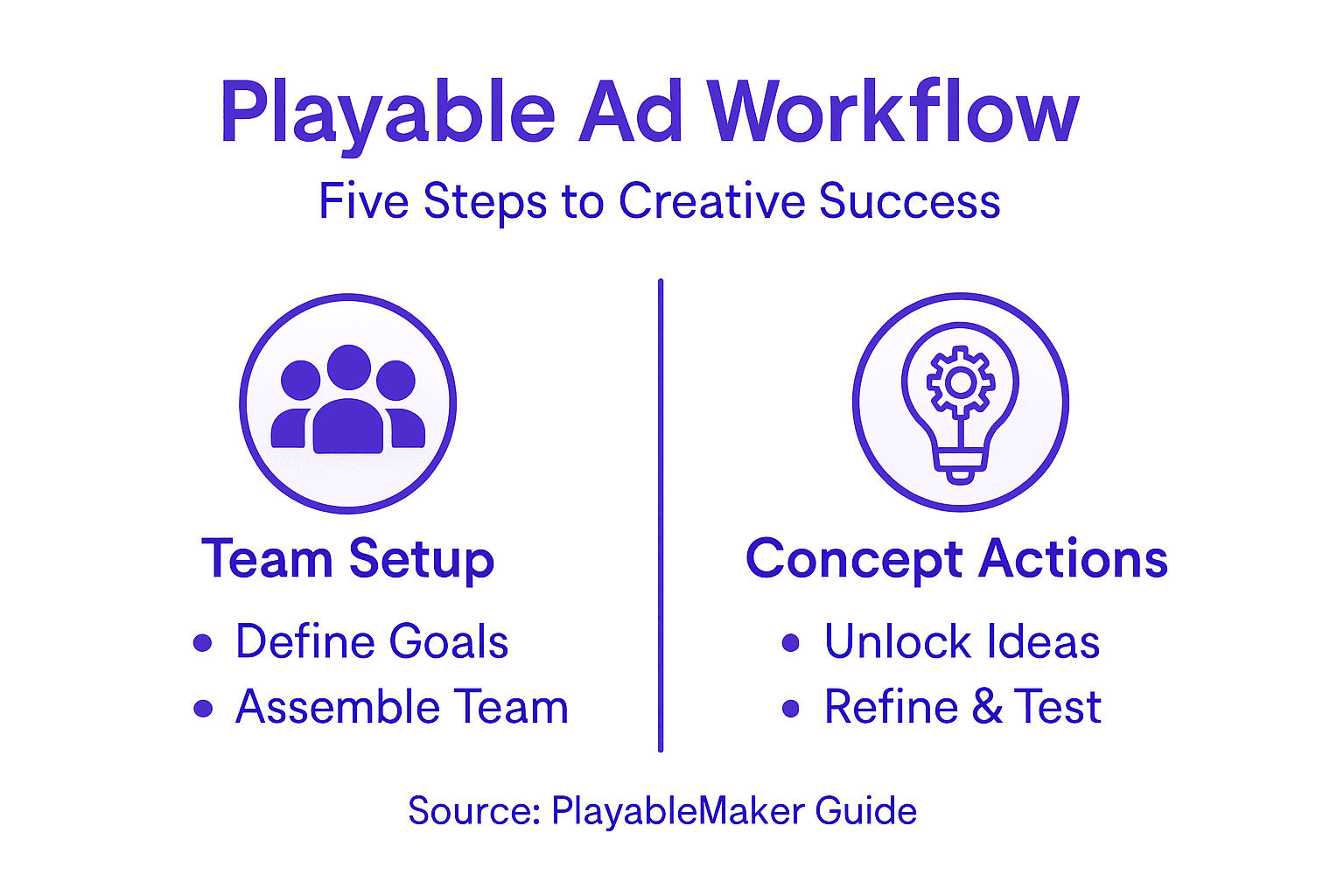
Systematic idea refinement techniques enable your team to methodically evaluate and enhance creative concepts. Implement structured assessment methods like dot voting or idea affinity mapping to objectively compare potential ad approaches. Consider evaluating each concept against key criteria such as player engagement potential, technical feasibility, and alignment with your game’s core narrative.
Audience segmentation strategies provide critical insights for narrowing your creative focus. Dive deep into demographic and psychographic data to understand precisely which ad concepts will resonate most powerfully with different player segments. This means examining player interests, gaming behaviours, and motivational triggers that might compel them to interact with your playable advertisement.
Professional Advice: Create a scoring matrix that weights audience relevance more heavily than internal team preferences to ensure your final ad concept truly speaks to potential players.
Step 5: Validate proposed creatives through quick testing
Validating your playable ad concepts rapidly and efficiently helps minimise wasted resources and maximise marketing performance. Your primary objective is to quickly determine which creative approaches resonate most strongly with your target audience before full deployment.
A/B testing methodologies offer powerful frameworks for comparing different ad variations systematically. Develop multiple versions of your playable ad with subtle variations in gameplay mechanics, visual design, or narrative approach. Run controlled experiments where you expose different audience segments to these variations and measure key performance indicators such as engagement rates, click through rates, and user retention.
Functional testing strategies are crucial for ensuring your playable ads perform seamlessly across various devices and user contexts. Implement both manual and automated testing protocols to identify potential technical issues, user experience friction points, or unexpected behavioural challenges. This comprehensive approach allows you to refine your creative concepts quickly and confidently before investing significant resources in full scale production.
This table compares A/B testing and functional testing in the context of validating playable ads:
| Aspect | A/B Testing | Functional Testing |
|---|---|---|
| Core Purpose | Measures player response | Ensures smooth ad performance |
| Focus | Creative effectiveness | Technical reliability |
| Metrics Analysed | Engagement, clicks, retention | Device compatibility, error rates |
| Typical Outcome | Identifies best-performing creative | Confirms all players have seamless play |
Professional Advice: Establish a consistent benchmark metric before testing to objectively evaluate which creative variations genuinely improve your advertising performance.
Transform Your Playable Ad Brainstorming Into Action with PlayableMaker
Struggling to turn your ad creative brainstorming workflow into efficient, cost-effective playable ads Manual development drains your developers’ time and balloons your budget The article highlights the challenges of defining clear creative objectives, assembling diverse teams, and rapidly validating concepts – all crucial steps that demand agility and seamless collaboration
PlayableMaker offers a no-code, budget-friendly solution built precisely to solve these pain points Build interactive ads fast without burdening your company resources or needing deep technical skills Experience the freedom to experiment with diverse playable ad concepts and refine them quickly with your team Stay focused on your key goals like capturing attention and emotional storytelling while we handle the technical side
Discover practical support in our Help Archives and unlock streamlined publishing strategies at Publishing Archives Take your first step towards effortless playable ad creation now by visiting PlayableMaker and start building your standout interactive ads today
Frequently Asked Questions
How do I define creative objectives for playable ads?
Defining creative objectives involves establishing precise marketing goals that align with your brand. Start by identifying your primary aim, such as increasing brand awareness or promoting game mechanics, and understand your target audience’s preferences. This clarity will guide your ad development and help create an engaging experience.
What types of brainstorming techniques can I use for developing playable ads?
Utilise various brainstorming techniques like rapid idea generation, perspective switching, and warm-up exercises to foster creativity. For example, try rapid idea generation to gather multiple concepts quickly, which can set a solid foundation for innovative advertising ideas.
How can I generate diverse concepts for playable ads?
Leverage interactive advertising tools to facilitate concept generation. Use AI-powered platforms to create multiple unique ad approaches quickly, allowing your team to experiment with different gameplay snippets and visual styles, ultimately expanding your creative options.
What is the importance of audience insights in refining ad concepts?
Audience insights are critical for transforming initial ideas into targeted marketing assets. Conduct a thorough analysis of demographic and psychographic data to ensure your ad concepts resonate with players’ interests and motivations, leading to more effective engagement.
How do I validate my playable ad ideas before full deployment?
Implement A/B testing to systematically compare different ad variations and measure key performance indicators. By doing so, you can quickly assess which concepts perform best among your target audience, enabling you to refine and enhance your ads before full-scale production.
What should I include in a scoring matrix for evaluating ad concepts?
Create a scoring matrix that weighs audience relevance more heavily than internal preferences. Include criteria such as player engagement potential and alignment with your game’s narrative to ensure your final concept resonates effectively with your intended players.
Recommended
- Complete Guide to Creativity in Advertising – playablemaker.com Complete Guide to Creativity in Advertising
- Concept of Creativity in Advertising Explained – playablemaker.com Concept of Creativity in Advertising Explained
- Concept of Creativity in Advertising: Complete Guide – playablemaker.com Concept of Creativity in Advertising: Complete Guide
- Concept of Creativity in Advertising Explained – playablemaker.com Concept of Creativity in Advertising Explained