
TL;DR:
- Playable and interactive ads now outperform traditional video ads in user engagement and conversion.
- Effective playable ads simulate core gameplay, driving stronger user intent and higher retention.
- Using no-code tools and strategic testing optimizes interactive ad production and campaign results.
Video ads have long been treated as the default choice for mobile game marketers. They are familiar, scalable, and easy to produce at volume. Yet the landscape is shifting in ways that challenge this assumption directly. Playable and interactive ad formats are growing rapidly, offering measurable improvements in user intent, retention, and cost-per-install (CPI) efficiency. For user acquisition (UA) managers and marketing directors, understanding this shift is no longer optional. This guide examines how ad formats have evolved, what makes interactive formats work, and how to apply them efficiently within real campaign budgets.
Table of Contents
- The evolution of ad formats in mobile gaming
- Playable ads and interactive formats: What makes them work
- Choosing the optimal ad format: Matching objective to approach
- Driving efficiency: Tools, platforms, and creative strategies
- A fresh perspective on ad innovation in gaming
- Enhance your campaigns with proven tools
- Frequently asked questions
Key Takeaways
| Point | Details |
|---|---|
| Interactivity drives results | Playable ads outperform traditional formats by boosting user engagement and intent. |
| Select the right format | Align ad format to your campaign objective for the best ROI and performance. |
| Embrace creative tools | Modern platforms and AI can help produce high-quality ads efficiently and cost-effectively. |
| Experiment for success | Ongoing testing and flexible strategy are essential for staying ahead in gaming ad innovation. |
The evolution of ad formats in mobile gaming
Mobile game advertising has passed through several distinct phases. In the early years, static banner ads were the norm. Then video ads took over, offering richer storytelling and broader reach across ad networks. Rewarded video ads followed, giving players an incentive to watch in exchange for in-game currency or lives. Each shift was driven by a simple pressure: marketers needed better results for less money.
Today, that pressure is more acute than ever. CPI rates have climbed steadily, squeezing margins for studios of all sizes. The search for formats that deliver genuine user intent, rather than passive impressions, has led many teams toward playable and interactive ads. These formats allow prospective players to experience a slice of actual gameplay before committing to an install.
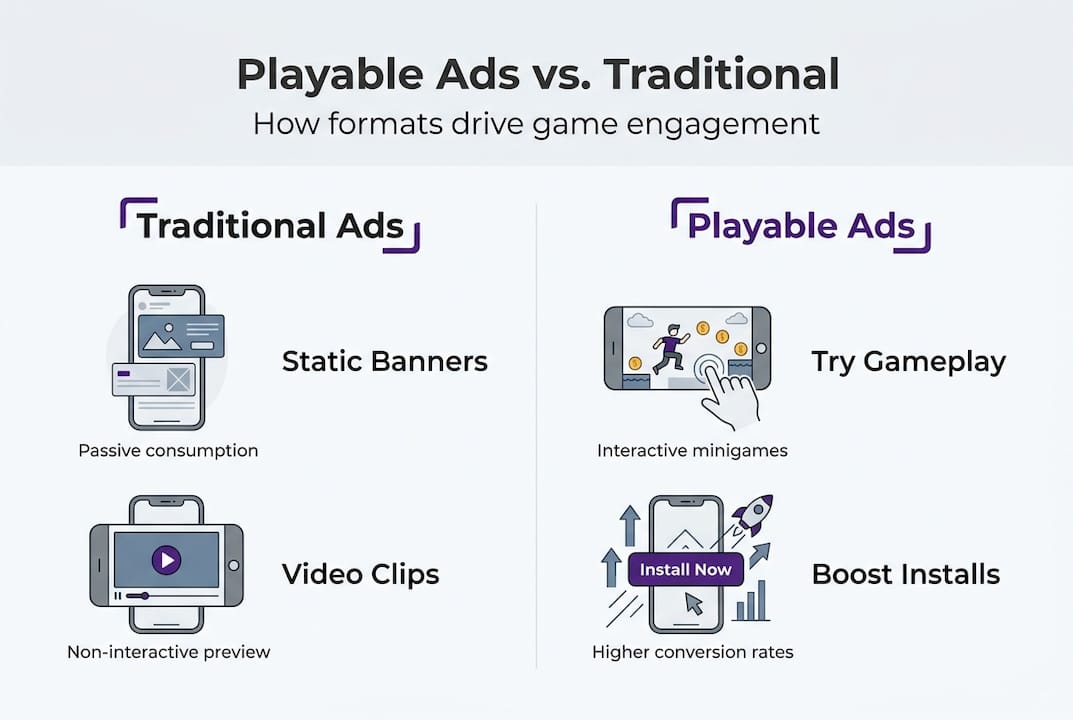
The numbers reflect this momentum. Playable ads account for 8.3% of all creatives in mobile gaming, a figure that continues to grow as more teams validate their performance. However, it is worth noting that this format is not universally appropriate. Genre, audience, and campaign objective all influence whether a playable ad will outperform a well-crafted video.
Here is a quick overview of how the main ad formats compare across key performance indicators:
| Format | Engagement level | Avg. CPI impact | Best use case |
|---|---|---|---|
| Static banner | Low | Low cost, low intent | Retargeting |
| Video (non-rewarded) | Medium | Moderate | Brand awareness |
| Rewarded video | Medium-high | Moderate | Mid-funnel retention |
| Playable/interactive | High | Higher upfront, better ROAS | High-intent installs |
Several factors are accelerating this transition:
- Rising CPI across major ad networks is forcing teams to justify every creative decision
- App store competition means users are more selective before installing
- Ad fatigue from repetitive video formats is reducing click-through rates
- Platforms such as Meta and Google have expanded native support for playable formats
For a grounded introduction to playable ads and their role in modern UA strategy, it helps to understand not just what they are, but why they emerged when they did. Equally, exploring creative ad concepts can reveal how format innovation connects to broader creative strategy. Rigorous ad format testing remains essential for validating which approach suits your specific audience.
Playable ads and interactive formats: What makes them work
Playable ads are not simply short video clips with a button at the end. They simulate core gameplay mechanics, giving users direct, hands-on experience of what the game feels like before they decide to install. This distinction matters enormously from a psychological standpoint.

When a user actively engages with an ad rather than passively watching it, several things happen. Attention deepens. Decision-making becomes more informed. And crucially, the intent behind any resulting install is far stronger. Playable ads leverage psychology to drive engagement and conversion in ways that passive formats simply cannot replicate.
Here is how the three main formats compare on the dimensions that matter most to UA teams:
| Dimension | Static | Video | Playable |
|---|---|---|---|
| User intent post-engagement | Low | Medium | High |
| Creative production cost | Low | Medium | Medium-high |
| Attention duration | Short | Medium | Longer |
| Post-install retention signal | Weak | Moderate | Strong |
A common misconception is that playable ads are only suited to hypercasual games with simple tap mechanics. In reality, game ad examples from puzzle, strategy, and RPG titles demonstrate that even complex genres can distil their core loop into a compelling 15 to 30 second interactive experience. The key is identifying the single mechanic that best represents your game’s appeal and building the ad around that.
Some of the most effective interactive ads share these characteristics:
- A clear, immediate call to action within the first three seconds
- Intuitive controls that require no instruction
- A satisfying micro-reward or moment of progression before the install prompt
- Visual consistency with the actual game to avoid post-install disappointment
“The best playable ads feel like the first ten seconds of the game itself, not a trailer for it.”
Pro Tip: Test interactivity depth carefully. An ad that is too complex will frustrate users before they reach the install prompt. One that is too simple will fail to communicate genuine gameplay value. Aim for a single, satisfying interaction loop. Review playable ad techniques to find the right balance for your genre.
Choosing the optimal ad format: Matching objective to approach
Not every campaign objective calls for the same ad format. One of the most common and costly mistakes in mobile game UA is treating format selection as an afterthought rather than a strategic decision. The user journey has distinct stages, and each responds differently to different formats.
Video ads are ideal for brand awareness, while playables are most effective at converting high-intent users who are already considering a new game. Understanding this distinction helps you allocate budget with greater precision.
Here is how to map ad formats to user journey stages:
- Awareness: Video ads and rich media build familiarity at scale. Reach is the priority here, not conversion.
- Interest: Rewarded video and short interactives begin to qualify intent. Users who opt in are already engaged.
- Action: Playable ads are most powerful at this stage. A user who completes a playable interaction and then installs is far more likely to retain.
When deciding which format to deploy, consider these trade-offs:
- Cost vs. intent: Playables typically cost more to produce but attract users with stronger install intent, improving return on ad spend (ROAS).
- Reach vs. depth: Video reaches more users but engages them less deeply. Playables reach fewer but convert better.
- Speed vs. quality: Static and video ads can be produced quickly. Playables require more creative investment but deliver richer data on user behaviour.
- Platform compatibility: Not all networks support playable formats equally. Verify placement options before committing budget.
Exploring the full range of ad experience types helps clarify which combinations suit different campaign structures. For practical guidance on making engaging ads, the creative execution is just as important as the format choice itself.
Pro Tip: Rotate formats across your campaign lifecycle. Running playables alongside video in an A/B structure not only tests performance but keeps your creative catalogue fresh, reducing ad fatigue and improving overall campaign ROI.
Driving efficiency: Tools, platforms, and creative strategies
Choosing the right format is only half the equation. Executing efficiently, without burning through development resources or budget, is where many teams struggle. The good news is that the tooling available in 2026 makes this significantly more manageable than it was even two years ago.
CPI has risen 12% year-on-year, which means that creative efficiency is no longer a nice-to-have. It is a competitive necessity. Teams that can produce, test, and iterate on playable ad variants quickly will consistently outperform those locked into slow, dev-dependent production cycles.
Here is a practical workflow for building and scaling interactive ads efficiently:
- Define your core loop: Identify the single mechanic or moment that best represents your game. This becomes the foundation of your playable.
- Use a no-code or low-code builder: Drag-and-drop platforms allow creative teams to build and modify playable ads without engineering support, cutting production time dramatically.
- Generate multiple variants: AI-powered tools can produce several creative variations from a single base asset, enabling broad A/B testing without proportional cost increases.
- Run structured A/B tests: Test one variable at a time, whether that is the end card, the difficulty of the interaction, or the visual theme. Isolating variables produces cleaner data.
- Analyse and iterate: Use install rate, play-through rate, and post-install retention data to identify which variants perform best, then scale those.
“Speed of iteration matters more than perfection of any single creative. The team that tests ten variants learns faster than the one that perfects two.”
For a detailed playable ad campaign breakdown, including how to structure testing phases, the principles above translate directly into measurable improvements. Teams looking to extend the value of existing assets should also consider repurposing ad creatives across formats to maximise return on creative investment.
Pro Tip: Use AI tools to generate rapid, multi-variant creative tests. Rather than committing to a single playable concept, produce three to five lightweight variants and let performance data guide your full production investment.
A fresh perspective on ad innovation in gaming
There is a tendency in mobile game marketing to treat format adoption as a binary choice: either follow what the top publishers are doing, or risk falling behind. This framing leads teams to copy dominant formats without understanding why those formats work for specific audiences and objectives.
The uncomfortable truth is that following the herd produces diminishing returns. When every game in a category runs the same style of playable ad, users become desensitised. The format stops being a differentiator and becomes background noise.
Real advantage comes from consistent experimentation at the level of narrative and interaction design, not just format selection. Micro-failures, the ad variants that underperform, are often more instructive than successes. They reveal what your audience does not respond to, which is equally valuable information.
True innovation in gaming ads is user-first thinking. It asks: what does this person need to feel before they will install? Not: what format is trending this quarter? Teams that build from that question, and use tools like playable ad conversion guides to sharpen their approach, tend to find more durable performance gains than those chasing the latest creative trend.
Enhance your campaigns with proven tools
If this guide has clarified the value of playable and interactive ads, the next step is putting that understanding into practice without overextending your budget or your team. PlayableMaker is built precisely for this challenge. The platform lets you create, test, and launch effective playable ads without writing a single line of code, removing the dependency on developer time that makes traditional playable production so costly. Whether you are exploring playable ads for the first time or scaling an existing interactive strategy, the PlayableMaker platform gives your team the speed and flexibility to iterate and win.
Frequently asked questions
What is the key difference between playable and video ads?
Playable ads let users interact directly with game mechanics, generating active engagement and stronger install intent. Video ads are passive, meaning the user watches without participating, which typically produces lower conversion rates. Playable ads simulate actual gameplay in a way that video cannot replicate.
Are playable ads only suitable for hypercasual games?
No. Playable ads are effective across multiple genres, including puzzle, strategy, and RPG titles. The format works whenever a core mechanic can be distilled into a short, intuitive interactive experience.
How can I keep playable ad production cost-effective?
Use drag-and-drop builders and AI-powered creative tools to reduce reliance on developer resources. AI and creative platforms simplify playable ad generation, cutting both production time and CPI without sacrificing creative quality.
Does adding interactivity always improve ad performance?
Not automatically. Interactivity boosts engagement when the format suits the audience and campaign objective. Matching ad format to objective is critical. A poorly designed interactive ad can frustrate users and harm performance more than a well-crafted video.
Recommended
- 7 Creative Ad Formats List Every Mobile Marketer Needs – playablemaker.com 7 Creative Ad Formats List Every Mobile Marketer Needs
- 7 Best Examples of Mobile Game Ads and Why They Work – playablemaker.com 7 Best Examples of Mobile Game Ads and Why They Work
- 7 Types of Ad Experiences for Better User Acquisition Results – playablemaker.com 7 Types of Ad Experiences for Better User Acquisition Results
- The Benefits of Playable Ads for Mobile Marketers – playablemaker.com The Benefits of Playable Ads for Mobile Marketers
- POPJAM.IO – AI Ad Generator & Creative Testing Platform | Test Before You Spend