
TL;DR:
- Ad click-through rate indicates initial interest but does not guarantee user quality or long-term engagement. It is influenced by creative quality, ad format, placement, and targeting, and must be analyzed alongside post-click metrics for accurate campaign evaluation. Prioritizing comprehensive, cross-metric analysis and quality creatives ensures sustainable mobile game user acquisition success.
Not every click on your ad represents genuine interest, and that distinction matters enormously when you are managing a user acquisition budget under pressure. Many UA managers in mobile gaming treat click-through rate as a straightforward indicator of success, when in reality it is one of the most misread metrics in the entire performance marketing stack. Understanding what ad CTR truly measures, what distorts it, and how to act on it strategically is the difference between campaigns that scale efficiently and campaigns that burn spend chasing hollow engagement signals.
Table of Contents
- What is ad CTR and why does it matter?
- Which factors influence ad CTR in mobile gaming?
- Ad CTR versus other key metrics: What is it really telling you?
- How to boost ad CTR: Practical strategies for mobile UA
- Why chasing CTR alone misses the bigger picture in mobile game UA
- Take your ad CTR—and results—further with Playablemaker
- Frequently asked questions
Key Takeaways
| Point | Details |
|---|---|
| CTR fundamentals | Ad CTR measures the percentage of viewers who click your ad, signalling the creative’s appeal. |
| Influencing factors | Creative quality, ad format, and audience targeting have the biggest impact on CTR in mobile gaming. |
| Context matters | High CTR alone does not guarantee campaign success—consider conversions and long-term value. |
| Practical optimisation | Testing creatives and placements, and rotating ads, can efficiently boost your CTR. |
What is ad CTR and why does it matter?
Ad click-through rate is the percentage of people who click on your ad after seeing it. The formula is simple: divide the number of clicks by the number of impressions, then multiply by one hundred. If your ad received 500 clicks from 50,000 impressions, your CTR is 1%. It sounds straightforward, but the implications of that number run much deeper than the arithmetic suggests.
Good CTR benchmarks vary considerably by platform, format, and genre, but the metric itself functions as a top-level filter on two fundamental questions: is your creative compelling enough to interrupt someone mid-scroll, and is your targeting precise enough to put that creative in front of people who actually care? Both questions carry serious weight for budget efficiency.
To make the formula concrete, consider this illustrative comparison across three hypothetical campaigns:
| Campaign | Impressions | Clicks | CTR |
|---|---|---|---|
| Campaign A (static banner) | 200,000 | 1,800 | 0.90% |
| Campaign B (video ad) | 150,000 | 2,700 | 1.80% |
| Campaign C (playable ad) | 100,000 | 4,200 | 4.20% |
The playable ad here generates far fewer impressions but substantially more clicks. On CTR alone it looks like a runaway winner. Whether it actually is depends on what happens after the click, which we will address shortly.
It is equally important to understand what CTR does not tell you. The metric is a surface-level signal, not a full verdict on campaign quality. Here is a practical breakdown:
What CTR shows:
- How visually engaging or attention-grabbing your creative is
- Whether your headline and visual hierarchy align with audience expectations
- How well your targeting matches the creative message
- Initial relevance of the offer to the audience segment
What CTR does NOT show:
- Whether users who clicked will install, register, or make a purchase
- The quality or lifetime value of those users
- Whether clicks came from genuine intent or accidental taps
- How your ad compares to essential ad metrics further down the funnel
Pro Tip: Never read CTR in isolation. Always pair it with post-click metrics such as install rate, cost per install, and day-7 retention to understand whether the clicks your creative is generating are actually worth paying for.
Now that we have established why a click is more than just a number, let us clarify exactly how CTR is calculated and what it reveals to user acquisition teams.
Which factors influence ad CTR in mobile gaming?
With CTR defined, it is time to unpack what makes this metric fluctuate so much between campaigns, genres, and even ad formats. The variance in CTR across mobile gaming ads can be enormous. A rewarded video ad for a casual puzzle game might comfortably achieve 3 to 5% CTR, whilst a static interstitial for a midcore RPG might struggle to reach 0.5%. Understanding the reasons behind that gap is essential for setting realistic expectations and making informed creative decisions.
Creative quality, ad type, and placement are among the major drivers of CTR variance in mobile advertising, and each factor operates independently while also interacting with the others. A high-quality creative placed in the wrong context will underperform. A well-targeted placement with a weak creative will do the same.
Ad format is one of the most powerful levers. Interactive and playable ads consistently outperform static formats because they demand active participation rather than passive viewing. When a user can tap, swipe, or interact with a mini version of your game, they are already engaged before they reach the install screen. Video ads sit in the middle, offering movement and narrative but no tactile involvement. Static banners, whilst cost-efficient to produce, typically generate the lowest CTRs because they rely entirely on a single visual impression.

Creative elements shape CTR in ways that go well beyond aesthetic preference. Your call-to-action (CTA) must be specific, visible, and placed at the moment of peak engagement within the ad. Vague CTAs like “Learn more” consistently underperform against action-oriented phrases like “Play now” or “Try it free.” Colour contrast, character animation, and the clarity of your value proposition all contribute to whether a user’s thumb moves towards your ad or scrolls past it.
Ad placement introduces another layer of complexity. Here are the key factors that most directly shape mobile ad CTR:
- Ad format type: Playable and interactive formats typically deliver higher CTR than static or standard video
- Placement context: Rewarded placements, where users voluntarily engage, produce different CTR patterns than forced interstitials
- Audience relevance: Targeting a genre-matched audience consistently lifts CTR compared to broad demographic targeting
- Creative freshness: Ads that have been running for several weeks experience CTR decay as frequency increases and novelty fades
- Platform environment: Social feed placements on Facebook or TikTok behave very differently from in-app rewarded placements within other games
Understanding CTR factors in Facebook ads is particularly relevant for mobile UA teams running campaigns on Meta, where creative quality scoring directly influences cost per impression and ad delivery.
Pro Tip: Always benchmark playable ads separately from traditional creatives. Comparing a playable ad’s CTR against a static banner CTR is like comparing conversion rates on a free trial versus a paid subscription page. The audience intent and engagement levels are structurally different.
Understanding the factors behind CTR sets the scene for a critical comparison: how should you read CTR alongside other metrics to avoid misjudgment?
Ad CTR versus other key metrics: What is it really telling you?
High CTR is genuinely useful as an early indicator of creative and targeting health. But it is not, and should never be treated as, a proxy for campaign success. Many UA managers have experienced the painful lesson of scaling a high-CTR campaign only to watch install rates stagnate and cost per install climb.
The conversion rate in advertising must be analysed alongside CTR to produce a meaningful picture of campaign performance. Here is how the three most commonly tracked upper-funnel metrics compare:
| Metric | Definition | Primary use | Key pitfall |
|---|---|---|---|
| CTR | Clicks divided by impressions | Measures creative appeal and targeting fit | Can be inflated by accidental taps or misleading creative |
| Conversion rate | Installs (or actions) divided by clicks | Measures post-click quality and store page effectiveness | Can be low even with strong CTR if the landing page or store listing is weak |
| Engagement rate | Active interactions divided by impressions | Measures depth of interaction beyond a simple click | Harder to standardise across platforms and formats |
The contrast between CTR and conversion rate is where campaigns most frequently go wrong. A visually arresting creative can generate strong CTR by triggering curiosity or confusion, but if the ad promises one type of experience and the game delivers another, users will click through and not install. This misalignment is more common than most UA teams acknowledge.
“High CTR does not equal quality users. A click is an expression of momentary curiosity, not a commitment to install, engage, or spend. Optimising exclusively for CTR risks filling your funnel with low-intent traffic that inflates your click costs without improving your bottom line.”
Consider a real scenario: a campaign using exaggerated “fail gameplay” creatives for a casual mobile game might achieve 5% CTR because the content is provocative and visually striking. But if the actual game does not match the tone or difficulty shown in the ad, the install rate might sit at 15% where a more honest creative would achieve 35%. The high-CTR campaign ends up costing more per quality install, despite appearing stronger on paper.
This is why cross-metric analysis is not optional. It is how UA managers avoid making expensive decisions based on incomplete information.
How to boost ad CTR: Practical strategies for mobile UA
Once you know where CTR fits in and how it behaves, the real challenge is improving it efficiently. Here is a toolkit for doing exactly that.
Testing creatives, refining targeting, and applying mobile ad best practices demonstrably improve CTR in mobile gaming campaigns. The key is approaching improvement systematically rather than relying on intuition or single-variable guesswork.
-
Revamp your creative with intent. Audit your current ads and identify whether the first three seconds communicate a clear, compelling value proposition. In mobile gaming, showing actual gameplay or a satisfying game mechanic within the opening frames consistently outperforms lifestyle or brand-awareness openers.
-
Test interactive and playable formats. If your current mix relies heavily on static or standard video, introducing a playable ad unit gives users a hands-on preview of your game. This self-selection mechanic means the users who click through have already expressed active interest rather than passive curiosity.
-
Refine your CTA placement and language. Conduct focused tests where the only variable is the CTA copy or position within the creative. “Play now” versus “Download free” versus “Start playing” can produce meaningfully different CTR and conversion outcomes depending on your audience segment and genre.
-
Implement structured A/B testing. Following a robust A/B testing framework for ads ensures that creative improvements are based on statistically reliable data rather than short-run performance noise. Test one variable at a time, run tests to adequate sample sizes, and document learnings systematically.
-
Tighten your audience targeting. Broad targeting might seem like it maximises reach, but CTR almost always improves when you narrow to genre-matched audiences, lookalikes based on high-LTV users, or behavioural segments that align closely with your game’s core loop.
-
Optimise for placement context. Review performance by placement and allocate budget towards the environments where your creative format naturally performs best. Rewarded placements generally suit engagement-led games; social feed placements suit broader awareness goals with strong creative hooks.
-
Use campaign micro-tests before scaling. Before committing significant spend, run small-budget tests across multiple creative variants. Analyse CTR, install rate, and early engagement together. Refer to the UA campaign checklist for a structured approach to pre-scale validation.
Pro Tip: Rotate your creative assets every two to four weeks to combat ad fatigue. CTR decay is one of the most predictable causes of rising cost per install in mature campaigns, and fresh creative is consistently the fastest fix.
Why chasing CTR alone misses the bigger picture in mobile game UA
Here is an uncomfortable truth that does not get enough airtime in mobile gaming UA discussions: the industry has a CTR fetish. Dashboards are built around it, creative briefs are written to chase it, and bonus structures are sometimes tied to it. But over-indexing on CTR is one of the more subtle ways UA teams waste budget at scale.
When you optimise too aggressively for CTR, you train your algorithms and creative teams to produce content that generates taps, not installs. Provocative visuals, misleading gameplay snippets, and emotionally manipulative hooks all lift CTR. They also attract users who have no genuine interest in your game, users who will churn within 24 hours or never complete the install.
Sustainable mobile gaming growth depends on playable ad quality and the depth of user engagement that follows the click, not the volume of clicks itself. Lifetime value, day-30 retention, and in-app purchase rates are the verdicts that determine whether a campaign was actually successful. CTR is only the opening chapter.
“Don’t let CTR become your North Star. It is the departure gate, not the destination.”
The teams that build sustainable UA programmes treat CTR as an early warning system. When CTR drops, it signals a creative or targeting problem worth investigating. When CTR is healthy but conversion rate is low, it signals a misalignment between the ad promise and the product experience. When both are strong but retention is poor, it points to an audience quality problem.
Building a cross-metric dashboard where CTR, conversion rate, engagement rate, and early retention sit side by side is not a complex technical challenge. It is a mindset shift. UA managers who make that shift stop asking “how do I get more clicks?” and start asking “how do I attract users who will actually love this game?” That reframe produces fundamentally better campaigns.
Take your ad CTR—and results—further with Playablemaker
With a holistic perspective on CTR, your team can move from theory to practice. Playablemaker’s resources are designed specifically to support UA managers who want to improve CTR the right way, through better creative strategy rather than misleading hooks. Explore the psychology behind playable ad effectiveness to understand why interactive formats consistently outperform static creatives on both CTR and post-click quality. If you are ready to see how the format drives real results, the evidence behind how playable ads drive results makes a compelling case for adding them to your next campaign cycle. Better CTR starts with better creative, and Playablemaker makes building it accessible for every team.
Frequently asked questions
What is a good ad CTR for mobile games?
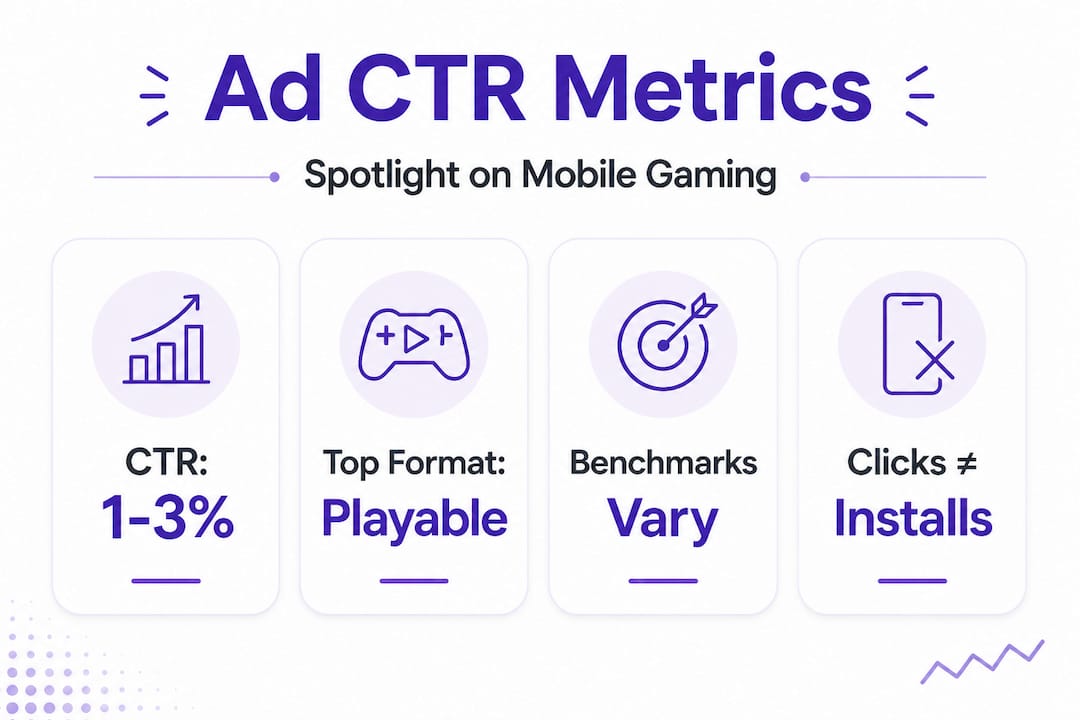
A good CTR for mobile game ads typically falls between 1% and 3%, though this varies significantly by format, placement, and game genre, with playable ads often exceeding that range.
Does a higher CTR mean more quality installs?
Not necessarily. A high CTR without strong conversion often signals creative misalignment, where the ad generates curiosity but the game fails to match the expectation set by the ad.
How can I improve my mobile gaming ad CTR quickly?
Test different ad creatives with clear, action-oriented CTAs, and apply proven mobile ad practices including audience refinement and placement optimisation to see meaningful CTR improvements quickly.
Is CTR more important than conversion rate for mobile UA?
Both serve distinct purposes. CTR measures top-of-funnel interest, whilst conversion rate measures actual installs or in-app actions, making them complementary rather than competing metrics.
What affects playable ads’ CTR the most?
The ad’s format and creative quality are the strongest drivers, since interactive formats that accurately reflect the game experience tend to attract higher-intent clicks and better post-click outcomes.
Recommended
- Advertising Conversion Rate: Elevating Mobile Game Installs – playablemaker.com Advertising Conversion Rate: Elevating Mobile Game Installs
- 8 Key Ad Performance Metrics for Mobile Gaming Success – playablemaker.com 8 Key Ad Performance Metrics for Mobile Gaming Success
- What Is a Good Facebook Ad CTR? Complete Guide – playablemaker.com What Is a Good Facebook Ad CTR? Complete Guide
- Playable ad CTR: benchmarks and optimisation tips – playablemaker.com Playable ad CTR: benchmarks and optimisation tips
- How to boost ad performance: a step-by-step guide