
TL;DR:
- Personalisation in mobile gaming ads improves user retention, engagement, and ROAS significantly.
- Effective personalisation relies on understanding player behaviour and designing relevant, non-intrusive creatives.
- Privacy compliance and player trust are crucial, requiring consent-based, aggregated data approaches and transparent controls.
Collecting more player data does not automatically translate into better campaign performance. Many mobile gaming marketers have invested heavily in analytics infrastructure, only to find their ads still miss the mark with target audiences. The real advantage comes from acting on that data in a way that feels relevant and timely to each player. High-quality personalised ads boost user retention and engagement in mobile games, yet most campaigns still serve generic creatives to broadly defined audiences. This article breaks down the frameworks, tools, and approaches that separate effective personalisation from wasted spend.
Table of Contents
- Why personalisation matters in mobile gaming ads
- Core methods for personalising mobile ads
- Choosing the right tools and platforms for personalisation
- Overcoming challenges: privacy and avoiding user backlash
- The uncomfortable truth about mobile ad personalisation
- Accelerate your next campaign with PlayableMaker’s solutions
- Frequently asked questions
Key Takeaways
| Point | Details |
|---|---|
| Personalisation boosts ROI | Tailored mobile gaming ads result in higher retention rates, lower costs, and better user engagement. |
| Privacy is essential | Consent, data aggregation, and compliance with GDPR/ATT are critical to avoid backlash and regulatory risk. |
| Incremental testing works best | Start small with pilots, use unified data, and benchmark improvement using metrics like D7 ROAS. |
| Choose tools wisely | Select platforms with recommendation engines and robust analytics to support personalisation at scale. |
Why personalisation matters in mobile gaming ads
Personalisation in mobile advertising means tailoring the creative, offer, and timing of an ad to match a specific player’s behaviour, preferences, or progression stage. It is not simply showing a different banner to different demographic groups. True personalisation uses in-game signals, session patterns, and cohort data to serve something that feels almost individually crafted.
The results are measurable. Persona.ly campaigns demonstrated 25% below re-attribution cost KPI targets at 15x scale, with 4x Day 7 ROAS and as much as 4.8x ROAS. Separately, Deloitte research found that 72% of players who see high-quality personalised ads continue playing, and 20% play more often. These are not marginal improvements; they represent a fundamental shift in how players respond to advertising when it respects their context.
“Players do not want to feel like they are simply a unit in an acquisition funnel. When an ad reflects where they are in their gaming journey, they engage with it differently.”
Understanding player ad experiences helps explain why this works psychologically. Players who encounter a rewarded ad for a game they already enjoy playing, or who see a re-engagement ad referencing a level they have not yet beaten, are far more receptive than those served a generic install prompt.
The benchmarks from games like CookieRun and titles operated by Nexon and Leniu Games reinforce this further. Campaigns built around personalised ad benchmarks consistently outperform standard creative rotation strategies, especially when applied at scale.
Here is a comparison of personalised versus non-personalised campaign outcomes:
| Metric | Non-personalised campaigns | Personalised campaigns |
|---|---|---|
| Day 7 ROAS | Baseline | Up to 4x improvement |
| Re-attribution cost | Standard KPI | 25% below target |
| Player retention (Day 30) | Industry average | Up to 72% continuation rate |
| Engagement frequency | Normal | 20% increase in play frequency |
| Creative fatigue rate | High | Reduced through variant rotation |
The contrast is clear. Personalisation consistently outperforms generic approaches across every major mobile gaming metric. The key is understanding what makes a personalised campaign structurally different, and then building that structure with intention.
Key outcomes that personalisation reliably drives:
- Higher ROAS through more relevant ad delivery to receptive players
- Improved retention by serving ads that feel relevant to a player’s current stage
- Lower churn through non-disruptive, contextually appropriate formats
- Better creative performance when variants are tested against specific player cohorts
Practices like email personalisation for retention in e-commerce offer a useful parallel; the same principles of segmenting by behaviour and timing communications around lifecycle stage apply directly to mobile gaming ad strategies.
Core methods for personalising mobile ads
There are several practical approaches to implementing personalisation, and they vary considerably in complexity, cost, and data requirements. Understanding each method helps you prioritise what is achievable given your current infrastructure.
1. Cohort segmentation by behaviour
Segmenting players by behaviour means grouping them according to actions they have taken in-game, such as level completion rate, session frequency, or in-app purchase history. A player who has completed the tutorial but has not yet made a purchase is fundamentally different from a high-spending veteran. These two players should never see the same ad.

2. Session-based creative triggers
Using session history to trigger specific creatives allows you to respond to real-time signals. If a player has had three sessions within a week but none in the past four days, a re-engagement ad is more appropriate than a new user acquisition creative. This approach improves relevance without requiring deep individual profiling.
3. A/B testing creative and messaging variants
Systematic A/B testing remains one of the most reliable personalisation methods available. Testing different visual styles, value propositions, and calls to action across defined cohorts reveals which combinations resonate with each group. Structured testing prevents guesswork and surfaces genuine insights. Exploring a solid personalised ads guide can help you structure these testing frameworks effectively.
4. Recommendation engine integration
Platforms like Adjust and Databricks allow you to build or integrate recommendation engines that suggest ad content based on aggregated behavioural patterns. These engines analyse collective player data to infer what type of creative a player segment is most likely to respond to, without relying on individual tracking.
5. Selecting non-disruptive ad format types
The format of an ad is part of its personalisation. Rewarded video, interstitial, and playable ad formats all create different experiences. Matching format to player context, such as offering rewarded video to players mid-session who are likely to want in-game currency, dramatically improves receptivity.
Effective personalising of ad content also depends on the quality and relevance of the creative itself, not just the targeting logic.
Personalisation effectiveness by method:
| Method | Implementation difficulty | Impact on ROAS | Privacy risk level |
|---|---|---|---|
| Cohort segmentation | Low to medium | High | Low |
| Session-based triggers | Medium | High | Low |
| A/B testing variants | Low | Medium to high | Very low |
| Recommendation engines | High | Very high | Medium |
| Format personalisation | Low | Medium | Very low |
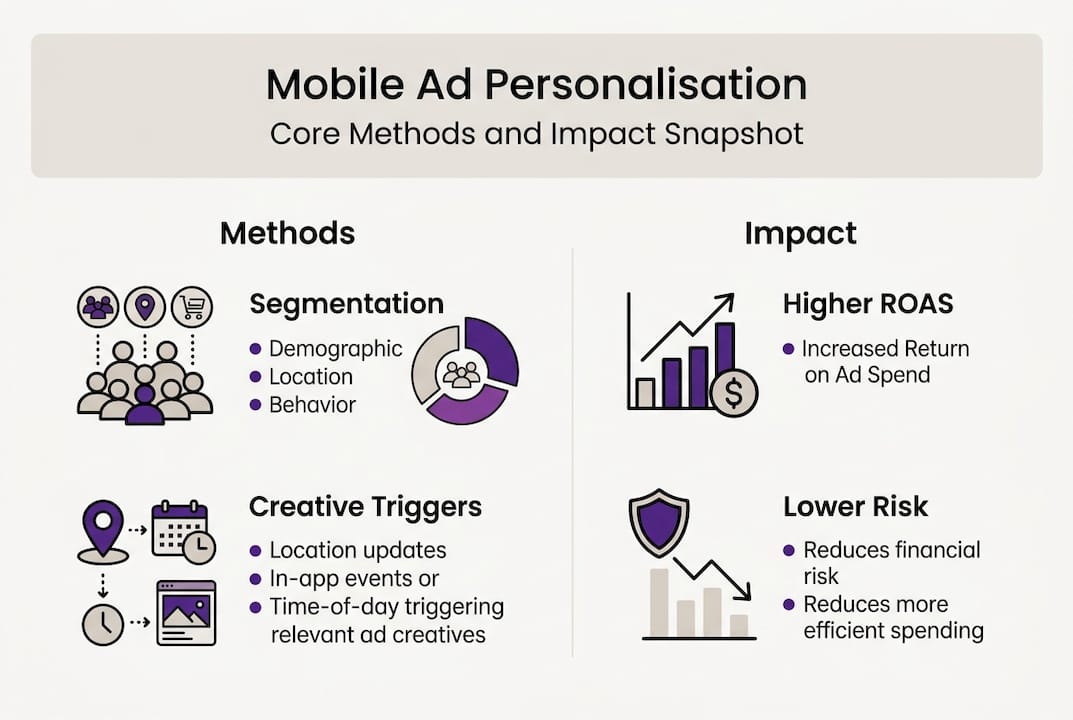
Critically, effective personalisation depends on privacy-aware use of aggregated data following the industry changes brought by Apple’s App Tracking Transparency (ATT) framework and SKAdNetwork, with GDPR compliance being non-negotiable throughout.
Pro Tip: Avoid forced redirects and non-skippable ad formats in your personalised campaigns. Even the most relevant creative will generate negative sentiment if the format feels coercive. Prioritising player choice, especially in rewarded formats, consistently produces stronger engagement metrics than interruption-based approaches.
Choosing the right tools and platforms for personalisation
Selecting the appropriate platform for your personalisation strategy is not simply a matter of choosing the tool with the most features. It involves matching the platform’s capabilities to your team’s technical capacity, your data infrastructure, and the scale of your campaigns.
Several platforms dominate the mobile gaming personalisation space. Adjust provides mobile measurement and attribution alongside audience segmentation tools. Databricks offers a more technical, data-engineering approach, particularly useful for teams building custom recommendation engines. AppsFlyer and ironSource also provide solid personalisation and targeting capabilities with varying degrees of creative control.
When evaluating platforms, consider the following criteria:
- Attribution accuracy under SKAdNetwork constraints
- Audience segmentation depth and granularity
- Creative serving flexibility and A/B testing support
- Data privacy compliance tools and consent management integration
- Integration ecosystem with your existing analytics and creative stack
According to incremental testing insights, leveraging unified data platforms like Adjust or Databricks through structured, incremental testing is key to building scalable personalisation systems. The emphasis on incremental testing is important: starting with a single personalisation variable, measuring its impact carefully, and then expanding is more reliable than attempting to personalise every dimension at once.
Here is a comparison of major platforms:
| Platform | Strength | Best for | Privacy tooling |
|---|---|---|---|
| Adjust | Attribution and segmentation | Mid to large studios | Strong ATT/GDPR support |
| Databricks | Data engineering and ML | Technical teams, scale | Configurable compliance |
| AppsFlyer | Attribution and analytics | Broad studio sizes | GDPR compliant |
| ironSource | Ad serving and mediation | Monetisation-focused | Standard compliance |
| Meta Advantage+ | Creative optimisation | Broad reach campaigns | Privacy-limited |
Explore the top ad platforms in mobile gaming for a more detailed breakdown of how each fits different campaign types.
When measuring outcomes, three metrics deserve the most attention. Day 7 ROAS tells you quickly whether your personalisation is influencing early monetisation decisions. Retention rate at Day 14 and Day 30 shows whether personalised re-engagement ads are pulling players back. Churn rate, measured against the baseline before personalisation was introduced, indicates whether your approach is generating goodwill or friction. Strategies for retention through tools in adjacent sectors also reinforce the value of cross-channel consistency when measuring lift.
Overcoming challenges: privacy and avoiding user backlash
Privacy is not just a regulatory concern; it is a product experience issue. Players who feel their data is being used in ways they did not consent to, or who encounter creatives that feel surveillance-like in their specificity, often react negatively. This reaction damages both brand sentiment and long-term retention.
The most common mistakes that generate privacy backlash include:
- Over-targeting on personal behaviour in ways that feel intrusive rather than helpful
- Failing to provide clear opt-in mechanisms before collecting behavioural data
- Using non-aggregated, individual-level data after ATT changes without explicit consent
- Ignoring GDPR requirements for European audiences, including data minimisation and right to erasure
- Showing ads that directly reference individual actions rather than cohort-level inferences
Privacy post-ATT/SKAdNetwork requires consent and GDPR compliance to avoid the kind of intrusiveness that drives backlash. The solution is not to avoid personalisation; it is to build it on aggregated, consent-based data foundations.
Consent management platforms (CMPs) are now a practical necessity for any studio serving audiences in the UK, Europe, or other regulated markets. These tools present users with clear choices about data collection, store those choices in a compliant format, and pass consent signals through to your ad platforms. Building consent management into your onboarding flow, rather than presenting it as an afterthought, produces significantly higher opt-in rates.
Aggregated data approaches use group-level patterns, such as what players at a specific progression stage tend to respond to, rather than individual tracking. This preserves meaningful personalisation while operating within the constraints of a post-ATT environment. It requires a shift in how you think about targeting: less about the individual, more about the well-defined cohort.
Pro Tip: Always give players a straightforward way to control their personalisation preferences within your app. A visible, easy-to-use privacy settings menu reduces regulatory risk and, counterintuitively, often increases trust and engagement among players who feel respected by the transparency.
Reviewing a structured strategy guide for compliance can help formalise your approach to consent, data use policies, and the internal processes needed to keep campaigns compliant as regulations evolve. Your personalisation and privacy framework should be a living document, reviewed regularly as both regulation and platform policy continue to shift.
The uncomfortable truth about mobile ad personalisation
Most mobile gaming marketers have come to believe that personalisation is fundamentally a technical problem. More data, better machine learning, more sophisticated automation: these are the solutions many teams default to when campaigns underperform. This is the wrong framing, and it quietly undermines the results of otherwise well-resourced campaigns.
Real personalisation is a design and empathy problem first. It asks: what does this player actually need to see right now to feel that this ad is worth their attention? A recommendation engine can surface patterns, but it cannot answer that question without human insight about what creates delight, relevance, and trust in a specific gaming context.
The automation fallacy shows up repeatedly in how studios approach creative development. Teams invest in sophisticated audience modelling but then serve five creative variants across a hundred audience segments without genuinely interrogating whether any of those creatives were designed with specific player motivations in mind. The segmentation is technically robust; the creative is still generic.
The studios achieving the strongest results are not necessarily those with the largest data teams. They are the ones building player-centric ad strategies from a foundation of genuine understanding of their player community. They interview churned players. They watch session recordings. They talk to their community about what makes an ad feel welcome versus intrusive.
There is also a meaningful ethical dimension here that is often underemphasised in performance marketing discussions. When you personalise ads effectively, you are exercising considerable influence over player behaviour. That influence carries responsibility. Using it to serve genuinely relevant, valuable content that helps players find games they will enjoy is categorically different from using it to exploit engagement loops or target vulnerable players with high-spend prompts. The former builds sustainable businesses; the latter creates short-term gains with long-term cost.
The practical implication is this: before adding another layer of technical personalisation to your campaigns, ask whether the current creative and format would genuinely feel welcome to the player you are targeting. If the honest answer is no, more automation will not fix it.
Accelerate your next campaign with PlayableMaker’s solutions
Building personalised mobile ad campaigns that genuinely resonate with players requires both the right strategic framework and the right creative tools. PlayableMaker offers a no-code platform designed specifically to make playable ads fast, affordable, and accessible without requiring developer resources. Interactive and playable formats are among the most effective for personalised campaigns, and how playable ads work at a psychological level explains why engagement rates consistently outperform static alternatives. Whether you are testing new creatives across cohorts or scaling a proven concept, PlayableMaker gives your team the capability to iterate quickly and stay budget-conscious throughout the process.
Frequently asked questions
What are the most effective variables to personalise in mobile ads for games?
Cohort behaviour, session frequency, and player progress are usually the strongest variables; segmenting by behaviour and in-game activity consistently improves both retention and ROAS across campaign types.
How can I measure the impact of personalisation on my mobile ad campaigns?
Compare Day 7 ROAS, user retention, and ad-driven engagement before and after introducing personalisation; benchmark with D7 ROAS and retention lifts, testing incrementally to isolate the effect of each personalisation variable.
What are the main risks in personalising mobile ads?
Intrusive formats and privacy missteps increase churn and create compliance exposure; disruptive features such as forced redirects and non-skippable ads are particularly damaging and should be avoided in favour of consent-led, relevance-first approaches.
Can personalisation boost monetisation for mobile games?
Yes, well-structured personalised campaigns can drive significantly higher engagement and lower acquisition costs; campaigns achieved up to 4.8x ROAS and 25% lower re-attribution costs when personalisation was implemented at scale with rigorous cohort targeting.
Recommended
- Understanding Ad Placement Strategy in Mobile Gaming – playablemaker.com Understanding Ad Placement Strategy in Mobile Gaming
- Mobile game ad localisation: strategy for 35% better results – playablemaker.com Mobile game ad localisation: strategy for 35% better results
- Mobile ad formats for gaming UA: complete list 2026 – playablemaker.com Mobile ad formats for gaming UA: complete list 2026
- 7 Best Examples of Mobile Game Ads and Why They Work – playablemaker.com 7 Best Examples of Mobile Game Ads and Why They Work