
TL;DR:
- No-code development enables rapid software creation through visual interfaces, empowering non-technical users to build solutions quickly and cost-effectively. It delivers significant advantages like faster delivery, broader accessibility, and lower costs, but faces limitations in scaling and complex integrations. Effective implementation requires deliberate governance, hybrid strategies, and clear scope to maximize benefits and mitigate risks.
No-code development is defined as the practice of building functional software applications through visual, drag-and-drop interfaces and pre-configured components, without writing a single line of code. For professionals exploring ways to simplify app development, the question of why choose no-code tools has a clear answer: speed, accessibility, and measurable cost savings. Platforms like SAP, Pega, and Figma have demonstrated that removing traditional programming barriers empowers business teams to create solutions faster than conventional development cycles allow. The result is a shift in who builds software, moving creation from specialist developers to the professionals who understand the business problem most directly.
What are the main benefits of no-code tools for businesses?
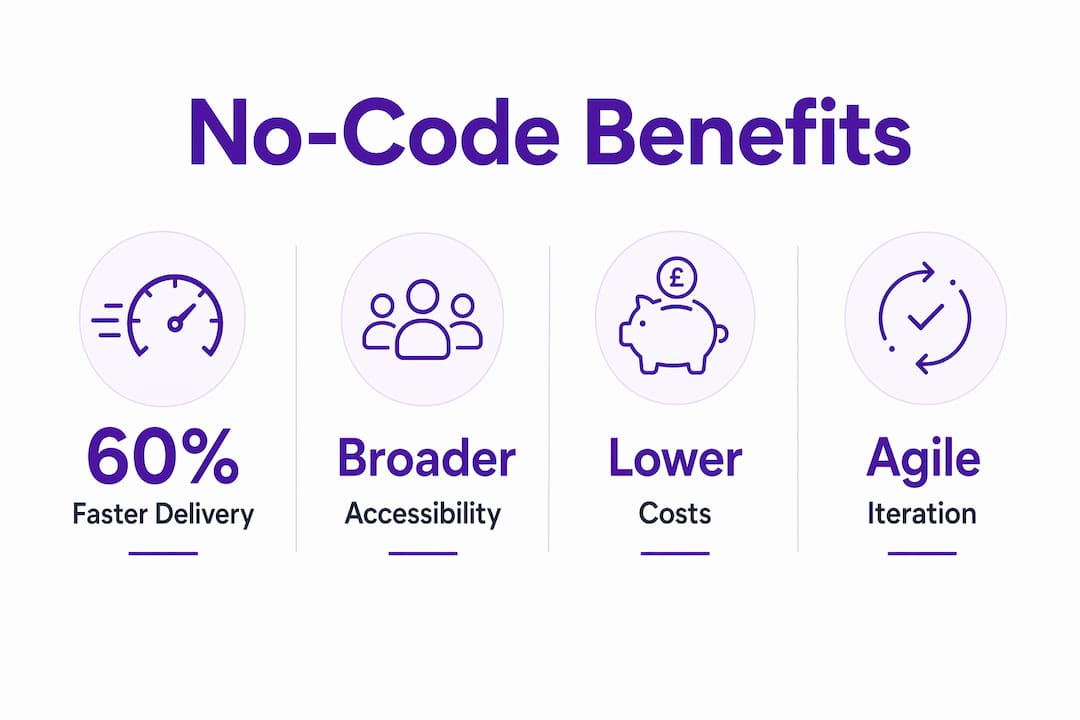
No-code platforms deliver four core advantages: faster delivery, broader accessibility, lower costs, and accelerated iteration. Each of these has measurable evidence behind it, not just theoretical appeal.
Speed and development efficiency
Visual builders and templates reduce development time by removing the need to write, test, and debug code from scratch. SAP notes that drag-and-drop components and ready-made integrations allow teams to move from concept to working prototype in days rather than months. Pega’s Forrester Total Economic Impact study found that users of its cloud platform deliver apps 50% faster than those using traditional development methods. That figure represents a genuine operational shift, not a marginal improvement.
Accessibility for non-technical professionals

No-code tools democratise app creation by enabling what the industry calls “citizen developers.” These are business analysts, marketers, operations managers, and other professionals who understand workflows deeply but lack formal coding training. SAP describes this as removing friction between business teams and IT, which accelerates innovation because the person closest to the problem is also the person building the solution. This matters particularly in fast-moving industries where waiting for developer resource is a competitive disadvantage.
Cost reduction
Reduced reliance on specialist developers translates directly into lower project costs. OutSystems’ Forrester TEI study reports a 363% ROI over three years and development speeds 60% faster than traditional coding. Pega’s equivalent study shows a 71% ROI over three years for its platform users. These figures reflect not just build time savings but also reduced debugging cycles, as automated regression testing and standardised pipelines cut testing time by 40%.
“Agility is a core driver behind no-code adoption, enabling rapid adaptation to market and regulatory changes.” — SAP
Pro Tip: When calculating the cost case for no-code adoption, include testing and validation time in your baseline. Teams often underestimate how much time traditional development spends on debugging rather than building.
Faster iteration cycles also improve business agility. When a process changes or a new requirement emerges, a no-code app can be updated in hours rather than weeks. This responsiveness is particularly valuable in regulated industries where compliance requirements shift frequently.
No-code vs low-code: what is the difference and when should you choose each?
No-code and low-code are related but distinct approaches, and conflating them leads to poor platform choices.
| Dimension | No-code | Low-code |
|---|---|---|
| Target user | Non-technical business professionals | Developers and technically literate users |
| Customisation | Limited to platform components | Extensible with custom code modules |
| Delivery speed | Fastest for simple to moderate apps | Fast, with greater complexity headroom |
| Scalability | Suited to departmental or prototype scale | Better suited to enterprise-grade systems |
| Governance | Requires early oversight to prevent sprawl | Typically integrates with IT governance frameworks |
No-code is the right choice when the goal is a quick win: a landing page, an internal workflow tool, a prototype for stakeholder validation, or a marketing asset like a playable ad. Figma notes that no-code platforms prioritise speed and simplicity but that risk escalates as solutions scale beyond their original scope. The platform’s constraints become apparent when integration with legacy systems or complex business logic is required.
Low-code platforms, by contrast, require minimal coding knowledge and are better suited to applications that need custom logic, deeper integrations, or enterprise-level governance. They sit between no-code and traditional development, offering more control without the full overhead of a professional engineering team.
Pro Tip: Use no-code to validate the concept and gather user feedback. If the solution proves its value and needs to scale, that is the point to evaluate a migration to low-code or a hybrid approach, not before.
The practical rule is straightforward. If the application can be built within the platform’s component library and does not require proprietary system integration, no-code is the faster and more cost-effective path. If it cannot, low-code or a hybrid strategy is more appropriate from the outset.
What are the limitations and challenges of no-code tools?
No-code tools carry genuine risks that professionals should understand before committing to them at scale.
- Governance debt. When no-code apps multiply across a business without oversight, the result is what practitioners call governance debt. Figma identifies uncontrolled no-code proliferation as a source of data security and operational risk. Apps built without IT involvement may store data in non-compliant ways or create shadow processes that are difficult to audit.
- Security and compliance. No-code platforms vary significantly in their security posture. Professionals in financial services, healthcare, or any regulated sector must verify that a platform meets their compliance requirements before building on it. The speed advantage is irrelevant if the resulting application cannot pass a security review.
- Scaling constraints. Most no-code platforms are designed for departmental or prototype-scale applications. When usage grows or business logic becomes more complex, the platform’s component library may not be sufficient. Migrating a mature no-code application to a more capable system is a real cost that teams rarely plan for at the outset.
- Integration limits. Proprietary or legacy systems often lack the APIs that no-code platforms require. This is a hard constraint, not a configuration problem, and it limits where no-code can be applied in organisations with older infrastructure.
Pro Tip: Before selecting a no-code platform, map every system it will need to connect to. If more than two of those systems require custom connectors, a low-code or hybrid approach will save significant time in the medium term.
The Lowcode Agency notes that teams typically use no-code for operational slices where constraints are manageable, then migrate complex cases to coding approaches as requirements mature. This staged thinking is the most practical way to manage the limitations without abandoning the speed benefits.
How can professionals implement no-code tools effectively in their organisations?
Effective no-code adoption follows a deliberate sequence rather than an ad hoc rollout.
-
Start with rapid prototyping and workflow automation. The highest-value early use cases are internal tools: approval workflows, data collection forms, reporting dashboards, and marketing assets. These have clear scope, limited integration requirements, and fast feedback loops. SAP recommends hybrid development strategies that use no-code for early-phase operational tools before migrating complex cases to governed low-code or pro-code environments.
-
Establish governance from day one. Governance is not a later-stage concern. Involve IT in platform selection, define data handling standards before the first app is built, and create a catalogue of approved no-code tools. This prevents the governance debt described in the previous section and keeps security teams informed rather than reactive.
-
Plan for a hybrid development model. No-code, low-code, and traditional development are not competing choices. They are complementary layers of a single development strategy. SAP describes a hybrid platform experience with governance across all three streams as the model that drives sustainable digital acceleration. Professionals who treat no-code as one tool in a broader toolkit get more value from it than those who treat it as a replacement for all other approaches.
-
Leverage AI-driven no-code features. Generative AI is increasingly embedded in no-code platforms, automating workflow orchestration and component generation. SAP notes that AI automates code generation in no-code environments, changing the role of citizen developers from manual builders to supervisors of AI-generated outputs. Platforms that incorporate these features extend the complexity ceiling of what non-technical users can build.
-
Encourage collaboration between business users and developers. The most effective no-code implementations involve developers setting guardrails and templates that business users then operate within. This preserves technical standards while giving non-technical teams genuine creative and operational autonomy. A marketing automation checklist approach, where each workflow is documented and reviewed before deployment, works well for teams new to no-code governance.
Pro Tip: Assign a no-code champion in each business unit. This person does not need to be a developer. They need to understand the governance rules and act as the first point of contact before a new app is built or deployed.
Key takeaways
No-code tools deliver the greatest value when adopted with clear governance, realistic scope, and a hybrid development strategy that matches tool complexity to application requirements.
| Point | Details |
|---|---|
| Speed is the primary advantage | No-code platforms cut development time by 50% to 90%, enabling faster delivery of internal tools and prototypes. |
| Governance prevents hidden costs | Unmonitored no-code app proliferation creates security and compliance risks that outweigh initial speed gains. |
| No-code and low-code serve different needs | No-code suits non-technical users and simple apps; low-code handles greater complexity and enterprise scale. |
| Hybrid strategies maximise value | Combining no-code, low-code, and pro-code in a governed framework produces the most sustainable outcomes. |
| AI is extending no-code capability | Generative AI embedded in no-code platforms is raising the complexity ceiling for citizen developers. |
No-code as a strategic asset, not just a shortcut
By Ondrej
Having worked closely with no-code adoption across marketing and product teams, my honest observation is that most organisations underuse no-code tools in one area and overextend them in another simultaneously. Teams reach for no-code platforms for genuinely complex integrations where they will eventually hit a wall, while ignoring the category of use cases where no-code is simply the correct tool: rapid creative production, workflow prototyping, and marketing asset creation.
The ROI figures from Pega and OutSystems are real, but they are averages across a wide range of implementations. The teams that achieve the upper end of those returns are the ones that treat no-code as a deliberate layer in their development strategy, not as a workaround for a slow IT queue. They define scope clearly, involve IT early, and accept that some applications will outgrow the platform.
What I find most interesting about the current moment is the AI dimension. Generative AI embedded in no-code platforms is not a gimmick. It is genuinely changing what a non-technical professional can produce independently. The citizen developer of 2026 is not just dragging and dropping components. They are supervising AI-generated workflows and making editorial decisions about logic and structure. That is a meaningfully different and more capable role than the one that existed three years ago. Professionals who engage with that shift now will have a significant advantage over those who wait for the technology to mature further.
— Ondrej
Build playable ads without code, without the budget strain
Playablemaker is built for exactly the use case where no-code tools deliver their clearest value: creative production that traditionally required developer time and significant budget. With Playablemaker’s drag-and-drop builder, marketing teams can produce engaging mobile game ads without writing a line of code, deploying interactive playable ads in a fraction of the time a development sprint would require. The platform integrates with standard marketing workflows and scales across campaigns without adding engineering overhead. If you are evaluating no-code tools for ad creation, Playablemaker removes the cost and complexity that typically make playable ads inaccessible to teams without dedicated development resource.
FAQ
What does no-code development mean?
No-code development is the practice of building software applications using visual, drag-and-drop interfaces and pre-built components, with no programming required. SAP defines it as a method that removes the need for traditional coding, enabling business teams to create solutions independently.
Why use no-code development instead of hiring a developer?
No-code tools reduce both cost and delivery time significantly. OutSystems’ Forrester study reports 60% faster development and a 363% ROI over three years compared to traditional coding approaches, making no-code the more efficient choice for applications within the platform’s scope.
Should I choose no-code or low-code for my project?
Choose no-code for simple, fast-turnaround applications built by non-technical users, such as prototypes, workflow tools, or marketing assets. Choose low-code when the application requires custom logic, complex integrations, or enterprise-scale governance.
What are the biggest risks of no-code tools?
Governance debt and scaling constraints are the two most significant risks. Figma identifies unmonitored app proliferation as a source of data security and compliance exposure, while most no-code platforms have hard limits on the complexity of applications they can support long-term.
Are no-code tools suitable for beginners with no technical background?
No-code platforms are specifically designed for non-technical users. Kissflow benchmarks show that no-code tools deliver 50% to 90% reductions in development time precisely because they remove the technical barriers that would otherwise require specialist knowledge to overcome.
Recommended
- Streamline your creative assets workflow for ads in 2026 – playablemaker.com Streamline your creative assets workflow for ads in 2026
- No-Code Tools Explained: Fast-Tracking Playable Ads – playablemaker.com No-Code Tools Explained: Fast-Tracking Playable Ads
- The Game Development Revolution: Why No-Code is the Future of Gaming – playablemaker.com The Game Development Revolution: Why No-Code is the Future of Gaming
- Defining no-code development for engaging mobile game ads – playablemaker.com Defining no-code development for engaging mobile game ads