
TL;DR:
- The ad user journey encompasses every interaction, emotion, and motivation from initial exposure to final conversion. Understanding this journey enables the creation of targeted campaigns, optimized touchpoints, and better cross-team alignment. Regularly updating journey maps and matching ad formats to stages improves advertising effectiveness and user engagement.
The ad user journey is defined as the complete sequence of interactions a user has with your advertising, from the first impression through to final conversion and beyond. Unlike a simple click-path report, it captures emotions, motivations, and context at every stage. According to Adjust’s glossary, users typically require 5 to 10 touchpoints before making a final conversion decision. That figure alone should reframe how you think about any single ad placement. Understanding the ad user journey, or what the industry formally calls the customer journey in advertising, is the foundation of every well-optimised campaign.
What is the ad user journey and why does it matter?
The ad user journey is the end-to-end path a user travels from first encountering your ad to completing a desired goal, whether that is an app install, a purchase, or a subscription. It is not limited to clicks and impressions. It includes the emotional state of the user, the context in which they saw the ad, and the friction they encountered along the way.

What separates high-performing campaigns from average ones is rarely the creative alone. It is a thorough understanding of the advertising user flow: which channels a user passes through, in what sequence, and with what frequency. A mobile gaming advertiser running campaigns across Meta, Google UAC, and programmatic networks is not running three separate journeys. They are running one journey with multiple entry points, and each touchpoint either builds or erodes the user’s intent to convert.
The marketing funnel is the structural backbone of the ad user journey, but the journey itself is richer. It accounts for the fact that a user who sees a rewarded video ad, then a retargeted banner two days later, then a playable ad on a third visit, is in a fundamentally different psychological state at each stage. Recognising that difference is what allows you to design campaigns that feel relevant rather than repetitive.
What stages and touchpoints make up the ad user journey?
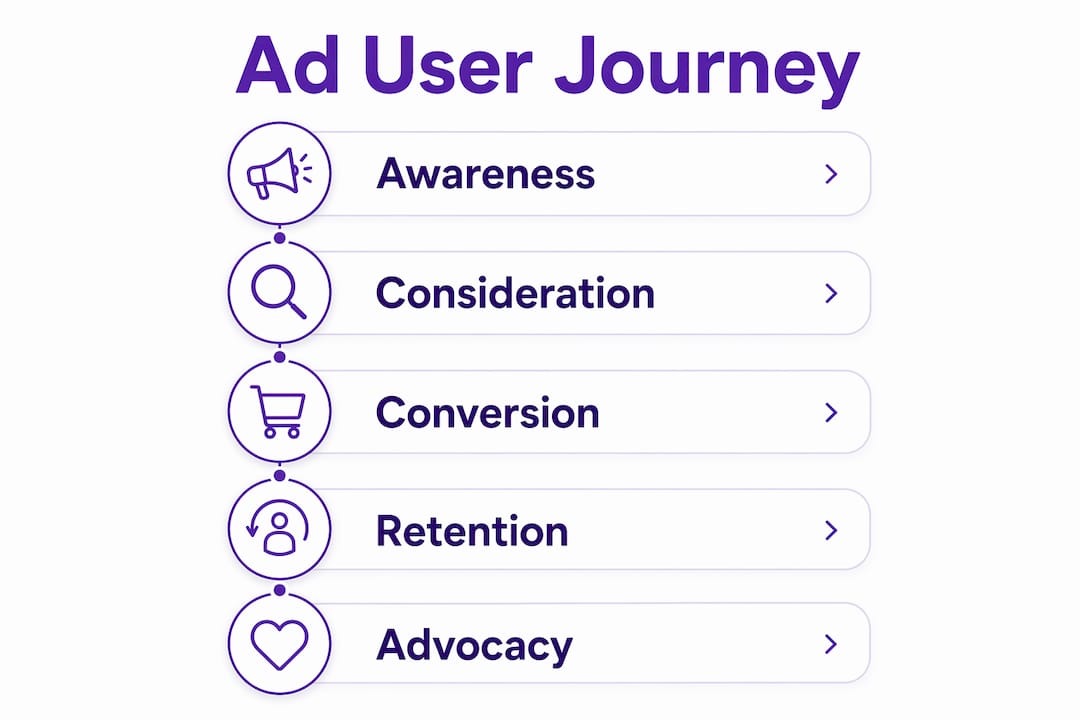
The advertising journey stages follow a consistent pattern across most digital channels: awareness, consideration, decision, and retention. Each stage demands a different ad format, message, and frequency.
- Awareness: The user encounters your brand for the first time, typically through display ads, social video, or native placements. The goal is recognition, not conversion. Pushing a hard call-to-action here creates friction before trust is established.
- Consideration: The user has seen your brand at least once and is now evaluating it. Push notifications, in-feed native ads, and mid-funnel video perform well here. This is where sequenced messaging earns its value.
- Decision: The user is close to converting. Retargeting campaigns, clickable end cards, and playable ads that let the user experience the product before committing are highly effective at this stage.
- Retention: Post-conversion engagement through re-engagement campaigns, loyalty messaging, and personalised push notifications keeps users active and reduces churn.
Ad frequency is a critical variable at every stage. Research from Kadam shows that optimal frequency for fintech sits at 1 to 2 popunder impressions per day, while gaming campaigns perform best at 2 to 3. Beyond 4 impressions per day, fatigue sets in and performance drops. This means the digital ad user paths you design must account for frequency caps as a deliberate structural choice, not an afterthought.
Pro Tip: Map your ad formats to specific journey stages before you build creative. A playable ad served at the awareness stage wastes its conversion power; the same ad at the decision stage can be the difference between an install and a bounce.
How to map and visualise the ad user journey effectively
User journey mapping is the process of creating a visual representation of every stage, touchpoint, emotion, and opportunity in the user’s experience with your advertising. The five-step mapping process covers persona and goal definition, stage identification, touchpoint mapping, capturing user actions and emotions, and identifying opportunities for improvement.
Here is how to apply that process in practice:
- Define your persona and goal. Be specific. “Mobile gamer aged 25 to 34 who plays strategy games” is a persona. “Mobile user” is not. The goal should be a single conversion event, such as a first in-app purchase.
- Identify your stages. Limit your map to 4 to 7 stages for clarity. More than seven stages creates a diagram that nobody uses. Fewer than four misses critical transitions.
- Map every touchpoint. Include paid ads, organic search, app store listings, and even word-of-mouth referrals. A touchpoint is any moment the user interacts with your brand, regardless of whether you paid for it.
- Capture emotions and actions. This is where most teams underinvest. Note what the user is feeling at each stage, not just what they are doing. A user who clicks a retargeted ad after three days of consideration is in a very different emotional state than one who clicks on first exposure.
- Identify opportunities. Frame each gap as a question: “How might we reduce friction at the app store listing stage?” This keeps the map actionable rather than decorative.
Journey maps vs. user flows: what is the difference?
These two tools are frequently confused, and the confusion is costly. A user journey map captures feelings and motivation across time. A user flow outlines specific interface interactions and decision nodes within a product. Mixing them up produces documents that can neither improve UI nor capture customer sentiment. Use journey maps for strategic campaign planning and user flows for product and onboarding design.
One element that most teams omit is the unhappy path: the sequence of events when something goes wrong. A user who clicks your ad and lands on a slow-loading page, or encounters a broken install flow, does not simply disappear. They form a negative association with your brand. Mapping the unhappy path makes those failure points visible and fixable.
Pro Tip: Run a collaborative mapping session with your media buying, creative, and product teams together. 64% of top UX teams use collaborative journey mapping to align product and marketing, and the cross-functional conversation alone surfaces friction points that no single team would catch independently.
What are best practices for tracking and analysing the ad user journey?
Tracking the ad user journey requires moving well beyond last-touch attribution. Last-touch models assign all credit to the final ad a user clicked before converting, which systematically undervalues every awareness and consideration touchpoint that built intent in the first place.
Effective tracking rests on three principles:
- Track micro-conversions alongside macro-conversions. Micro-conversions include actions like email sign-ups, add-to-cart events, and tutorial completions. Without micro-conversion tracking, optimisation is blind to where users drop off in the funnel. A campaign with a strong install rate but poor day-7 retention has a problem somewhere in the onboarding flow, and only micro-conversion data will show you where.
- Integrate CRM and offline data. Digital ad data alone is incomplete. A user who saw your ad, visited your website, and then converted via a phone call will appear as a non-converter in a purely digital attribution model. Integrating CRM data closes that gap.
- Use multi-touch attribution models. Linear, time-decay, and data-driven attribution models each distribute credit differently across touchpoints. The right model depends on your sales cycle length and channel mix.
The table below summarises the most common attribution models and their practical implications:
| Attribution model | How credit is distributed | Best suited for |
|---|---|---|
| Last-touch | 100% to final touchpoint | Short, single-channel funnels |
| First-touch | 100% to first touchpoint | Brand awareness measurement |
| Linear | Equal credit across all touchpoints | Multi-channel campaigns |
| Time-decay | More credit to recent touchpoints | Short consideration cycles |
| Data-driven | Algorithmic, based on actual conversion paths | High-volume campaigns with sufficient data |
Time-to-convert metrics are particularly useful for retargeting decisions. If your data shows that 70% of users who eventually convert do so within 48 hours of first ad exposure, retargeting campaigns that run for 14 days are wasting budget on users who have already made their decision. Aligning retargeting windows to actual conversion timing is one of the highest-leverage optimisations available to most advertisers. You can explore specific ad performance metrics to build a more precise measurement framework.
How does understanding the ad user journey improve advertising outcomes?
The practical value of understanding the advertising user flow shows up in four specific areas: onboarding optimisation, creative sequencing, budget allocation, and cross-department alignment.
Onboarding is the most underappreciated segment of the entire journey. A smooth onboarding flow dramatically reduces early churn, which means every pound spent on acquisition retains its value for longer. Poor onboarding is the most common way that strong ad creative fails to produce strong business results. The ad does its job; the product experience undoes it.
Creative sequencing based on journey stage data produces measurably better results than running the same ad to all users regardless of where they are in the funnel. A user who has already watched your brand video twice does not need to see it a third time. They need a decision-stage ad that removes the final barrier to conversion, whether that is a free trial, a limited-time offer, or a playable experience that lets them try before they commit.
- Reduce user frustration by identifying the specific touchpoints where drop-off rates spike and redesigning those experiences.
- Improve budget allocation by attributing spend to the touchpoints that actually drive conversion, not just the last click.
- Align teams around a shared understanding of the user experience, which converts abstract complaints into specific design changes.
The most common pitfall in journey work is mapping for the sake of it. A journey map that sits in a shared drive and is never updated is worse than no map at all, because it creates false confidence. Journey maps must be living documents, updated whenever campaign data, product changes, or user research reveals a new pattern. Treat them as operational tools, not presentation assets. For practical guidance on improving ad UX, the principles of journey mapping translate directly into creative and landing page decisions.
Key takeaways
The ad user journey is the single most important framework for connecting advertising spend to genuine user value, and it only works when treated as a living, cross-functional tool.
| Point | Details |
|---|---|
| Define the full path | The ad user journey spans from first impression to post-conversion retention, not just the click. |
| Map stages with precision | Limit journey maps to 4 to 7 stages and always include the unhappy path to surface real friction. |
| Track micro-conversions | Tracking only final conversions hides the drop-off points that cost you the most budget. |
| Match frequency to stage | Exceeding 4 ad impressions per day risks fatigue; calibrate frequency caps by channel and funnel stage. |
| Keep maps as living documents | Journey maps that are not updated after new data arrives quickly become misleading rather than useful. |
Why journey mapping has changed how I think about ad campaigns
By Ondrej
The most significant shift I have observed in how serious marketing teams approach the ad user journey is the move from treating it as a research exercise to treating it as a strategic alignment tool. The map itself is almost secondary. The conversation it forces between media buyers, creatives, and product managers is where the real value sits.
What I find genuinely underappreciated is the emotional dimension. Most tracking infrastructure is built to capture actions: clicks, installs, purchases. It captures almost nothing about how a user felt when they encountered your ad for the third time in two hours, or why they installed your app and never opened it again. The journey map is the only place in most organisations where someone is formally asking those questions.
The formats that interest me most right now are interactive and playable ads, precisely because they collapse the distance between the consideration and decision stages. A user who has played a 30-second version of your game has already experienced the product. Their conversion decision is informed rather than speculative. That changes the psychology of the entire journey in a way that passive formats simply cannot replicate. The user journey in playable ads is worth studying closely if you work in mobile gaming or any category where product experience is the primary purchase driver.
The teams I have seen get the most from journey mapping are the ones who revisit their maps every quarter, not every year. Markets shift, user expectations change, and the ad formats that worked in one cycle may create friction in the next. A map that reflects last year’s user is not a map. It is a historical document.
— Ondrej
Build better ad experiences with Playablemaker
Understanding the ad user journey is only half the work. The other half is building ad formats that match each stage of that journey with the right level of engagement. Playablemaker’s no-code platform lets you create playable and interactive ads without developer resources or large production budgets. Playable ads are particularly effective at the decision stage, where users need to experience your product before committing. Explore why playable ads work from a psychological standpoint, and see how interactive formats can reduce friction at the most critical point in your funnel. If you want to understand the broader picture, playable ads explained covers how the format transforms user engagement throughout the entire journey.
FAQ
What is the ad user journey in simple terms?
The ad user journey is the complete path a user takes from first seeing an advertisement to completing a conversion goal, including every touchpoint, emotion, and decision in between. It typically spans 5 to 10 interactions before a final conversion occurs.
How is a user journey map different from a user flow?
A user journey map captures feelings, motivations, and context across the full advertising experience over time. A user flow details specific interface interactions and decision points within a product or onboarding sequence. Confusing the two produces documents that cannot improve either UI design or campaign strategy.
How many stages should an ad user journey map have?
Research recommends limiting journey maps to 4 to 7 stages for actionable clarity. Common stages are awareness, consideration, decision, and retention, with additional sub-stages added only when they represent a distinct shift in user intent or behaviour.
What is the most common mistake in ad user journey mapping?
The most common mistake is creating a journey map and never updating it. Maps must be living documents that reflect current campaign data, product changes, and user research. A static map creates false confidence and leads to decisions based on outdated assumptions.
Why does ad frequency matter in the user journey?
Ad frequency directly affects user experience at every funnel stage. Exceeding 4 impressions per day risks ad fatigue and lower performance, while too few impressions fail to build sufficient awareness. Calibrating frequency to funnel stage and channel type is a core part of retargeting strategy and journey optimisation.
Recommended
- UX tips for ads: boost engagement and conversions – playablemaker.com UX tips for ads: boost engagement and conversions
- Master User Acquisition Ad Strategies for Mobile Games – playablemaker.com Master User Acquisition Ad Strategies for Mobile Games
- Master Mobile Gaming Ad Strategies for Effective User Acquisition – playablemaker.com Master Mobile Gaming Ad Strategies for Effective User Acquisition
- Step-by-Step Guide to High-Performing Game Ads Creation – playablemaker.com Step-by-Step Guide to High-Performing Game Ads Creation