
Nearly 40 percent of British mobile gamers say that an engaging playable ad makes them more likely to install a new game. In a crowded market where every second matters, understanding the exact moments that influence user behavior has never been more critical. By uncovering which interactive elements and creative strategies actually drive installs, you can create mobile marketing that stands out and converts.
Table of Contents
- Step 1: Identify Key Touchpoints In The Playable Ad Journey
- Step 2: Map User Flow Using No-Code Playable Ad Tools
- Step 3: Design Interactive Ad Elements For Engagement
- Step 4: Test And Optimise The User Journey For Performance
- Step 5: Analyse Results And Refine Future Campaigns
Quick Summary
| Key Message | Explanation |
|---|---|
| 1. Engage Users Immediately | Capture attention in the first three seconds with clear visuals and gameplay. |
| 2. Map User Flow Strategically | Use no-code tools to visualize interactions and ensure a seamless journey. |
| 3. Design Intuitive Interactions | Create game mechanics that are easily grasped and prompt user participation. |
| 4. Implement Rigorous A/B Testing | Test different ad versions to refine engagement and identify effective elements. |
| 5. Analyse Data for Continuous Improvement | Collect detailed metrics to inform future campaign strategies and enhance performance. |
Step 1: Identify key touchpoints in the playable ad journey
Navigating the user journey in mobile gaming playable ads requires strategic understanding of critical interaction points that transform casual viewers into engaged players. By mapping out precise touchpoints, marketers can craft experiences that captivate and convert potential users from first glance to game download.
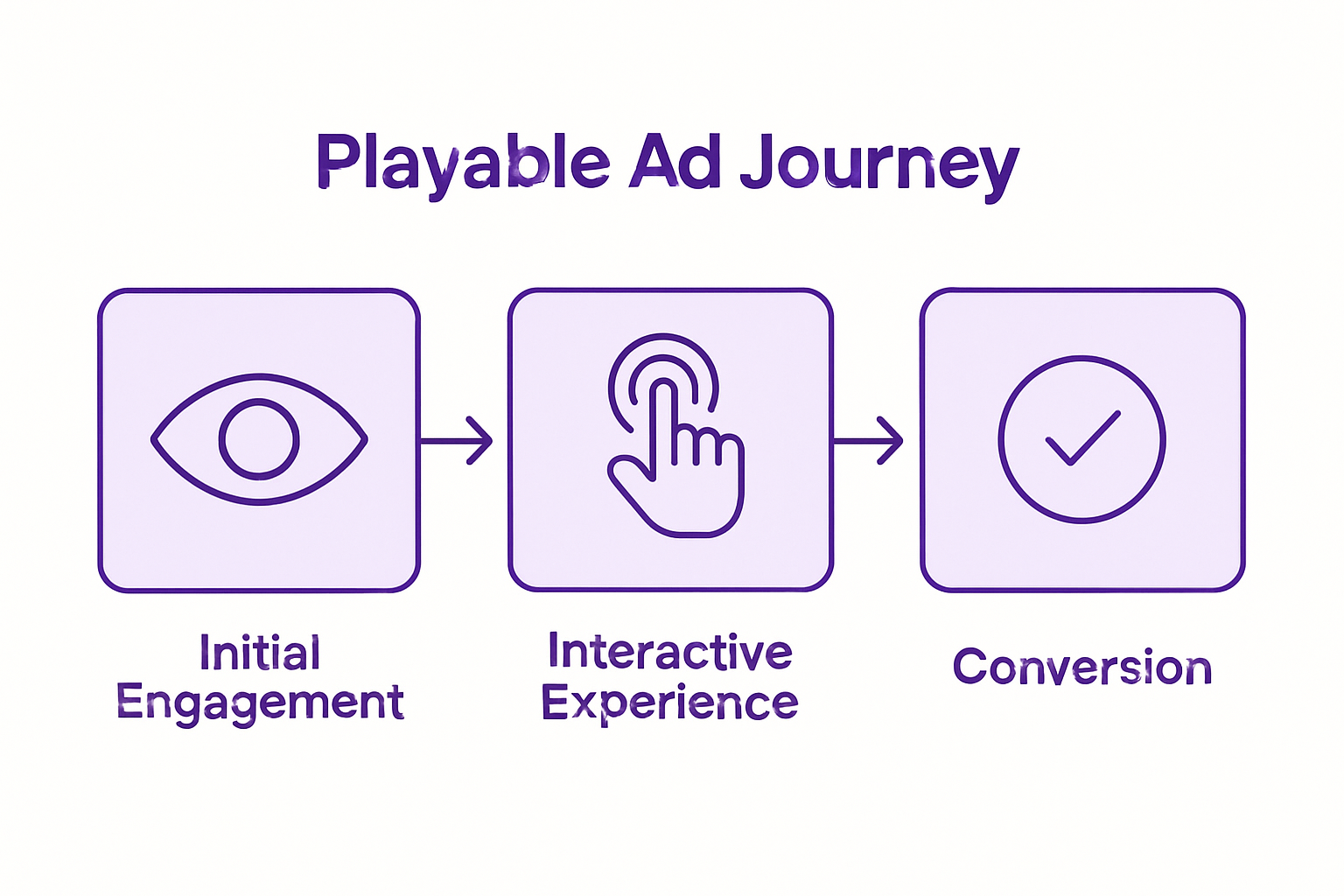
The journey begins with initial engagement, where users first encounter the playable ad. Researchers examining mobile game interaction models reveal that the first three seconds are crucial in determining whether a user will continue interacting. During this moment, your ad must communicate gameplay mechanics, visual appeal, and core entertainment value instantly. Key touchpoints include the opening visual design, initial interaction prompt, and the first controllable game mechanic that allows users to experience gameplay directly.
Subsequent touchpoints involve progressive user interaction, where the playable ad guides users through increasingly complex game scenarios. According to user acquisition research, these touchpoints should demonstrate game depth, showcase unique features, and create a sense of achievement that motivates users to complete the ad experience. Each interaction point must feel rewarding, intuitive, and seamlessly connected to the ultimate goal of encouraging game installation.
Professional Advice: Meticulously track user behaviour across each touchpoint, using analytics to understand where users disengage and continuously refine your playable ad experience to maximise conversion potential.
Here’s a concise summary of critical playable ad touchpoints and their primary impact:
| Touchpoint | Purpose | User Impact |
|---|---|---|
| Opening Visual Design | Capture immediate attention | Encourages further viewing |
| Initial Interaction Prompt | Introduce gameplay controls | Reduces user confusion |
| First Game Mechanic | Demonstrate core entertainment value | Increases immersion |
| Progressive Interaction | Show evolving gameplay depth | Builds long-term interest |
| Achievement Moments | Reward ongoing participation | Motivates completion |
Step 2: Map user flow using no-code playable ad tools
Designing an effective user journey in mobile gaming playable ads requires strategic planning and intuitive interface mapping. No-code playable ad tools offer marketers a streamlined approach to visualising and implementing complex user interactions without extensive technical expertise.
Begin by understanding the core interactions within your mobile game. Interactive ad creation tools enable you to break down user flow into discrete steps, mapping each potential user interaction from initial engagement to final conversion. Start by identifying key decision points where users might choose different paths through your playable ad experience. These decision points should represent meaningful gameplay moments that showcase your game’s unique mechanics and entertainment value.
When mapping user flow, consider the progression from initial interaction to game download as a narrative journey. Visualise how each interaction builds upon the previous one, creating a sense of incremental achievement and growing excitement. Ensure that your no-code tool allows you to prototype and test multiple user pathways, enabling you to refine the experience based on user behaviour and engagement metrics.

Professional Advice: Implement micro interactions and subtle visual feedback within your user flow to maintain engagement and provide a sense of responsiveness that keeps users exploring your playable ad experience.
Step 3: Design interactive ad elements for engagement
Creating compelling interactive ad elements requires a strategic approach that transforms passive viewing into active user participation. The goal is to design experiences that not only capture attention but also provide a genuine preview of your mobile game’s core entertainment value.
Interactive advertising techniques fundamentally rely on designing elements that invite immediate user interaction. Begin by selecting game mechanics that are instantly understandable and require minimal instructions. Focus on creating one to two core interactions that demonstrate your game’s unique gameplay style within the first few seconds. These interactions should be intuitive enough that users can immediately grasp the core gameplay loop without extensive tutorials or complex explanations.
When designing interactive elements, prioritise visual clarity and responsive feedback. Each user interaction should trigger an immediate and satisfying response that reinforces their engagement. Consider implementing simple gesture controls, quick challenge scenarios, or mini gameplay segments that showcase your game’s most compelling features. The key is to create a microcosm of your game experience that leaves users wanting more and feeling confident about their ability to enjoy the full game.
Professional Advice: Test your interactive ad elements with diverse user groups to ensure the interactions are universally intuitive and generate genuine excitement about your mobile game experience.
Step 4: Test and optimise the user journey for performance
Optimising the user journey in playable ads requires a systematic approach to understanding and improving user engagement. Your goal is to create a data driven strategy that continuously refines the interactive experience and maximises conversion potential.
A/B testing methodologies provide critical insights into user behaviour and preferences. Begin by creating multiple variations of your playable ad with subtle differences in interaction design interaction points game mechanics or visual elements. Track key performance metrics such as initial interaction rate time spent in the ad and conversion percentage. Focus on understanding which specific elements drive user engagement and which potentially create friction in the user experience.
Implement a rigorous testing framework that allows for continuous iteration. Segment your audience to ensure you are gathering representative data across different user demographics and device types. Pay close attention to micro interactions user flow and the emotional response generated by each version of your playable ad. The most successful optimisation strategies involve granular analysis of user behaviour identifying and eliminating potential points of user disengagement while amplifying the most compelling elements of your game experience.
Professional Advice: Develop a consistent testing schedule that allows you to systematically evaluate and refine your playable ad performance rather than relying on sporadic or intuition based modifications.
Below is a comparison of A/B testing elements and their analytical importance in playable ads:
| Element Tested | Insights Gained | Optimisation Outcome |
|---|---|---|
| Game Mechanics | Reveal preferred play patterns | Adjust engagement focus |
| Interaction Design | Identify friction points | Refine user journey flow |
| Visual Elements | Measure impact on attention | Enhance aesthetic appeal |
| Conversion Steps | Spot barriers to installs | Boost install completion rates |
Step 5: Analyse results and refine future campaigns
Successful mobile game marketing demands a strategic approach to analysing performance data and transforming insights into actionable campaign improvements. Your ultimate objective is to develop a dynamic, responsive methodology that continuously elevates user acquisition and engagement strategies.
Mobile ad metric analysis requires comprehensive evaluation of multiple performance indicators beyond basic conversion rates. Examine granular metrics including user interaction duration initial engagement percentages drop off points and comparative performance across different audience segments. Look beyond surface level statistics to understand the underlying behavioural patterns that drive user decision making. Identify subtle nuances in user interactions that reveal deeper insights about your game’s appeal and potential areas for creative refinement.
Establish a systematic framework for translating analytical findings into strategic campaign improvements. Create detailed performance profiles that map user interactions against specific creative elements within your playable ads. This approach enables you to incrementally optimise your advertising strategy by making precise targeted modifications rather than implementing broad sweeping changes. Focus on understanding the specific creative and interactive elements that resonate most powerfully with your target audience and use these insights to progressively enhance future campaign iterations.
Professional Advice: Develop a standardised reporting template that allows for consistent comparative analysis across multiple campaign iterations ensuring you can track incremental improvements with scientific precision.
Elevate Your Playable Ads with No-Code Solutions
Mastering the user journey in playable ads can be challenging when time, budget, and technical resources are limited. The article highlights the importance of designing engaging touchpoints and optimising interactions to boost mobile game installs. You need tools that let you build interactive ads quickly and intuitively without relying heavily on developers. PlayableMaker answers this need by offering a no-code platform that empowers marketers to create compelling playable ads without draining your budget or company resources.
Explore how you can streamline your ad creation process and focus on the strategic elements discussed in the article by visiting our main site. For guidance on publishing and optimising your campaigns, check out our Publishing Archives. If you want tips and help on designing effective ads, our Help Archives provide valuable resources. Start transforming your playable ad journey today and see the difference an easy to use no-code tool can make.
Frequently Asked Questions
How can I identify key touchpoints in my playable ads?
To identify key touchpoints, map out the user journey from initial engagement to game download. Focus on the opening visual design, initial interaction prompt, and first game mechanic to create an engaging experience.
What are no-code tools, and how can they help in mapping user flow?
No-code tools allow marketers to visualise and implement user interactions without technical expertise. Utilise these tools to break down interactions into discrete steps and test multiple user pathways for effective engagement.
What makes interactive ad elements effective for user engagement?
Effective interactive ad elements captivate users by inviting immediate interaction and showcasing core gameplay. Select easily understandable game mechanics and provide responsive feedback to maintain user interest.
How can I optimise the user journey based on performance data?
Optimise the user journey by implementing A/B testing and analysing user behaviour metrics. Create different variations of your playable ad and track metrics such as interaction rates to refine your advertising strategy and improve engagement.
What key performance indicators should I analyse after my campaign?
Analyse metrics such as user interaction duration, initial engagement percentages, and drop-off points. Focus on understanding user behaviour patterns to identify areas for creative refinement in future campaigns.
Recommended
- Master Mobile Gaming Ad Strategies for Effective User Acquisition – playablemaker.com Master Mobile Gaming Ad Strategies for Effective User Acquisition
- Master User Acquisition Ad Strategies for Mobile Games – playablemaker.com Master User Acquisition Ad Strategies for Mobile Games
- Mastering Mobile Playable Ad Workflow for Gaming Success – playablemaker.com Mastering Mobile Playable Ad Workflow for Gaming Success
- 7 Creative Ad Concepts for Mobile Game User Acquisition – playablemaker.com 7 Creative Ad Concepts for Mobile Game User Acquisition