Nearly half of British mobile gamers say an immersive ad experience influences their loyalty to an app. For user acquisition specialists and marketing managers, understanding interstitial ads is essential to designing campaigns that drive engagement while controlling costs. This guide clarifies what sets interstitial ads apart, tackles common misconceptions, and highlights how smart, no-code solutions can transform campaign results for mobile gaming audiences worldwide.
Table of Contents
- Interstitial Ad Definition And Common Misconceptions
- Types Of Interstitial Ads And Their Distinctions
- How Interstitial Ads Function In Mobile Gaming
- Impact On User Engagement And Acquisition Outcomes
- Risks, Costs, And Best Practices To Avoid Poor Performance
Key Takeaways
| Point | Details |
|---|---|
| Effective Timing | Strategically place interstitial ads during natural content transitions to enhance user engagement without causing disruptions. |
| User Trust | Always provide a clear exit mechanism for interstitial ads to maintain user trust and prevent app abandonment. |
| Ad Format Variety | Utilise different types of interstitial ads, such as video and interactive formats, to cater to various user engagement objectives. |
| Analytics Monitoring | Continuously monitor user engagement metrics to refine ad strategies and improve both monetisation and user experience. |
Interstitial ad definition and common misconceptions
Interstitial ads are full-screen digital advertisements that occupy the entire display of a mobile app or website during natural content transitions. Unlike traditional banner advertisements, these immersive ads appear strategically at moments when users are moving between different app screens or game levels. Full-screen advertising techniques represent a sophisticated approach to capturing user attention without causing significant disruption.
The core distinction between interstitial ads and traditional pop-ups lies in their intentional placement and timing. While pop-ups are often considered intrusive, interstitial advertisements are carefully designed to integrate seamlessly into the user experience. They typically appear during natural breaks in content consumption, such as between game levels, loading screens, or when transitioning between app sections. This strategic positioning helps maintain user engagement while providing opportunities for monetisation.
Common misconceptions about interstitial ads often stem from negative experiences with poorly implemented advertisements. Many users assume these ads are universally disruptive, but well-designed interstitials can actually enhance user interaction when executed thoughtfully. Key factors that differentiate effective interstitial ads include precise timing, relevant content, and an easy-to-locate close or skip option. Mobile game developers and marketers must balance advertisement visibility with user experience to prevent potential user frustration.
Pro tip: When implementing interstitial ads, always provide a clear and immediate exit mechanism to maintain user trust and prevent potential app abandonment.
Types of interstitial ads and their distinctions
Interstitial advertisements encompass several distinct formats, each designed to engage mobile users in unique ways. Mobile ad formats range from static images to complex interactive experiences, providing marketers with versatile tools for capturing user attention. The primary categories include static image ads, video interstitials, playable ads, rich media ads, and interactive advertisements.

Static image ads represent the most straightforward interstitial format, displaying a single full-screen graphic that communicates a marketing message instantly. Video interstitials offer a more dynamic approach, allowing brands to tell compelling stories through motion and sound. Playable ads take engagement to the next level by enabling users to interact with a miniature game or product demonstration before proceeding, which can significantly increase conversion potential. Rich media interstitials incorporate multiple multimedia elements, combining images, text, and interactive features to create a more immersive advertising experience.
Each interstitial ad type serves different strategic purposes and targets specific user engagement objectives. Interactive ads, for instance, can generate higher user interaction rates compared to passive static advertisements. The effectiveness of these ad formats depends critically on precise timing, relevance to the user’s current context, and the ability to provide a seamless transition back to the original content. Mobile game developers and marketers must carefully select and implement these ad types to balance revenue generation with maintaining a positive user experience.
Here’s a comparison of major interstitial ad types and their business impact:
| Ad Type | User Engagement Level | Monetisation Potential | Typical Use Case |
|---|---|---|---|
| Static Image | Low | Basic | Quick brand awareness |
| Video | Moderate | High | Storytelling, brand lift |
| Playable | Very high | Very high | Game demos, app trials |
| Rich Media | High | High | Interactive promotions |
| Interactive | Highest | Highest | Engagement, conversions |
Pro tip: Test multiple interstitial ad formats systematically and analyse user engagement metrics to determine the most effective approach for your specific mobile application.
How interstitial ads function in mobile gaming
Interstitial advertisements operate as strategic monetisation tools within mobile gaming environments, carefully integrated into the gameplay experience. Mobile game advertising mechanics involve displaying full-screen advertisements at precise moments that minimise user disruption while maximising engagement and revenue potential. These ads typically appear during natural gameplay transitions, such as level completions, loading screens, or between game sessions, ensuring they do not abruptly interrupt the player’s core experience.
The functional mechanism of interstitial ads revolves around timing and contextual relevance. Game developers strategically place these advertisements at moments when players are most receptive, such as after completing a challenging level or during a natural pause in gameplay. This approach helps maintain user engagement by avoiding intrusive interruptions. Modern interstitial ads often incorporate interactive elements, allowing players to engage with the advertisement content, watch a brief video, or even preview another game, which can transform the ad from a potential annoyance into an entertaining micro-experience.
Technically, these advertisements leverage sophisticated software development kits (SDKs) that integrate seamlessly with mobile game architectures. The SDKs manage crucial aspects like ad frequency, user consent, and performance tracking, ensuring that the advertisements do not overwhelm players. Mobile game developers can configure precise parameters such as minimum time between ads, skip options, and reward mechanisms to maintain a delicate balance between monetisation and user satisfaction. By offering players optional interactions or rewards for watching ads, developers can actually enhance user retention and create a more positive perception of in-game advertising.
Pro tip: Implement a smart rotation strategy for interstitial ads, limiting frequency and providing clear user controls to prevent potential player frustration and app abandonment.
Impact on user engagement and acquisition outcomes
Interstitial advertisements play a nuanced role in mobile gaming user engagement, presenting a delicate balance between monetisation and player experience. Player attitudes towards advertising demonstrate that carefully implemented interstitial ads can actually enhance rather than diminish user interaction. When strategically deployed, these advertisements can transform from potential disruptions into valuable engagement opportunities that support both game developers’ revenue goals and player satisfaction.
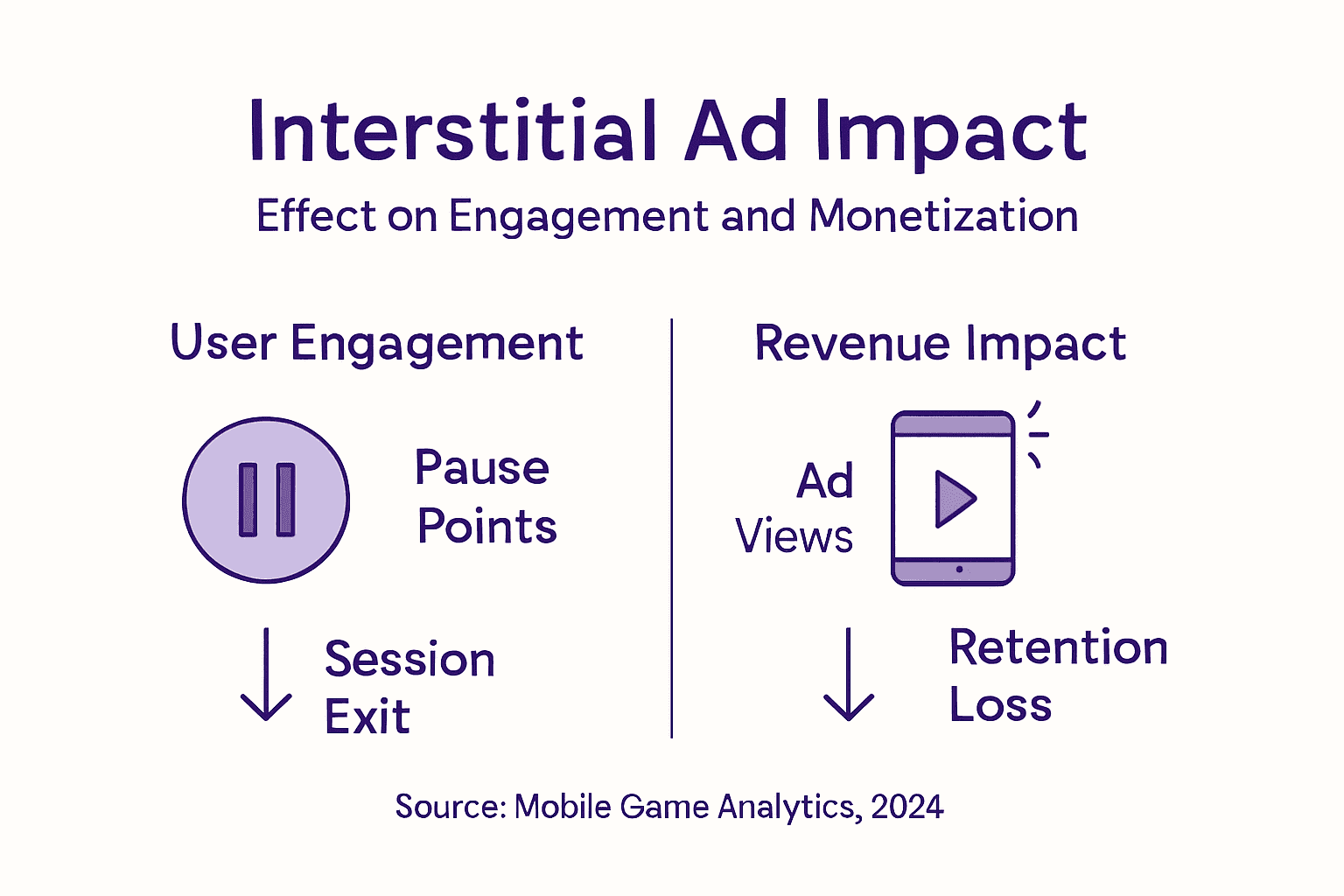
Research investigating mobile game interactions reveals fascinating insights into ad effectiveness. A comprehensive study using the mobile game ‘Between Beats’ uncovered that rewarded interstitial ads significantly reduce perceived intrusiveness while maintaining player retention. By offering players optional interactions, such as earning in-game rewards for watching advertisements, developers can create a more positive advertising ecosystem. This approach not only generates revenue but also provides additional value to players, potentially increasing user acquisition and long-term engagement.
The key to successful interstitial ad implementation lies in understanding user psychology and technical integration. Mobile game developers must consider critical factors like ad frequency, placement, and reward mechanisms to prevent user frustration. Advanced analytics now enable precise tracking of user engagement metrics, allowing developers to fine-tune their advertising strategies. By implementing intelligent rotation strategies and providing clear user controls, games can maintain a harmonious balance between monetisation and user experience, ultimately supporting sustainable user acquisition and retention.
Pro tip: Implement a dynamic reward system for interstitial ads that provides tangible player benefits, ensuring advertisements feel like opportunities rather than interruptions.
Risks, costs, and best practices to avoid poor performance
Interstitial advertisements present significant challenges for mobile game developers, requiring a strategic approach to mitigate potential risks and optimise performance. Mobile ad implementation strategies reveal that poorly executed advertisements can substantially damage user retention and overall app experience. The primary risks include excessive ad frequency, inappropriate timing, and disruptive placement that can trigger user frustration and potential app uninstallation.
The financial implications of mismanaged interstitial ads extend beyond immediate revenue loss. Mobile platforms like Google impose strict guidelines and penalties for intrusive advertising, which can result in reduced app visibility, lower search rankings, and potential platform restrictions. Developers must carefully balance monetisation objectives with user experience, considering factors such as ad frequency capping, strategic placement during natural app transitions, and providing clear user control mechanisms like skip options.
Successful interstitial ad implementation requires a holistic approach that prioritises user psychology and technical precision. Key best practices include developing contextually relevant advertisements, limiting ad exposure to prevent user fatigue, and continuously monitoring performance metrics. Advanced analytics can help developers understand user engagement patterns, enabling them to refine ad strategies dynamically. By treating advertisements as potential value-added experiences rather than mere revenue generators, mobile game creators can maintain a positive user relationship while effectively monetising their platforms.
The following table highlights key risks of interstitial ads in mobile games and strategies to minimise them:
| Risk | Possible Consequence | Mitigation Approach |
|---|---|---|
| Excessive ad frequency | User frustration, churn | Frequency capping, spaced intervals |
| Poor timing | Disrupted gameplay | Show during natural transitions |
| Inadequate exit options | App uninstalls | Always provide visible close buttons |
| Low content relevance | Reduced engagement | Personalised, context-aware ads |
| Ignoring analytics | Missed improvement chances | Continuous performance monitoring |
Pro tip: Implement comprehensive A/B testing for interstitial ad placement and frequency to systematically identify the optimal balance between user experience and revenue generation.
Elevate Your Interstitial Ad Strategy with No-Code Playable Ads
Interstitial ads require precise timing and engaging content to avoid disrupting player experience while maximising monetisation. The challenges discussed in the article highlight key pain points such as maintaining user engagement without excessive ad frequency and crafting interactive experiences that resonate with players. If you are aiming to produce highly effective playable and interactive ads without draining your company resources or developer time, this is where PlayableMaker can transform your approach.
Explore our Publishing Archives to understand best practices for ad integration and discover how our no-code platform helps you build stunning playable ads quickly and affordably. With PlayableMaker, you have the power to create custom interactive ads that align perfectly with your gameplay transitions and reward strategies, enhancing player retention. Start designing ads that feel like engaging moments instead of interruptions by visiting https://app.playablemaker.com today and see how easy it is to boost both revenue and user satisfaction.
For additional guidance on optimising your ad implementation, check out our helpful resources in the Help Archives. Don’t let poor ad design undermine your game’s success. Act now to create captivating interstitial ads that truly engage your audience and improve acquisition outcomes.
Frequently Asked Questions
What are interstitial ads?
Interstitial ads are full-screen digital advertisements that appear during natural transitions within a mobile app or website, such as between game levels or app sections.
How do interstitial ads impact user experience in mobile gaming?
When implemented thoughtfully, interstitial ads can enhance user engagement by appearing at appropriate moments, offering relevant content without significantly disrupting gameplay.
What types of interstitial ads are most effective in mobile gaming?
The most effective types of interstitial ads include playable ads, video interstitials, and rich media ads, as they engage users more interactively and are more relevant to their experience.
What are some best practices for implementing interstitial ads?
Best practices include ensuring clear exit options, limiting ad frequency, deploying ads during natural gameplay transitions, and monitoring user engagement metrics to continuously optimise ad performance.
Recommended
- Interstitial Advertising: Why It Matters to Mobile Marketers – playablemaker.com Interstitial Advertising: Why It Matters to Mobile Marketers
- Understanding What is Ad Placement in Mobile Gaming – playablemaker.com Understanding What is Ad Placement in Mobile Gaming
- Understanding Ad Placement Strategy in Mobile Gaming – playablemaker.com Understanding Ad Placement Strategy in Mobile Gaming
- What Two Main Ad Formats Can Be Used in Mobile Gaming? – playablemaker.com What Two Main Ad Formats Can Be Used in Mobile Gaming?
- 8 Soorten mobiele apps die je moet kennen | BYTE24