
TL;DR:
- Successful hyper-casual marketing combines data analysis, rapid creative iteration, and engaging ad formats.
- Playable ads and rewarded videos are highly effective for driving quality installs and engagement.
- Continuous creative testing and integrated retention strategies are essential for scalable, profitable campaigns.
Hyper-casual marketing carries a reputation it does not entirely deserve. Many user acquisition managers assume it is purely a volume game, a race to the lowest cost-per-install with throwaway creatives and minimal strategy. That assumption leaves serious money on the table. In reality, the most successful hyper-casual campaigns combine rigorous data analysis, rapid creative iteration, and sophisticated ad formats that engage players before they even install. This article breaks down the core concepts, the most effective ad formats, practical budgeting frameworks, and integration strategies so you can build campaigns that scale without burning through your resources.
Table of Contents
- Defining hyper-casual marketing in mobile gaming
- Key ad formats and channels for hyper-casual games
- Budgeting and optimisation for scalable campaigns
- How to integrate hyper-casual marketing into your strategy
- Why most marketers underestimate hyper-casual marketing’s true power
- How to get started with hyper-casual marketing solutions
- Frequently asked questions
Key Takeaways
| Point | Details |
|---|---|
| Simple strategy, big impact | Hyper-casual marketing focuses on high-volume, quick campaigns for big growth. |
| Ad format flexibility | Combining playable ads, rewarded videos, and interstitials yields the best results. |
| Budget smart, scale fast | Regular creative testing and data-driven budgeting are essential to ROI. |
| Integrate for sustained growth | Blending hyper-casual UA with retention strategies maximises lifetime value. |
Defining hyper-casual marketing in mobile gaming
Hyper-casual marketing is a discipline built around the unique characteristics of hyper-casual games: titles with near-zero learning curves, universal appeal, and extremely short session lengths. As hyper-casual games impact the broader mobile landscape, their marketing model has evolved into something genuinely distinct. The approach focuses on simple, quick-to-play game acquisition and streamlined user acquisition strategies that prioritise volume, speed, and measurable returns.
What separates hyper-casual marketing from mid-core or hardcore app marketing is the relationship between product and campaign. Mid-core games can rely on deep narrative hooks, community features, and long-term loyalty programmes to justify higher CPIs. Hyper-casual titles cannot. The product is simple by design, so the marketing must communicate value in seconds, not minutes.
Understanding user acquisition in mobile gaming for hyper-casual titles means accepting a fundamentally different funnel. Users enter at enormous scale, churn quickly, and generate revenue primarily through in-app advertising rather than in-app purchases. That changes everything about how you measure success.
The core principles that define this model are:
- Simplicity: Ads mirror the game’s ease of play, removing friction at every touchpoint.
- Mass appeal: Creatives target broad demographics rather than niche communities.
- Rapid development: New ad concepts are produced and tested within days, not weeks.
- Data-driven optimisation: Every decision, from format to targeting, is guided by live performance data.
Key performance metrics for hyper-casual campaigns differ from those in other genres. You should monitor CPI (cost per install), IPM (installs per mille, meaning installs per thousand impressions), day-one and day-seven retention rates, and ARPU (average revenue per user). These figures tell you whether a campaign is genuinely profitable or merely generating installs that evaporate.
“The most effective hyper-casual campaigns treat every creative as a hypothesis. You are not making ads. You are running experiments at scale.”
This experimental mindset is what separates teams that plateau from those that consistently find breakout titles.
Key ad formats and channels for hyper-casual games
With a clear understanding of the concept, let’s explore the practical ad formats and channels that drive results for hyper-casual projects.
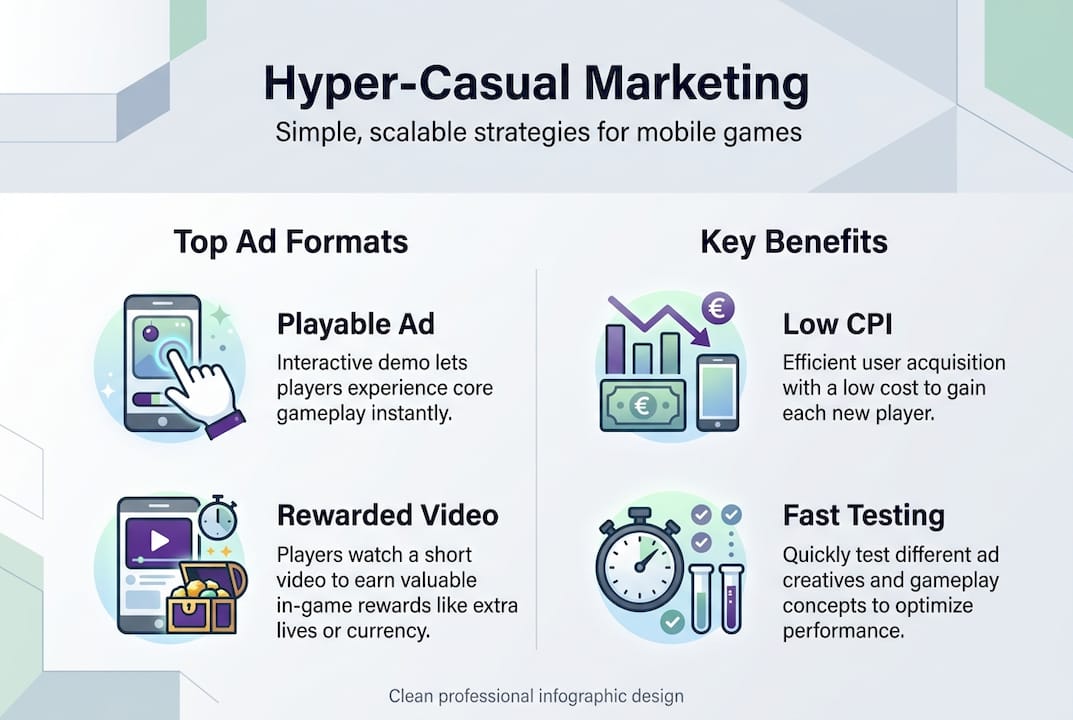
Playable ads, rewarded videos, and interstitials are the most widely used formats for user acquisition in hyper-casual marketing, and each serves a distinct purpose. Knowing when to deploy each format is as important as knowing how to produce it.
| Ad format | Engagement level | Best use case | Typical IPM range |
|---|---|---|---|
| Playable ad | Very high | Demonstrating core mechanic | 40 to 80+ |
| Rewarded video | High | Incentivised install intent | 20 to 50 |
| Interstitial | Medium | Broad reach, low friction | 10 to 30 |
| Banner | Low | Retargeting, brand recall | 2 to 8 |
Playable ads are the standout format for hyper-casual titles because they let users experience the game loop before committing to an install. This pre-qualification effect means the users who do install are more likely to engage and retain. Reviewing best mobile game ads confirms that the most shared and highest-converting creatives almost always involve some form of interactivity.

Rewarded videos work particularly well on ad networks where users are already in a gaming mindset. They offer a value exchange: watch this ad and receive an in-game reward. The opt-in nature of the format produces higher quality engagement than forced placements.
Interstitials remain useful for scale. They reach broad audiences at low cost and serve as effective direct response ads when paired with a compelling call to action.
For distribution, the primary channels are:
- Facebook and Meta Ads: Strong demographic targeting and large scale, though CPIs have risen in recent years.
- TikTok Ads: Rapidly growing for hyper-casual due to its young, mobile-first audience and native video format.
- Ad networks (such as AppLovin, Unity Ads, and ironSource): Essential for reaching players already active in other mobile games.
Exploring popular ad formats across these channels reveals that format performance varies significantly by platform. What converts on TikTok may underperform on a traditional ad network.
Pro Tip: Run a two-week format test across at least three channels simultaneously. Allocate equal small budgets to each, then compare IPM and CPI before committing to a primary channel. This prevents confirmation bias and surfaces unexpected winners.
Budgeting and optimisation for scalable campaigns
Having covered ad format selection, it’s crucial to know how to allocate budget and optimise campaigns for sustained growth.
Hyper-casual marketing succeeds in large part because of lower CPI and rapid creative iteration. Typical CPIs for hyper-casual titles range from £0.20 to £1.50 depending on geography and format, significantly below mid-core benchmarks. That cost advantage only holds if your creative pipeline is fast and your budget allocation is disciplined.
| Geography | Typical CPI range | Notes |
|---|---|---|
| Tier 1 (UK, US, AU) | £0.80 to £1.50 | Higher revenue per user |
| Tier 2 (DE, FR, JP) | £0.40 to £0.90 | Balanced volume and value |
| Tier 3 (BR, IN, ID) | £0.20 to £0.50 | High volume, lower ARPU |
A structured approach to budget playable ad creatives prevents overspending on underperforming concepts. Follow these steps:
- Set a weekly testing budget: Allocate 20 to 30 per cent of total campaign spend to new creative tests each week.
- Define a kill threshold: Pause any creative that fails to reach your target CPI within 500 to 1,000 impressions.
- Identify winners early: Creatives that outperform your CPI target by 20 per cent or more within the first 48 hours are candidates for scale.
- Reallocate spend aggressively: Move budget from underperformers to winners within the same week, not the next.
- Refresh creatives regularly: Even top performers fatigue. Plan a new creative variant every 7 to 10 days to maintain performance.
Exploring customer acquisition methods in mobile gaming shows that teams who treat creative production as a continuous process, rather than a campaign-launch activity, consistently outperform those who do not.
Pro Tip: When a campaign’s CPI rises more than 30 per cent above your baseline over three consecutive days, pause it immediately. This is nearly always creative fatigue, not audience saturation. Swap the creative before scaling spend back up.
How to integrate hyper-casual marketing into your strategy
With campaign management in place, here’s how to embed hyper-casual methods in your broader marketing mix.
The marketing funnel must be adapted to the fast churn and large volumes typical in hyper-casual game marketing. A standard B2C funnel assumes extended consideration phases. Hyper-casual funnels compress those phases dramatically. Awareness and conversion happen within seconds.
Here is a step-by-step approach to adapting your funnel:
- Top of funnel: Use broad-targeting video and playable ads to generate awareness and installs at scale.
- Mid funnel: Segment new users by day-one behaviour. Users who complete the tutorial are your retention targets.
- Bottom of funnel: Deploy retargeting campaigns via a funnel for app marketing approach to re-engage lapsed users with personalised creatives.
Combining UA with retention is where many teams underinvest. Customer acquisition and retention strategies should run in parallel, not in sequence. Push notifications, daily rewards, and lightweight social features can meaningfully improve day-seven retention even in simple titles.
Common mistakes to avoid when scaling:
- Scaling too fast: Increasing spend before creative performance is validated wastes budget and distorts data.
- Ignoring retention metrics: Optimising purely for CPI without monitoring retention produces installs that never generate revenue.
- Neglecting creative diversity: Running a single creative concept across all channels limits learning and accelerates fatigue.
Metrics to monitor for sustained growth:
- Day-one, day-three, and day-seven retention rates
- ARPU by cohort and geography
- IPM by creative and channel
- Return on ad spend (ROAS) at day 14 and day 30
“The teams that sustain growth in hyper-casual marketing are not those with the largest budgets. They are the ones who learn fastest from their data.”
Why most marketers underestimate hyper-casual marketing’s true power
The prevailing view is that hyper-casual marketing is a blunt instrument: high volume, low quality, and interchangeable with any other cheap traffic source. That view is wrong, and it is costing teams real competitive advantage.
The simplicity of the product masks the sophistication required to market it profitably. Any team can buy installs. Very few can buy installs that generate positive ROAS at scale over 30 days. That gap is where genuine expertise lives.
Top-performing teams use hyper-casual campaigns as a creative laboratory. They test messaging angles, visual styles, and interaction patterns at low cost, then apply those learnings to larger campaigns across genres. The insights gathered from creative user acquisition concepts at the hyper-casual level often reveal what motivates players across the entire mobile gaming spectrum.
The 90 per cent of teams who miss this opportunity treat each hyper-casual title as a standalone project. The top 10 per cent treat it as a data-gathering exercise that informs every future campaign. That shift in perspective is not a minor tactical adjustment. It is a fundamental change in how you value the channel.
Precision, not volume, is what separates breakout campaigns from forgettable ones.
How to get started with hyper-casual marketing solutions
Ready to apply these insights to your marketing? Here’s where to start.
PlayableMaker is built specifically for teams who need to produce interactive ad creatives quickly and without stretching their development budget. If you want to understand the mechanics behind why these formats work, the playable ads psychology guide explains the behavioural principles that make interactivity so effective at driving installs. For a broader grounding, playable ads explained covers the format’s evolution and best practices. When you are ready to build, see pricing to find a plan that fits your campaign scale and budget.
Frequently asked questions
What makes hyper-casual marketing different from traditional mobile game marketing?
Hyper-casual marketing is built on simplicity, speed, and scale, relying on rapid iteration and high-volume, low-cost ad campaigns to drive mass user adoption efficiently. Traditional mobile game marketing typically involves longer consideration cycles, deeper narrative hooks, and higher acceptable CPIs.
Which ad formats work best for hyper-casual games?
Playable ads and rewarded videos are the top-performing formats in hyper-casual marketing, with interstitials providing useful scale for broader reach campaigns.
How can I optimise my hyper-casual ad budget for better ROI?
Smart budgeting and frequent creative testing improve ROI significantly. Refresh creatives every 7 to 10 days, reallocate spend to winners quickly, and pause underperformers before they drain your budget.
Can hyper-casual marketing be integrated with longer-term retention strategies?
Yes. Retention strategies should accompany hyper-casual user acquisition from the start, combining fast UA bursts with push notifications and daily engagement features to improve lifetime value and reduce churn.
Recommended
- 2025 SocialPeta & Newsbreak Mobile Game Report: 9M+ Monthly Advertisers & the Rise of Weekly Creative Iteration – playablemaker.com 2025 SocialPeta & Newsbreak Mobile Game Report: 9M+ Monthly Advertisers & the Rise of Weekly Creative Iteration
- 7 Creative Ad Concepts for Mobile Game User Acquisition – playablemaker.com 7 Creative Ad Concepts for Mobile Game User Acquisition
- 7 Best Examples of Mobile Game Ads and Why They Work – playablemaker.com 7 Best Examples of Mobile Game Ads and Why They Work
- The Rise of Hyper-Casual Games and Their Impact on Playable Ads – playablemaker.com The Rise of Hyper-Casual Games and Their Impact on Playable Ads
- No-BS marketing strategies to boost client acquisition