
Mobile game ads are everywhere these days with over 60 percent of global in-game advertising now happening on mobile platforms. You might think players find this flood of ads annoying or disruptive. In reality, the right ad format can make the difference between someone quitting in frustration and someone actually feeling rewarded for their time.
Table of Contents
- Defining Ad Format: An Introduction To Its Types
- The Importance Of Ad Format In Mobile Gaming Marketing
- How Ad Formats Influence User Engagement And Acquisition
- Key Concepts And Metrics In Ad Format Evaluation
Quick Summary
| Takeaway | Explanation |
|---|---|
| Choose appropriate ad formats | Select ad types that align with game genre and audience needs to enhance user experience and monetisation. |
| Balance revenue and user retention | Implement ad formats that generate income while minimising disruption to gameplay and retaining player interest. |
| Focus on player psychology | Understand player motivations and emotions to design ads that engage rather than annoy, creating meaningful interactions. |
| Measure performance effectively | Evaluate ad formats using key metrics like conversion rates and user retention to assess their impact and adjust strategies accordingly. |
| Integrate ads into gameplay seamlessly | Aim for ad formats that fit naturally within the game, ensuring they enhance rather than detract from the overall player experience. |
Defining Ad Format: An Introduction to its Types
In the dynamic world of mobile gaming, ad formats serve as critical communication channels between game developers, advertisers, and players. An ad format represents a specific method or template for delivering advertising content within a mobile game environment, designed to capture player attention while maintaining gameplay integrity.
Types of Ad Formats in Mobile Gaming
Mobile gaming ad formats are diverse and strategically crafted to balance user experience with marketing objectives. These formats include:
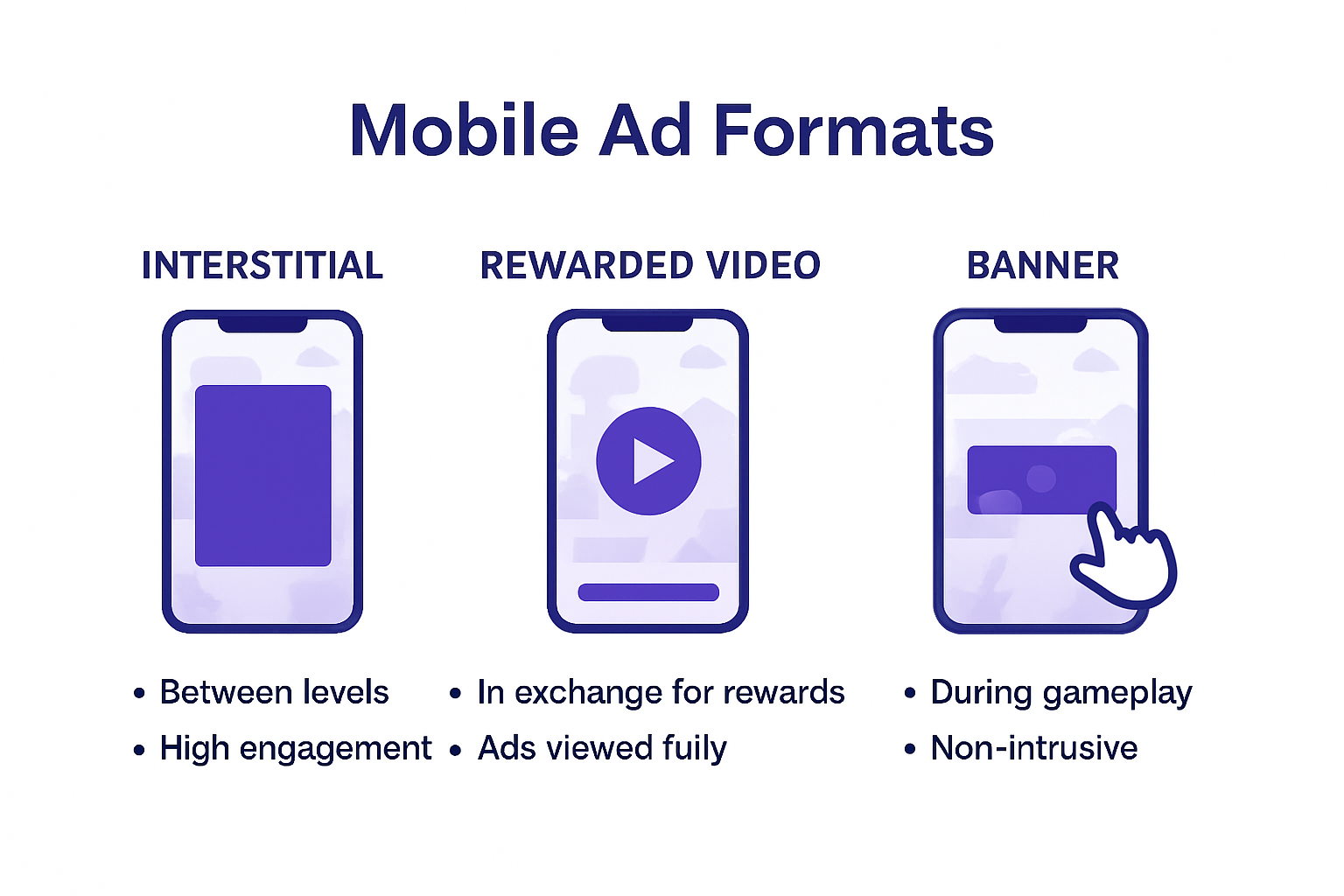
- Interstitial Ads: Full-screen advertisements appearing at natural transition points during gameplay
- Rewarded Video Ads: Optional video advertisements offering in-game rewards for voluntary viewing
- Banner Ads: Small, rectangular graphic advertisements typically positioned at screen edges
- Playable Ads: Interactive advertisement formats allowing players to experience a mini version of another game
Psychological and Strategic Considerations
To better understand the main types of ad formats used in mobile gaming, the following table provides a concise overview of each format and its key characteristics.
| Ad Format | Description | Key Characteristics |
|---|---|---|
| Interstitial Ads | Full-screen ads shown at transition points during gameplay | Attention-grabbing, can disrupt game flow |
| Rewarded Video Ads | Optional video ads offering in-game rewards for viewing | Voluntary, incentivises engagement |
| Banner Ads | Small, rectangular ads placed at the edges of the screen | Persistent, non-intrusive, limited interaction |
| Playable Ads | Interactive ads that let users try a mini version of another game | Highly engaging, demonstrates gameplay |
Effective ad formats go beyond mere visual placement. Research from Mobile Marketing Association suggests that successful mobile game ad formats must consider player psychology, engagement metrics, and intrinsic game design. The most impactful formats seamlessly integrate advertising without disrupting player immersion.
Game developers and marketers must carefully select ad formats that align with their specific game genre, target audience, and monetization strategies. Each format presents unique advantages and potential user experience challenges.
Technical Implementation and User Experience
Understanding ad format implementation requires recognizing the delicate balance between revenue generation and player retention. Optimal ad formats are:
- Contextually relevant
- Non-intrusive
- Potentially rewarding for players
By strategically implementing appropriate ad formats, mobile game developers can create sustainable monetization models that respect user experience. Learn more about creating engaging ad experiences and maximising player engagement through thoughtful advertising approaches.
The Importance of Ad Format in Mobile Gaming Marketing
Ad formats represent more than simple advertising mechanisms in mobile gaming marketing. They are strategic tools that bridge game developers, advertisers, and players, creating nuanced communication channels that drive engagement, revenue, and user retention.
Economic and User Experience Dynamics
Mobile game advertising is not merely about displaying promotional content. According to research from MarTech, mobile gaming advertising is projected to capture over 60% of global in-game advertising market share, demonstrating its critical economic significance.
The strategic importance of ad formats can be understood through several key dimensions:
- Revenue Generation: Providing sustainable monetization pathways for game developers
- User Engagement: Creating non-disruptive advertising experiences
- Marketing Effectiveness: Delivering targeted, contextually relevant promotional content
Psychological Engagement and Marketing Effectiveness
Successful ad formats transcend traditional advertising by understanding player psychology. They must seamlessly integrate into the gaming experience, offering value rather than interruption. Effective ad formats transform advertising from a potential annoyance into an engaging interaction.
Mobile game marketers must consider multiple factors when selecting ad formats:
- Player demographic characteristics
- Game genre and design
- Potential reward mechanisms
- User retention metrics
Strategic Implementation and Performance Metrics
Implementing the right ad format requires a sophisticated understanding of player behavior and technological capabilities. Explore advanced strategies for creating engaging ad experiences that balance marketing objectives with user satisfaction.
Ultimately, the most successful mobile game marketing strategies view ad formats not as intrusive elements, but as integral components of the overall user experience. By prioritizing player engagement and offering meaningful interactions, developers can transform advertising from a necessary inconvenience into a value-added feature of their gaming ecosystem.
How Ad Formats Influence User Engagement and Acquisition
Ad formats function as sophisticated psychological interfaces between mobile games and potential players, serving as critical mechanisms for driving user engagement and acquisition. These formats are not merely advertising tools but strategic communication channels that can significantly impact user behavior and game marketing success.
Psychological Dynamics of Ad Interaction
Research from the International Journal of Information Management reveals that gameful experiences profoundly influence user attitudes towards both gaming content and in-game advertisements. Successful ad formats leverage psychological principles to transform potential interruptions into engaging interactions.
Key psychological factors influencing ad format effectiveness include:
- Perceived Value: Providing tangible benefits or entertainment
- Minimal Disruption: Maintaining gameplay flow and immersion
- Interactive Potential: Enabling user agency and participation
Engagement Mechanics and User Acquisition
Effective ad formats act as bridges between curiosity and conversion. They must strike a delicate balance between capturing user attention and respecting the gaming experience. Mobile game marketers must design ad formats that:
- Demonstrate game mechanics authentically
- Offer meaningful preview experiences
- Provide clear value propositions
- Create immediate emotional connections
Strategic Implementation and Performance Metrics
Understanding ad format performance requires sophisticated analysis of user interactions. Explore advanced user acquisition strategies that transform advertising from a potential friction point into a compelling user journey.
Ultimately, the most successful ad formats transcend traditional advertising paradigms. They become interactive experiences that not only introduce games but also invite players into immersive digital worlds, turning potential users into engaged community members.
Key Concepts and Metrics in Ad Format Evaluation
Evaluating ad formats in mobile gaming requires a sophisticated approach that goes beyond traditional marketing metrics. These assessments involve complex interactions between technological capabilities, user psychology, and marketing objectives.
Fundamental Performance Indicators
Research exploring reinforcement learning frameworks highlights the critical metrics for assessing ad format effectiveness. Performance evaluation encompasses multiple dimensions that capture user engagement and advertising impact.
Key performance indicators include:
- Conversion Rate: Percentage of users who complete desired actions
- User Retention: Percentage of users who remain engaged after ad interaction
- Click-Through Rate: Proportion of users who click on advertisement
- Impressions: Total number of ad views
Contextual and Psychological Dimensions
The following table summarises the key performance indicators and contextual factors involved in evaluating ad format effectiveness in mobile games.
| Metric | Definition | Importance |
|---|---|---|
| Conversion Rate | Percentage of users completing desired actions after ad interaction | Measures ad impact on user behaviour |
| User Retention | Percentage of users who remain engaged after seeing ads | Indicates long-term player satisfaction |
| Click-Through Rate (CTR) | Proportion of users who click on an advertisement | Reflects ad attractiveness and engagement |
| Impressions | Total number of times an ad is shown to users | Gauges ad exposure |
| Perceived Intrusiveness | User perception of how disruptive the ad is | Impacts user attitude and retention |
| Emotional Resonance | Degree to which ad emotionally connects with users | Affects brand memory and affinity |
Successful ad format evaluation transcends numerical metrics. It requires understanding the nuanced psychological responses triggered by different advertising approaches. Mobile game marketers must consider factors such as:
- Emotional resonance with target audience
- Alignment with game aesthetic and user experience
- Perceived intrusiveness of advertisement
- Potential for creating memorable brand interactions
Advanced Analytical Frameworks
Discover innovative approaches to ad format creativity that transform standard evaluation metrics into strategic insights. Modern analytical frameworks incorporate machine learning algorithms and sophisticated user behavior tracking to provide comprehensive understanding of ad performance.
Ultimately, the most effective ad format evaluation strategies view metrics not as isolated data points, but as interconnected insights that reveal the complex relationship between advertising content, user experience, and marketing objectives. By adopting a holistic approach, mobile game developers can create ad formats that are not just technically proficient, but genuinely engaging and meaningful to their target audience.
Effortless Playable Ad Creation Starts Here
Struggling with the complexity and high costs of bringing engaging ad formats into your mobile games? The article shows how critical it is to keep ads seamless yet interactive, but creating playable ads often drains your team’s time and budget. If you want quick results without sacrificing quality, you need a solution built for modern game publishers.
Explore our Publishing resources for tips on accelerating your ad format workflow.
Ready to make interactive ads easy and affordable? Join the PlayableMaker platform and access our no-code tools for fast and effective playable ad creation. Save time, reduce costs, and keep your players engaged. Start streamlining your ad strategy now for a real competitive advantage.
Frequently Asked Questions
What is an ad format in mobile gaming?
An ad format in mobile gaming refers to a specific method or template for delivering advertising content within a game, designed to engage players without disrupting their gaming experience.
What are the main types of ad formats used in mobile gaming?
The primary types of ad formats in mobile gaming include interstitial ads, rewarded video ads, banner ads, and playable ads, each serving unique purposes and player engagement strategies.
How do ad formats impact user retention in mobile games?
Effective ad formats enhance user retention by providing non-intrusive, relevant advertisements that offer rewards or add value to the gameplay experience, thereby encouraging players to remain engaged with the game.

Why is psychological engagement important for mobile game ad formats?
Psychological engagement is crucial as it determines how players perceive and interact with ads. Understanding player psychology helps in creating ads that resonate emotionally, leading to better user acquisition and overall marketing effectiveness.
Recommended
- The Evolution of Mobile Game Monetization: Where Do Playable Ads Fit? – playablemaker.com
- What Is an Ad Network? Understanding Ad Networks in Mobile Gaming – playablemaker.com
- Playable Ads: The Best Approach for Game Marketing – playablemaker.com
- Introduction to Playable Ads in Mobile Game Marketing – playablemaker.com
Article generated by BabyLoveGrowth