
TL;DR:
- Time to market in ads encompasses the entire duration from campaign ideation to a live, serving ad, heavily influenced by organizational workflows. Advances in platform tools, such as real-time policy reviews and API deployment, have significantly reduced approval and launch times in 2026, enabling near-instant campaign setups. Operational improvements like parallel approvals, reusable assets, and structured phased launches empower mobile gaming teams to accelerate deployment and improve data-driven decision-making.
Time to market in ads is the total duration from campaign concept to a live, serving ad, and in mobile gaming, this interval directly determines whether you capture a trend or miss it entirely. The industry term for this process is ad campaign velocity, though “time to market” has become the working shorthand across performance marketing teams. Mobile gaming operates on compressed acquisition windows. A soft launch window can close in weeks, and a competitor’s creative can saturate a channel before your campaign even clears approval. Google’s Real-Time Policy Reviews and Meta’s API-driven workflows have reshaped what is technically possible in 2026, but platform speed alone does not solve the operational friction that causes most delays.
What are the key stages and bottlenecks in ad campaign time to market?
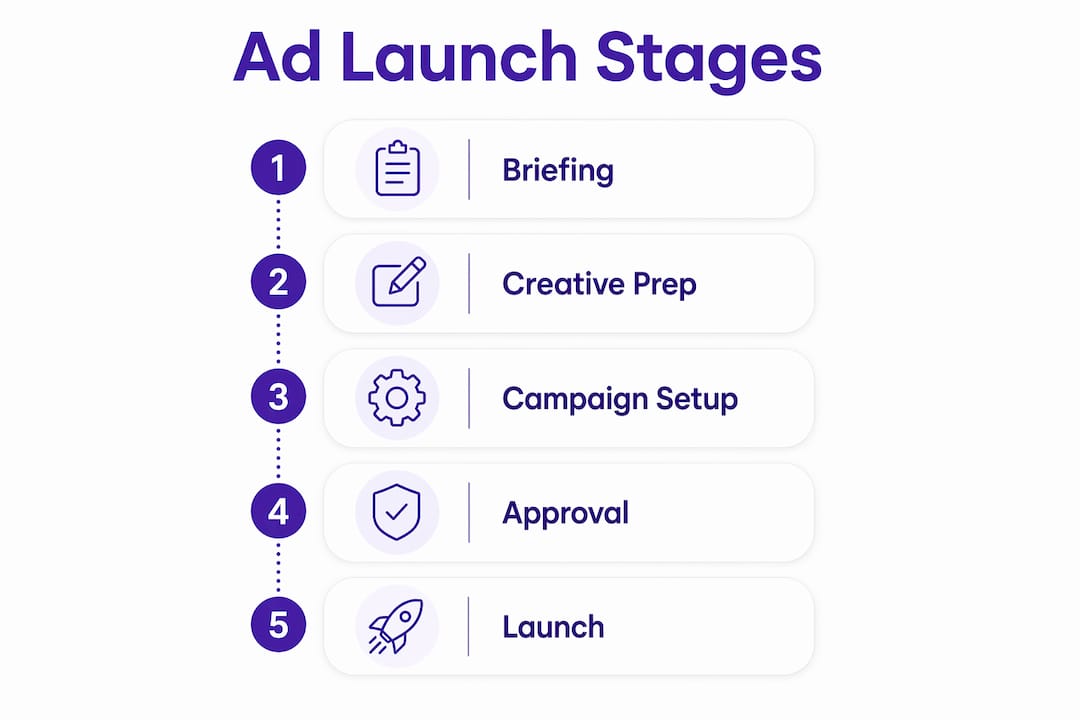
The standard path from brief to live ad moves through five distinct stages: creative asset preparation, campaign setup, approval workflows, platform policy review, and quality assurance testing. Each stage is a potential delay point, and most teams underestimate how much time accumulates between stages rather than within them.

Creative asset preparation is often the most variable stage. A mobile gaming team producing playable ads, video creatives, and static banners simultaneously faces asset sourcing from multiple contributors, version control issues, and format conversion for each platform. Approval latency causes more delays than design or technical setup, which means the bottleneck is rarely the designer. It is the queue waiting for a stakeholder to review.
Sequential approval chains are particularly damaging. When legal, brand, and performance teams review in series rather than in parallel, a campaign that requires three approvals at two days each accumulates six days of wait time before a single ad is published. Handoff inefficiencies compound this: assets sent via email threads, feedback scattered across Slack and shared documents, and no single source of truth for the current approved version.
Platform policy reviews add another layer. Meta’s standard paid social ad launch spans 2 to 5 days primarily because of approval and handoff delays, even though the active creative work averages only 30 to 90 minutes. This gap between effort and elapsed time is the clearest evidence that process, not production, is the primary constraint.
Pro Tip: Map your last three campaigns against a timeline and mark every period where no active work was happening. That dead time is your real time to market problem, and it is almost always in approval queues.
Common bottlenecks to audit in your own workflow include:
- Asset sourcing delays when briefs are written without pre-approved reference materials
- Rework loops triggered by misaligned creative direction between performance and brand teams
- Policy rejections caused by compliance checks happening at submission rather than during creation
- Manual campaign builds in platform UIs when bulk or API methods would be faster
How have 2026 platform innovations reduced ad approval and launch times?
The most significant shift in ad campaign speed in 2026 is the movement of compliance checks from post-submission to in-creation. Google’s Real-Time Policy Reviews deliver instant compliance decisions at the point of saving, meaning Responsive Search Ads that previously waited hours for review now receive feedback immediately. This shifts approval left into the creation process itself, allowing marketers to fix errors proactively rather than reactively.
“Same-day ad serving on platforms with real-time policy reviews requires finalising all creative and destination details before the final save to avoid fallback post-save reviews.” — Google, 2026
Meta has moved in a parallel direction with CI/CD-style workflows that include pre-flight checks and bulk API deployment. The practical difference in deployment speed is substantial, as the table below illustrates.
| Deployment method | Typical deploy time | Best use case |
|---|---|---|
| Meta Ads Manager UI (manual) | 45 to 90 minutes | Single campaigns, low volume |
| Bulk CSV upload | 10 to 20 minutes | Mid-volume campaign sets |
| Meta Marketing API | 3 to 8 minutes | High-volume, repeatable structures |
| Google Real-Time Policy Review | Near-instant at save | Responsive Search Ads, supported types |
These numbers matter because they reframe what a realistic same-day launch looks like. A mobile gaming team running a soft launch across Meta and Google could, with the right operational setup, move from finalised assets to live campaigns within 30 to 60 minutes. That was a multi-day process as recently as 2024.
The implication for mobile gaming marketers is direct. Faster platform-side processing removes the excuse of waiting on approval, which means the remaining delays are entirely within your team’s control. Platform innovation has raised the ceiling on ad campaign speed. Whether you reach it depends on your internal processes.
What operational strategies can mobile gaming marketers use to cut launch times?
Reducing ad launch time at the operational level requires systematic changes, not one-off fixes. The following sequence addresses the highest-impact areas in order of leverage.
-
Build a reusable campaign template library. Structure templates for your most common campaign types: soft launch, retargeting, seasonal promotion. Pre-populate targeting parameters, naming conventions, UTM structures, and budget tiers. This eliminates repetitive setup work and reduces the risk of configuration errors that trigger rework.
-
Use research-first creative briefs. Researching top-performing ads for persistent hooks before production can cut 2 to 3 days per campaign by eliminating multiple rework cycles. When the brief includes validated creative angles drawn from competitive intelligence, the team aligns on direction before a single asset is produced.
-
Parallelise approval and QA gates. Legal, brand, and performance reviews should run simultaneously, not sequentially. Assign a single decision-maker per workstream with a defined SLA, typically 24 hours or less. Pre-approved creative parameters, such as colour palettes, character usage rules, and CTA language, reduce the volume of items requiring review in the first place.
-
Adopt bulk and API deployment methods. For mobile gaming teams running high-volume creative tests, pre-flight checklists with approval gates and rollback protocols reduce Facebook deployment times from 4 hours to 35 minutes while preventing costly errors. The same structured approach applies to Google campaigns.
-
Validate soft launch creatives before global rollout. A 12-week phased timeline is the recommended structure for mobile gaming launches: weeks 1 to 4 for foundation, weeks 5 to 8 for soft launch, and weeks 9 to 12 for global rollout. Testing with modest budgets before scaling, using retention and CPI thresholds to gate expansion, prevents wasted spend on unvalidated creatives at scale.
-
Systematise asset reuse. Reusable assets and reduced rework can cut production time by 40 to 60 per cent within approximately 90 days. An organised asset library with tagged, platform-ready files removes the sourcing delays that stall campaigns before they even reach approval.
Pro Tip: Treat your user acquisition checklist as a living document. Update it every time a campaign is delayed by a step that was not accounted for. Within three campaigns, you will have a near-complete map of your actual process.
How does faster ad deployment affect mobile gaming user acquisition?
Faster ad deployment does not simply save time. It changes the quality of decisions your team can make during a campaign. When the cycle from creative idea to live data is measured in hours rather than days, you can run more iterations within the same budget period and respond to performance signals before they become expensive problems.
The connection to mobile gaming user acquisition is structural. Acquisition campaigns in mobile gaming operate in phases, and each phase has a different risk profile. During soft launch, the goal is to validate retention and CPI benchmarks with minimal spend. A slow ad deployment cycle means fewer creative variants tested, less data collected, and higher uncertainty when the decision to scale arrives.
The practical benefits of a well-structured go-to-market approach for mobile gaming campaigns include:
- Faster iteration cycles that allow creative variants to be tested and eliminated before budget scales
- Reduced wasted spend because underperforming creatives are identified and paused sooner
- Better CPI and retention data at the point of global rollout decisions, reducing the risk of scaling a campaign that will not hold
- Competitive responsiveness, meaning your team can react to a competitor’s creative move within the same news cycle rather than the following week
Fast iteration and validated learning phases in mobile gaming marketing are more effective than rushing global launches without data. Speed without structure produces noise. Speed with a validated process produces compounding performance gains across every subsequent campaign.
Key takeaways
Reducing time to market in ads for mobile gaming requires fixing process bottlenecks first, then using platform tools to remove the remaining friction.
| Point | Details |
|---|---|
| Process, not production, causes most delays | Approval queues and handoff gaps account for the majority of elapsed campaign time. |
| Platform tools now enable near-instant launches | Google’s Real-Time Policy Reviews and Meta’s Marketing API reduce deploy times to minutes. |
| Parallelise approvals to cut calendar time | Running legal, brand, and performance reviews simultaneously removes sequential wait time. |
| Validate before scaling in mobile gaming | A phased 12-week launch structure protects budget and improves data quality at rollout. |
| Reusable assets compound over time | Systematised libraries and templates cut production time by 40 to 60 per cent within 90 days. |
Why I think most teams are solving the wrong problem
The conversation around ad campaign speed in mobile gaming almost always gravitates towards tools. Teams ask which platform has the fastest approval, which creative tool produces assets quickest, which automation software removes the most manual steps. These are reasonable questions, but they address the wrong layer of the problem.
In my experience, the dominant cause of slow launches is organisational friction, not technical limitation. A team with access to Meta’s Marketing API but no defined approval SLAs will still take four days to launch a campaign. A team using manual Ads Manager builds but with parallelised reviews and pre-approved creative parameters will consistently outperform them on speed.
The CI/CD pipeline analogy is genuinely useful here, not as a metaphor but as a structural model. Treating ad deployment as a pipeline with explicit stages, defined owners, and rollback options changes how teams think about failure. A rejected ad is not a setback. It is a signal that a gate was not configured correctly, and the fix is systemic rather than reactive.
The one area where I would urge caution is the assumption that speed and quality are in tension. They are not, provided governance is built into the process rather than bolted on at the end. The teams that launch fastest are also the teams with the clearest pre-approved parameters, because they have removed the ambiguity that causes rework. Speed is a product of clarity, not a substitute for it.
— Ondrej
How Playablemaker helps you launch faster
If your mobile gaming team is losing time at the creative production stage, Playablemaker addresses that directly. The platform lets you build playable and interactive ads without writing a line of code, removing the developer dependency that typically adds days to playable ad production. You can iterate on formats, test creative variants, and produce platform-ready assets in a fraction of the time a traditional development workflow requires. For teams working through the psychology behind high-performing ads, Playablemaker’s no-code approach means the gap between a validated creative concept and a deployable asset is measured in hours, not sprints. That is the kind of production speed that makes the rest of your deployment process matter.
FAQ
What is time to market in ads?
Time to market in ads is the total elapsed time from campaign concept to a live, serving ad. It includes creative production, campaign setup, approval workflows, and platform policy review.
Why does ad campaign speed matter in mobile gaming?
Mobile gaming acquisition windows are short and competitive. Faster ad deployment allows teams to test more creative variants, collect better data during soft launch, and scale with confidence rather than guessing.
How fast can Meta and Google campaigns launch in 2026?
With Meta’s Marketing API, campaigns can deploy in 3 to 8 minutes. Google’s Real-Time Policy Reviews enable near-instant compliance checks, making same-day launch realistic for supported ad types.
What is the biggest cause of slow ad launches?
Approval latency and organisational friction cause more delay than creative production. Sequential review chains and unclear ownership are the primary culprits in most teams.
How do playable ads fit into a faster go-to-market strategy?
Playable ads produced with no-code tools remove the developer bottleneck from creative production, reducing the time between a validated concept and a deployable asset without requiring engineering resources.
Recommended
- Ad tech trends 2026: create playable ads fast and affordably – playablemaker.com Ad tech trends 2026: create playable ads fast and affordably
- 2025 SocialPeta & Newsbreak Mobile Game Report: 9M+ Monthly Advertisers & the Rise of Weekly Creative Iteration – playablemaker.com 2025 SocialPeta & Newsbreak Mobile Game Report: 9M+ Monthly Advertisers & the Rise of Weekly Creative Iteration
- Master Mobile Ad Trend Analysis 2025 for Playable Ads Success – playablemaker.com Master Mobile Ad Trend Analysis 2025 for Playable Ads Success
- Ad innovation in gaming: Playable ads boost engagement – playablemaker.com Ad innovation in gaming: Playable ads boost engagement