
TL;DR:
- Modular ad design uses reusable components to increase campaign performance and reduce costs significantly in mobile gaming marketing. It enables faster testing, continuous creative refreshment, and improved campaign metrics through AI-driven assembly and proper tagging. Adopting a structured component library and an appropriate iteration cadence creates a sustainable, scalable system for optimized advertising success.
Modular ad design is the practice of constructing advertisements from discrete, reusable components — hooks, bodies, and calls to action — that can be independently tested, swapped, and recombined to maximise campaign performance. In mobile gaming marketing, this approach has moved from experimental to indispensable. Brands using modular frameworks have recorded 352% higher campaign ROI and production cost reductions of up to 67%. That figure is not a marginal gain. It represents a structural shift in how performance teams at studios and publishers should think about creative production entirely.
What are the main advantages of modular ad design?
The core advantage of modular advertising strategies is speed without sacrificing quality. Traditional creative workflows require a full brief, production cycle, and review process for each new ad. Modular production replaces that with a component library: pre-approved hooks, gameplay footage segments, voiceover clips, and CTA overlays that can be assembled in hours rather than weeks.
The benefits extend well beyond production speed:
- Testing velocity. Modular systems allow teams to isolate individual variables. Changing only the hook while keeping the body and CTA constant produces statistically cleaner data on what drives attention. This is variable isolation testing, and it is far more informative than comparing two entirely different ads.
- Creative fatigue reduction. Recombining modular elements refreshes ads faster and at lower cost than commissioning new creative briefs. A winning gameplay clip can anchor dozens of variants simply by pairing it with different hooks or CTAs.
- Cost efficiency. Iterative reuse of approved assets cuts the per-variant production cost significantly. When AI-assisted generation tools enter the workflow, that cost drops further still.
- Campaign KPI improvement. The downstream effect on CTR, CPA, and ROAS is measurable. Dynamic Creative Optimisation powered by modular elements delivers 2 to 5x higher CTR, 20 to 50% lower CPA, and over 30% higher ROAS compared with static monolithic ads.
Pro Tip: Build your component library before you need it. Catalogue hooks, bodies, and CTAs as standalone assets from your very first production, even if you are not yet running modular campaigns. Retrofitting a library from finished ads is far more labour-intensive than building one from the start.
The impact of modular design on team capacity is equally significant. A small creative team that previously produced four to six finished ads per month can realistically deliver twenty or more variants by recombining a well-structured library. That scale matters enormously in mobile gaming, where audience fatigue sets in quickly and platforms reward fresh creative with lower CPMs.
Modular vs traditional ad creation: how do they compare?
Understanding the structural differences between modular and monolithic workflows clarifies why the shift matters for mobile game marketers specifically.
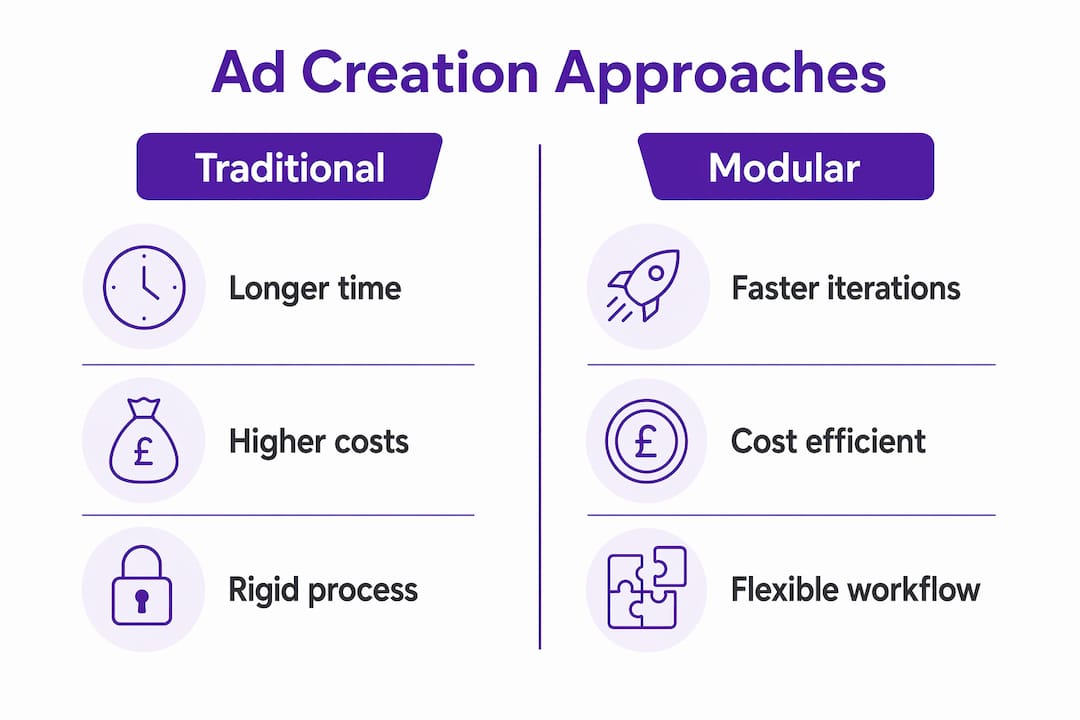
| Dimension | Traditional monolithic ads | Modular ad design |
|---|---|---|
| Production time | Weeks per creative | Hours to days per variant |
| Cost per variant | High, full production each time | Low, reuses approved assets |
| Testing granularity | Whole-ad A/B only | Component-level variable isolation |
| Adaptability to trends | Slow, requires new brief | Fast, swap relevant module |
| Fatigue management | New concept required | Recombine existing elements |
| AI integration | Limited | Native, real-time assembly |
Monolithic ads carry a hidden cost beyond the obvious production budget. When a campaign underperforms, the team has no data on which part failed. Was the hook weak? Did the CTA fail to convert? Without component separation, those questions are unanswerable. Modular design solves this by making each element an independently measurable unit.
Real-time optimisation is another area where the gap is stark. Platforms like Meta and Google continuously shift audience behaviour, and creative that performed well in January may be exhausted by March. Modular systems allow teams to refresh the hook or swap the CTA without rebuilding the entire ad, keeping campaigns competitive without the overhead of a full production cycle.
Pro Tip: When transitioning from monolithic to modular workflows, do not attempt to rebuild your entire creative archive at once. Start with your top three performing ads, deconstruct them into components, and build your library from proven material.
What are the effective modular ad components and their roles?
Modular frameworks treat ads as flexible systems built from three primary functional layers, each serving a distinct role in the user journey.

The hook occupies the first two to three seconds of an ad. Its sole function is to arrest scrolling behaviour and generate enough curiosity or emotional response to hold attention. In mobile gaming, effective hooks include dramatic gameplay moments, unexpected character interactions, or a direct challenge to the viewer (“Can you beat level one?”). The hook does not sell. It earns the next few seconds.
The body builds the message. This is where gameplay mechanics are demonstrated, social proof is introduced, or a narrative arc plays out. The body is the longest component and the most expensive to produce, which is why modular systems prioritise reusing strong body segments across multiple hook and CTA combinations. A single high-quality gameplay demonstration can serve as the body for dozens of variants.
The call to action closes the loop. In mobile gaming ads, CTAs typically direct users to install, play a demo, or claim an in-game reward. The specific language, visual treatment, and timing of the CTA all affect conversion rates independently of the hook and body. Testing multiple CTAs last is the most efficient sequencing strategy because CTAs are cheapest to produce but carry significant conversion weight.
Beyond these three layers, a structured tagging library linking each asset to audience segment, funnel stage, and historical performance data is what separates a functional modular system from a truly scalable one. Without metadata, AI-driven recombination becomes guesswork. With it, the system can assemble contextually appropriate ads automatically.
Pro Tip: Tag every asset at the point of creation, not retrospectively. Include at minimum: component type (hook/body/CTA), audience segment, funnel stage, and the campaign it was originally produced for. This metadata is what makes automated recombination reliable.
How does AI and dynamic creative optimisation enhance modular performance?
AI and modular ad design are mutually reinforcing. Modular components provide the structured inputs that AI systems require; AI provides the assembly speed and personalisation depth that make modularity commercially viable at scale.
The operational sequence works as follows:
- Asset ingestion and tagging. AI platforms such as Omneky and Segwise ingest component libraries and apply or refine metadata tags based on visual and semantic analysis.
- Real-time assembly. AI-driven assembly selects and combines components based on viewer context: device type, location, time of day, and behavioural signals. A user on an Android device at 9pm receives a different combination than a user on iOS during a lunch break.
- Performance feedback loops. The system tracks engagement and conversion data at the component level, not just the ad level. Hooks with low completion rates are flagged; CTAs with high install rates are prioritised in future assemblies.
- Fatigue detection. Creative fatigue differs from creative failure. A component that performed well for three weeks may simply be exhausted rather than fundamentally flawed. AI systems can detect frequency thresholds and trigger automatic substitution before performance degrades significantly.
The AI in creative ideation space is evolving rapidly, and mobile gaming marketers who build modular libraries now are positioning themselves to extract maximum value from these tools as they mature. The 2 to 5x CTR uplift associated with Dynamic Creative Optimisation is not achievable without the modular component structure that feeds it. The two are inseparable in practice.
Understanding why AI changes campaign management in 2026 is directly relevant here: the shift is not about replacing creative judgement but about giving that judgement a faster, more data-rich feedback environment.
What are the best iteration cadences for modular mobile gaming ads?
Sustainable iteration is one of the least-discussed but most consequential aspects of modular advertising strategies. Producing too many variants simultaneously dilutes learning; producing too few leaves performance gains on the table.
- Set a weekly production target of three to five variants. Performance marketing teams producing at this cadence focus on recombinations rather than new concepts, which keeps production costs low while generating statistically meaningful data.
- Follow the hook-first testing hierarchy. Test hooks before bodies, and bodies before CTAs. Hooks determine whether an ad earns attention at all. There is no value in optimising a CTA for an ad that loses viewers in the first two seconds.
- Apply data-driven kill rules. Define in advance the performance thresholds at which a component is retired. A hook that falls below a 20% completion rate after 5,000 impressions, for example, should be replaced regardless of how well the body and CTA perform.
- Use fatigue alerts, not just performance drops. By the time CTR visibly declines, an ad has often already exhausted a meaningful portion of its addressable audience. Frequency-based fatigue alerts allow teams to rotate components proactively.
- Treat the modular system as a living catalogue. New components should be added regularly, informed by trend analysis, seasonal relevance, and competitive observation. The library is not a static archive; it is an active production asset.
Pro Tip: Schedule a monthly library audit. Retire components that have not been used in 60 days or that consistently underperform. A bloated library slows AI assembly and introduces noise into performance data.
Key takeaways
Modular ad design drives superior mobile gaming campaign performance by enabling component-level testing, AI-powered assembly, and continuous creative refresh without the cost of full production cycles.
| Point | Details |
|---|---|
| ROI and cost impact | Modular frameworks deliver 352% higher ROI and cut production costs by up to 67%. |
| Component structure | Hooks, bodies, and CTAs each serve distinct roles and must be tested independently for clean data. |
| AI and DCO synergy | Dynamic Creative Optimisation powered by modular assets achieves 2 to 5x CTR uplift and 30%+ ROAS gains. |
| Iteration cadence | Three to five modular variants per week, tested hook-first, is the sustainable performance standard. |
| Tagging infrastructure | A structured metadata library is the foundation that makes AI-driven recombination reliable and scalable. |
Why modular design is the system mobile gaming marketers cannot afford to ignore
I have watched mobile gaming marketing teams spend six-figure budgets on creative production only to discover, after the fact, that they cannot tell which part of their ads was working. The entire ad is treated as a single unit, which means the entire ad must be rebuilt when performance drops. That is an expensive way to learn very little.
The shift to modular design is not primarily a production efficiency story, though the cost savings are real. It is a knowledge infrastructure story. When you build ads from discrete components and tag them properly, every campaign becomes a structured experiment. You accumulate learning at the component level, and that learning compounds. A hook that tested well in a puzzle game campaign may transfer directly to a strategy game campaign. You would never know that without a modular system.
The pitfall I see most often is teams treating modularity as a production process rather than a creative system. They deconstruct a few ads, produce some variants, and then revert to monolithic thinking when the next big campaign brief arrives. The teams that extract the most value are those that repurpose ad creatives systematically and treat their component library as a strategic asset, not a production shortcut.
Looking ahead to the remainder of 2026, the emergence of specialist roles such as modular creative strategist and component performance analyst reflects how seriously leading studios are taking this approach. The technology is maturing quickly. The teams building structured libraries now will have a compounding advantage over those who start later.
— Ondrej
How Playablemaker helps you build modular playable ads
Playablemaker is built for exactly this kind of modular, iterative creative work. The no-code playable ad builder allows mobile gaming marketers to construct, test, and deploy interactive ad variants rapidly, without developer resource or inflated production budgets. You can swap components, test hooks, and iterate on CTAs within a single workflow. For teams exploring why playable ads are so effective from a psychological standpoint, or those looking for a clear explanation of how playable ads work in practice, Playablemaker provides both the tools and the context to act on that understanding immediately.
FAQ
What is the role of modular ad design in mobile gaming?
Modular ad design structures advertisements as interchangeable components — hooks, bodies, and CTAs — that can be independently tested and recombined. In mobile gaming, this enables rapid iteration, reduced creative fatigue, and measurable performance improvement at the component level.
How much can modular ad design improve campaign ROI?
Brands using modular creative frameworks have recorded 352% higher campaign ROI and production cost reductions of up to 67%, according to research from D2C Times.
What is the recommended iteration cadence for modular ads?
Performance marketing teams produce three to five modular variants per week, focusing on recombinations of existing components rather than entirely new concepts. This cadence balances learning velocity with production sustainability.
How does dynamic creative optimisation relate to modular design?
Dynamic Creative Optimisation relies on modular components as its inputs. AI systems assemble contextually relevant ads in real time from tagged component libraries, delivering 2 to 5x higher CTR and over 30% higher ROAS compared with static ad formats.
What makes a tagging library critical for modular ad systems?
A structured tagging library links each asset to audience segment, funnel stage, and performance history. Without this metadata, AI-driven recombination cannot select contextually appropriate components, making the system unreliable at scale.
Recommended
- Mobile Gaming Ad Formats: Boosting Global User Acquisition – playablemaker.com Mobile Gaming Ad Formats: Boosting Global User Acquisition
- Ad innovation in gaming: Playable ads boost engagement – playablemaker.com Ad innovation in gaming: Playable ads boost engagement
- Mobile ad formats for gaming UA: complete list 2026 – playablemaker.com Mobile ad formats for gaming UA: complete list 2026
- Boost ad UX in mobile gaming with no-code tools – playablemaker.com Boost ad UX in mobile gaming with no-code tools