
TL;DR:
- True ad localisation deeply adapts visuals, language, and gameplay to align with cultural norms.
- Localised ads significantly improve key metrics like CPI, CTR, retention, and LTV.
- Ongoing iteration and regional insights are essential for effective localisation and sustained performance.
Ad localisation is one of the most underestimated levers in mobile game user acquisition. Many teams assume that swapping out copy into another language is sufficient, yet localisation goes far deeper than word-for-word translation. It reshapes the entire ad experience to fit a player’s cultural context, visual expectations, and behavioural norms. The gap in performance between a genuinely localised interactive ad and a generic one is measurable and significant. This guide unpacks what true ad localisation involves, why it matters for your acquisition metrics, and how to apply a practical framework to your interactive and playable ad campaigns.
Table of Contents
- What ad localisation really means for mobile gaming
- Why ad localisation drives superior user acquisition results
- Key elements of effective ad localisation strategies
- Common pitfalls and optimisation opportunities in ad localisation
- Why most mobile gaming marketers underuse ad localisation
- Supercharge your results with advanced localisation tools
- Frequently asked questions
Key Takeaways
| Point | Details |
|---|---|
| Localisation goes beyond translation | Effective ad localisation adapts messaging, imagery, and mechanics for each culture. |
| Boosts user acquisition metrics | Well-localised ads consistently improve conversion, retention, and ROI in mobile gaming. |
| Frameworks and checklists drive results | A clear localisation process helps teams cover every important ad element and avoid common mistakes. |
| Continuous optimisation is essential | Testing, feedback, and iteration unlock the full value of localised interactive ads. |
What ad localisation really means for mobile gaming
Having established why nuance matters, let’s break down the fundamentals of ad localisation for your campaigns.
Localisation, in the context of mobile gaming ads, means adapting every layer of an ad so that it feels native to a specific market. This includes language, but it also covers cultural references, visual design, user interface conventions, pricing formats, colour associations, and even the social cues embedded in gameplay mechanics. A player in Japan and a player in Brazil may both speak a language other than English, yet their expectations around humour, pacing, visual density, and reward structures differ considerably.
The distinction between translation and localisation is best illustrated with a concrete example. Imagine a puzzle game ad that features a character celebrating a win with a thumbs-up gesture and a dollar sign reward. A translated version of this ad for a German audience would simply change the text to German. A localised version would replace the dollar sign with a euro symbol, reconsider whether the thumbs-up gesture carries the same positive connotation, and adjust the visual tone to match regional aesthetic preferences. As local video marketing strategies demonstrate, this kind of contextual adaptation consistently outperforms literal translation.
“Localisation is not about changing what you say. It is about changing how it feels to the person receiving it.”
Playable ads are particularly well suited to nuanced localisation in playable ads because every interactive element, from button labels to reward animations, can be adapted independently. This granularity is not available in static or video formats.
Here is a quick comparison of translation versus localisation across key ad elements:
| Ad element | Translation only | Full localisation |
|---|---|---|
| Copy | Converted to target language | Adapted for tone, idiom, and register |
| Imagery | Unchanged | Culturally relevant visuals selected |
| Currency | May still show original | Correct local currency and format |
| UI layout | Unchanged | Adjusted for right-to-left or local norms |
| Gameplay cues | Unchanged | Tuned to local reward preferences |
Key areas that full localisation addresses include:
- Cultural references and humour: What is funny or aspirational in one market may be confusing or offensive in another.
- Visual symbolism: Colours, gestures, and imagery carry different meanings across cultures.
- Offer framing: Discounts, bundles, and in-app purchase structures resonate differently by region.
- Compliance: Some markets have specific rules around gambling-adjacent mechanics or age-related content in ads.
Getting this right from the outset saves significant rework costs and protects your brand reputation in new markets.
Why ad localisation drives superior user acquisition results
Now that we’ve defined localisation, let’s look at how it impacts the bottom line for acquisition metrics.
Localisation increases engagement and conversion in interactive ads in ways that generic campaigns simply cannot replicate. The data consistently shows meaningful performance deltas across cost per install (CPI), click-through rate (CTR), retention, and lifetime value (LTV).

Consider the following benchmark comparison between localised and non-localised mobile game ads:
| Metric | Non-localised ad | Localised ad | Typical uplift |
|---|---|---|---|
| CPI | Higher baseline | Reduced by 20-35% | Significant cost saving |
| CTR | 1.5-2% average | 2.5-4% average | Up to 100% improvement |
| Day-7 retention | 15-20% | 22-30% | Stronger early engagement |
| LTV (90-day) | Baseline | 25-40% higher | Compounding revenue gain |
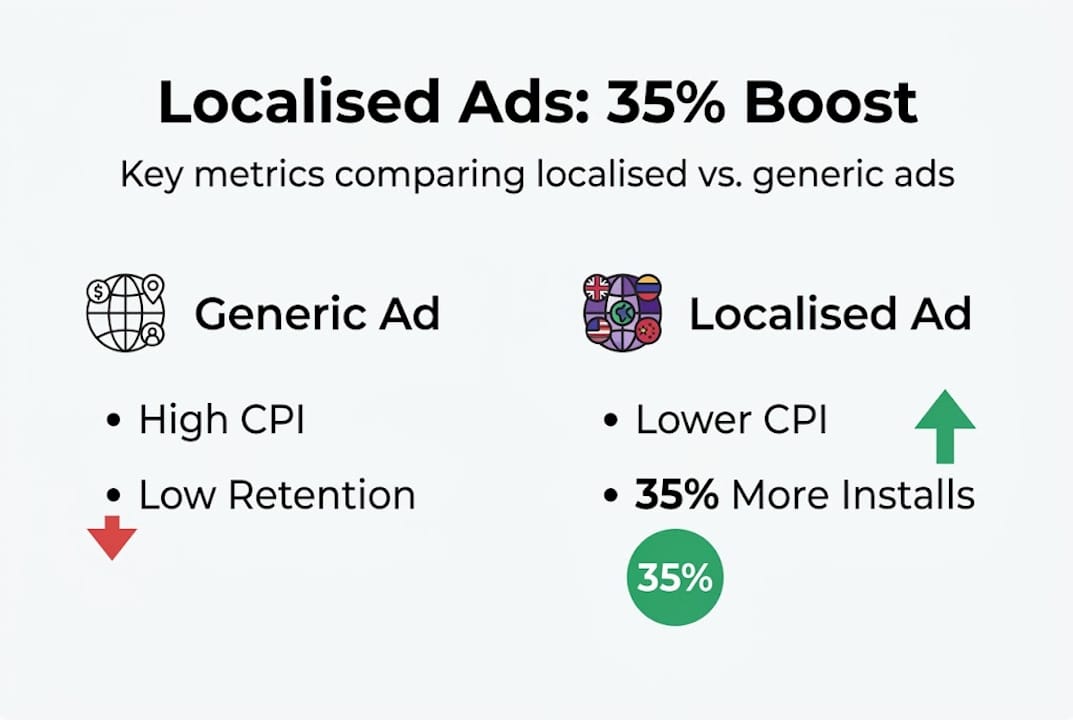
These figures reflect patterns observed across multiple regional campaigns and are consistent with broader how playable ads drive engagement research in the mobile gaming sector.
Pro Tip: Do not treat localisation as a one-time launch task. Markets evolve, and seasonal events, local holidays, and trending cultural moments offer recurring opportunities to refresh your localised creatives for a measurable CTR boost.
Four key ways localisation affects player response:
- Relevance signals trust: When a player sees their currency, language, and cultural context reflected in an ad, they perceive the game as made for them, not just translated for them.
- Reduced cognitive friction: Familiar visual and linguistic patterns lower the mental effort required to engage, increasing the likelihood of a tap or install.
- Emotional resonance: Culturally appropriate humour, aspirational imagery, and reward framing create stronger emotional responses, which directly influence install intent.
- Compliance confidence: Localised ads that respect regional regulations avoid rejection by ad networks, protecting your spend and delivery.
For a deeper look at how these principles apply across formats, effective mobile game ad practices provide a useful reference point for benchmarking your own campaigns.
Key elements of effective ad localisation strategies
Understanding the effect is only half the battle. Let’s map out exactly how to localise your interactive ads for success.
A reliable mobile ad localisation best practices framework covers five core dimensions: language, visuals, mechanics, compliance, and offer structure. Each requires deliberate attention rather than assumption.
Here is a stepwise process for localising interactive mobile ads:
- Audit your base creative: Identify every element that contains language, cultural reference, or market-specific assumption before you begin adapting.
- Localise copy with native input: Use native speakers, not machine translation alone, to adapt headlines, calls to action, and in-game text for tone and register.
- Adapt visuals and UI: Replace imagery that carries cultural assumptions. Adjust layouts for right-to-left languages. Ensure colour choices align with local associations.
- Tune gameplay mechanics: Reward structures, difficulty curves, and interactive prompts should reflect local player preferences. Some markets favour skill-based challenges; others respond better to luck-based mechanics.
- Verify compliance: Check regional advertising standards for gambling-adjacent content, data privacy disclosures, and age-appropriate messaging.
Pro Tip: When reusing creatives for localisation, build your base ad with modular components from the start. Separating text layers, image assets, and interactive elements makes regional adaptation dramatically faster and cheaper.
A practical checklist for localising interactive mobile ads:
- Native language copy reviewed by a regional speaker
- Currency, date formats, and units corrected
- Imagery audited for cultural sensitivity
- UI layout tested for text expansion (German and Finnish text, for instance, can be 30-40% longer than English)
- Reward and offer framing adapted to local purchasing norms
- Compliance requirements verified for each target market
- Interactive mechanics reviewed for local preference alignment
As effective marketing campaigns research confirms, the brands that invest in this level of detail consistently outperform those that treat localisation as a cosmetic exercise.
Common pitfalls and optimisation opportunities in ad localisation
To ensure your localisation delivers, let’s highlight the errors to avoid and how to iteratively optimise.
Even experienced teams make predictable mistakes when scaling localised campaigns. Recognising these patterns early saves budget and protects performance.
Common localisation mistakes to avoid:
- Over-literal translation: Machine-translated copy often sounds unnatural and erodes trust. Players notice immediately when language feels robotic or out of place.
- Ignoring visual localisation: Changing only the text while leaving culturally misaligned imagery in place undermines the entire adaptation effort.
- Assuming one localisation per language: Spanish spoken in Mexico differs from Spanish in Spain. Portuguese in Brazil differs from Portuguese in Portugal. Treating a language as monolithic misses significant regional nuance.
- Skipping compliance checks: Ad network rejections caused by non-compliant localised content waste time and delay campaign launches.
- Launching and forgetting: Localised ads require ongoing refinement based on performance data, not just a one-time adaptation.
“The most costly localisation mistake is not making one at launch. It is failing to iterate after launch when the data tells you something is not working.”
Pro Tip: Use A/B testing for localised ads to compare cultural variants systematically. Test one variable at a time, such as offer framing or character design, to isolate what is actually driving performance differences across regions.
Optimisation opportunities that many teams overlook:
- Local feedback loops: Partner with regional community managers or player groups to gather qualitative feedback on ad creatives before full launch.
- Seasonal and cultural calendar alignment: Localising around local holidays, sporting events, or cultural moments can produce significant short-term CTR spikes.
- Data-driven personalisation: Use regional performance data to inform future creative decisions, building a localisation intelligence library over time.
- Iterative testing cycles: Treat each market as an ongoing experiment. A structured workflow for interactive ads that includes regular creative refreshes will compound gains over time.
The teams that treat localisation as a living process rather than a launch checklist consistently outperform those that do not.
Why most mobile gaming marketers underuse ad localisation
Stepping back from the tactical, there is an uncomfortable truth worth examining directly. Most mobile gaming marketing teams know that localisation matters. They cite it in strategy documents and acknowledge it in retrospectives. Yet, in practice, it is frequently the first thing cut when timelines compress or budgets tighten.
The underlying assumption is that localisation is a refinement layer, something to add once a campaign is proven in the home market. This logic is flawed. A campaign that performs adequately in one market with generic creative will not reveal its true ceiling until it is tested with genuine localisation in place. You are not refining a proven asset. You are discovering what the asset could actually be.
Budget pressure is real, and we understand it. But the cost of poor localisation is not just lower CTR. It is wasted spend in markets where your ad is actively creating a negative impression. Innovation in playable ads has made it easier than ever to build modular, adaptable creatives without starting from scratch for each market. The barrier is lower than most teams assume. The opportunity cost of underinvesting in localisation, particularly in high-growth markets across Southeast Asia, Latin America, and the Middle East, is substantial and measurable.
Supercharge your results with advanced localisation tools
Ready to take your ad localisation to the next level? Here’s how you can get started today.
At PlayableMaker, we built our no-code platform specifically so that user acquisition teams can create, adapt, and test localised playable ads without depending on developer resources or stretching budgets. Whether you are exploring the revolution in playable ads for the first time or refining an existing global strategy, our tools make regional adaptation fast and cost-effective. Understanding the psychology behind playable ads helps you build creatives that resonate, and our platform gives you the flexibility to apply those insights across every market. If you are scaling user acquisition on Facebook or other major networks, localised playable ads are one of the highest-leverage moves available to you right now.
Frequently asked questions
What is the difference between ad localisation and translation?
Ad localisation adapts all elements of an ad, including images, cultural references, and gameplay mechanics, for a specific region, whereas translation only converts the language.
Does localisation always improve mobile ad performance?
Localisation consistently improves engagement and conversion across most markets, particularly when combined with data-led testing and iterative creative refinement.
What elements should be localised in a mobile gaming ad?
Key elements include text, imagery, offers, user interface layout, interactive mechanics, compliance disclosures, and culturally relevant references specific to each target market.
How can you measure the impact of localised ads?
Track CPI, CTR, day-7 and day-30 retention, and 90-day LTV before and after localisation, using structured A/B testing to isolate the effect of each adaptation.
What is the risk of poor ad localisation?
Poor localisation can produce cultural missteps, reduced engagement, ad network rejections, and wasted acquisition budget in markets where the creative actively works against your brand.
Recommended
- Localisation, Multi-language and Playable Ads Explained – playablemaker.com Localisation, Multi-language and Playable Ads Explained
- 2025 SocialPeta & Newsbreak Mobile Game Report: 9M+ Monthly Advertisers & the Rise of Weekly Creative Iteration – playablemaker.com 2025 SocialPeta & Newsbreak Mobile Game Report: 9M+ Monthly Advertisers & the Rise of Weekly Creative Iteration
- Step-by-Step Guide to A/B Testing Ads for Mobile Games – playablemaker.com Step-by-Step Guide to A/B Testing Ads for Mobile Games
- What is Ad Optimization? Understanding Its Importance – playablemaker.com What is Ad Optimization? Understanding Its Importance
- Effective Video Ads For Small Business Growth | Bonomotion