
TL;DR:
- Mobile creatives are purpose-built, interactive ad assets optimized for quick load times and engagement on mobile devices. Using a variety of formats like playable ads and rewarded videos, teams can drive higher user acquisition and better retention through rapid testing and iteration. No-code tools like PlayableMaker enable marketing teams to efficiently produce, test, and optimize these creatives without heavy technical resources.
Many user acquisition managers assume mobile creatives are simply resized versions of existing banner or video assets. This misunderstanding quietly drains budgets and kills campaign performance. In reality, mobile creatives are purpose-built, engagement-first ad experiences, and in competitive mobile gaming markets, the gap between a static banner and a well-crafted playable ad can mean the difference between a cost-per-install that scales and one that stagnates. This guide explains what mobile creatives genuinely are, covers the formats that matter most, and outlines practical, resource-light methods for building and testing them effectively.
Table of Contents
- What are mobile creatives?
- Types of mobile creatives in mobile gaming
- Why mobile creatives matter for user acquisition
- Building and optimising mobile creatives without heavy technical resources
- What most guides miss about mobile creatives
- Streamline your mobile creative production with Playablemaker
- Frequently asked questions
Key Takeaways
| Point | Details |
|---|---|
| Mobile creatives defined | Mobile creatives are interactive ad assets built specifically for mobile devices to maximise engagement and conversions. |
| Most effective formats | Playable ads and videos outperform static ads in driving user acquisition for mobile games. |
| Cost-effective creation | No-code tools enable marketers to design and optimise mobile creatives without heavy technical resources. |
| Frequent testing | Regularly testing and refreshing creatives boosts UA results and lowers campaign costs. |
| Efficiency mindset | Top teams succeed by treating creatives as flexible, rapidly iterated assets, not one-off productions. |
What are mobile creatives?
The term “mobile creatives” gets used loosely, but precision matters when you are allocating budget and developer time. Mobile creatives are visual and interactive ad assets designed specifically for mobile environments, meaning they are built from the ground up for touchscreens, variable connection speeds, and short attention windows.
This is a meaningfully different brief than desktop advertising. A mobile creative must load quickly, communicate value within seconds, and invite interaction rather than passive viewing. The environment demands it. Users are scrolling fast, often in noisy or distracted settings, and they will abandon an experience that feels slow or irrelevant without a second thought.
The definition has also expanded significantly over the past several years. Early mobile advertising relied almost entirely on static image banners, which were essentially print ads dropped onto a phone screen. Today, the scope of mobile creative formats includes:
- Static banners: Simple image-based ads, still widely used for retargeting and brand awareness.
- Interstitials: Full-screen ads that appear between content moments, typically in gaming apps between levels.
- Playable ads: Mini interactive experiences that let users try a game mechanic before installing.
- Rewarded video: Opt-in video ads where users receive in-app currency or lives in exchange for watching.
- Native ads: Ads styled to blend with the surrounding app content, reducing disruption.
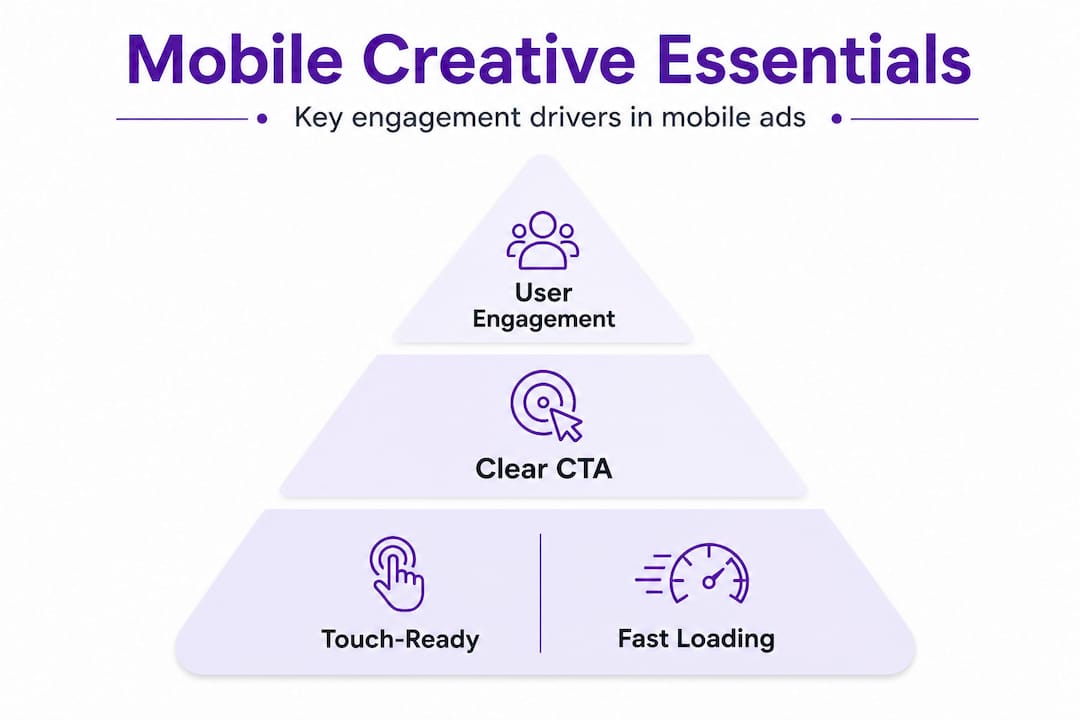
The key characteristics that unite all effective mobile creatives are touch-readiness, fast loading, and a clear engagement hook. Without those three properties, even a visually impressive asset will underperform. The challenge for marketing teams is balancing creative ambition with the technical constraints of mobile delivery, particularly file size limits, render performance, and cross-device compatibility.
Types of mobile creatives in mobile gaming
Understanding the general definition is a foundation, but mobile gaming UA managers need a more specific map of which formats serve which campaign goals. Each creative type carries distinct trade-offs around cost, complexity, and user engagement.
Playable ads, videos, and interactive formats consistently outperform static creatives in mobile gaming user acquisition. That pattern holds across genres and markets, but it does not mean static formats are obsolete. The most effective campaigns use a portfolio approach, mixing formats strategically.
Here is a comparison of the major mobile creative types relevant to mobile gaming:
| Creative type | User engagement | Cost to produce | Complexity | Best use case |
|---|---|---|---|---|
| Static banner | Low | Low | Low | Retargeting, brand awareness |
| Video (non-interactive) | Medium | Medium | Medium | Top-of-funnel awareness |
| Playable ad | High | Medium to high | Medium to high | User acquisition, conversion |
| Rewarded video | High | Medium | Medium | Re-engagement, opted-in audiences |
| Native ad | Medium | Low to medium | Low | Awareness in content-heavy apps |
Static banners are cheap and quick to produce, making them useful for broad retargeting. However, they ask nothing of the user and generate very little intent signal.
Video ads perform better because motion naturally draws attention. A 15 to 30-second gameplay video with strong early-game footage can communicate the game’s feel quickly. The limitation is passivity. Users watch but do not interact, which means the intent they carry into the app store is softer.

Playable ads sit at the top of the engagement hierarchy. When a user completes a short interactive game loop inside the ad itself, they arrive at the install page already invested. That pre-qualification effect is why playable ads typically deliver strong return on ad spend (ROAS). The historical barrier has been production cost and developer time, which is why the format was once reserved for publishers with large technical teams.
Rewarded video generates opt-in engagement, which is psychologically valuable. Users who choose to watch are far more receptive than those who had an ad forced on them. This format works well for re-engagement campaigns where the audience already knows your brand.
Native ads blend into the app environment, reducing banner blindness. They work best when placement context is closely aligned with the game’s target audience.
Pro Tip: Do not treat playable ad creation as a one-off project. The teams consistently achieving the best results build a small library of playable variations and rotate them based on performance data, using playable ad creativity as a repeatable production process rather than a single bespoke effort.
Why mobile creatives matter for user acquisition
User acquisition is ultimately a creative problem. Media buying platforms have become increasingly automated, with algorithmic targeting narrowing the performance gap between campaigns at the audience selection level. What still differentiates results is the creative itself.
Well-crafted creatives directly impact conversion rates and lower cost per install in mobile gaming. The mechanism is straightforward: a more engaging ad generates a higher click-through rate and a stronger store conversion rate, which reduces the effective CPI even when bid prices remain constant.
“Creative quality is the single largest variable still within the direct control of UA managers. Everything else is increasingly automated.” This reflects the industry consensus that has built steadily as programmatic buying has matured.
The impact extends beyond the install itself. Users acquired through interactive or playable formats tend to show stronger early retention because they entered the game with an accurate expectation of the experience. A rewarded video or playable ad sets context. A static banner rarely does.
Common pitfalls that undermine mobile creative performance include:
- Recycling old assets without adaptation: An asset that performed well six months ago is likely fatigued. Audiences see it repeatedly and scroll past.
- Ignoring interactivity entirely: Teams that rely exclusively on static and video formats are leaving engagement on the table, particularly given how accessible interactive production has become.
- Poor optimisation for device and placement: An ad built for a tablet interstitial will not perform the same way on a phone banner. Aspect ratios, text sizes, and interaction zones all need adjustment.
- Skipping early-loop testing: Many teams launch a creative and wait weeks for results. Fast iteration, testing variants within days, identifies winners much sooner.
The common pitfalls in mobile advertising are well-documented, and most of them trace back to treating creative production as a slow, expensive, one-directional process rather than a continuous feedback loop. The data-driven approach treats every launched creative as a hypothesis. You measure quickly, learn what works, and build on it. This mindset shift alone can significantly improve campaign efficiency without any increase in media spend.
Building and optimising mobile creatives without heavy technical resources
Knowing which formats work and why they matter is useful. Knowing how to produce them efficiently is what determines whether your strategy is actually executable. For most mobile gaming marketing teams, developer bandwidth is the constraint that limits creative ambition.
The encouraging shift in the industry is that no-code tools and platforms now enable marketers to quickly build, test, and optimise creatives without developers. This is not a niche workaround. It has become a mainstream production approach for teams of all sizes.
Here is a practical sequence for building and iterating mobile creatives with minimal technical involvement:
- Start with a proven template. Most no-code platforms offer libraries of game-specific creative templates. Choosing a template that matches your core game mechanic reduces build time dramatically and gives you a baseline that is already structurally sound.
- Customise the visual layer. Swap in your game’s artwork, colour palette, and UI elements. This does not require code. Drag-and-drop interfaces handle asset placement and animation timing visually.
- Define the interaction loop. For playable ads, the interaction should mirror the core mechanic of your game in under 30 seconds. Keep it simple. The goal is to convey the feel of the game, not its full depth.
- Set up variants for testing. Build two or three versions with different opening hooks, call-to-action copy, or interaction triggers. Testing without variants provides no learning.
- Launch and measure within a short window. Commit to a review cycle of seven to fourteen days. Check completion rate, click-through rate, and post-install retention by creative variant.
- Iterate based on data, not opinion. Replace underperforming elements, not entire creatives. Often a single change to the opening sequence or the CTA placement shifts results noticeably.
This structured approach to building interactive ad creatives removes the two most common blockers: waiting for developer time and waiting for a “final” creative to be approved before testing begins.
| Workflow | Time to first creative | Cost per creative | Iteration speed |
|---|---|---|---|
| Traditional (dev-led) | 2 to 6 weeks | High | Slow |
| No-code platform | 1 to 3 days | Low to medium | Fast |
| Hybrid (template plus dev polish) | 1 to 2 weeks | Medium | Medium |
Following established mobile ad best practices when using no-code workflows ensures that speed does not come at the expense of quality. Templates help, but understanding the principles behind strong mobile creatives, clear value communication, minimal friction, and a relevant interaction, is what separates teams that iterate well from those that iterate quickly but without direction.
Pro Tip: Prioritise iteration speed over initial perfection. A good creative launched and measured within a week will teach you more than a perfect creative that takes a month to build and approve. The data from real campaign performance is always more reliable than internal opinions about what will work.
What most guides miss about mobile creatives
Most published guidance on mobile creatives focuses on design quality. Get the artwork right. Make the animation smooth. Use the correct aspect ratios. That advice is not wrong, but it systematically underweights the factor that actually determines which teams scale fastest: the speed and discipline of their testing loops.
The uncomfortable truth is that creative quality is partially subjective and partly unpredictable. Teams that invest heavily in producing expensive, polished playables before testing assumptions frequently discover that a simpler, faster-built variant outperforms their flagship creative. This happens repeatedly across the industry, and yet the instinct to seek perfection before launch persists.
What genuinely separates high-performing UA teams is not the complexity of their creatives. It is the volume and quality of their learning cycles. A team running ten tested variants per month will consistently outpace a team running two highly polished variants per quarter, even if the latter team has superior design resources.
The mindset shift required is treating every creative as a flexible starting point rather than a finished product. Repurposing ad creatives from existing assets, adapting performing elements into new formats, and recycling winning hooks across different creative types are all practices that experienced teams adopt naturally. Teams newer to this discipline often resist it, feeling that reuse signals laziness rather than efficiency.
There is also an underappreciated advantage in constraint. No-code platforms force a degree of structural discipline because templates guide decisions. That constraint often produces creatives that load faster and communicate more clearly than bespoke builds that try to do too much. The best mobile creative is rarely the most complex one.
Streamline your mobile creative production with Playablemaker
With a clear understanding of what mobile creatives are, which formats matter most, and how to build them efficiently, the practical next step is finding tools that match the pace your campaigns require. PlayableMaker is built specifically for marketing and UA teams who need to produce, iterate, and optimise interactive ad creatives without pulling developers away from the game itself.
The drag-and-drop playable ad builder gives you full control over playable ad creation with no coding required. You can build from templates, customise with your game’s assets, set up variants for testing, and launch within days rather than weeks. The platform integrates smoothly into existing marketing workflows, so your team gains speed without disruption. Explore the guides and resources available on PlayableMaker to see how no-code interactive ad production fits your specific campaign goals.
Frequently asked questions
What are the most effective types of mobile creatives for game marketing?
Playable ads and interactive formats consistently drive the highest engagement and conversion rates in mobile gaming, outperforming static and passive video formats across most campaign objectives.
How can I create interactive mobile ad creatives without coding?
No-code platforms like PlayableMaker’s drag-and-drop builder allow marketers to create, test, and iterate fully interactive ad creatives efficiently without any developer involvement.
Why do mobile creatives impact user acquisition costs?
High-quality creatives increase engagement and improve click-through and store conversion rates, which directly reduces the effective cost per install even without changing your media bids.
How often should mobile creatives be tested and refreshed?
Testing and iterating on a weekly or fortnightly basis is recommended, as data-driven iteration enables teams to identify fatigued assets and winning variants before performance deteriorates significantly.
Recommended
- 8 Mobile Ad Best Practices for Successful Campaigns – playablemaker.com 8 Mobile Ad Best Practices for Successful Campaigns
- High-impact mobile ad creatives: list, tips & tools – playablemaker.com High-impact mobile ad creatives: list, tips & tools
- 5 mobile ad creative types to boost user acquisition – playablemaker.com 5 mobile ad creative types to boost user acquisition
- Why Creatives Matter for Mobile Game Ad Success – playablemaker.com Why Creatives Matter for Mobile Game Ad Success
- Your essential guide to building a mobile-friendly website
- Mastering Ad Creatives: Proven Strategies for Higher ROI – Palmador Blog