
TL;DR:
- Ad conversion rate measures user actions post-ad exposure, revealing true campaign performance.
- Playable ads significantly outperform passive formats in mobile gaming conversions by pre-qualifying interested users.
- Prioritizing high-quality conversions aligned with lifetime value drives sustainable growth over simple install volume.
Scaling a mobile gaming campaign on budget alone is a flawed strategy. Many user acquisition teams pour significant spend into ad networks, only to find that impressive impression counts and click volumes translate into disappointing install numbers. The real performance lever is ad conversion: the rate at which users exposed to your ad actually complete a meaningful action. Understanding this metric, measuring it correctly, and optimising creatives around it separates campaigns that deliver genuine growth from those that simply burn through budget.
Table of Contents
- Defining ad conversion: more than just clicks
- How is ad conversion measured in mobile gaming?
- Ad conversion vs other key metrics: what makes it so powerful?
- Playable ads: the conversion game-changer for user acquisition
- Why focusing on conversion quality is the new frontier
- Boost your ad conversion with effortless playable ad creation
- Frequently asked questions
Key Takeaways
| Point | Details |
|---|---|
| Ad conversion definition | Ad conversion means a user takes a target action like installing a mobile game after seeing an ad. |
| Measure for real success | Tracking conversion rate reveals how efficiently your ads are driving the actions that matter most. |
| Playables boost results | Playable ads consistently achieve higher conversion rates than static formats in mobile gaming. |
| Quality over quantity | Optimising for engaged, high-value users—not just raw conversion numbers—yields better long-term returns. |
Defining ad conversion: more than just clicks
Now that we’ve acknowledged the real battleground is conversion, let’s clarify exactly what ad conversion means and why it’s so critical.
Ad conversion describes when users take a desired action after seeing an advert, such as installing a mobile game. That definition sounds straightforward, but in practice, the term covers a range of actions that matter to different stakeholders across a user acquisition team.
In mobile gaming specifically, the most common conversion events include:
- App installs: The user downloads the game after seeing the ad.
- Account registrations: The user signs up, often indicating higher intent than a passive install.
- Tutorial completions: A signal that the user has engaged meaningfully with the game’s onboarding flow.
- In-app purchases: The most commercially significant conversion, indicating a paying user.
- Level completions or milestones: Proxy signals for retention and future monetisation potential.
Each of these events represents a distinct stage in the user journey. Focusing only on installs, for example, can mask poor downstream engagement. Understanding ad conversion rate at each funnel stage gives strategists a far clearer picture of where campaigns succeed and where they leak value.
It’s also important to separate ad conversion from related metrics that often get conflated with it. An impression counts every time an ad is displayed. A click records a tap or interaction. Neither guarantees that a user completed any meaningful action. Conversion is the metric that connects ad exposure to actual business outcomes, which is why it functions as the foundation of performance marketing rather than a secondary concern.
“Ad conversion is not simply a counting exercise—it is a behavioural signal that reveals whether your creative, your targeting, and your offer are aligned with what your audience actually wants.”
Pro Tip: Set one primary conversion action per campaign. When teams try to optimise for installs, registrations, and purchases simultaneously, attribution becomes muddled and creative decisions lose their anchor. Define your primary goal first, then track secondary events as supporting data.
How is ad conversion measured in mobile gaming?
With a working definition in place, it’s time to look at how ad conversion is actually measured and monitored in day-to-day practice.
Conversion rate is calculated as the percentage of users who take the intended action after interacting with an ad. The standard formula is clean and consistent:
Conversion Rate = (Conversions / Total Ad Interactions) × 100
So if an ad receives 10,000 interactions and generates 500 installs, the conversion rate is 5%. That single figure tells you more about campaign health than raw impression volume ever could.
In practice, tracking this accurately requires the right tooling. Here’s a typical measurement workflow for a mobile gaming user acquisition team:
- Define your conversion event in your ad network’s campaign settings before launch. This might be an app install tracked via a store link or an in-app event fired by your game’s SDK.
- Connect a Mobile Measurement Partner (MMP) such as Adjust, AppsFlyer, or Singular. MMPs attribute each conversion to the correct ad source, preventing double-counting and giving you reliable cross-network data.
- Set up analytics dashboards to monitor conversion rate alongside related signals such as cost per install, return on ad spend, and session length post-install.
- Pull ad network reports regularly to cross-reference MMP data. Discrepancies often reveal attribution issues or creative tracking errors worth investigating.
- Run A/B tests on creatives to isolate which elements drive higher conversion, using statistically significant sample sizes before drawing conclusions.
The table below outlines typical conversion rate ranges observed across common mobile ad formats, giving you a useful benchmark for evaluating your own campaigns.
| Ad format | Typical conversion rate | Notes |
|---|---|---|
| Static banner | 0.5% to 1.5% | Low engagement, high volume |
| Video (non-interactive) | 1.5% to 4.0% | Strong for brand awareness |
| Playable / interactive | 4.0% to 12.0% | Highest intent signals |
| Interstitial | 2.0% to 6.0% | Context-dependent performance |
| Rewarded video | 3.0% to 8.0% | Opt-in improves quality |
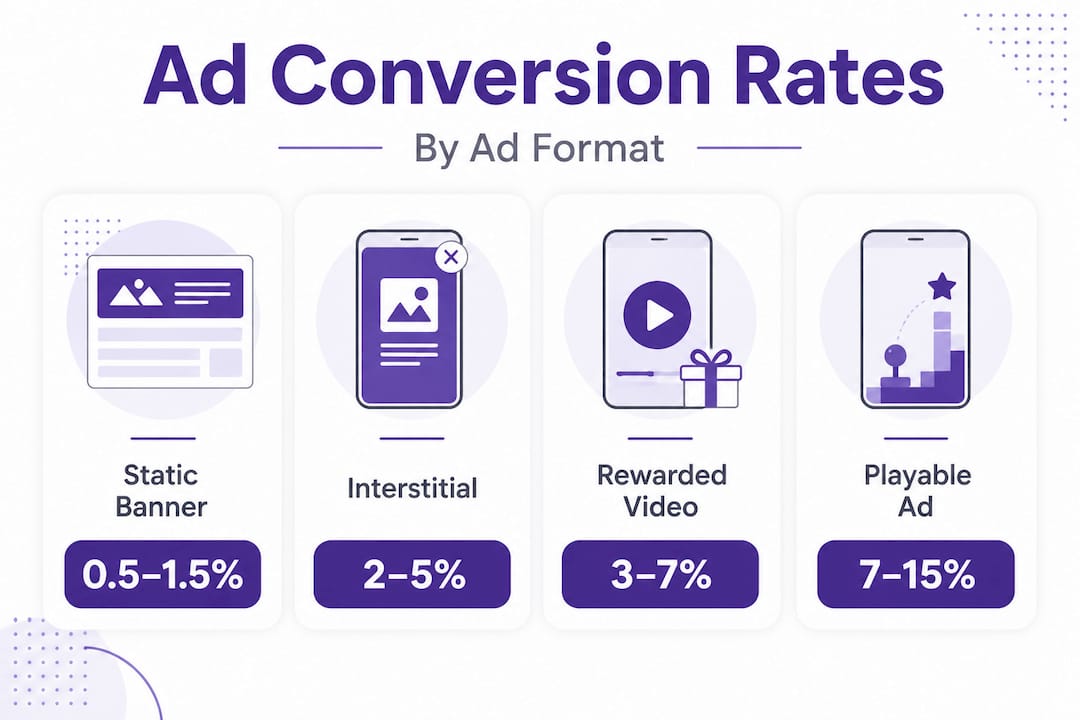
For teams looking to understand maximising conversion advertising, the data above makes a compelling case for format selection as a strategic decision, not an afterthought. It’s also worth examining why playable ads convert better compared to passive formats, particularly for gaming audiences who respond to interaction.
Understanding key ad performance metrics beyond conversion rate is also valuable, but conversion remains the anchor metric for evaluating whether your ad spend is genuinely working.
Pro Tip: Use A/B testing on a single variable at a time. Test the end card against a control, then test the opening sequence. Stacking multiple changes makes it impossible to identify what actually moved the needle.
Ad conversion vs other key metrics: what makes it so powerful?
Understanding measurement is half the battle. The real leverage comes from knowing why conversion outshines other metrics as a decision-making tool.
Many teams still plan and report primarily on impressions, click-through rate (CTR), and cost per mille (CPM). These metrics have their place in reach planning and pricing negotiations. However, they reveal very little about whether an ad is actually driving valuable user behaviour. The table below makes the distinction concrete.
| Metric | What it measures | Key limitation |
|---|---|---|
| Ad conversion rate | Users completing a desired action | Requires robust attribution |
| CTR (click-through rate) | Users clicking the ad | Click fraud inflates numbers |
| CPM (cost per mille) | Cost per 1,000 impressions | No indication of user quality |
| CPI (cost per install) | Cost for each app install | Ignores post-install behaviour |
Conversion rate directly impacts cost efficiency, performance-based optimisation, and ultimately return on investment. That’s why experienced acquisition teams treat conversion rate as their primary decision variable when allocating creative budgets and adjusting bids.
The practical benefits of prioritising conversion rate over volume metrics are significant:
- Budget focus: You can allocate spend to the ad formats and placements that demonstrably drive action, not just exposure.
- Creative insight: Low conversion rates on specific creatives signal a disconnect between the ad’s promise and the user’s expectation, prompting targeted improvements.
- Better LTV prediction: High-quality conversions from relevant audiences correlate more strongly with long-term player value than inflated install counts from broad targeting.
- Reduced wasted spend: Campaigns optimised for conversion naturally deprioritise placements that generate impressions without downstream results.
- Stronger iteration cycles: Conversion data gives clear feedback loops for creative teams, enabling faster, more informed decisions about which concepts to scale.
Following mobile ad best practices consistently across your campaign setup also reduces the common errors that distort conversion data, such as mismatched landing pages, slow load times, or poorly constructed end cards.
Playable ads: the conversion game-changer for user acquisition
Now that conversion’s importance is clear, let’s focus on why playable ads are increasingly the tool of choice for acquisition teams looking for both impact and efficiency.
Playable ads consistently outperform static banners when it comes to conversion rates in gaming campaigns. The reason is structural. Instead of asking a user to imagine what a game feels like, a playable ad lets them experience a condensed version of actual gameplay before they install. That direct interaction pre-qualifies the user in a way that passive formats simply cannot replicate.

The mechanics matter here. A well-designed playable ad creates a feedback loop within its brief runtime: the user takes an action, receives a response, and feels the core satisfaction loop of the game. When that experience resonates, the intent to install is organic rather than manufactured by marketing messaging alone.
Why playable ads perform strongly for user acquisition:
- Interactivity removes ambiguity: Users know exactly what they’re signing up for, which reduces uninstall rates and improves day-one retention.
- Higher engagement time: Playables hold user attention for longer than video formats, increasing the depth of the pre-install experience.
- Stronger intent signals: A user who completes a playable ad interaction is expressing active interest, not passive attention.
- Reduced creative waste: Because playable ads self-select engaged users, the installs they generate tend to have higher lifetime value.
- Cost-effective lead quality: Fewer but better-qualified installs often deliver stronger return on ad spend than high-volume, low-retention campaigns.
Playable ads generated conversion rates four to six times higher than standard display formats in several mid-core gaming campaigns tracked across 2024 and 2025.
For teams managing tight acquisition budgets, this quality-over-quantity dynamic is particularly relevant. It’s also worth examining your ad testing for playable ads process carefully. A playable ad that performs well in one market segment may need adjusted mechanics or difficulty tuning for another audience, and structured testing is the only reliable way to identify those differences.
Pro Tip: Always track post-install events alongside install volume when assessing playable ad performance. An ad that generates 300 installs with 60% completing the tutorial is delivering far more value than one generating 500 installs with a 10% tutorial completion rate.
Why focusing on conversion quality is the new frontier
With the tactical side covered, let’s shift focus to why not all conversions are equal in today’s landscape.
The mobile gaming market has matured considerably. Acquisition costs have risen, attribution has become more complex following privacy changes across iOS and Android, and the window for cheap, high-volume installs has largely closed for most genres. In this environment, many teams still chase conversion rate as a raw number. They celebrate when the rate climbs and panic when it dips, without asking a more important question: what is the quality of the users converting?
It is entirely possible to engineer a high conversion rate through misleading creative, overly simplistic playable mechanics, or targeting audiences with low commercial intent. Short-term metrics look impressive. Downstream, those users churn quickly, generate minimal revenue, and inflate your attribution costs without delivering real return. This is a pattern we observe repeatedly when teams optimise for the metric rather than for the business outcome behind it.
The more sophisticated approach is to connect conversion optimisation to lifetime value assessment from the very start. That means defining not just what constitutes a conversion, but what a valuable conversion looks like. For a mid-core strategy game, a valuable conversion might be a user who reaches level ten within their first week. For a casual puzzle title, it might be a user who makes a first purchase within thirty days.
Elevating game installs to a strategic level means designing playable ads whose mechanics naturally attract the player profile most likely to stay and spend. If your game’s core loop involves resource management and patience, a playable ad that telegraphs that dynamic will deter casual users who would churn anyway, while drawing in the committed players who represent genuine long-term value.
‘Not all installs are created equal; true growth comes from users who stay and pay.’
This is the uncomfortable truth that conversion rate alone cannot capture. The next frontier for user acquisition professionals is not simply more conversions at lower cost, but better conversions that align with the commercial realities of sustainable game growth. Integrating LTV signals into creative decisions, campaign targeting, and bid strategies is where the real competitive advantage now lies.
Boost your ad conversion with effortless playable ad creation
Ready to put these strategies into action? Here’s how you can start optimising ad conversion without technical headaches.
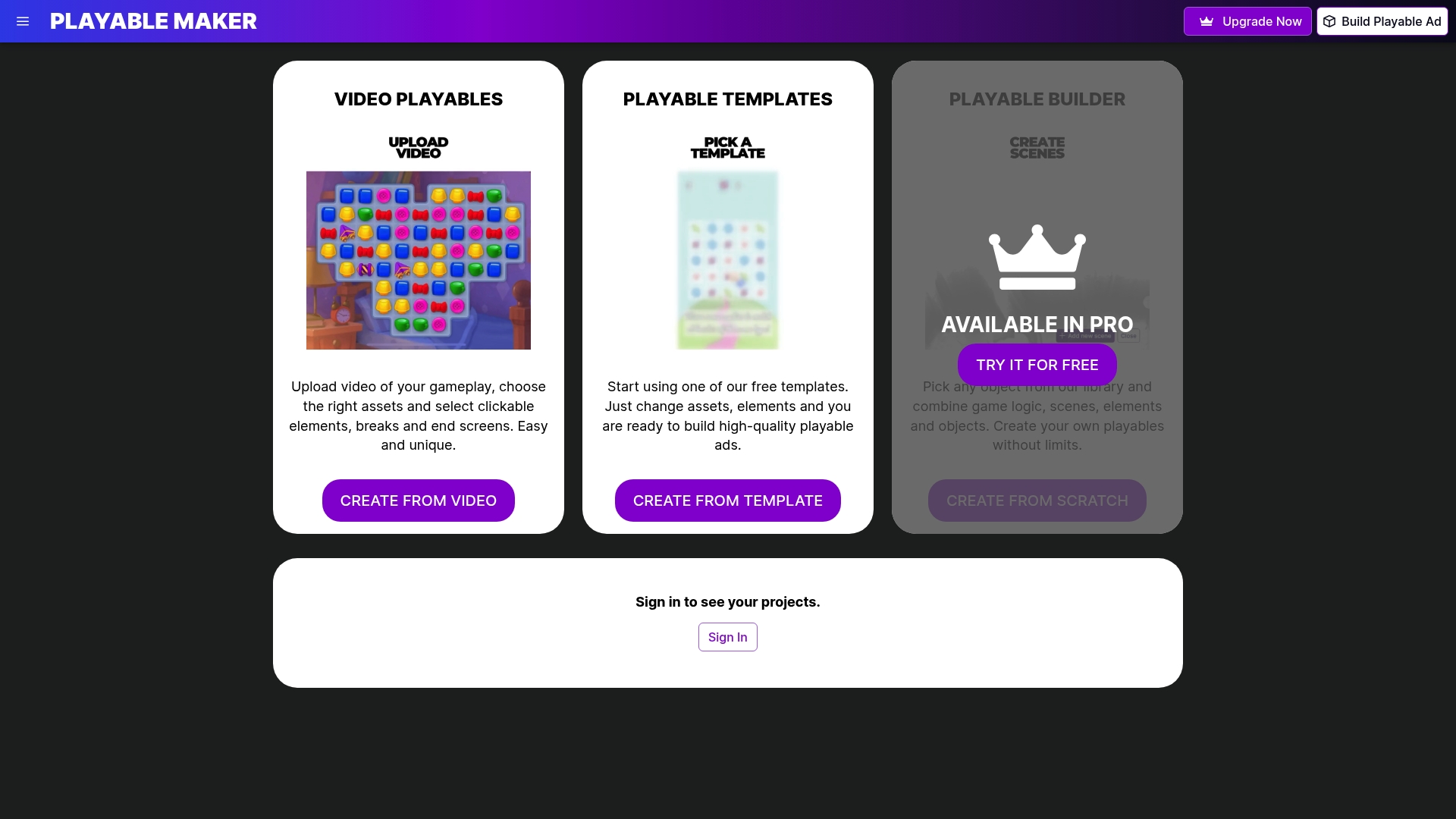
At PlayableMaker, we built our platform specifically for user acquisition professionals who understand the value of playable ads explained through results, not theory. Our no-code solution lets you design, build, and deploy interactive playable ads quickly, without pulling your development team away from the game itself. Following our ad creation guide gives you access to practical frameworks, market benchmarks, and ready-to-use templates that make high-performing playable ad creation genuinely accessible. You get the conversion advantages of interactive formats without the production costs and timelines that have historically made playable ads the preserve of large studios. Efficient, cost-effective, and built for performance.
Frequently asked questions
How do I calculate ad conversion rate?
Divide the number of users who completed the desired action by the total ad interactions, then multiply by 100. For example, 400 conversions from 8,000 interactions gives a conversion rate of 5%.
Why are playable ads more effective for mobile gaming?
Playable ads let users experience gameplay before installing, which pre-qualifies intent and improves post-install retention. Playable ads deliver higher conversion rates than passive banner formats in gaming campaigns.
What is a good ad conversion rate for mobile games?
Strong performance typically falls between 3% and 10%, though this varies by genre, platform, and creative quality. Typical mobile gaming rates shift considerably depending on whether you’re running casual or mid-core campaigns.
What tools can help optimise ad conversion?
Mobile Measurement Partners, analytics dashboards, and structured A/B testing platforms are the most effective combination for tracking and improving results. MMPs and A/B testing together provide both reliable attribution and actionable creative insights.
Recommended
- Advertising Conversion Rate: Elevating Mobile Game Installs – playablemaker.com Advertising Conversion Rate: Elevating Mobile Game Installs
- Facebook Ad Conversion Rates: Boosting Mobile Games – playablemaker.com Facebook Ad Conversion Rates: Boosting Mobile Games
- Conversions Advertising: Maximising Mobile Game Installs – playablemaker.com Conversions Advertising: Maximising Mobile Game Installs
- Top mobile ad platforms for gaming user acquisition – playablemaker.com Top mobile ad platforms for gaming user acquisition
- Interactive video ads: boost engagement and conversions | QuickAdVideo Blog