
TL;DR:
- Industry standards in ads are frameworks established by bodies like IAB, ASA, and CAP to govern creative, measurement, and compliance across digital platforms. These standards ensure campaigns pass platform review, enable accurate cross-channel measurement, and reduce legal and reputational risks, which is essential for scalable mobile gaming marketing. Adherence to these layered guidelines, including early creative QA and alignment with Project Eidos taxonomy, is critical for efficient delivery and optimized performance.
Industry standards in ads are the agreed frameworks, regulatory codes, and data classifications that define how advertising must be created, measured, and distributed across digital platforms. For mobile gaming marketers, these standards are not optional governance. They are the operational foundation that determines whether campaigns reach players, pass platform review, and generate measurable returns. Bodies including the IAB, ASA, and CAP set the rules that govern creative formats, data taxonomy, and compliance obligations. Understanding how these layers interact is the difference between campaigns that scale and campaigns that stall.
What are the main components of advertising standards for campaigns?
Advertising standards operate across three distinct layers: creative guidelines, data taxonomy, and regulatory codes. Each layer addresses a different failure point in campaign execution, and mobile gaming marketers need to manage all three simultaneously.

Creative guidelines define what assets are technically and visually acceptable on a given platform. Google’s app campaign guidance, for example, specifies that clear app logos and install buttons must be persistently visible to aid both ad approval and performance. Superimposing text such as “Download” directly onto images is explicitly disallowed. These rules exist because platform algorithms and human reviewers enforce them at the point of delivery, not after.
Data taxonomy standards address how campaign metadata is classified and reported. The IAB’s Campaign Data Standards 1.0 standardise classifications for placements, formats, and required data fields to reduce reconciliation gaps across platforms. Without consistent taxonomy, comparing performance across Google, Meta, and programmatic channels becomes an exercise in guesswork rather than analysis.
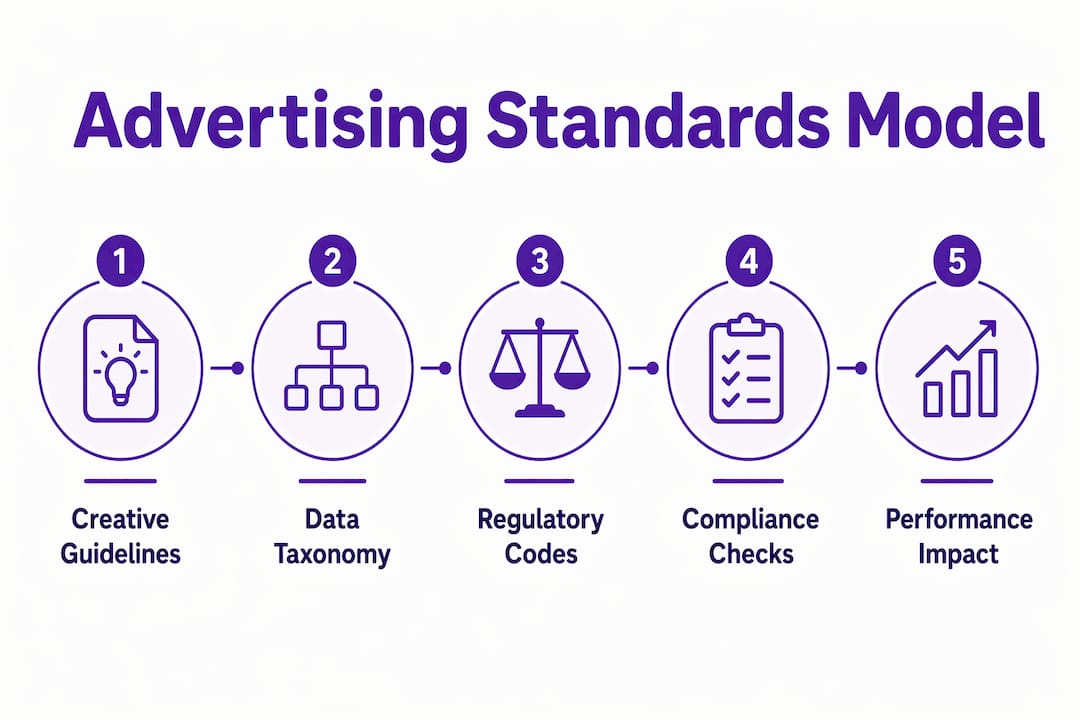
Regulatory codes from bodies such as the ASA and CAP govern truthfulness, substantiation, and audience targeting. These apply to all advertisers operating in the UK, including mobile game publishers running user acquisition campaigns.
The practical value of meeting advertising guidelines across all three layers includes:
- Reduced ad rejection rates and faster campaign delivery
- Accurate cross-platform measurement and attribution
- Lower legal and reputational risk from non-compliant claims
- Consistent creative quality that supports brand recognition
- Better data for creative iteration and spend optimisation
Pro Tip: Build a pre-launch checklist that covers all three layers: creative asset specs, taxonomy naming conventions, and regulatory claim substantiation. Reviewing these separately before submission catches the majority of rejection and compliance issues before they cost you time.
How does IAB’s Project Eidos change campaign measurement?
Project Eidos is the IAB’s 2026 initiative to create a common language for campaign data, and it represents the most significant shift in marketing industry benchmarks for measurement in several years. The core problem it addresses is straightforward: different platforms use different terminology for the same concepts, making cross-channel comparison structurally unreliable.
“Project Eidos builds a common language for campaign data to align measurements rather than enforcing a single platform.” — IAB
The framework defines ad positions, pod placements, and format attributes at a granular level. This granularity matters because mobile gaming campaigns typically run across multiple channels simultaneously, including rewarded video, interstitials, playable formats, and social placements. Without a shared vocabulary for these formats, reconciling performance data between a DSP report and a platform dashboard requires manual interpretation that introduces error.
The table below illustrates how Project Eidos standardisation addresses common measurement gaps:
| Measurement challenge | Without Project Eidos | With Project Eidos |
|---|---|---|
| Format classification | Platform-specific labels vary | Shared taxonomy across channels |
| Placement reporting | Inconsistent position naming | Standardised ad position definitions |
| Cross-channel reconciliation | Manual mapping required | Aligned data fields reduce gaps |
| Creative performance comparison | Skewed by inconsistent metadata | Comparable data enables fair testing |
The standards promote interoperability and speed optimisation across platforms by creating a testable common data structure. For mobile gaming marketers running A/B tests across rewarded and playable formats, this means creative comparisons become statistically valid rather than directionally approximate. The public comment period for Campaign Data Standards 1.0 closed in early 2026, with finalisation expected to follow. Mobile marketers should begin aligning their internal taxonomy to the proposed classifications now, before adoption becomes mandatory for platform integrations.
What are best practices for creative compliance in mobile app advertising?
Creative compliance in mobile app advertising is where most campaigns encounter avoidable friction. The rules are documented, but the failure points are specific and easy to miss under production pressure.
Google’s guidance on asset types and call-to-action placement is explicit: even words like “Install” superimposed on creative imagery trigger disapproval. This is not a grey area. Platform policy compliance aligns directly with creative performance because disallowed treatments block ad delivery entirely, meaning the creative never reaches a player regardless of its quality. The QA step that checks final rendered assets against platform policies is not optional.
Creative variety is equally significant. Running campaigns with multiple unique ad headlines improves conversion rates by 12.4% on average, according to Reddit’s 2026 creative best practices report. At least one in every three headlines must be unique to produce this effect, with a conversational tone recommended. This finding applies beyond Reddit. The principle that headline variety reduces creative fatigue and improves engagement is consistent across mobile gaming platforms.
Common pitfalls that cause ad rejections in mobile gaming campaigns include:
- Superimposed text using restricted terms (“Download”, “Install”, “Free”) on image assets
- Missing or unclear app store badges and logos in display formats
- Misleading gameplay footage that does not reflect the actual product experience
- Inconsistent aspect ratios submitted across ad sets, causing cropping issues
- Claims about game ratings or awards that lack substantiation
Connecting creative standards to user acquisition success requires treating compliance not as a constraint but as a quality filter. Ads that pass platform review on first submission reach players faster, spend budget more efficiently, and generate cleaner performance data for optimisation.
Pro Tip: Test your final rendered creative assets in a staging environment that mirrors platform preview tools before submission. Catching a policy-restricted text placement at this stage takes minutes. Catching it after a campaign goes live and gets disapproved costs days of lost delivery.
Compliance challenges on digital platforms: what the data shows
The scale of non-compliance in digital advertising in 2026 is not a minor operational issue. The Advertising Standards Council of India (ASCI) found that 97.3% of problematic ads are online, with social media platforms accounting for the majority of violations. This concentration in digital channels reflects where advertising volume has migrated, but it also indicates that compliance workflows have not kept pace with campaign scale.
Meta accounts for the largest share of flagged violations in the ASCI data, which is directly relevant for mobile gaming marketers who rely heavily on Meta’s platforms for user acquisition. The implication is not that Meta is uniquely problematic. It is that high-volume platforms with self-serve ad tools make it structurally easy to publish non-compliant creative at scale before any review occurs.
The comparison below illustrates how enforcement and compliance risk differ across platform types:
| Platform type | Enforcement mechanism | Primary compliance risk |
|---|---|---|
| Social media (Meta, TikTok) | Automated review plus post-publication flagging | Volume-driven violations, misleading claims |
| Search and app stores (Google) | Pre-submission policy review | Asset specification and restricted text |
| Programmatic networks | Brand safety tools and post-campaign audits | Contextual placement and data consent |
| Influencer and creator channels | Regulator-led monitoring (ASA, CAP) | Undisclosed paid partnerships |
ASCI’s data shows that 98% of scrutinised ads require modification, which means the vast majority of ads reviewed for compliance fail on first assessment. This is a structural problem, not an isolated one. Proactive monitoring, substantiation workflows, and responsible influencer marketing practices are the mechanisms that reduce this risk. For mobile gaming brands, the practical response is to build compliance review into the campaign production process rather than treating it as a post-publication concern.
Internal creative repurposing strategies that account for platform-specific compliance rules from the outset reduce both rejection rates and production overhead. The cost of building compliance into the creative process is consistently lower than the cost of reworking and resubmitting disapproved assets.
Key takeaways
Meeting advertising guidelines across creative, data, and regulatory layers is the prerequisite for mobile gaming campaigns that deliver measurable, scalable user acquisition results.
| Point | Details |
|---|---|
| Three-layer standards model | Creative guidelines, data taxonomy, and regulatory codes must all be managed together for compliant campaigns. |
| Project Eidos taxonomy alignment | Begin aligning internal campaign metadata to IAB’s 2026 classifications now to prepare for cross-platform measurement. |
| Creative QA before submission | Check final rendered assets against platform policies to prevent disapprovals that block delivery and waste budget. |
| Headline variety drives conversions | Using multiple unique headlines improves conversion rates by 12.4%, making creative variety a measurable performance lever. |
| Compliance as a production step | Building review workflows into campaign production reduces rejection rates and the cost of reworking disapproved assets. |
Why I think most mobile gaming teams underestimate the taxonomy problem
The conversation about compliance in ad campaigns almost always centres on creative. Did the asset pass review? Is the CTA compliant? These are legitimate questions, but they address the visible surface of a deeper structural issue that I see consistently overlooked: inconsistent campaign metadata and taxonomy obstruct fair creative comparison and optimisation long before any individual ad is disapproved.
When a mobile gaming team scales from ten creatives to a hundred without establishing governance over naming conventions and classification, the data becomes uninterpretable. You cannot reliably compare a rewarded video against a playable interstitial if the two formats are labelled inconsistently across your DSP, your MMP, and your internal reporting. The creative that appears to underperform may simply be misclassified.
My view is that taxonomy governance is a prerequisite for scaling, not a housekeeping task to address later. The IAB’s Project Eidos framework gives teams a concrete external reference point to align against, which removes the need to build classification systems from scratch. The teams that adopt this discipline early will have a structural measurement advantage over those that continue to reconcile data manually.
Platform-native creative rules, such as the headline variety finding from Reddit’s 2026 report, deserve to sit alongside traditional brand compliance metrics in performance reviews. They are not separate concerns. They are part of the same question: is this campaign built to the standard that the platform rewards? The answer to that question determines both delivery and results. Playablemaker’s expert guide to campaign creative covers the practical side of this in detail for teams building out their QA and taxonomy processes.
— Ondrej
How Playablemaker helps you build compliant, high-performing playable ads
Playablemaker is built for mobile gaming marketers who need to produce compliant, engaging ad creatives without the development overhead that typically makes playable formats prohibitive. The platform’s no-code environment means your team can build and iterate playable ads that meet platform creative specifications without pulling engineering resource into the production cycle.
Playable ads are one of the formats most directly affected by creative compliance rules, and they are also among the most effective for user acquisition. Understanding why playable ads perform at a psychological level helps you design experiences that pass review and convert players. Playablemaker’s tools are designed to support both objectives: compliance-ready asset creation and performance-oriented creative testing, at a budget that scales with your campaigns rather than against them.
Explore Playablemaker and start building playable ads that meet the benefits of playable ads for mobile marketers without the cost and complexity of traditional development.
FAQ
What are industry standards in ads?
Industry standards in ads are the agreed frameworks covering creative specifications, data taxonomy, and regulatory codes that govern how advertising is produced, distributed, and measured. Bodies including the IAB, ASA, and CAP define and enforce these standards across digital platforms.
How do advertising guidelines affect mobile gaming campaigns?
Advertising guidelines determine whether creative assets pass platform review, how campaign data is classified for measurement, and whether claims made in ads meet regulatory requirements. Non-compliance results in disapprovals, measurement gaps, and legal risk.
What is IAB’s Project Eidos and why does it matter?
Project Eidos is the IAB’s 2026 framework for standardising campaign data taxonomy across platforms, defining ad positions, formats, and placement attributes with a shared vocabulary. It enables accurate cross-channel performance comparison, which is particularly valuable for mobile gaming campaigns running across multiple ad networks simultaneously.
How can mobile marketers reduce ad rejection rates?
The most direct approach is to check final rendered assets against platform-specific policies before submission, with particular attention to restricted text placements and asset specifications. Google’s app campaign guidance identifies superimposed terms like “Download” as a common rejection trigger that is straightforward to catch in a pre-submission QA review.
How does creative variety affect compliance in ad campaigns?
Creative variety is a performance standard as well as a compliance consideration. Running campaigns with multiple unique headlines improves conversion rates by 12.4% according to Reddit’s 2026 report, and platforms reward creative diversity with broader delivery. Meeting this standard requires treating headline variation as a deliberate production requirement rather than an afterthought.
Recommended
- Mobile ad formats for gaming UA: complete list 2026 – playablemaker.com Mobile ad formats for gaming UA: complete list 2026
- Ad innovation in gaming: Playable ads boost engagement – playablemaker.com Ad innovation in gaming: Playable ads boost engagement
- Ad tech trends 2026: create playable ads fast and affordably – playablemaker.com Ad tech trends 2026: create playable ads fast and affordably
- Top mobile ad platforms for gaming user acquisition – playablemaker.com Top mobile ad platforms for gaming user acquisition