More than 80 percent of British mobile game advertisers now prioritize targeted Facebook Custom Audiences to maximize user acquisition without overspending. With budgets tightening across gaming studios worldwide, user acquisition managers urgently need practical, cost-saving strategies to reach the right players for interactive ads. This guide reveals how data-driven audience segmentation can help mobile game marketers craft campaigns that speak directly to player interests while lowering ad costs and boosting engagement.
Table of Contents
- Defining Facebook Custom Audiences for Mobile Apps
- Key Types: Website, List, and Engagement Sources
- How Custom Audiences Enable Effective Retargeting
- Essential Setup Steps and Compliance Requirements
- Common Pitfalls and Cost-Efficient Strategies
Key Takeaways
| Point | Details |
|---|---|
| Effective Targeting | Facebook Custom Audiences offer mobile game marketers precise targeting strategies by leveraging user engagement data. |
| Audience Types | Different audience types—Customer Lists, Website Visitors, App Activity, and Engagement Audiences—enhance marketing precision and engagement. |
| Retargeting Strategy | Utilising Custom Audiences for retargeting improves user acquisition efficiency by addressing specific user behaviours and drop-off points. |
| Ongoing Optimisation | Regularly refreshing and analysing audience segments is essential to maintain targeting relevance and maximise advertising effectiveness. |
Defining Facebook Custom Audiences for Mobile Apps
Facebook Custom Audiences represent a powerful targeting strategy specifically designed for mobile app advertisers seeking precision in user acquisition. These sophisticated audience segments allow game developers to reconnect with users who have previously demonstrated interest in their mobile applications. By leveraging user engagement data from existing platforms, mobile game marketers can create highly targeted advertising campaigns that speak directly to specific user segments.
The core mechanism of Facebook Custom Audiences involves collecting and segmenting user data based on multiple interaction points. For mobile game developers, these interactions might include players who have downloaded the game, reached specific levels, made in-app purchases, or engaged with previous game advertisements. This granular approach enables advertisers to craft personalised marketing experiences that significantly improve conversion rates and reduce advertising spend.
Creating effective Custom Audiences requires strategic data collection and segmentation. Mobile game developers can build these audiences through several key methods:
- Uploading customer email lists
- Tracking website visitor behaviour
- Monitoring app installation and engagement metrics
- Analysing previous ad interaction data
Each of these methods provides unique insights into user behaviour, allowing for increasingly refined targeting strategies that can dramatically improve user acquisition efficiency.
Pro tip: When creating Custom Audiences, segment users based on their specific in-game behaviours to develop hyper-targeted advertising campaigns that speak directly to their experience and interests.
Key Types: Website, List, and Engagement Sources
Facebook Custom Audiences offer mobile game marketers multiple sophisticated targeting approaches, each leveraging distinct data collection methods. Custom audience types provide flexible targeting options across different interaction points, enabling game developers to craft precise marketing strategies that connect with potential players more effectively.
The primary custom audience types include:
- Customer Lists: Comprising user email addresses, phone numbers, and other direct contact information
- Website Visitors: Users tracked through Facebook Pixel who have interacted with game-related web content
- App Activity Audiences: Players who have downloaded, engaged with, or performed specific actions within the mobile game
- Engagement Audiences: Users who have interacted with Facebook content, including video views, page interactions, and advertisement responses
Each audience type offers unique targeting capabilities. Customer lists allow direct reconnection with known players, while website visitor tracking enables marketers to re-engage potential users who have shown initial interest. App activity audiences provide granular insights into player behaviour, helping developers create highly personalised marketing experiences that resonate with specific user segments.
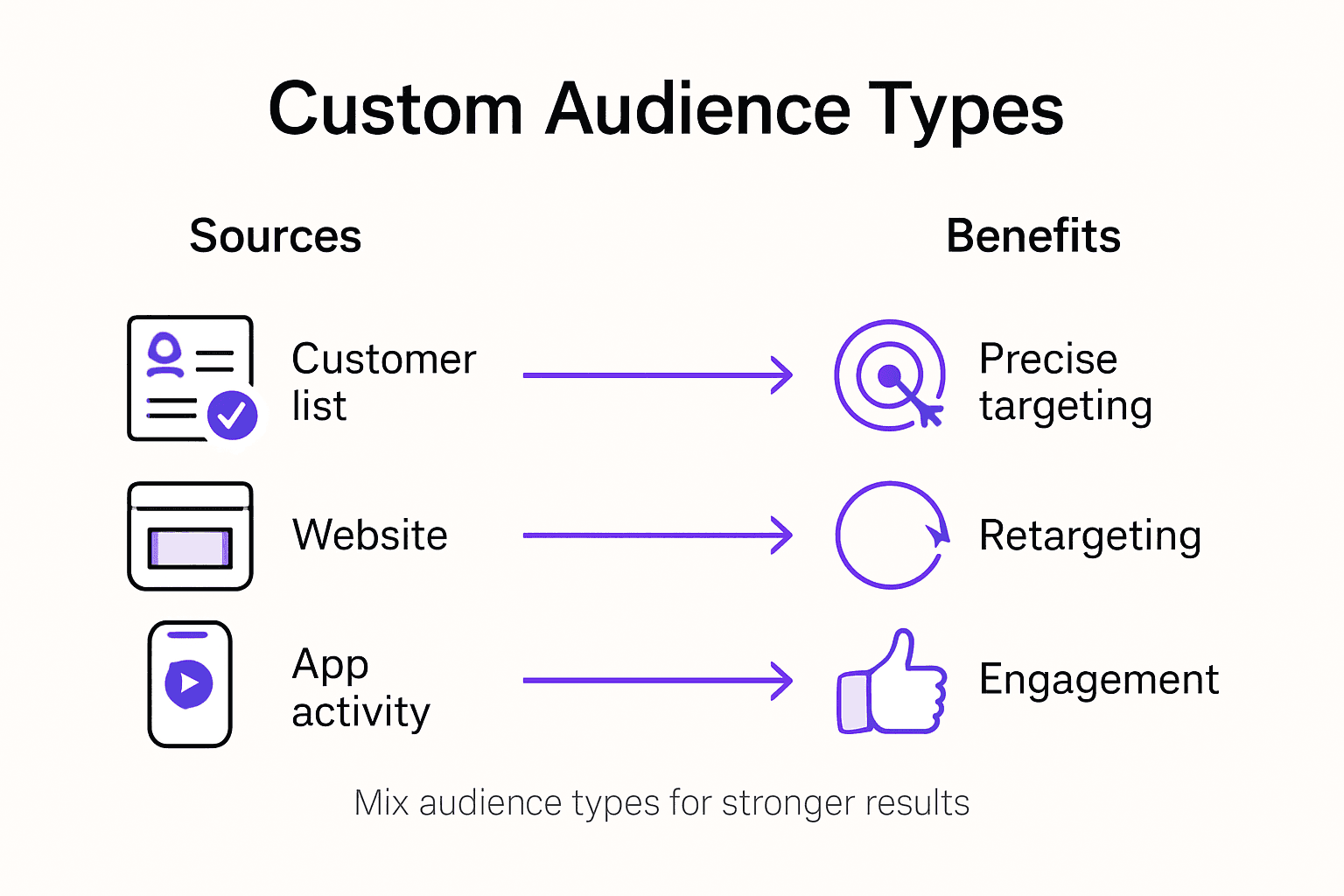
Here’s a summary of each Facebook Custom Audience type and its key marketing benefit:
| Audience Type | Unique Advantage | Ideal Use Case |
|---|---|---|
| Customer Lists | Directly reach known users | Re-engaging existing players |
| Website Visitors | Target based on browsing intent | Following up on web interest |
| App Activity | Segment by in-app behaviour | Rewarding or reactivating players |
| Engagement Audiences | Retarget Facebook content interactors | Deepening relationships with fans |
The strategic combination of these audience types empowers mobile game marketers to develop multi-layered targeting approaches. By understanding and leveraging the nuanced data from each source, developers can create more efficient, cost-effective advertising campaigns that speak directly to users’ preferences and interaction histories.
Pro tip: Experiment with combining different custom audience types to create more sophisticated, multilayered targeting strategies that maximise user acquisition potential.
How Custom Audiences Enable Effective Retargeting
Retargeting represents a critical strategy for mobile game marketers seeking to maximise user acquisition and engagement. Custom Audiences provide a powerful mechanism for reconnecting with users who have previously interacted with a mobile game, allowing developers to create highly personalised advertising experiences that dramatically improve conversion rates.
The core strength of retargeting through Custom Audiences lies in its ability to segment and target users based on specific behavioural interactions. Mobile game developers can create targeted campaigns for various user groups, such as:
- Players who downloaded but never completed the tutorial
- Users who reached a specific game level but stopped progressing
- Inactive players who haven’t opened the game in several weeks
- Users who initiated in-app purchases but didn’t complete the transaction
These granular targeting options enable marketers to craft precise messaging that addresses specific user drop-off points, potentially reactivating dormant players and improving overall user retention. By understanding and responding to individual user journeys, game developers can create more compelling re-engagement strategies that feel personalised and relevant.

The economic advantages of Custom Audiences retargeting are significant. Rather than spending resources on broad, untargeted campaigns, marketers can focus their advertising budget on users already familiar with their game, thereby reducing acquisition costs and improving return on investment. This approach transforms advertising from a scattergun strategy to a surgical, data-driven approach that speaks directly to users’ previous interactions and potential interests.
Pro tip: Create multiple retargeting segments with progressively more specific criteria to develop increasingly refined and cost-effective user re-engagement campaigns.
Essential Setup Steps and Compliance Requirements
Setting up Facebook Custom Audiences for mobile game marketing requires a strategic approach that balances technical implementation with rigorous data privacy compliance. Creating custom audiences demands careful navigation of privacy regulations and technical integration, ensuring marketers can effectively target users while maintaining legal and ethical standards.
The essential setup process involves several critical steps:
- Facebook Pixel Installation: Implement the tracking pixel on game websites and landing pages
- App SDK Configuration: Integrate Facebook’s mobile app tracking SDK for comprehensive user interaction monitoring
- Data Collection Consent: Develop clear, transparent consent mechanisms for user data collection
- Audience Segmentation: Create detailed audience groups based on specific behavioural criteria
- Privacy Policy Updates: Modify existing privacy documentation to reflect data usage practices
Compliance represents a crucial consideration in custom audience creation. Mobile game developers must adhere to international data protection regulations such as the General Data Protection Regulation (GDPR) and the California Consumer Privacy Act (CCPA). This means implementing robust user consent mechanisms, providing clear opt-out options, and maintaining transparent communication about how user data will be collected, stored, and utilised for advertising purposes.
Technical implementation requires meticulous attention to detail. Developers must ensure proper SDK integration, verify pixel tracking accuracy, and create precise audience segmentation rules that respect user privacy while enabling effective targeting. This involves understanding the nuanced requirements of different data protection frameworks and implementing technical solutions that provide both marketing effectiveness and user data protection.
Pro tip: Conduct regular audits of your custom audience setup to ensure ongoing compliance with evolving data protection regulations and maintain user trust.
Common Pitfalls and Cost-Efficient Strategies
Navigating the complex landscape of Facebook Custom Audiences requires strategic insight and careful planning. Mobile game marketers must understand the nuanced pitfalls that can undermine advertising effectiveness and budget efficiency, ensuring their targeting approaches remain precise and cost-effective.
Common pitfalls in custom audience management include:
- Audience Staleness: Failing to regularly refresh and update audience segments
- Overly Broad Targeting: Creating audiences that are too generic and unfocused
- Audience Fatigue: Repeatedly showing the same advertisements to identical user groups
- Conversion Tracking Errors: Neglecting to exclude recently converted users from retargeting campaigns
- Insufficient Segmentation: Not leveraging granular behavioural data for precise targeting
Cost-efficient strategies demand a proactive and analytical approach to audience management. Mobile game developers must continuously refine their targeting methods, focusing on creating dynamic audience segments that adapt to changing user behaviours. This involves implementing sophisticated exclusion rules, testing multiple creative variations, and maintaining a fluid approach to audience definition that responds to real-time user interaction data.
The following table contrasts common pitfalls with recommended strategies for ongoing Custom Audience optimisation:
| Pitfall | Why It’s Problematic | Optimisation Approach |
|---|---|---|
| Audience staleness | Reduces targeting relevance | Schedule regular list updates |
| Overly broad targeting | Leads to wasted ad spend | Apply granular behavioural filters |
| Conversion tracking errors | Retargets already converted users | Exclude recent converters |
| Audience fatigue | Diminishes ad effectiveness | Refresh creative and limit frequency |
The most successful marketers treat Custom Audiences as living, breathing entities that require constant monitoring and adjustment. By implementing rigorous testing protocols, leveraging lookalike audience technologies, and maintaining strict data hygiene, game developers can create targeting strategies that maximise user acquisition while minimising unnecessary advertising expenditure. The key lies in balancing technical precision with creative flexibility, ensuring that each advertising dollar is spent with maximum potential impact.
Pro tip: Implement a quarterly audience audit process that systematically reviews and refreshes your Custom Audience segments to maintain targeting precision and prevent performance degradation.
Elevate Your Mobile Game Ads with Smarter Custom Audience Targeting
Harnessing the full potential of Facebook Custom Audiences means crafting hyper-targeted, personalised campaigns that truly resonate with your players. Yet, creating engaging playable ads fast without exhausting your resources remains a significant challenge for many mobile game developers. This is where PlayableMaker steps in to transform your advertising strategy by enabling quick, no-code playable ad creation that fits within your budget. Our platform empowers you to build interactive ads that complement your segmented Custom Audiences and retargeting efforts, ensuring your ads captivate and convert effectively.
Explore how you can optimise your user acquisition and retargeting campaigns while maintaining strict compliance and cost-efficiency. Dive into our Publishing Archives for insightful tips on ad distribution and management. If you need help navigating the technical steps or overcoming audience fatigue, our Help Archives contain valuable resources to support your journey.
Ready to maximise impact with smarter Facebook Custom Audience ads? Take the next step now by creating your own interactive ads effortlessly at PlayableMaker and watch your user engagement soar.
Frequently Asked Questions
What are Facebook Custom Audiences for mobile games?
Facebook Custom Audiences allow mobile game advertisers to create targeted audience segments based on user engagement data, such as downloads, in-app purchases, and ad interactions. This precision helps to reconnect with interested users effectively.
How can I create effective Custom Audiences for my mobile game?
You can create effective Custom Audiences by uploading customer email lists, tracking website visitor behaviour, monitoring app installation and engagement metrics, and analysing previous ad interaction data to segment users based on their behaviours.
What types of Custom Audiences are available for mobile game marketing?
The primary Custom Audience types include Customer Lists, Website Visitors, App Activity Audiences, and Engagement Audiences, each offering unique targeting capabilities based on user interactions and behaviours.
How do Custom Audiences enhance retargeting strategies in mobile gaming?
Custom Audiences enhance retargeting by allowing mobile game marketers to reconnect with users who have previously engaged with the game, enabling personalised advertising experiences and improving conversion rates by addressing specific user behaviours.
Recommended
- Facebook Ads: Why Precise Targeting Transforms Mobile Game UA – playablemaker.com Facebook Ads: Why Precise Targeting Transforms Mobile Game UA
- Facebook Behavioural Targeting: Boost Mobile Game ROI – playablemaker.com Facebook Behavioural Targeting: Boost Mobile Game ROI
- Understanding Facebook Targeted Ads for Mobile Gaming – playablemaker.com Understanding Facebook Targeted Ads for Mobile Gaming
- Facebook Detailed Targeting: Boost User Acquisition Results – playablemaker.com Facebook Detailed Targeting: Boost User Acquisition Results