
TL;DR:
- Creative ideation is a structured process that involves generating, developing, and refining original marketing ideas to solve problems and foster innovation. For mobile gaming marketers, it emphasizes moving from a blank brief to compelling concepts through deliberate methods like design thinking and brainstorming techniques. When implemented iteratively with proper group dynamics and techniques, ideation produces higher-quality, more innovative campaign concepts that improve performance.
Creative ideation is the structured process of generating, developing, and refining original ideas to solve problems and drive innovation in marketing campaigns. For mobile gaming marketers, understanding creative ideation means knowing how to move from a blank brief to a compelling campaign concept through deliberate methods rather than waiting for inspiration. The process draws on frameworks like design thinking and creative brainstorming techniques to produce ideas at scale, then filter them for quality. When applied consistently, it transforms how teams approach campaign development, playable ad concepts, and player acquisition creative.
What is the ideation process in design thinking?
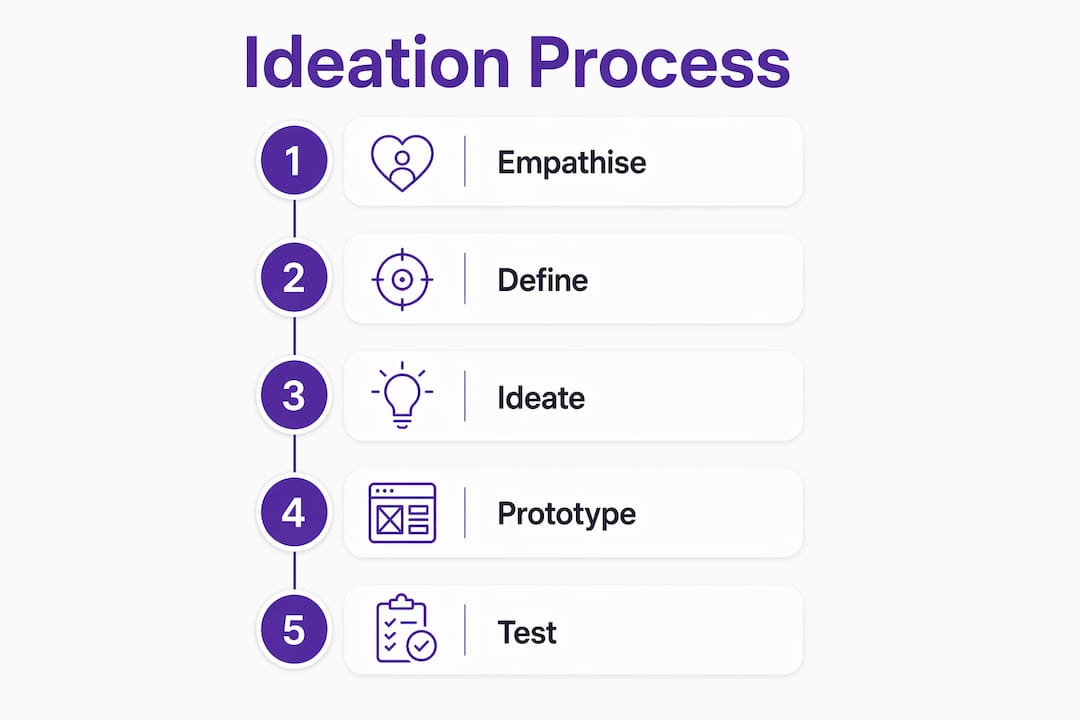
Design thinking is a five-stage iterative process: empathise, define, ideate, prototype, and test. Companies like Airbnb and Netflix have applied this framework to product and marketing decisions, using each stage to sharpen their understanding of user needs before committing to execution. The ideation stage sits at the centre of this cycle, arriving only after a team has empathised with its audience and defined the problem clearly. This sequencing matters because it prevents teams from generating solutions to the wrong question.
For mobile gaming marketing teams, the define stage might produce a brief like: “Players aged 18 to 34 abandon the game within the first session because the core loop is unclear in ads.” The ideation stage then generates as many solutions as possible to that specific problem, from mechanic-first video ads to interactive playable formats. The process is non-linear. Teams regularly loop back from prototyping to ideation when early concepts fail user testing.
The iterative nature of design thinking is what separates it from a one-off brainstorm. Each loop produces sharper creative anchors. A mobile game campaign that cycles through three rounds of ideation and low-fidelity testing will almost always outperform one built on a single creative direction chosen in a single meeting.
Key stages where ideation intersects with mobile marketing workflows include:
- Empathise: Gather player data, app store reviews, and competitor ad analysis to understand audience motivations.
- Define: Synthesise findings into a clear creative problem or opportunity statement.
- Ideate: Generate a broad range of campaign concepts, ad formats, and narrative directions without evaluation.
- Prototype: Build low-fidelity versions of the strongest concepts, such as rough storyboards or no-code playable ad drafts.
- Test: Run internal reviews and external A/B tests to validate which concepts resonate.
Divergent vs convergent thinking: why keep them separate?
Divergent and convergent thinking are two distinct cognitive modes that serve different purposes in the ideation process. Divergent thinking generates multiple varied responses to a single prompt, producing breadth and novelty. Convergent thinking narrows those responses down to the single best option through evaluation and logic. Mixing the two prematurely is one of the most common reasons ideation sessions stall.
| Thinking mode | Purpose | When to use it |
|---|---|---|
| Divergent | Generate many varied ideas without judgement | Opening phase of ideation |
| Convergent | Evaluate and select the strongest ideas | After a defined generation period |
When a team member critiques an idea during the generation phase, other participants self-censor. The result is a narrower idea pool before the evaluation phase has even begun. Separating the two modes structurally, by setting a timer for pure generation before any discussion, protects the quality of both phases.
For mobile gaming campaigns, divergent thinking might produce thirty different ad concepts for a puzzle game, ranging from tutorial-style playables to emotional narrative videos. Convergent thinking then applies filters: which concepts align with the defined player problem, which are feasible within budget, and which have performed well in analogous campaigns. The output is a shortlist worth prototyping.

Pro Tip: Set a hard rule in your ideation sessions: no evaluation language during the divergent phase. Phrases like “that won’t work” or “we tried that before” are banned until the timer ends. This single rule consistently increases the volume and originality of ideas generated.
Understanding creative ideation at this cognitive level gives marketing strategists a practical tool for session design, not just a philosophical framework.
How do group dynamics shape ideation quality?
Individual brilliance rarely produces the best campaign concepts. Research into embodied collective intelligence shows that group-level dynamics, including empathy, social regulation, and the preservation of idea diversity, determine ideation quality more reliably than any single contributor’s output. This has direct implications for how mobile gaming marketing teams structure their creative sessions.
The key mechanism is social precision weighting. In a well-functioning ideation group, participants implicitly calibrate how much weight to give each idea based on shared context and trust. When that trust is absent, or when one voice dominates, the group collapses its diversity prematurely. The result is a narrow set of ideas that reflects the loudest contributor rather than the collective intelligence of the room.
“Sustained creative ideation depends on social mechanisms balancing normative constraint and exploratory deviation, not just individual genius.” — Frontiers in Psychology, 2026
For mobile gaming marketing teams, this means session design is as important as the techniques used. A team of five with clear psychological safety will outperform a team of ten where hierarchy suppresses unconventional ideas. Rotating the role of session facilitator, anonymising initial idea submissions, and explicitly rewarding unusual contributions are all structural interventions that improve collective output.
The role of collective intelligence in mobile game marketing creative ideation is also shaped by the diversity of roles in the room. When performance marketers, narrative designers, and user acquisition specialists ideate together, the resulting concepts tend to be both creatively original and commercially grounded. Siloed ideation, where only creatives generate concepts, produces ideas that are often strong aesthetically but weak on conversion logic.
Creative strategy in advertising research consistently shows that cross-functional teams produce more testable, more differentiated campaign concepts than homogeneous groups. The social dimension of ideation is not a soft concern. It is a structural driver of campaign performance.
What ideation techniques work for mobile gaming campaigns?
Practical ideation for mobile gaming marketing requires more than a whiteboard and a timer. The following structured techniques produce measurable improvements in idea volume and quality.
-
Brainwriting: Each participant writes three ideas independently, then passes their sheet to the next person to build upon. Brainwriting increases participation from quieter contributors who are often suppressed in verbal brainstorms. For a mobile game campaign brief, this might mean each person writes three ad concept directions, then adds to a colleague’s list, producing a compounding set of variations.
-
Rapid ideation with quantity targets: Set a target of generating a high volume of ideas within a fixed window, such as thirty concepts in twenty minutes. Separating generation from evaluation and using quantity targets prevents the session from stalling on any single idea. The goal is fluency, not perfection.
-
Round robin: Each participant contributes one idea in turn, with no repetition allowed. This technique prevents dominant voices from monopolising the session and forces participants to think beyond the obvious. In a mobile gaming context, it works well for generating diverse ad format ideas across video, playable, and static formats.
-
Insight-to-anchor translation: Creative ideation for mobile campaigns works best when audience insights are translated into creative anchors before the session begins. An insight like “players feel rewarded by visible progress” becomes an anchor like “show the player winning within the first three seconds.” These anchors give the divergent phase a productive constraint.
-
Timebox and iterate: Run multiple short ideation rounds rather than one long session. Enforcing minimum idea counts and timeboxes prevents premature convergence and keeps the group in exploratory mode for longer.
Pro Tip: Before any ideation session for a mobile gaming campaign, spend fifteen minutes reviewing your top-performing ad creatives and your worst-performing ones. The failures are often more instructive than the successes, and they give the group concrete anchors to push against.
Applying these ad creative processes consistently across campaign cycles builds a repeatable ideation system rather than relying on occasional creative breakthroughs.
Key takeaways
Effective creative ideation combines structured cognitive processes, deliberate session design, and iterative testing to produce campaign concepts that are both original and commercially viable.
| Point | Details |
|---|---|
| Separate thinking modes | Run divergent and convergent phases in sequence, never simultaneously, to protect idea quality. |
| Use design thinking stages | Ideation produces better concepts when it follows a clearly defined problem statement from the define stage. |
| Design for group dynamics | Cross-functional teams with psychological safety consistently outperform homogeneous or hierarchy-bound groups. |
| Apply structured techniques | Brainwriting, rapid ideation, and insight-to-anchor translation produce more testable concepts than unstructured brainstorms. |
| Iterate at low fidelity | Prototype and test concepts before polishing to avoid fixation on the wrong creative direction. |
Where most mobile gaming teams go wrong in ideation
I have worked with enough mobile gaming marketing teams to recognise the pattern quickly. The session starts well, someone generates a genuinely unusual idea, and then a senior voice in the room says “we tried something like that in Q3 and it didn’t work.” The room contracts. The remaining ideas cluster around safe, familiar territory. The campaign that launches three weeks later looks almost identical to the last one.
The fix is not a new technique. It is a structural commitment to low-fidelity iteration before any evaluation happens. When teams know that no idea will be judged until it has been prototyped cheaply and tested quickly, the social cost of proposing something unusual drops significantly. That shift in perceived risk is what unlocks genuinely original campaign concepts.
The other mistake I see consistently is treating ideation as a single event rather than a recurring process. The teams that produce the most differentiated mobile gaming campaigns run short ideation cycles every two to three weeks, feeding learnings from live campaigns back into the next round. They treat creativity in advertising as a system, not a talent. The output compounds over time in a way that one-off brainstorms never can.
The uncomfortable truth is that most ideation sessions fail not because the team lacks creativity, but because the session design actively suppresses it. Fix the structure, and the ideas follow.
— Ondrej
How Playablemaker supports your ideation-to-execution workflow
The gap between a strong ideation session and a live campaign is where most mobile gaming marketing teams lose momentum. Playablemaker closes that gap by letting you build and test playable ad concepts without writing a single line of code. When your ideation session produces ten concept directions, you can prototype the strongest three in hours rather than weeks, test them against real audiences, and feed the results back into your next ideation cycle. The platform is built specifically for marketing teams who need to move fast without depending on developer resources. Explore how playable ads drive results for mobile marketers who treat ideation as a repeatable system.
FAQ
What is creative ideation in marketing?
Creative ideation in marketing is the structured process of generating and refining original campaign concepts through techniques like brainstorming, design thinking, and brainwriting. It produces a range of ideas that are then evaluated and prototyped before execution.
How does divergent thinking differ from convergent thinking?
Divergent thinking generates many varied ideas without judgement, while convergent thinking narrows those ideas to the single strongest option through evaluation. Separating the two phases produces better creative output than mixing them.
Why does group composition affect ideation quality?
Group dynamics, including empathy, psychological safety, and role diversity, directly influence the range and quality of ideas generated. Research shows that collective intelligence in ideation depends on social regulation, not just individual skill.
What is the best ideation technique for mobile gaming campaigns?
Brainwriting combined with insight-to-anchor translation produces strong results for mobile gaming campaigns. Brainwriting increases contribution from quieter team members, while anchors derived from audience data give the session a productive creative constraint.
How many ideas should a good ideation session produce?
Some structured brainstorming guides suggest targeting around 100 ideas in 30 minutes during rapid ideation phases. The goal is volume first, quality filtering second, to prevent premature convergence on familiar concepts.
Recommended
- Innovative ad ideas 2025: a guide for mobile gaming – playablemaker.com Innovative ad ideas 2025: a guide for mobile gaming
- Why Creatives Matter for Mobile Game Ad Success – playablemaker.com Why Creatives Matter for Mobile Game Ad Success
- Creativity in mobile advertising: how playable ads win – playablemaker.com Creativity in mobile advertising: how playable ads win
- What is a Creative Manager? Understanding Their Role – playablemaker.com What is a Creative Manager? Understanding Their Role