Over 60 percent of mobile game advertisers now turn to no-code tools for playable ad creation, yet many british specialists still struggle to define what makes a Creative Director essential in modern campaigns. As ad budgets tighten and creative standards rise, a clear understanding of strategic creative leadership becomes the key to driving user engagement and maximizing returns. Discover how Creative Directors shape mobile game advertising and unlock smarter, cost-efficient solutions for global user acquisition.
Table of Contents
- Defining Creative Director In Marketing
- Types Of Creative Directors In Advertising
- Essential Skills And Core Responsibilities
- Role In No-Code Playable Ad Creation
- Overcoming Common Pitfalls And Challenges
Key Takeaways
| Point | Details |
|---|---|
| Role of Creative Directors | Creative Directors transform brand narratives into engaging visual experiences across marketing channels, crucial for effective communication strategies. |
| Industry Diversity | Creative Directors work across various sectors, including advertising, film, and interactive media, requiring a blend of technical and storytelling skills. |
| Adaptation to No-Code Platforms | Embracing no-code platforms allows Creative Directors to streamline advertising processes, enhancing creativity while reducing technical barriers. |
| Navigating Challenges | Effective stakeholder communication and adaptability to technological changes are essential for Creative Directors to maintain artistic integrity and meet commercial goals. |
Defining Creative Director in Marketing
A Creative Director represents the strategic visionary who transforms brand narratives into compelling visual experiences across marketing channels. In the fast-evolving world of mobile advertising, these professionals serve as critical architects of communication strategies, synthesising complex brand messages into engaging, memorable content. Creative Directors are essential professionals in visual communication who translate strategic objectives into powerful creative programs.
The role extends far beyond traditional graphic design, encompassing comprehensive brand storytelling and team leadership. Creative Directors must reconcile multiple complex elements: understanding audience psychology, interpreting brand strategy, managing production constraints, and delivering creative assets that drive measurable business outcomes. They are responsible for defining visual and tonal brand systems, coordinating multidisciplinary creative teams, and maintaining consistent brand identity across diverse marketing platforms.
In the specific context of mobile game advertising and playable ads, Creative Directors play a pivotal role in crafting interactive experiences that capture user attention within seconds. Their expertise involves understanding game mechanics, user engagement principles, and leveraging brand visual and communicative direction to create compelling interactive advertisements that not only showcase game features but also generate immediate user interest.
Pro tip: When developing playable ad strategies, collaborate closely with your Creative Director to ensure every interactive element aligns precisely with your brand’s core messaging and aesthetic vision.
Types of Creative Directors in Advertising
The creative leadership landscape encompasses multiple hierarchical roles, each with distinct responsibilities and strategic focus. Advertising agencies feature a complex creative leadership ladder that ranges from entry-level design positions to senior executive creative roles. At the pinnacle sits the Chief Creative Officer (CCO), who establishes overarching creative vision and strategic direction for entire organisations.
Beneath the CCO, Executive Creative Directors (ECDs) manage multiple creative teams, ensuring strategic alignment and maintaining high-quality creative output across different projects and campaigns. Creative Directors operate at the campaign level, directly overseeing specific advertising initiatives and guiding creative teams towards executing the strategic vision. Associate Creative Directors provide supportive leadership, often serving as intermediaries between senior leadership and hands-on creative professionals.
Here’s a summary of key leadership roles in creative advertising and their distinct strategic focus:
| Role | Main Responsibility | Creative Focus | Typical Scope |
|---|---|---|---|
| Chief Creative Officer (CCO) | Sets organisation-wide creative vision | Organisation strategy | All campaigns and brands |
| Executive Creative Director (ECD) | Oversees multiple creative teams | Quality and alignment | Multiple projects and teams |
| Creative Director | Guides campaign execution | Concept and storytelling | Individual campaigns |
| Associate Creative Director | Supports senior leadership | Day-to-day direction | Liaison between levels |
Creative Directors are not confined to a single industry; they operate across diverse sectors including advertising, film, design, fashion, and interactive media. Their career trajectories typically commence in roles such as graphic designers or copywriters, progressively advancing through leadership positions. In the realm of mobile game advertising and playable ads, Creative Directors must possess a unique blend of technical understanding, storytelling skills, and interactive design expertise to craft compelling, engaging advertisements.
Pro tip: Aspiring Creative Directors should focus on developing a versatile portfolio that demonstrates both creative excellence and strategic thinking across multiple media platforms.
Essential Skills and Core Responsibilities
Creative Directors shoulder complex responsibilities that extend far beyond traditional design work. Their core responsibilities encompass delivering breakthrough creative work, driving business growth, and managing comprehensive brand visibility. This multifaceted role requires a sophisticated blend of strategic thinking, artistic vision, and pragmatic business acumen that transforms creative concepts into measurable marketing outcomes.
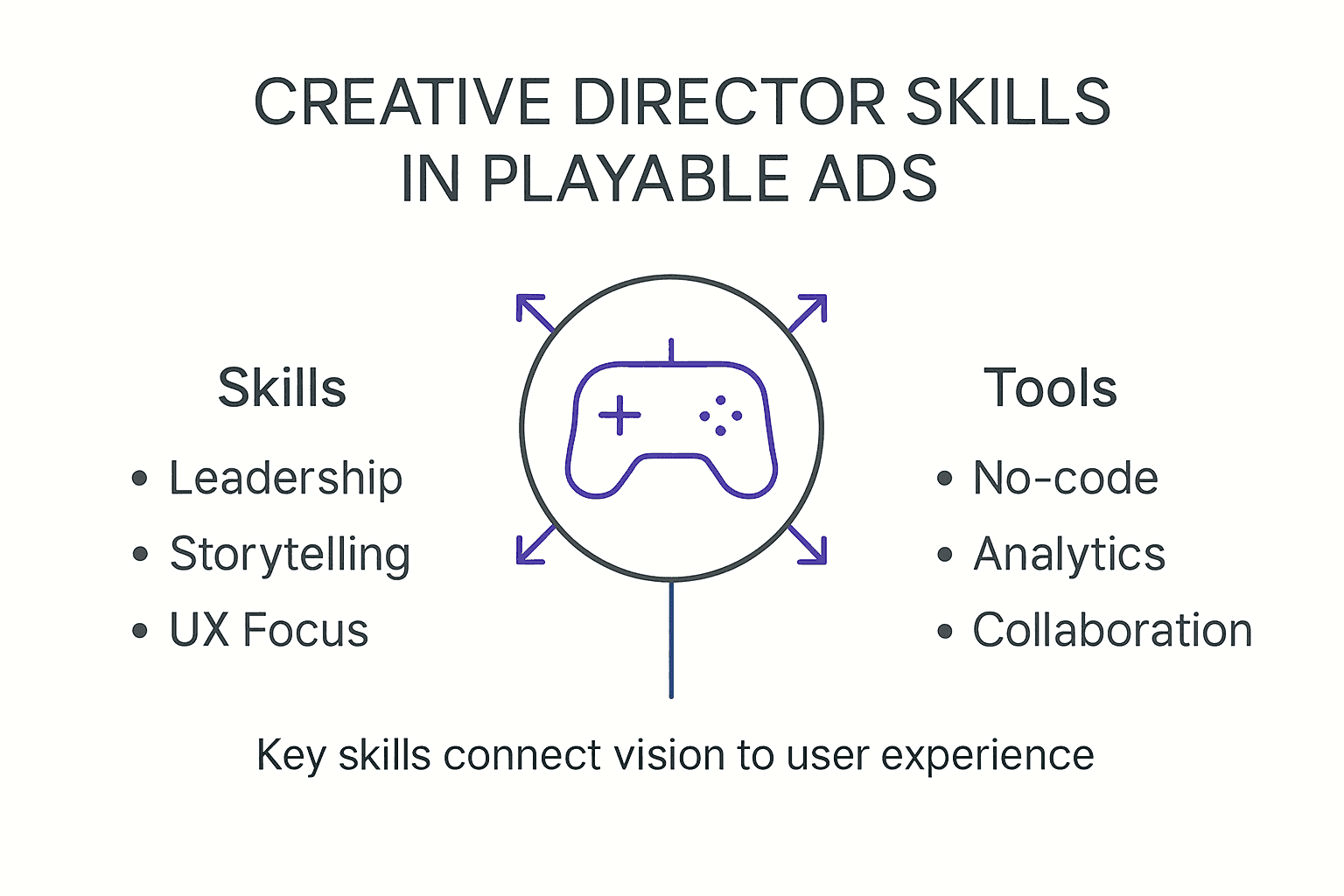
The essential skills for success in this role are diverse and interconnected. Strategic leadership remains paramount, involving the ability to synthesise complex marketing objectives with creative potential. Creative Directors must demonstrate exceptional communication skills, bridging gaps between creative teams, stakeholders, and clients. Technical proficiency has become increasingly critical, with professionals needing comprehensive understanding of digital technologies, data analytics, and emerging platforms like interactive mobile advertising.
In the specific context of playable ads and mobile game marketing, Creative Directors must cultivate a unique skill set that combines storytelling, technical understanding, and interactive design principles. They are responsible for creating compelling narrative experiences that capture user attention within seconds, translating game mechanics and brand messaging into engaging, interactive advertisements. This requires not just creative talent, but also deep comprehension of user psychology, technological constraints, and performance measurement techniques.
Pro tip: Develop a robust, cross-disciplinary portfolio that demonstrates your ability to create compelling narratives across multiple digital platforms and interactive media formats.
Role in No-Code Playable Ad Creation
Creative Directors are pivotal in revolutionising the playable ad creation process, particularly with the emergence of no-code platforms that democratise interactive advertising design. These platforms transform complex game mechanics and brand storytelling into accessible, user-friendly experiences that require minimal technical expertise while maintaining high creative standards.
In no-code environments, Creative Directors serve as strategic architects who translate complex marketing objectives into engaging, interactive narratives. Their role shifts from hands-on design to a more consultative approach, focusing on conceptual direction, user experience strategy, and ensuring that each interactive ad maintains brand integrity. This involves guiding design teams, defining core interactive elements, and establishing creative parameters that can be easily implemented through intuitive drag-and-drop interfaces and pre-configured templates.

The transition to no-code platforms represents a significant evolution in creative workflow, enabling faster iteration, reduced development costs, and greater accessibility for marketing teams. Creative Directors must now possess a hybrid skill set that combines traditional creative leadership with an understanding of user interface design, interaction principles, and digital platform capabilities. They act as critical mediators between creative vision and technological implementation, ensuring that complex marketing strategies can be rapidly transformed into compelling, interactive advertising experiences.
The following table highlights the unique impacts of no-code platforms on the Creative Director’s workflow in playable ad creation:
| Aspect | Traditional Workflow | No-Code Platform Workflow |
|---|---|---|
| Role Focus | Hands-on design and direction | Conceptual leadership and guidance |
| Iteration Speed | Slower, heavy on development | Rapid, fast prototyping enabled |
| Technical Barrier | Requires coding or scripting skills | Minimal to no code required |
| Team Involvement | Larger, specialised teams needed | Smaller, cross-functional teams |
| Creative Control | Direct but time-intensive | Broad, with quick testing possible |
Pro tip: Invest time in understanding no-code platform capabilities and limitations to maximise your creative potential and streamline ad production workflows.
Overcoming Common Pitfalls and Challenges
Creative Directors in the rapidly evolving landscape of interactive advertising face multifaceted challenges that demand strategic problem-solving and adaptive leadership. These professionals encounter significant obstacles including time constraints, stakeholder misalignment, and complex resource management that can potentially obstruct creative output and organisational efficiency.
In the specific domain of playable ad creation, Creative Directors must navigate intricate balancing acts between artistic vision and commercial imperatives. Stakeholder communication becomes paramount, requiring nuanced approaches to translate creative concepts into measurable marketing objectives. Cross-cultural challenges further complicate these interactions, necessitating strategic leadership and cultural sensitivity when managing diverse teams and global marketing initiatives.
Technological disruptions, particularly the rise of no-code platforms, introduce additional complexity to the creative workflow. Creative Directors must continuously upskill, developing hybrid competencies that blend traditional creative leadership with technical understanding. This requires maintaining artistic integrity while embracing technological innovations that streamline production processes, reduce development costs, and accelerate market responsiveness.
Pro tip: Cultivate a flexible mindset that views technological changes as opportunities for creative innovation rather than obstacles to traditional design practices.
Empower Your Playable Ads with No-Code Creative Leadership
Creative Directors face significant challenges bringing complex interactive ideas to life quickly and cost-effectively especially within mobile game advertising. When balancing storytelling with technical and budget constraints the innovative no-code approach offered by PlayableMaker can be a true game changer. This platform empowers marketing teams and creative leads to build engaging playable ads rapidly without draining developer resources or blowing budgets. It solves the critical pain points of slow iteration speed and high development costs highlighted in the creative workflow.
Discover how to transform your creative vision into compelling interactive experiences while maintaining full control and brand consistency. Explore insights, tips, and support in the Help Archives to maximise your creative potential. For publishing and launching your ads seamlessly, visit the Publishing Archives. Ready to streamline your playable ad creation process today Join thousands who trust PlayableMaker for fast no-code solutions that bring your creative direction to life with ease and budget-friendly speed.
Frequently Asked Questions
What is the role of a Creative Director in marketing?
A Creative Director in marketing is responsible for transforming brand narratives into compelling visual experiences, overseeing creative teams, and ensuring cohesive brand storytelling across various channels.
How do Creative Directors impact playable ads?
Creative Directors significantly influence playable ads by crafting engaging interactive experiences that capture user attention quickly, translating game mechanics and brand messaging into memorable advertisements.
What skills are essential for a Creative Director in the context of mobile advertising?
Essential skills include strategic leadership, exceptional communication, technical proficiency in digital technologies, storytelling capabilities, and understanding user engagement principles relevant to mobile advertising.
How have no-code platforms changed the workflow for Creative Directors?
No-code platforms have streamlined ad creation for Creative Directors by enabling faster iterations, reducing technical barriers, and allowing them to focus on conceptual leadership rather than hands-on design, thereby enhancing the creative process.
Recommended
- Understanding the Role of Creative Director in Gaming – playablemaker.com Understanding the Role of Creative Director in Gaming
- Creative Director Description: Leading Mobile Game Ads – playablemaker.com Creative Director Description: Leading Mobile Game Ads
- Concept of Creativity in Advertising Explained – playablemaker.com Concept of Creativity in Advertising Explained
- Concept of Creativity in Advertising Explained – playablemaker.com Concept of Creativity in Advertising Explained
- Creative Thinking Exercises for Future Entrepreneurs 2025 | siift