More than 60 percent of british and European mobile game studios now rely on budget-friendly, no-code playable ads to fuel successful user acquisition campaigns. Rapid audience growth demands fresh creative strategies, especially for creative directors balancing innovation with tight resources. Discover how no-code platforms are giving creative teams the tools to experiment faster, deliver standout experiences, and keep their games ahead in a fiercely competitive market.
Table of Contents
- Creative Director Role Defined in Mobile Games
- Key Responsibilities in User Acquisition Campaigns
- Essential Skills for Leading Creative Teams
- No-Code Playable Ads: Impact on Workflow
- Collaboration and Innovation in Mobile Studios
Key Takeaways
| Point | Details |
|---|---|
| Creative Director’s Role | Creative Directors in mobile gaming lead the artistic and strategic vision, requiring strong communication and collaboration across various teams to ensure compelling narratives and brand consistency. |
| User Acquisition Strategy | They are essential in crafting visual narratives for user acquisition campaigns, focusing on data-driven creative decisions to attract and retain players. |
| Leading Creative Teams | Successful leadership demands a blend of artistic insight and technical skills, enabling directors to motivate teams and translate complex ideas into actionable strategies. |
| Impact of No-Code Platforms | No-code tools streamline the ad development process, promoting creativity and rapid iteration while minimising technical barriers for the entire team. |
Creative Director Role Defined in Mobile Games
A Creative Director in mobile gaming represents the central visionary and strategic leader responsible for defining the artistic, narrative, and experiential direction of a game’s advertising and overall creative output. Creative directors navigate complex interdisciplinary environments where their role transcends traditional artistic management and extends into comprehensive project leadership.
At the core of a creative director’s responsibilities lies the ability to synthesise multiple creative perspectives into a cohesive, compelling vision. They work intimately with art teams, narrative designers, marketing specialists, and game developers to ensure that every visual and interactive element communicates the intended emotional experience. This requires exceptional communication skills, profound understanding of visual storytelling, and the capacity to translate abstract concepts into tangible creative strategies.
The creative director’s mandate involves several critical dimensions: establishing the game’s aesthetic language, guiding advertising campaigns, maintaining brand consistency, and ensuring that all creative outputs align with the studio’s strategic objectives. They must possess a rare combination of artistic sensitivity, technological understanding, and business acumen – balancing creative expression with commercial viability. Their decisions directly influence user acquisition, player engagement, and ultimately, the game’s market success.
Pro tip: Develop a comprehensive portfolio showcasing your ability to create cohesive visual narratives across multiple platforms and understand how different creative elements interact to tell a compelling story.
Key Responsibilities in User Acquisition Campaigns
A Creative Director in mobile gaming plays a pivotal role in designing and executing successful user acquisition (UA) campaigns, with responsibilities that extend far beyond traditional creative management. Strategically aligning creative output with campaign performance metrics requires a nuanced understanding of both artistic expression and data-driven decision-making.
The primary responsibilities encompass several critical domains. First, creative directors must develop compelling visual narratives that capture user attention within seconds. This involves crafting engaging video advertisements, interactive playable ads, and designing creative assets that communicate the game’s core value proposition. They must constantly iterate and test different creative approaches, analysing performance metrics to refine and optimise campaign effectiveness.

Moreover, creative directors coordinate cross-functional collaboration between marketing teams, game designers, and analytics specialists. Their strategic insights drive user acquisition strategies by translating complex data insights into actionable creative directions. They must balance artistic innovation with measurable business outcomes, ensuring that each creative asset not only attracts new users but also contributes to long-term player retention and engagement.
Pro tip: Develop a systematic approach to creative testing that allows for rapid iteration, combining quantitative performance data with qualitative user feedback to continuously improve your user acquisition campaign strategies.
Essential Skills for Leading Creative Teams
Leading creative teams in mobile gaming requires a sophisticated blend of artistic vision and strategic leadership. Creative directors must master a complex set of interpersonal and technical skills that enable them to inspire, manage, and drive innovation across multidisciplinary teams.
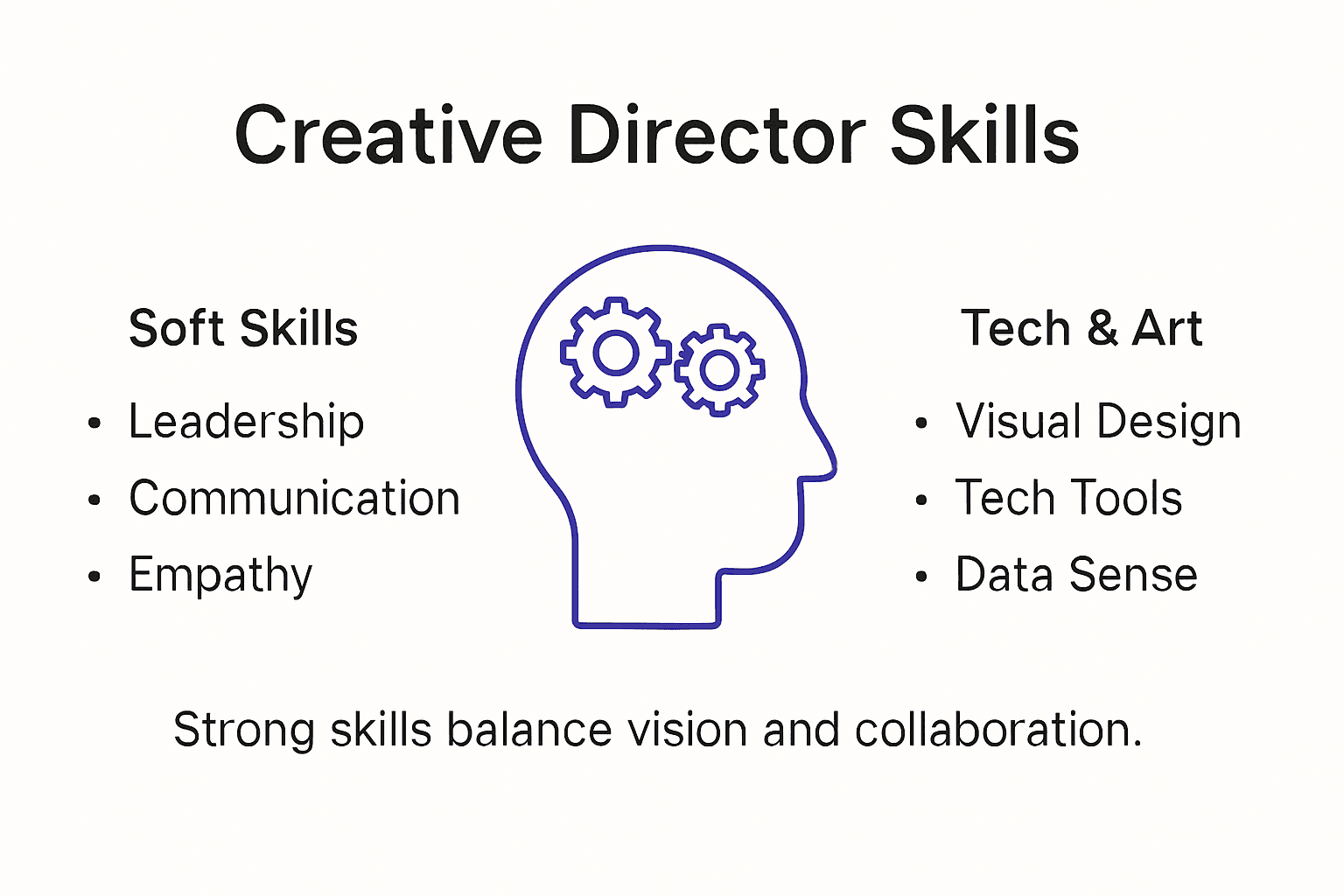
The fundamental skills encompass advanced communication, emotional intelligence, and technological proficiency. Creative directors must articulate complex creative concepts with clarity, bridging gaps between artistic teams, technical developers, and business strategists. This involves developing a nuanced communication style that can translate abstract creative vision into actionable strategies, while simultaneously motivating team members and maintaining a collaborative, innovative environment.
Effective creative leadership demands a delicate balance between artistic intuition and data-driven methodologies. Modern creative directors must be adept at leveraging business intelligence, understanding performance metrics, and making strategic decisions that align creative output with commercial objectives. This requires continuous learning, adaptability, and a willingness to experiment with emerging technologies such as artificial intelligence and advanced analytics tools.
Pro tip: Develop a personal development framework that allocates dedicated time for skills updating, technological exploration, and cross-disciplinary learning to stay ahead in the rapidly evolving mobile gaming creative landscape.
Here is a summary of key skills required for creative directors in mobile gaming:
| Skill Area | Description | Importance in Role |
|---|---|---|
| Artistic Vision | Setting visual and narrative direction | Critical for brand coherence |
| Communication | Conveying ideas across teams | Essential for collaboration |
| Technological Savvy | Adopting tools and analytics | Drives innovation and agility |
| Data Interpretation | Using metrics for creative decisions | Optimises campaign performance |
| Leadership | Inspiring and managing creative teams | Fosters innovation and cohesion |
No-Code Playable Ads: Impact on Workflow
No-code platforms are fundamentally transforming the creative workflow for mobile game advertising, offering unprecedented flexibility and efficiency. Drag-and-drop platforms are empowering creative teams to produce and customise playable ads without traditional coding constraints, dramatically reducing technical barriers and accelerating the ad development process.
The most significant workflow impact emerges through increased creative autonomy and rapid iteration capabilities. Creative directors can now directly manipulate ad elements, experiment with design variations, and quickly test different interactive experiences without relying on extensive developer resources. This shift allows for more agile creative processes, enabling teams to respond faster to market trends, user feedback, and performance analytics.
Moreover, no-code technologies democratise ad creation by reducing the technical skills required to produce high-quality, engaging playable advertisements. By eliminating complex coding requirements, these platforms enable broader team participation, facilitate cross-functional collaboration, and allow creative professionals to focus more on storytelling and user experience design rather than technical implementation. The result is a more streamlined, efficient workflow that prioritises creative innovation and strategic thinking.
Pro tip: Implement a structured experimentation framework within your no-code playable ad workflow, allocating specific time for creative exploration and systematic performance tracking to continuously refine your advertising approach.
This table compares traditional and no-code approaches to playable ad development:
| Approach | Development Speed | Skill Requirements | Impact on Creativity |
|---|---|---|---|
| Traditional | Slower, developer-led | High coding knowledge | Limits rapid experimentation |
| No-Code Platform | Fast, drag-and-drop | Minimal technical need | Enables quick creative trials |
Collaboration and Innovation in Mobile Studios
Innovation in mobile game studios emerges through sophisticated collaborative frameworks that transcend traditional team structures. Structured teamwork and cross-disciplinary integration serve as fundamental mechanisms for driving creative breakthroughs in an increasingly competitive digital entertainment landscape.
Mobile game studios cultivate innovation by establishing dynamic team environments that encourage open communication, knowledge sharing, and experimental thinking. Creative professionals, technical developers, and strategic leaders must work seamlessly, breaking down traditional departmental silos. This approach allows for rapid prototyping, iterative design processes, and the cross-pollination of ideas that can transform initial concepts into groundbreaking gaming experiences.
Collaborative models in game development increasingly emphasise distributed teamwork and flexible knowledge exchange, recognising that innovation stems from diverse perspectives and collective problem-solving. Modern mobile game studios implement agile methodologies, create multidisciplinary teams, and develop communication protocols that enable quick adaptation, continuous learning, and creative risk-taking. By fostering a culture that values experimentation and respects individual expertise, these studios create environments where innovative ideas can flourish.
Pro tip: Implement weekly cross-functional workshops that rotate team members across different project roles to stimulate fresh perspectives and break down communication barriers between creative and technical disciplines.
Streamline Creative Leadership with No-Code Playable Ads
Leading mobile game ads demands a sharp focus on creative vision, rapid iteration, and collaboration across teams. The article highlights challenges such as balancing artistic innovation with data-driven optimisation and managing complex workflows that often rely heavily on developer resources. This can slow down creative testing and limit the ability to respond quickly to user acquisition campaign needs.
At PlayableMaker, we understand how crucial it is for Creative Directors and their teams to have full creative autonomy without the traditional technical bottlenecks. Our no-code platform empowers you to build playable and interactive ads fast, freeing you from costly developer dependencies and extended timelines. By simplifying playable ad creation, PlayableMaker enables your team to rapidly iterate and experiment, helping you deliver compelling narratives that boost user acquisition and engagement.
Explore how our solution complements the strategic demands of creative leadership. Start transforming your mobile game advertising today by visiting PlayableMaker. For insights on navigating creative workflows and campaign publishing, check out our Publishing Archives and find helpful resources in our Help Archives. Don’t let technical limits hold your vision back; take control and innovate now.
Frequently Asked Questions
What is the role of a Creative Director in mobile gaming?
A Creative Director in mobile gaming is responsible for defining the artistic, narrative, and experiential direction of a game, overseeing all creative outputs to ensure they align with the game’s vision and commercial objectives.
How does a Creative Director impact user acquisition campaigns?
A Creative Director influences user acquisition campaigns by crafting compelling visual narratives and creative assets that capture user attention, while analysing performance metrics to refine and optimise the effectiveness of these campaigns.
What essential skills should a Creative Director possess?
A Creative Director should possess advanced communication skills, artistic vision, technological proficiency, data interpretation abilities, and strong leadership skills to effectively manage creative teams and align outputs with business goals.
How do no-code platforms benefit the workflow of Creative Directors?
No-code platforms empower Creative Directors by enabling rapid creation and testing of playable ads without extensive coding, allowing for more agile processes and greater focus on storytelling and user experience design.
Recommended
- Creative Manager Explained: Key Role in Mobile Gaming – playablemaker.com Creative Manager Explained: Key Role in Mobile Gaming
- Understanding the Role of Creative Director in Gaming – playablemaker.com Understanding the Role of Creative Director in Gaming
- Master Effective Ad Creative Processes for Mobile Gaming – playablemaker.com Master Effective Ad Creative Processes for Mobile Gaming
- What is a Creative Manager? Understanding Their Role – playablemaker.com What is a Creative Manager? Understanding Their Role
- Mobile SEO: Key Ranking Factors