
TL;DR:
- Efficient creative delivery workflows are vital for mobile game marketing teams to speed up campaign launches and improve performance. Implementing structured intake, work splitting, single-approver policies, and branded portals reduces delays and revision cycles, enabling scalable asset production. Most bottlenecks stem from process inefficiencies rather than talent, making operational discipline the key to faster, higher-quality creative outputs.
The creative delivery process is the structured set of steps, tools, and governance rules that takes a mobile game ad from brief to final asset in the hands of a media buyer or platform. For mobile gaming marketing teams, where playable ads, video creatives, and interactive formats must ship at pace across Meta, Google UAC, and ironSource, a poorly designed process is the single largest drag on campaign performance. Most delays stem from unclear briefs and approval sprawl, not from a shortage of creative talent. The industry term for the discipline that governs this end-to-end flow is Creative Operations, and understanding it is the foundation for everything that follows.
What are the key components of an efficient creative delivery process?
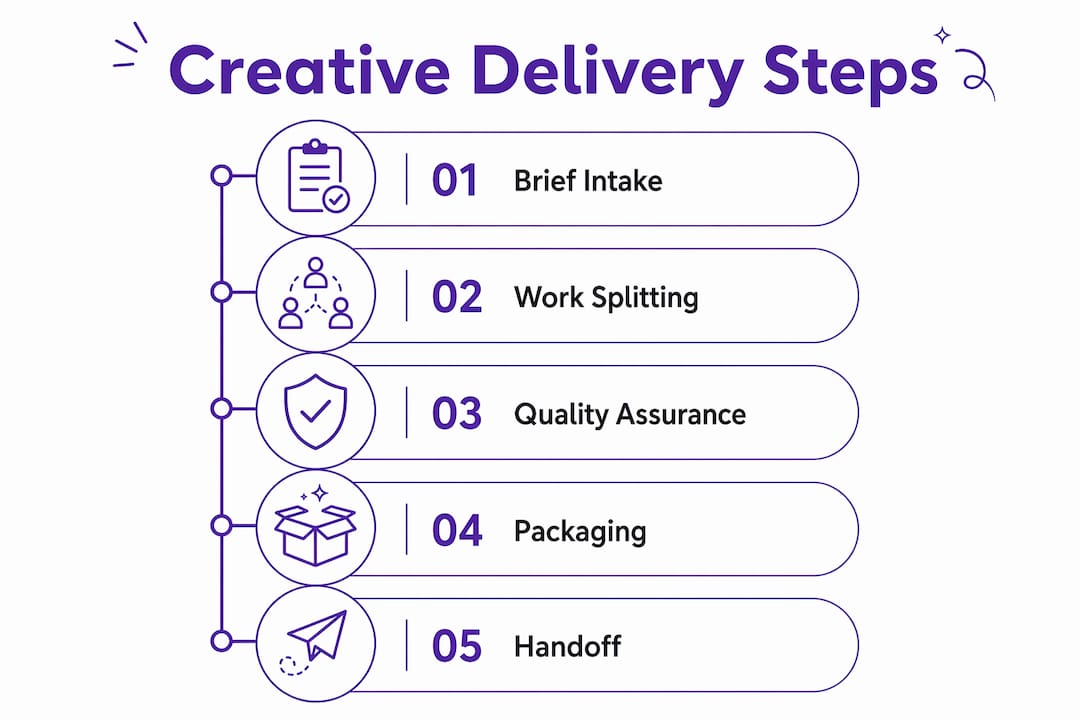
Creative Operations is the operating system enabling faster outputs for any marketing team. It defines how work enters the system, how it moves through production, and how it exits cleanly to the client or media platform. For mobile gaming teams producing dozens of ad variants per week, each component below is load-bearing.
1. Structured intake with validated briefs
Validated briefs at intake correlate directly with the speed and quality of output. A validated brief means the request arrives through a single channel, passes a defined checklist before production begins, and contains all the information a designer or developer needs without a follow-up call. Tools like Atlassian’s Jira or purpose-built intake forms enforce this gate automatically.

2. Work splitting into lanes
Not all creative requests carry the same urgency or complexity. Splitting work into three lanes keeps the pipeline moving:
- BAU (business as usual): Routine resizes, copy swaps, and format adaptations
- Burst: High-volume campaign launches requiring rapid iteration
- Project: New playable ad builds or full creative concept development
Each lane has its own SLA, resource allocation, and review cadence. Without this separation, a large project blocks routine BAU work and causes missed deadlines across the board.
3. Quality assurance before approval
QA gates placed before an asset reaches the approver catch technical errors, brand inconsistencies, and spec violations early. This step alone prevents the most common source of revision cycles in mobile game ad production: an approver rejecting work for a fixable technical reason that QA should have caught first.
4. Delivery packaging and handoff
Final assets must be organised logically, named consistently, and delivered through a secure channel. Flat folders sent via email are a professional liability. Structured subfolders, clear naming conventions, and a brief README file for complex deliveries set a higher standard.
Pro Tip: Use a standardised naming convention such as [GameTitle][Format][Size]_[Version] for every asset. This single habit eliminates the most common source of confusion during media buying.
Standardised templates and automated intake reduce review cycles by 20% and cut approval time by 50%. That figure translates directly into faster campaign launches and more iterations tested per quarter.
Which automation tools can speed up mobile game ad delivery?
Automation is the difference between a creative team that scales and one that simply works longer hours. The analogy from physical logistics is instructive: manual order routing becomes unscalable above 200 orders per day, and the same principle applies to creative asset routing when volume climbs. Below is a comparison of the tool categories most relevant to mobile gaming marketing teams.
| Tool category | Primary function | Example tools |
|---|---|---|
| Intake and ticketing | Capture, validate, and route creative requests | Atlassian Jira, Monday.com |
| Asset delivery portals | Branded, secure, expiring links for final delivery | TrunkTransfer |
| No-code ad builders | Rapid production of playable and interactive ads | Playablemaker |
| AI feedback summarisation | Consolidate review threads into a single change list | AI layers within approval platforms |
| Capacity planning | Map workload against bandwidth ahead of campaign peaks | Spreadsheet-based or integrated PM tools |
AI can consolidate multiple feedback threads into a single, human-approved change list, cutting unnecessary revision cycles while maintaining quality control. This is particularly valuable in mobile gaming campaigns where multiple stakeholders, including performance marketers, brand managers, and studio teams, all submit feedback on the same creative.
Delivery portals deserve specific attention. Branded portals with auto-expiring links of around 30 days remove third-party advertising from the delivery experience and signal professionalism to media partners and clients. TrunkTransfer is one tool built specifically for this use case.
Pro Tip: Connect your intake form directly to your project management tool so that every validated brief automatically generates a ticket, assigns an owner, and sets a due date. This removes the manual handoff that most teams still do by email.
A multi-hub content delivery approach mirrors the logic of distributed fulfilment networks in e-commerce. When creative assets are stored and served from geographically distributed infrastructure, delivery speed to global media platforms improves. This matters for gaming studios running simultaneous campaigns across North America, Europe, and South-East Asia.
How to manage approvals and revision cycles without bottlenecks
Approval sprawl is the most common reason a mobile game ad misses its go-live date. The fix is structural, not cultural.
The one-approver-only policy is the single most effective structural change a team can make. Other stakeholders provide input, but only one person holds sign-off authority per asset. This eliminates the scenario where conflicting feedback from three people sends a creative back to square one.
Beyond the single approver, the following practices reduce revision cycles in practice:
- Set a revision limit. Two rounds of revisions is the standard. A third round triggers a brief review meeting, not another round of guesswork.
- Require actionable feedback. Feedback must specify what to change and why. “Make it pop” is not actionable. “Increase the CTA button size by 20% and change the colour to the brand red” is.
- Run QA before every approval request. An asset that fails a technical spec check should never reach the approver. QA is the team’s responsibility, not the approver’s.
- Hold weekly triage sessions. A 15-minute review of all in-flight work surfaces blockers before they become delays.
You can find a detailed breakdown of how to structure these steps in this guide to ad creative review workflow for mobile game marketers.
Pro Tip: Build a simple feedback form into your approval step. Ask approvers to select from a predefined list of change categories before writing free-text notes. This alone reduces ambiguous feedback by a significant margin.
Capacity planning sits alongside approval management as a structural fix. Monthly 30-minute capacity planning sessions prevent last-minute rushes and allow campaign-based and subscription-based work to be balanced proactively. Without this session, gaming marketing teams routinely discover mid-sprint that three campaigns are competing for the same two designers.
What are best practices for final creative delivery and post-delivery follow-up?
The final delivery step is where many otherwise well-run processes fall apart. A polished asset delivered through a disorganised handoff undermines the work that preceded it.
Follow these steps to deliver professionally every time:
- Organise files into logical subfolders. Group by format, platform, and size. A media buyer should be able to find the correct asset in under 30 seconds.
- Apply a consistent naming convention. Use the convention agreed at intake. Never rename files at the delivery stage.
- Use a branded delivery portal. Avoid flat folder deliveries; use a portal with your branding, no third-party advertising, and an auto-expiring link.
- Include a brief delivery note. Two to three sentences confirming what is included, any known limitations, and the next step. This is not a cover letter; it is a functional handoff document.
- Set link expiry and track acknowledgement. A 30-day expiry is standard. Confirm the recipient has accessed the files within 48 hours.
- Send a brief follow-up. Three to five days after delivery, check whether the assets have been uploaded and whether any technical issues have emerged. This step catches problems before they affect campaign launch.
- Archive assets and log delivery details. Record the delivery date, recipient, asset versions, and portal link in your project management tool. This log is essential for audits and future campaign iterations.
A brief satisfaction check after delivery, one or two questions sent by email, provides data that improves the next brief. It also signals to media partners and clients that the team operates with discipline.
Key takeaways
A structured Creative Operations system is the most reliable way to reduce approval time, accelerate campaign launches, and scale mobile game ad production without proportional increases in headcount.
| Point | Details |
|---|---|
| Validate briefs at intake | A single-channel intake with a validation gate prevents the majority of production errors and revision cycles. |
| Split work into lanes | Separating BAU, burst, and project work protects routine delivery from being blocked by large builds. |
| Enforce one approver per asset | A single sign-off authority cuts revision cycles and removes conflicting feedback as a source of delay. |
| Use branded delivery portals | Secure, expiring, branded links replace flat folder handoffs and raise the standard of client delivery. |
| Plan capacity monthly | A 30-minute monthly session prevents campaign peaks from creating reactive, overloaded sprints. |
Why I think most mobile gaming teams are solving the wrong problem
After working closely with mobile gaming marketing teams, the pattern I see most often is this: a team invests in hiring more designers or buying more creative tools, but the output does not improve proportionally. The bottleneck is almost never talent or tooling. It is the system those people and tools operate within.
The teams that produce the most creative volume per person are not necessarily the most talented. They are the most disciplined about intake, approvals, and delivery packaging. They treat creative approval workflow as infrastructure, not administration.
The uncomfortable truth is that most gaming marketing teams tolerate approval sprawl because challenging it feels political. Telling a senior stakeholder they no longer have sign-off authority on ad creatives is a difficult conversation. But the data is clear: one approver per asset is the structural change with the highest return.
I would also push back on the assumption that AI tools are primarily useful for generating creative concepts. The highest-value application I have seen is AI summarising feedback threads into a single change list. It removes the most tedious and error-prone step in the revision cycle without replacing human judgement at the approval stage.
If you are managing playable ad production specifically, the complexity multiplies. Playable ads require coordination between designers, developers, and performance marketers, and the delivery format is more technically demanding than a static or video asset. Building a structured process around playable ad production is not optional at scale. It is the only way to maintain quality and speed simultaneously.
— Ondrej
How Playablemaker supports a faster creative delivery workflow
Playablemaker is built for mobile gaming marketing teams that need to produce playable and interactive ads quickly, without developer dependency and without overspending. The platform’s no-code builder removes the production bottleneck that typically sits between a validated brief and a finished playable ad. When your intake and approval process is structured correctly, Playablemaker lets you move from approved concept to live asset in a fraction of the time a traditional development workflow requires. Explore why playable ads work at a psychological level, or go straight to understanding playable ads for game marketing to see how the format fits your campaign strategy.
FAQ
What is a creative delivery process in mobile game marketing?
The creative delivery process is the end-to-end workflow that takes an ad brief through production, review, approval, and final handoff to a media platform or client. In mobile gaming, it covers formats including playable ads, video, and static creatives across multiple platforms.
How does automation improve creative delivery for gaming campaigns?
Automation removes manual handoffs at intake, routing, and approval stages. Standardised workflows and automated intake reduce review cycles by 20% and approval time by 50%, allowing teams to ship more creative iterations per campaign period.
Why does the one-approver rule matter for ad creative teams?
A single approver per asset eliminates conflicting feedback and prevents revision cycles from multiplying. The one-approver-only policy is the structural change with the most direct impact on delivery speed.
What should a final creative delivery package include?
A professional delivery package includes logically organised subfolders, a consistent naming convention, a branded delivery portal link with an expiry date, and a brief delivery note confirming contents and next steps.
How often should mobile gaming teams run capacity planning sessions?
Monthly 30-minute sessions are sufficient for most teams. These sessions map upcoming campaign demand against available bandwidth and prevent reactive, overloaded sprints during peak periods.
Recommended
- Creative Testing for Mobile Games: Step-by-Step Success – playablemaker.com Creative Testing for Mobile Games: Step-by-Step Success
- Why Creatives Matter for Mobile Game Ad Success – playablemaker.com Why Creatives Matter for Mobile Game Ad Success
- 7 Creative Ad Concepts for Mobile Game User Acquisition – playablemaker.com 7 Creative Ad Concepts for Mobile Game User Acquisition
- How to Repurpose Ad Creatives for Mobile Gaming Success – playablemaker.com How to Repurpose Ad Creatives for Mobile Gaming Success