Managing playable ad campaigns can feel like herding cats when every stakeholder interprets your brief differently. For user acquisition managers in mobile gaming, finding an approach that gets your team, designers, and external partners on the same page is no small feat—especially with tight deadlines and lean budgets. A creative brief is a facilitative document that bridges the gap between business objectives and creative execution, providing clarity and direction for building effective, attention-grabbing ads with no-code tools.
Table of Contents
- Defining A Creative Brief In Advertising
- Core Components And Structure Explained
- Types And Variations For Mobile Gaming
- Role In No-Code Playable Ad Creation
- Common Pitfalls And How To Avoid Them
Key Takeaways
| Point | Details |
|---|---|
| Importance of a Creative Brief | A creative brief serves as a strategic blueprint aligning all stakeholders towards a common goal in ad campaigns. |
| Core Sections | Your brief should include objectives, audience insights, and creative strategy to ensure clarity and alignment. |
| Format Adaptation | Different ad formats require tailored brief structures, emphasising specific elements relevant to each format. |
| No-Code Context | In no-code ad production, a detailed brief is essential to define achievable interactions and prevent scope creep. |
Defining a Creative Brief in Advertising
A creative brief is a facilitative document that bridges the gap between business objectives and creative execution. For user acquisition managers running mobile gaming campaigns, think of it as your strategic blueprint—the written agreement between your team, creative designers, and external agencies about what needs to be built and why. Rather than a rigid rulebook, the brief adapts as you learn more about what resonates with your players, making it invaluable for teams building playable ads under time and budget constraints.
At its core, a creative brief in advertising functions as a vital blueprint that aligns all participants in the creative process towards a shared objective. It serves to define goals, deliverables, constraints, and additional relevant information specific to your ad campaign. For mobile gaming acquisition managers, this means documenting exactly what your playable ad should accomplish—whether that’s demonstrating core gameplay mechanics in 30 seconds, showcasing progression systems, or highlighting the game’s most engaging feature. The brief captures your audience insights beyond basic demographics, drilling into player motivations, pain points, and what makes them tap instead of skip.
What makes a creative brief particularly powerful for your use case is how it reduces friction between stakeholders. When your design team, marketing manager, and creative partner all work from the same brief, you eliminate costly revisions born from misalignment. Your brief articulates the key message your playable ad must communicate, the tone of voice (casual, competitive, aspirational), and the specific constraints—whether that’s keeping file size under 5MB or ensuring the ad works across both iOS and Android devices. This clarity means your team produces work aligned with defined goals and audience preferences on the first or second iteration, not the fifth.
The brief also serves as risk mitigation, particularly valuable when working with no-code platforms where you need crystal-clear direction to maximise your creative output without developer overhead. When building playable ads through no-code solutions, your brief prevents the “not invented here” syndrome where teams disregard initial direction and veer off course mid-project. Instead, everyone references the same document to understand whether a particular interaction mechanic, colour scheme, or gameplay element genuinely serves your acquisition strategy or simply felt like a good idea in the moment.
Your creative brief should include three core sections: clear objectives (what success looks like for this ad), detailed audience insights (who you’re targeting and what motivates them), and creative strategy (the specific approach you’ll take to capture attention and drive installs). For playable ad teams specifically, your brief becomes especially valuable when defining the interactive experience—which features to prioritise, how many taps before reaching the install button, and whether players should experience success or difficulty during the playable section.
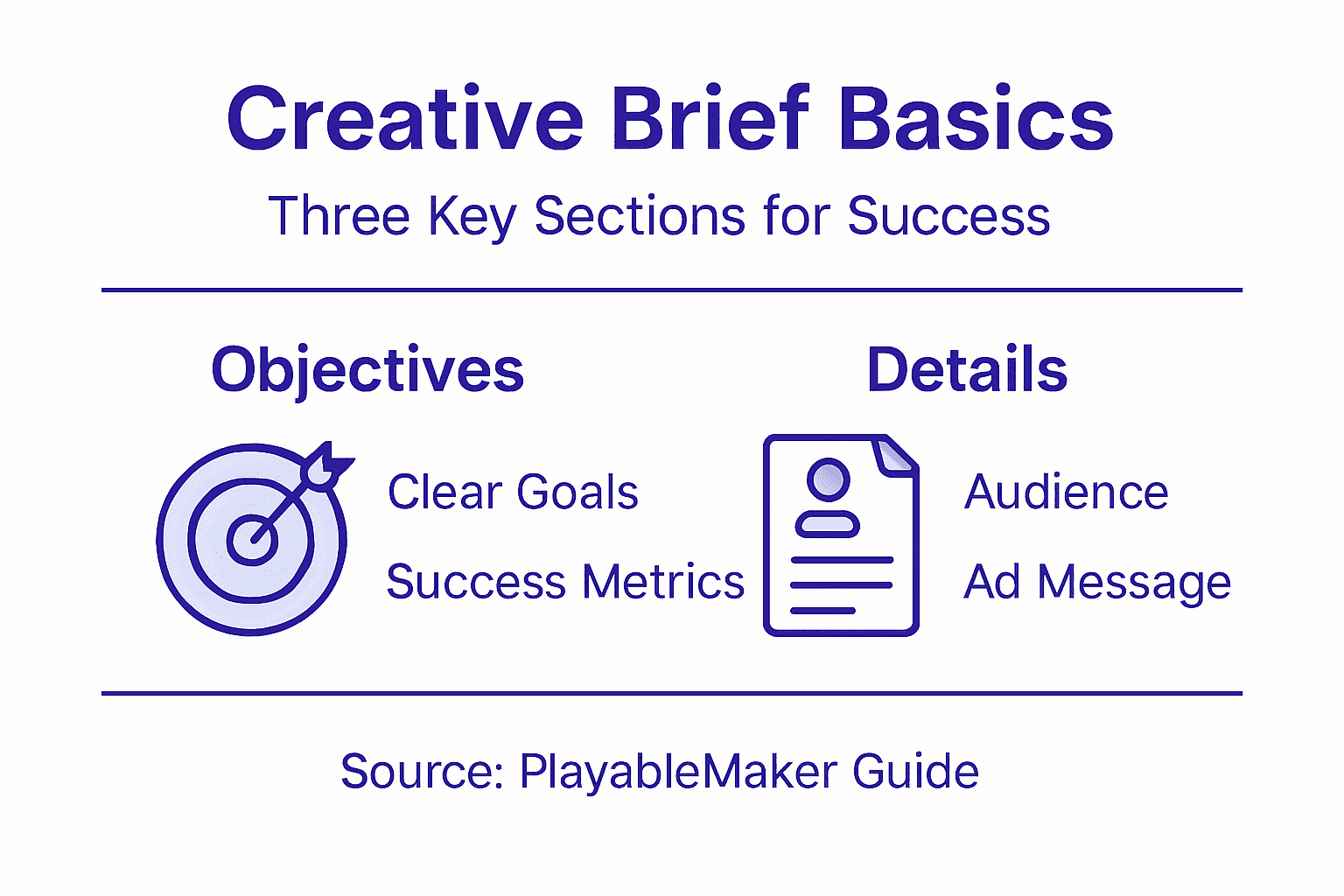
The table below clarifies how each core section of a creative brief directly affects your ad campaign’s effectiveness:
| Brief Section | Main Purpose | Business Outcome |
|---|---|---|
| Objectives | Define success criteria | Aligns team on end goals |
| Audience Insights | Identify player motivations | Improves targeting and relevance |
| Creative Strategy | Shape interactive approach | Guides creative decisions |
| Constraints | Highlight technical limitations | Prevents wasted development time |
| Success Metrics | Measure ad performance | Enables data-driven optimisation |
Pro tip: Document your brief in a shared document your entire team can access, then reference it at each creative milestone—when storyboarding your playable ad, when testing interactions, and when evaluating whether changes align with your original strategy rather than simply solving problems that emerge during production.
Core Components and Structure Explained
A solid creative brief contains several interconnected components that work together to guide your team towards a unified creative direction. Think of these elements as the scaffolding that supports your entire playable ad production. A creative brief typically includes several core components essential to its function as a strategic plan: a project overview, target audience details, key message, tone and style guidelines, unique selling propositions, media channels, budget, and schedule. For mobile gaming acquisition managers, however, the structure needs slight adaptation to account for the interactive nature of playable ads.
Start with your project overview—this is your one-sentence snapshot of what you’re building and why. For a playable ad, this might read: “Create a 30-second interactive tutorial that demonstrates our tower defence mechanic to drive installs among strategy game enthusiasts aged 18-35.” Next comes your target audience insight, which goes far deeper than demographics. You need to understand what makes your specific player segment actually engage. Are they motivated by competition, progression, creative expression, or mastery? Do they prefer quick feedback loops or strategic planning? This insight becomes the lens through which every design decision gets filtered. Your advertising objective defines what success looks like—whether that’s a 2% install conversion rate, 40% video completion, or achieving a specific cost per install threshold. The key consumer insight identifies the specific problem your game solves or the desire it fulfils. Perhaps your players feel bored with repetitive strategy games, or they crave a mobile experience they can jump into during lunch breaks without lengthy tutorials.
Additionally, include your tone and style guidelines, which govern how your playable ad feels and sounds. Should it feel chaotic and energetic, or calm and strategic? What visual aesthetic matches your game—minimalist, cartoon-based, hyper-realistic? Your unique selling proposition clarifies what differentiates your game from competitors already in the player’s phone. Then document your constraints and specifications—file size limits, supported devices, ad placement channels (TikTok, Instagram, rewarded video networks), and production timeline. For playable ads built through no-code platforms, being explicit about technical constraints prevents scope creep that could blow your budget or delay launch.

Organise these components in a single-page or two-page document your team references daily. Use a simple format: headings for each component, bullet points for details, and visual examples or reference images where helpful. The structure itself matters less than ensuring every team member can quickly find answers to questions that arise during production—“Should this interaction feel rewarding?” (check tone guidelines), “Who exactly are we targeting?” (check audience insight), “What’s our file size budget?” (check constraints).
Pro tip: Create a brief template specific to playable ads that includes sections for interaction mechanics, number of taps to install, and success feedback elements, then reuse this template across all your campaigns to build institutional knowledge about what resonates with your player base.
Types and Variations for Mobile Gaming
Creative briefs for mobile gaming ads differ fundamentally from traditional advertising briefs because mobile gamers behave differently than general consumers. Your brief needs to account for the specific context where your ad appears—whether that’s between levels in a puzzle game, before a YouTube video, or within a social media feed. In mobile gaming advertising, creative briefs must adapt to the specific audience and platform characteristics, with distinct gamer demographics requiring tailored messaging and engagement strategies. A brief for a casual puzzle game audience looks entirely different from one targeting hardcore strategy gamers. The former might emphasise relaxation and quick wins, whilst the latter emphasises strategic depth and progression systems. Your brief must account for these psychological differences explicitly, not assume they’ll emerge naturally during creative production.
Different ad formats also demand different brief structures. Playable ads require a brief that details interactive mechanics, the number of actions before reaching the install button, and what constitutes a successful player experience within the ad itself. Your brief should specify whether players should feel rewarded (winning a level, completing a challenge) or frustrated (teasing them with difficulty) during their interactive experience. Video ads, by contrast, focus on storytelling, visual pacing, and emotional hooks within a strict time constraint. Short-form video briefs emphasise the first three seconds—when most viewers decide to stay or skip. User-generated content briefs shift focus entirely, concentrating on authentic player moments and community voices rather than polished production. Here you’re briefing on tone, authenticity guidelines, and which player experiences genuinely represent your game. Each format requires the creative team to prioritise different elements, making your brief’s specificity absolutely crucial.
Here is a comparison of the different brief focus areas required for the main mobile gaming ad types:
| Ad Format | Main Brief Focus | Key Audience Experience |
|---|---|---|
| Playable Ad | Interactive mechanics | Hands-on gameplay demo |
| Video Ad | Story and emotional hooks | Visual narrative engagement |
| User-Generated | Authentic player moments | Peer-led community trust |
Consider how attention span challenges reshape your brief structure. A player scrolling TikTok has roughly 1.5 seconds to decide whether an ad deserves their attention. Your brief must therefore articulate what visual hook, sound design element, or interactive prompt captures that initial moment. Traditional advertising briefs rarely address this level of granularity. Similarly, your brief should account for mobile interaction patterns—thumb zones, landscape versus portrait orientations, and whether players will engage with your ad on a phone, tablet, or both. Crafting briefs involves careful consideration of mobile interaction, attention spans, and immersive storytelling to improve ad effectiveness, demands that extend well beyond standard advertising practices.
The most adaptable briefs for mobile gaming include a section specifically addressing “mobile-first mechanics.” This section documents how core gameplay translates into a playable ad experience, which features compress into 30 seconds, and how progression feels satisfying without requiring minutes of interaction. Your brief might also specify platform-specific variations—what works on Instagram Reels differs from TikTok, which differs again from in-game rewarded video placements. Rather than creating separate briefs for each platform, you can use one core brief with platform-specific annotations, ensuring consistency whilst allowing for necessary adaptation.
Pro tip: Create a “format comparison” section in your brief template that documents what your message emphasises across playable ads, video ads, and user-generated content, ensuring your creative team understands how core messaging adapts to each format without losing strategic coherence.
Role in No-Code Playable Ad Creation
No-code platforms have fundamentally changed how teams approach playable ad production, but they haven’t eliminated the need for clear strategic direction. If anything, a strong creative brief becomes more critical when you’re working with non-technical team members who need absolute clarity about what they’re building. Without developer overhead to manage scope creep, your brief serves as the primary guardrail preventing endless iteration and feature additions. Within the context of creative processes in advertising, creative briefs ensure that facilitated collaboration among diverse stakeholders remains valid, feasible, and inspirational. In no-code environments, this guidance function intensifies because your team lacks the technical intermediary who might otherwise translate vague concepts into specific implementation details.
The no-code context demands a brief structured around what’s actually achievable within your platform’s constraints. Rather than writing “create an engaging interactive experience,” your brief needs to specify: “design three interactive mechanics that demonstrate core gameplay, keep total load time under two seconds, and deliver a clear install button after 45 seconds of engagement.” You’re documenting not just what to build, but what your no-code platform can realistically build. This specificity prevents your team from attempting features that would require custom code or custom integrations. Your brief should include a section explicitly addressing platform capabilities and limitations, ensuring creative decisions stay grounded in technical reality rather than aspirational thinking. When your designer understands that the no-code tool supports animation but not particle effects, they make different creative choices upfront rather than discovering this limitation halfway through production.
No-code platforms also enable rapid iteration, which could either accelerate your project or spiral into endless revision if not managed properly. Your creative brief becomes the reference point for evaluating whether an iteration truly improves the ad or simply changes it. Does this new interaction better communicate your game’s core mechanic (check the brief’s creative strategy section), or does it just feel different? Is this additional animation worth the increased file size (check your brief’s technical constraints)? When your team references the brief regularly, you avoid the “design fatigue” where decisions get made based on tiredness rather than strategy. Effective playable ad techniques for mobile gaming demand consistent reference to your original strategic direction, particularly when you’re juggling multiple iterations across different platforms and audiences.
Perhaps most importantly, no-code creation democratises playable ad production—your marketing manager, creative director, or even a junior designer can now build sophisticated interactive ads. This accessibility makes your creative brief the common language that ensures everyone’s pulling in the same direction. The brief clarifies roles and responsibilities: who decides on core messaging, who approves final interactions, who tests performance. It establishes decision-making criteria so teams can resolve disagreements by referencing the brief rather than relying on hierarchy or loudest voice. In traditional agency workflows, the creative director often serves this alignment function informally. In no-code teams, that function gets documented explicitly in the brief.
When building playable ads through no-code solutions, your brief should include three specific sections addressing no-code realities. First, document your platform choice and why it matches your project requirements. Second, outline your interaction flow step-by-step—exactly how many taps, swipes, or drags before players reach the install button. Third, specify success metrics in concrete terms: “players should reach the install button within 40 seconds” or “at least 60% of testers should successfully complete the playable section without getting stuck.” These additions transform your brief from a general advertising document into a no-code production blueprint.
Pro tip: Before your team starts building, run your brief through a no-code platform demonstration to validate that your envisioned interactive experience is actually achievable; catching misalignments early prevents wasted production time and frustration when features prove impossible mid-project.
Common Pitfalls and How to Avoid Them
Most creative briefs fail not because of poor concepts, but because teams skip the foundational work required to make them actually useful. The most common mistake is writing a brief that sounds good on paper but provides no actionable guidance for your creative team. When your brief states “create something engaging” or “make it feel like a fun game,” you’ve created a document that checks a box without solving problems. Common pitfalls in using creative briefs include vagueness in objectives, overloading briefs with too much information, and failing to tailor the brief to the creative team’s needs. For user acquisition managers building playable ads, vague briefs translate directly into wasted iterations. Your designer doesn’t know whether “engaging” means fast-paced or strategic, whether it means visually spectacular or mechanically interesting. You end up in revision cycles that could have been prevented with 30 minutes of clarity upfront.
Another widespread pitfall is treating the brief as a one-time document rather than a living reference tool. You write it, circulate it once, then forget it exists. When questions arise during production—and they will—teams make decisions without checking the brief. This is how playable ads end up with two contradictory visual styles or interactive mechanics that don’t actually demonstrate your game. The solution is simple but requires discipline: schedule weekly brief review sessions where your team explicitly discusses which brief sections are guiding their current work. Ask questions like “Does this interaction align with our key message?” and “Are we respecting our file size constraint?” By treating the brief as a living document, you catch misalignments before they become expensive revisions. Your brief should evolve as you learn more about what works, but those changes should be documented and communicated to the entire team, not silently made by individuals.
Overloading your brief with excessive information creates a different problem. Teams ignore briefs that read like encyclopaedia entries. Typical mistakes when creating creative briefs include not spending enough time on the brief, writing vague objectives, neglecting audience research, overloading the brief with unnecessary details, and ignoring input from the creative team. Your brief should be scannable—ideally one to two pages for a single playable ad project. If your creative director needs 15 minutes to find the audience insight section, you’ve created friction rather than clarity. For mobile gaming teams specifically, this means excluding tangential information about competitor analysis or historical campaign performance. Include only what directly influences creative decisions for this particular ad. Your audience insight should answer one clear question: “What specific motivation drives this player segment to tap install?” Not a five-paragraph analysis—one crisp insight backed by data.
Ignoring creative team feedback during the briefing process is another guarantee of friction. Your brief will be stronger if you write a draft, share it with your designer and creative director, then iterate based on their questions. They’ll identify gaps you missed and suggest specificity that actually matters. When your team contributes to the brief rather than receiving it as gospel, they own the direction rather than resent it. This collaborative approach also surfaces disagreements early, when they’re easy to resolve. Better to debate whether the brief should emphasise quick progression or strategic depth during the briefing stage than to discover this fundamental misalignment mid-production.
For no-code playable ad teams, one particularly costly pitfall is failing to validate platform capabilities before committing to your brief vision. Your brief describes a gorgeous parallax scrolling background animation. Your no-code platform supports static backgrounds. You’ve just created a document that’s guaranteed to cause conflict. Before finalising your brief, spend an hour testing your envisioned interactions within your chosen platform. Document what works and what requires workarounds or compromises. Your brief becomes stronger when it acknowledges these constraints explicitly rather than pretending they don’t exist.
Pro tip: Write your brief with a single core message in mind—one truth about your game that your playable ad must communicate—then ruthlessly delete anything that doesn’t directly support that core message; this discipline transforms a decent brief into a powerful one.
Simplify Your Creative Brief Process with No-Code Playable Ads
Crafting a detailed and actionable creative brief is crucial to align your mobile gaming ad campaigns and avoid endless revisions. The article highlights common challenges such as vague objectives, managing interactive mechanics, and adhering to technical constraints that often slow down production and inflate budgets.
At PlayableMaker, we understand these pain points and offer a no-code platform designed specifically to bring your creative brief to life quickly and cost effectively. Our solution empowers teams to build interactive playable ads that perfectly follow your brief’s objectives and constraints without the need for developer overhead. By using PlayableMaker, you can streamline the creative process, reduce misalignment across stakeholders, and test iterations rapidly with clarity.
Discover how to manage your playable ad projects effectively by visiting our Help Archives for expert guidance. Ready to turn your creative brief into engaging playable ads that resonate with your audience and respect your budget? Start building today at PlayableMaker and bring your vision to life faster. For insights on launching your creations to market, explore our Publishing Archives and take the next step toward successful ad campaigns.
Frequently Asked Questions
What is the purpose of a creative brief in advertising?
A creative brief serves as a strategic blueprint that aligns the marketing and creative teams on goals, deliverables, and insights for an advertising campaign.
How can a creative brief improve the development of playable ads in mobile gaming?
By clearly defining objectives, audience insights, and creative strategies, a creative brief helps ensure that playable ads resonate with players and meet specific marketing goals without unnecessary revisions.
What key components should be included in a creative brief for mobile games?
A solid creative brief should include project overview, target audience details, key message, tone and style guidelines, unique selling propositions, constraints, and success metrics related to the mobile game ad.
How does a creative brief benefit no-code ad creation?
In no-code environments, a creative brief provides clear and achievable guidelines that prevent scope creep and misalignment, ensuring that non-technical team members understand what can realistically be built within the platform’s limitations.
Recommended
- Creative Brief Advertising: Powering Playable Ad Success – playablemaker.com Creative Brief Advertising: Powering Playable Ad Success
- Creative Strategy in Advertising: Complete Guide – playablemaker.com Creative Strategy in Advertising: Complete Guide
- Concept of Creativity in Advertising Explained – playablemaker.com Concept of Creativity in Advertising Explained
- Mastering Creative Approval Workflow for Mobile Marketing – playablemaker.com Mastering Creative Approval Workflow for Mobile Marketing
- Creative Thinking Exercises for Future Entrepreneurs 2025 | siift