
TL;DR:
- Collaborative ad design aligns marketing, design, and production teams to create advertising assets efficiently.
- A structured workflow with clear roles, shared assets, and scored briefs improves creative consistency and speed.
Collaborative ad design is defined as the structured process of aligning marketers, designers, and producers within shared workflows to produce advertising assets at scale. For mobile gaming teams, this approach is not optional. Collaborative Ads can deliver up to 23X ROI by tapping retailer-specific audience data and retargeting windows of up to 180 days. The industry term for this discipline is creative operations, and it sits at the intersection of campaign strategy, design craft, and production systems. This collaborative ad design guide covers the tools, workflows, and best practices that turn fragmented creative efforts into a repeatable, high-output machine.
What does a collaborative ad design guide actually require?
Every effective creative operations setup begins with three things: clear roles, shared assets, and a brief that leaves no room for interpretation. Without these, even talented teams produce inconsistent work and waste revision cycles.
Roles to define before any project starts:
- Marketer: owns campaign goals, audience targeting, and performance benchmarks
- Designer: translates strategy into visual concepts and executes production
- Producer: manages batch requests, QA reviews, and delivery timelines
Platforms like SizeIM offer Brand Kit features that centralise fonts, colour palettes, and logo variants so every team member pulls from one source of truth. AI-assisted creative generators such as ppl.studio accelerate the production phase by generating 45–80 image variants per batch. These tools do not replace human judgement. They remove the mechanical labour so designers can focus on concept quality.
Pro Tip: Set up your brand asset library before briefing any creative work. A shared library cuts the back-and-forth on brand compliance by removing ambiguity at the source.

Modular design frameworks are the structural backbone of collaborative ad production. The framework separates each ad into three components: hook, body, and CTA. Modular systems enable rapid component swapping for multivariate tests without rebuilding full assets. This matters enormously in mobile gaming, where audience fatigue sets in quickly and variant volume determines which creative wins.
| Component | Role in the ad | Collaboration owner |
|---|---|---|
| Hook | Captures attention in the first 1.5 seconds | Designer + Marketer |
| Body | Communicates core value proposition | Designer |
| CTA | Drives the install or engagement action | Marketer |
Inviting designers into strategy discussions from campaign inception, rather than handing them a finished brief, produces assets that are more feasible to execute and more relevant to the audience. This single habit separates high-performing creative teams from those stuck in endless revision loops.
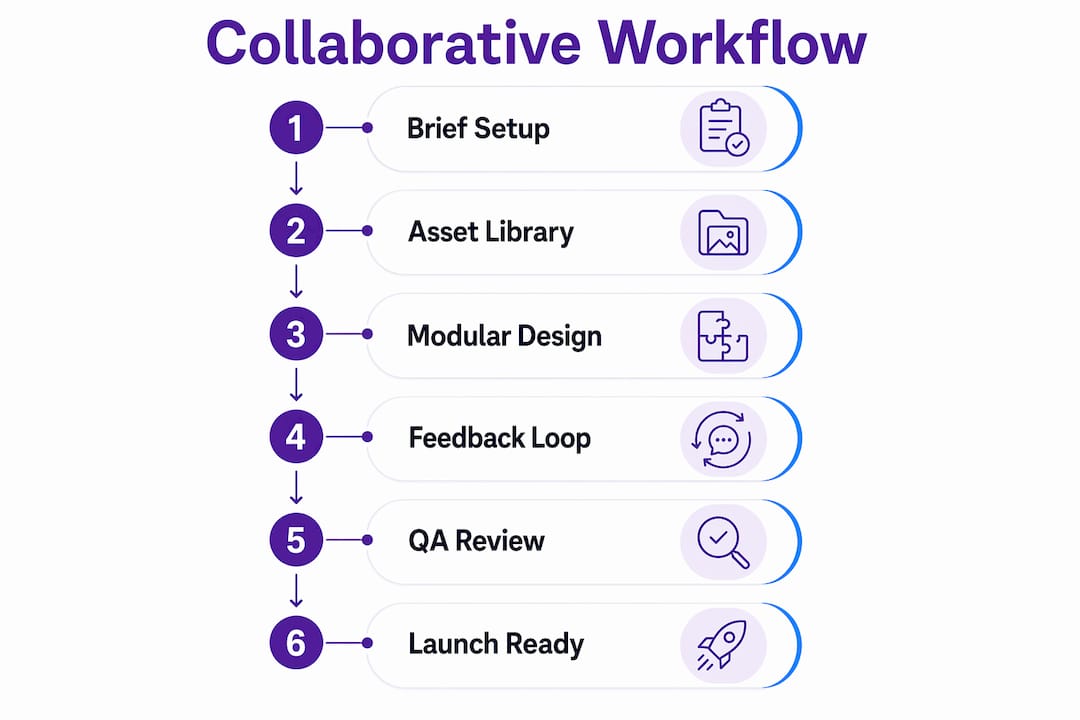
How to execute a collaborative ad design workflow step by step
A reliable workflow removes the guesswork from creative production. The steps below reflect how teams producing over 100 ad variants per month actually operate.
-
Write a one-screen creative brief. The brief must fit on a single screen and include the campaign objective, target persona, key message, offer, and platform specs. Precision briefs reduce revision cycles by 80% because they eliminate the ambiguity that causes most rework.
-
Score the brief before briefing the team. Rate the brief on hooks, messaging clarity, and offer alignment. Objective scoring transforms subjective feedback into clear creative direction. If the brief scores poorly on any dimension, rewrite it before production begins.
-
Batch creative requests for AI or producer execution. Group similar asset types into a single production run. Structured AI-assisted workflows produce high-quality variants in under four hours, with preparation taking 30–45 minutes and winner analysis taking just five minutes.
-
Run a binary QA review. Apply a rubric of 5–8 items to each variant. A five-item QA rubric covering brand-fit, persona consistency, hook readability, product accuracy, and platform specs catches the majority of errors before launch.
-
Schedule one feedback round per production cycle. Consolidate all stakeholder feedback into a single session. Fragmented, asynchronous feedback is the primary cause of scope creep and delayed launches.
-
Analyse winners and feed insights back into the next brief. Spend five minutes reviewing which hooks, bodies, and CTAs performed. Feed those findings directly into the next brief to create a learning loop.
“The creative brief is the highest-leverage 20 minutes in the entire production cycle. Teams that treat it as a formality pay for that decision in revision rounds.” — ppl.studio
Pro Tip: Use a shared collaboration board such as Figma or Notion to centralise all feedback. One thread per asset, one round of comments, one approval. This prevents the same note appearing five times from five different people.
The ad creative feedback process is where most collaborative workflows break down. Structuring feedback as a formal step, not an informal chat, is what separates teams that ship consistently from those that stall.
What best practices improve team collaboration and creative iteration?
The most effective teams treat creative production as a data problem, not a taste problem. Every decision about hooks, visuals, and CTAs should be traceable to a performance signal.
Proven practices that raise both output quality and speed:
- Involve designers in campaign planning. Designers who understand audience personas and campaign goals produce assets that require fewer revisions. Early designer involvement improves creative feasibility and asset relevance significantly.
- Use modular asset creation for rapid iteration. Build hooks, bodies, and CTAs as independent files. Swapping a single hook across ten ad variants takes minutes, not days.
- Apply objective creative scoring. Score every creative against the brief before it enters QA. This removes subjective bias from approval decisions and gives designers clear criteria to work towards.
- Use AI tactically, not wholesale. AI tools accelerate image generation and copy variation. Human judgement remains responsible for strategy, tone, and brand integrity.
- Run high-velocity testing cycles. Two-person teams can produce 100+ monthly variants with clean operational layers in place. Volume without structure produces noise. Structure without volume produces slow learning.
The repurposing of ad creatives is a natural extension of modular design. When components are built as independent assets, reusing a winning hook in a new campaign takes seconds. This compounds the value of every creative investment the team makes.
For mobile gaming specifically, the hook is the most contested real estate in any ad. Players scroll fast. A hook that does not register within 1.5 seconds is a hook that does not register at all. Testing three to five hook variants per campaign cycle is a minimum, not a stretch target.
How to avoid common mistakes in collaborative ad design
Most collaborative ad design failures trace back to one of four root causes: unclear briefs, delayed feedback, inconsistent brand application, and missing permissions. Each has a direct fix.
Common problems and their solutions:
| Problem | Root cause | Solution |
|---|---|---|
| Endless revision cycles | Ambiguous brief | Score the brief before briefing the team |
| Delayed approvals | Fragmented feedback channels | Centralise feedback to one tool, one round |
| Off-brand assets | No shared asset library | Use a Brand Kit platform like SizeIM |
| Scope creep | No revision limits set upfront | Define maximum revision rounds in the brief |
| Platform compliance failures | QA applied too late | Run the binary QA rubric before any asset leaves production |
Partnership and collaborative ads carry an additional layer of complexity: permissions. Meta Partnership Ads require early negotiation of advertising permissions so brands can amplify creator content using advanced targeting tools. Leaving permissions as an afterthought blocks campaigns at launch and wastes the creative work already completed.
Asset version control is a practical problem that teams underestimate. When five people work on the same file without a naming convention, the wrong version ships. Establish a simple naming system: campaign code, asset type, variant number, and date. This takes ten minutes to set up and prevents hours of confusion.
Overproduction without operational structure is equally damaging. Generating 200 variants with no QA rubric and no brief scoring produces a pile of assets that nobody can evaluate. Scaling beyond 100 monthly variants depends on clean operational layers, not on the volume of AI output alone.
The top mobile ad platforms for gaming each have distinct spec requirements. Building platform compliance into the QA rubric from day one prevents the costly rework of resizing and reformatting assets after production.
Key takeaways
Collaborative ad design in mobile gaming succeeds when clear roles, modular asset systems, and objective QA rubrics work together inside a structured production workflow.
| Point | Details |
|---|---|
| Define roles before production | Assign marketer, designer, and producer roles explicitly before any brief is written. |
| Write precision briefs | A well-scored brief reduces revision cycles by 80% and sets clear creative direction. |
| Use modular design systems | Separating hook, body, and CTA enables rapid iteration without rebuilding full assets. |
| Apply a binary QA rubric | A five-item rubric covering brand-fit, hook readability, and platform specs catches errors before launch. |
| Negotiate permissions early | For partnership ads on platforms like Meta, secure advertising permissions before production begins. |
What I have learned about collaborative ad design in mobile gaming
The conventional wisdom says that more tools solve collaboration problems. My experience says the opposite. Most teams that struggle with creative production are not under-tooled. They are under-structured. The brief is vague, the feedback is scattered, and nobody has agreed on what “approved” actually means.
The single change that produces the most visible improvement is treating the creative brief as a scored document, not a written request. When a marketer scores a brief on hook clarity, offer specificity, and persona fit before it reaches a designer, the designer receives a creative direction, not a guess. That shift alone removes the majority of revision rounds I have seen teams endure.
I am also sceptical of the idea that AI replaces creative judgement in mobile gaming advertising. AI generates volume. It does not generate insight. The teams producing the best-performing ads in mobile gaming use AI in the creative process to handle mechanical variation, while human strategists decide which concepts are worth testing in the first place.
The future of collaborative ad design will likely involve tighter integration between performance data and creative briefing tools. When a winning hook automatically informs the next brief, the learning loop becomes genuinely continuous. That is not science fiction. Teams building that infrastructure today will have a structural advantage within two years.
— Ondrej
How Playablemaker supports collaborative ad design for mobile gaming
Playablemaker is built for mobile gaming teams that need to produce high-quality interactive ads without the cost and complexity of traditional development. Playable ads consistently outperform static formats on engagement and install rates, and understanding why playable ads work psychologically gives your team a creative edge when briefing and iterating. Playablemaker’s no-code builder means designers and marketers can collaborate directly on interactive formats without waiting for developer time. If your team is building a collaborative ad design workflow and wants to include playable formats without blowing the production budget, explore Playablemaker’s approach to playable ads as a practical next step.
FAQ
What is collaborative ad design in mobile gaming?
Collaborative ad design is the structured process of aligning marketers, designers, and producers within shared workflows to produce advertising assets efficiently. In mobile gaming, it typically involves modular design systems, AI-assisted production tools, and objective QA rubrics to generate high volumes of tested creative variants.
How many ad variants can a small team produce collaboratively?
Two-person teams can produce over 100 ad variants per month with clean operational layers in place, including scored briefs, batched production runs, and a binary QA rubric. Volume depends more on process structure than on team size.
Why do most collaborative ad design workflows fail?
Most failures trace back to ambiguous briefs, fragmented feedback channels, and missing permissions for partnership ads. Investing 20 minutes in a scored, precise brief before production begins removes the majority of these failure points.
What is a binary QA rubric in ad design?
A binary QA rubric is a checklist of 5–8 pass/fail items applied to every ad variant before launch. Typical items include brand-fit, hook readability within 1.5 seconds, persona consistency, product accuracy, and platform specification compliance.
When should designers join the campaign planning process?
Designers should join at campaign inception, not after the brief is written. Early involvement improves creative feasibility and produces assets that are more relevant to the target audience, reducing revision cycles significantly.
Recommended
- Boost ad UX in mobile gaming with no-code tools – playablemaker.com Boost ad UX in mobile gaming with no-code tools
- Why Creatives Matter for Mobile Game Ad Success – playablemaker.com Why Creatives Matter for Mobile Game Ad Success
- How to Repurpose Ad Creatives for Mobile Gaming Success – playablemaker.com How to Repurpose Ad Creatives for Mobile Gaming Success
- Creative Director Description: Leading Mobile Game Ads – playablemaker.com Creative Director Description: Leading Mobile Game Ads