
TL;DR:
- Matching marketing messages to the five buyer awareness stages significantly improves conversion rates and campaign efficiency.
- Effective awareness campaigns require long-term measurement, segmentation, and tailored creative formats across multiple channels.
Awareness stage advertising is the practice of crafting marketing messages specifically tailored to where a potential user sits in their knowledge of a problem and its available solutions. For mobile gaming marketers, this distinction matters enormously. Running a product offer ad to someone who has never heard of your game category wastes budget at scale. The framework that makes this precise is Eugene Schwartz’s five stages of buyer awareness, and 2026 Meta performance data confirms that ads matched to the correct awareness stage convert two to three times better than generic messaging. Getting this right is the foundation of any credible user acquisition strategy.
What are the five stages of awareness and how do they guide advertising?
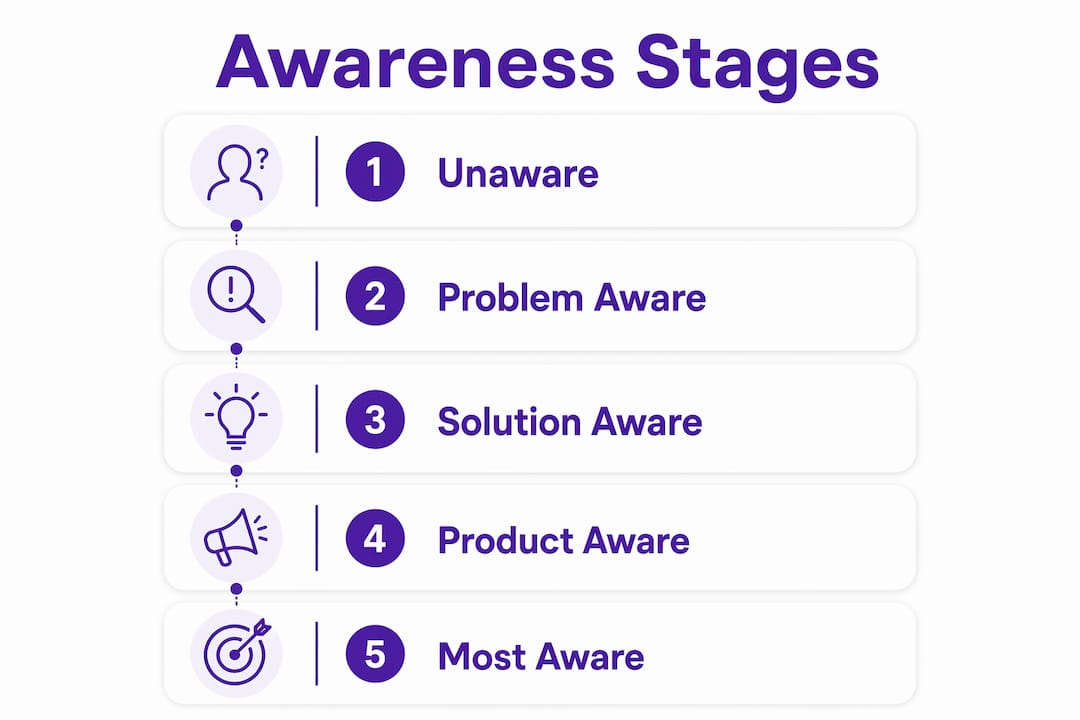
Eugene Schwartz identified five distinct stages of buyer awareness, and each one demands a different creative approach. Treating them as a single audience is one of the most costly mistakes in advertising, responsible for wasting 25% or more of ad budgets across most accounts.
The five stages are:
- Completely Unaware. The user does not know they have a problem or a need. For mobile gaming, this is someone who has never considered playing a strategy game. Ads here must spark curiosity, not sell. Short-form video showing the emotional experience of play works well at this stage.
- Problem Aware. The user recognises a need, such as wanting a way to unwind, but has not connected it to gaming. Messaging should name the problem and position gaming as a relevant category of solution.
- Solution Aware. The user knows mobile games exist as a solution but has not evaluated specific titles. Ads should highlight what makes your game genre or mechanic distinct from alternatives.
- Product Aware. The user knows your game exists but has not installed it. This is where direct comparison, social proof, and limited-time offers become effective.
- Most Aware. The user has installed or lapsed. Re-engagement campaigns, loyalty rewards, and personalised offers apply here.
The practical implication is that cold prospecting campaigns targeting Stages 1 and 2 require patience and education-led creatives, while Stages 4 and 5 support direct response formats. Running product offer ads to cold, unaware audiences leads to ad neglect regardless of spend or copy quality. This is not a theory. It is a documented failure pattern.
Pro Tip: Map your existing ad creatives against the five stages before your next campaign review. Most mobile gaming accounts cluster creatives in Stages 4 and 5, leaving the top of the funnel entirely unaddressed and starving future pipeline.
Tailoring ad creativity to awareness levels is not just about messaging tone. It determines which format, which platform, and which call to action is appropriate. A playable ad demonstrating core gameplay mechanics is highly effective at Stage 3, where users are evaluating solutions. A simple install prompt is appropriate only at Stage 4 or 5.

Which metrics matter most for measuring awareness campaign success?
The most common error in awareness measurement is treating impressions and reach as proof of performance. Page views and social impressions are vanity metrics. The meaningful indicators connect directly to revenue and pipeline movement.
The metrics that actually matter fall into three tiers:
| Tier | Metric | What it signals |
|---|---|---|
| Revenue-connected | First-touch pipeline value | Which awareness content initiated the user journey |
| Behaviour-connected | Branded search volume | Whether your game title is entering user consideration |
| Activity-connected | Content-assisted conversions | How often awareness content appears in multi-touch paths |
Return visitor rate also belongs in the second tier. A user who returns to your store listing or website after first encountering an awareness ad is demonstrating intent progression, which is precisely what top-of-funnel campaigns are designed to produce.
The critical constraint is time. Awareness content requires 90 to 180 days to show measurable impact on pipeline and revenue. This means that cutting a campaign after four weeks because branded search volume has not moved is a structural error, not a creative one. The 90-day window is the minimum evaluation period, not a target.
Pro Tip: Set up a branded keyword tracking dashboard in Google Search Console or a tool like Semrush before launching any awareness campaign. Without a baseline, you cannot demonstrate uplift to stakeholders, and awareness budgets are the first to be cut when reporting is weak.
For attribution, position-based multi-touch models assign 40% credit to the first touch and 40% to the last, distributing the remaining 20% across middle interactions. This approach gives awareness content its fair share of conversion credit, which last-click models erase entirely. Mobile gaming marketers using last-click attribution are systematically undervaluing their top-of-funnel spend and making budget decisions on incomplete data. Integrating AI-powered brand measurement tools can help surface these patterns faster than manual reporting.
How should mobile gaming marketers structure and budget awareness campaigns?
Campaign structure for awareness stage advertising follows the same logic as the five stages: segment by audience temperature, not by platform or format alone. Three distinct campaign buckets serve different purposes.
- Cold prospecting (Stages 1 and 2). These campaigns target users with no prior exposure to your game or genre. Budgets here are investments in future pipeline, not immediate return. Creative should be video-led, emotionally engaging, and focused on the experience rather than the product.
- Warm prospecting (Stage 3). These users have shown interest in the game category. Playable ads and interactive formats perform strongly here because they let users experience the core mechanic before committing to an install. This is where differentiation messaging earns its keep.
- Retargeting (Stages 4 and 5). These campaigns target users who have engaged with your game, visited your store page, or lapsed after install. Retargeting audiences convert faster and at lower cost, making them the logical starting point for accounts with limited budgets.
On budgeting, the principle is statistical validity. Initial test budgets must capture 20 to 30 clicks to produce optimisation data worth acting on. At an average CPC of $5, that requires $100 to $150 at minimum. For small campaigns with meaningful learning objectives, $500 is a more realistic floor. Spending below this threshold and drawing conclusions from the data is a common error that leads to premature creative decisions.
Pro Tip: Allocate at least 60% of your initial awareness budget to retargeting and warm prospecting while your cold prospecting campaigns gather data. Expand cold budgets only once the lower funnel is profitable. This sequencing protects return on investment during the learning phase.
Campaign duration matters as much as budget. Awareness campaigns abandoned before 90 days consistently fail to show pipeline impact, not because the strategy is wrong but because the measurement window is too short. Commit to the full evaluation period before making structural changes.
What advanced strategies are redefining awareness advertising in 2026?
The most significant shift in awareness marketing tactics in 2026 is the integration of AI tools into content mapping and creative generation. Several platforms now incorporate buyer persona data, awareness stage classification, and competitive positioning before generating ad copy or creative briefs. AI-driven tools enable systematic mapping of buyer awareness stages to produce tailored creative at scale, reducing the manual effort required to maintain stage-appropriate messaging across large campaign portfolios.
The second major shift is the rise of Generative Engine Optimisation, or GEO. As users increasingly discover brands through AI-powered search tools such as ChatGPT, Perplexity, and Google’s AI Overviews, brand relevance in AI-driven search depends on earning third-party citations and producing original research. For mobile gaming marketers, this means that top awareness campaigns now require a content layer: original data studies, proprietary frameworks, and shareable assets that earn external links and citations.
The content types that perform best at the awareness stage reflect this shift:
- Problem-education content attracts users at Stages 1 and 2 by naming and contextualising the problem before presenting any solution.
- Original data and research earns high linkage and social sharing, building domain authority and AI citation probability simultaneously.
- Proprietary frameworks get bookmarked and referenced repeatedly, creating sustained brand visibility without ongoing ad spend.
“Brand awareness in 2026 is no longer a quarterly campaign. It is an ongoing system across multiple digital channels, and consistency is the only strategy that compounds.” — Neal Schaffer
Multichannel distribution amplifies each of these content types. Awareness campaigns that run across paid social, organic search, email nurture sequences, and AI answer engines reach users at multiple points in their discovery process. Digital marketing metrics worth tracking in 2026 reflect this multichannel reality, with cross-channel attribution becoming a standard expectation rather than an advanced capability. Mobile gaming brands that treat awareness as a single-channel paid media exercise are leaving significant brand equity on the table.
Key takeaways
Awareness stage advertising works because matching messages to buyer awareness stages produces measurably better conversion rates, more efficient spend, and sustainable pipeline growth over a 90-day or longer measurement window.
| Point | Details |
|---|---|
| Stage-matched creatives convert better | Ads aligned to the five awareness stages convert two to three times better than generic messaging, per 2026 Meta data. |
| Vanity metrics mislead budget decisions | Track branded search volume, first-touch pipeline value, and content-assisted conversions rather than impressions or reach. |
| 90-day minimum evaluation window | Cutting awareness campaigns before 90 days produces misleading data and wastes the budget already spent. |
| Segment campaigns by audience temperature | Structure cold prospecting, warm prospecting, and retargeting as separate campaigns with distinct creatives and budgets. |
| GEO and original research build AI-era authority | Producing citable, original content earns brand mentions in AI-driven search, extending awareness beyond paid media. |
Why most mobile gaming awareness campaigns fail before they start
I have reviewed a significant number of mobile gaming ad accounts, and the pattern is consistent. The creative is often strong. The targeting is often reasonable. But the campaign structure collapses the five awareness stages into one undifferentiated audience, and the measurement window is cut at four to six weeks because stakeholders want results.
The discipline required for awareness stage advertising is genuinely difficult to maintain. It asks you to spend money on users who will not install today, to measure outcomes that take months to surface, and to defend that investment to teams accustomed to last-click attribution reports. That tension is real, and it is not solved by better creative alone.
What I have found actually works is separating the conversation about awareness metrics from the conversation about performance metrics entirely. Awareness campaigns should be evaluated on branded search growth, return visitor rates, and content-assisted conversions. Presenting those numbers alongside direct response results, rather than instead of them, makes the case for top-of-funnel investment far more effectively than arguing about attribution philosophy.
The AI dimension is also changing faster than most teams are adapting. Mobile brands embracing GEO strategies and producing original research are building a form of brand authority that paid media alone cannot replicate. The mobile gaming studios that will dominate awareness in the next two years are the ones investing in citable content now, not just in ad spend.
— Ondrej
How playable ads strengthen your awareness strategy
Playable ads are one of the most effective formats for awareness stage advertising in mobile gaming because they let potential users experience your game before committing to an install. At Stage 3, where users are evaluating solutions, an interactive ad that demonstrates core gameplay mechanics is far more persuasive than a static banner or a passive video. The psychological engagement of playable ad formats produces stronger brand recall and higher intent signals than any passive format.
Playablemaker builds no-code playable ad creation tools designed specifically for mobile gaming marketers who need to move fast without consuming developer resources. You can explore why playable ads work psychologically and understand how to apply them across your awareness campaigns. For teams managing playable ad optimisation at scale, the platform provides a practical starting point without the typical cost and complexity.
FAQ
What is awareness stage advertising?
Awareness stage advertising is the practice of creating and distributing marketing messages tailored to users who are early in their buyer journey, before they have considered specific products or formed purchase intent. The goal is to build brand recognition and move users towards consideration.
How long does it take for awareness campaigns to show results?
Awareness content typically requires 90 to 180 days to produce measurable impact on pipeline and revenue. Evaluating campaigns before the 90-day minimum produces misleading data.
Which ad formats work best for mobile gaming awareness campaigns?
Playable ads and short-form video perform strongly at the awareness stage for mobile gaming. Playable formats are particularly effective at Stage 3, where users are evaluating solutions and benefit from experiencing gameplay mechanics directly.
What is the minimum budget for an awareness stage ad campaign?
Initial test budgets should be sufficient to capture 20 to 30 clicks for statistically valid data. At an average CPC of $5, this requires $100 to $150 at minimum, with $500 recommended for small campaigns to avoid drawing conclusions from insufficient data.
How does the five-stage awareness framework improve conversion rates?
Applying Eugene Schwartz’s five stages framework to ad creative selection improves conversion rates by 200% to 300%, according to 2026 Meta performance data. The improvement comes from matching message sophistication and format to where the user actually sits in their awareness journey.
Recommended
- 2025 SocialPeta & Newsbreak Mobile Game Report: 9M+ Monthly Advertisers & the Rise of Weekly Creative Iteration – playablemaker.com 2025 SocialPeta & Newsbreak Mobile Game Report: 9M+ Monthly Advertisers & the Rise of Weekly Creative Iteration
- Ad tech trends 2026: create playable ads fast and affordably – playablemaker.com Ad tech trends 2026: create playable ads fast and affordably
- Mobile Ad Glossary: 60% CPI Spend Drives Gaming Growth – playablemaker.com Mobile Ad Glossary: 60% CPI Spend Drives Gaming Growth
- Master Mobile Ad Trend Analysis 2025 for Playable Ads Success – playablemaker.com Master Mobile Ad Trend Analysis 2025 for Playable Ads Success