More than half of british mobile gaming advertisers admit their attribution models miss key interactions, costing valuable conversion insights. For user acquisition specialists tracking playable ad campaigns worldwide, accurate attribution is not just a technical requirement, it is critical for budget efficiency and performance. This guide clarifies how advanced methods and privacy rules reshape attribution, helping experienced professionals choose cost-effective solutions for sustained success.
Table of Contents
- Defining Advertising Attribution In Gaming
- Methods Of Attribution And Their Distinctions
- How Attribution Works For Playable Ads
- Privacy Rules Impacting Attribution Models
- Financial Pitfalls And Common Attribution Mistakes
Key Takeaways
| Point | Details |
|---|---|
| Importance of Attribution Models | Effective advertising attribution in gaming is crucial for understanding user acquisition and optimising advertising strategies. |
| Diverse Attribution Approaches | Marketers should utilise various attribution models to accurately assess their advertising performance across different touchpoints. |
| Privacy Considerations | Stricter privacy regulations require marketers to adopt ethical and legally compliant attribution frameworks that protect user data. |
| Avoiding Common Pitfalls | To enhance accuracy, user acquisition teams must implement comprehensive tracking strategies that consider all advertising interactions. |
Defining Advertising Attribution in Gaming
Advertising attribution in gaming represents a sophisticated analytical approach that tracks and evaluates the effectiveness of digital advertising interactions within interactive entertainment platforms. Quantifying the contribution of advertising touchpoints is critical for user acquisition specialists seeking to understand complex consumer engagement pathways in mobile gaming ecosystems.
At its core, advertising attribution involves mapping player interactions across multiple digital channels and measuring their impact on key performance metrics like downloads, in-app purchases, and long-term user retention. The process goes beyond simple click tracking, employing advanced statistical models that assess how different advertising formats influence player behaviour. Digital game advertising research demonstrates that psychological responses to in-game advertisements can vary significantly across different demographic segments, making precise attribution increasingly important.
Gaming advertising attribution typically involves several sophisticated tracking mechanisms:
- Multi-touch attribution: Evaluating multiple ad interactions before conversion
- First-click attribution: Crediting the initial advertising touchpoint
- Last-click attribution: Assigning full credit to the final advertising interaction before conversion
- Linear attribution: Distributing credit equally across all advertising touchpoints
Pro tip: Implement a robust tracking system that captures granular data across multiple advertising channels to create more accurate attribution models.
Methods of Attribution and Their Distinctions
Advertising attribution methods are complex analytical frameworks that help user acquisition specialists understand how different advertising interactions contribute to player engagement and conversion. Attribution theories provide critical insights into how individuals assign causality across various behavioural contexts, which is particularly relevant in mobile gaming advertising strategies.
Attribution models represent distinct approaches to understanding and allocating credit for user interactions. These methods vary significantly in their approach to tracking and evaluating advertising touchpoints. Different attribution processes consider multiple dimensions, including consensus, consistency, and distinctiveness, which help marketers more accurately assess the impact of their advertising efforts.
Key attribution methods in mobile gaming advertising include:
- First-Click Attribution: Assigns full credit to the initial advertising touchpoint
- Last-Click Attribution: Credits the final interaction before conversion
- Linear Attribution: Distributes credit equally across all touchpoints
- Time Decay Attribution: Gives more weight to interactions closer to the conversion
- Position-Based Attribution: Allocates varying credit percentages to different interaction stages
Pro tip: Experiment with multiple attribution models simultaneously to gain a more comprehensive understanding of your advertising performance across different channels.
Here’s a concise comparison of key advertising attribution models in mobile gaming:
| Attribution Model | Credit Assignment Approach | Typical Use Case |
|---|---|---|
| First-Click | Full credit to initial interaction | Campaign testing |
| Last-Click | Full credit to last interaction | Rapid conversion campaigns |
| Linear | Equal credit across all touchpoints | Long user journeys |
| Time Decay | Higher credit for recent interactions | High-frequency campaigns |
| Position-Based | Weighted credits for first and last steps | Complex multi-channel strategies |
How Attribution Works for Playable Ads
Playable ad attribution represents a sophisticated tracking mechanism that analyses user interactions with interactive mobile advertisements. Complex data-driven models track the intricate user journey through multiple digital touchpoints, enabling marketers to understand precisely how these engaging ad formats influence player behaviour and conversion rates.

The attribution process for playable ads involves capturing detailed interactions beyond simple click measurements. Advanced neural network techniques now enable marketers to dynamically assess the relative importance of each ad exposure, creating nuanced models that capture behavioural patterns with unprecedented accuracy. These methods go far beyond traditional last-touch attribution, providing a comprehensive view of how playable ads contribute to user acquisition and engagement.
Key components of playable ad attribution include:
- Interaction Tracking: Monitoring specific user actions within the playable ad
- Engagement Measurement: Quantifying time spent, gameplay depth, and interaction quality
- Conversion Path Analysis: Identifying how playable ad interactions relate to final user actions
- Multi-Touch Credit Assignment: Distributing attribution credit across different touchpoints
- Behavioural Pattern Recognition: Understanding sequential user interactions
The mobile gaming industry increasingly relies on these sophisticated attribution models to optimise advertising spend and improve targeting strategies. By understanding the precise mechanisms of user engagement, marketers can create more effective, targeted playable ad experiences.
Pro tip: Implement advanced tracking tools that capture granular interaction data to develop more precise attribution models for your playable ads.
Privacy Rules Impacting Attribution Models
The landscape of digital advertising attribution is undergoing significant transformation, driven by increasingly stringent global privacy regulations. Privacy-preserving attribution technologies are emerging as a critical solution, enabling marketers to measure ad effectiveness while maintaining user data protection and anonymity.
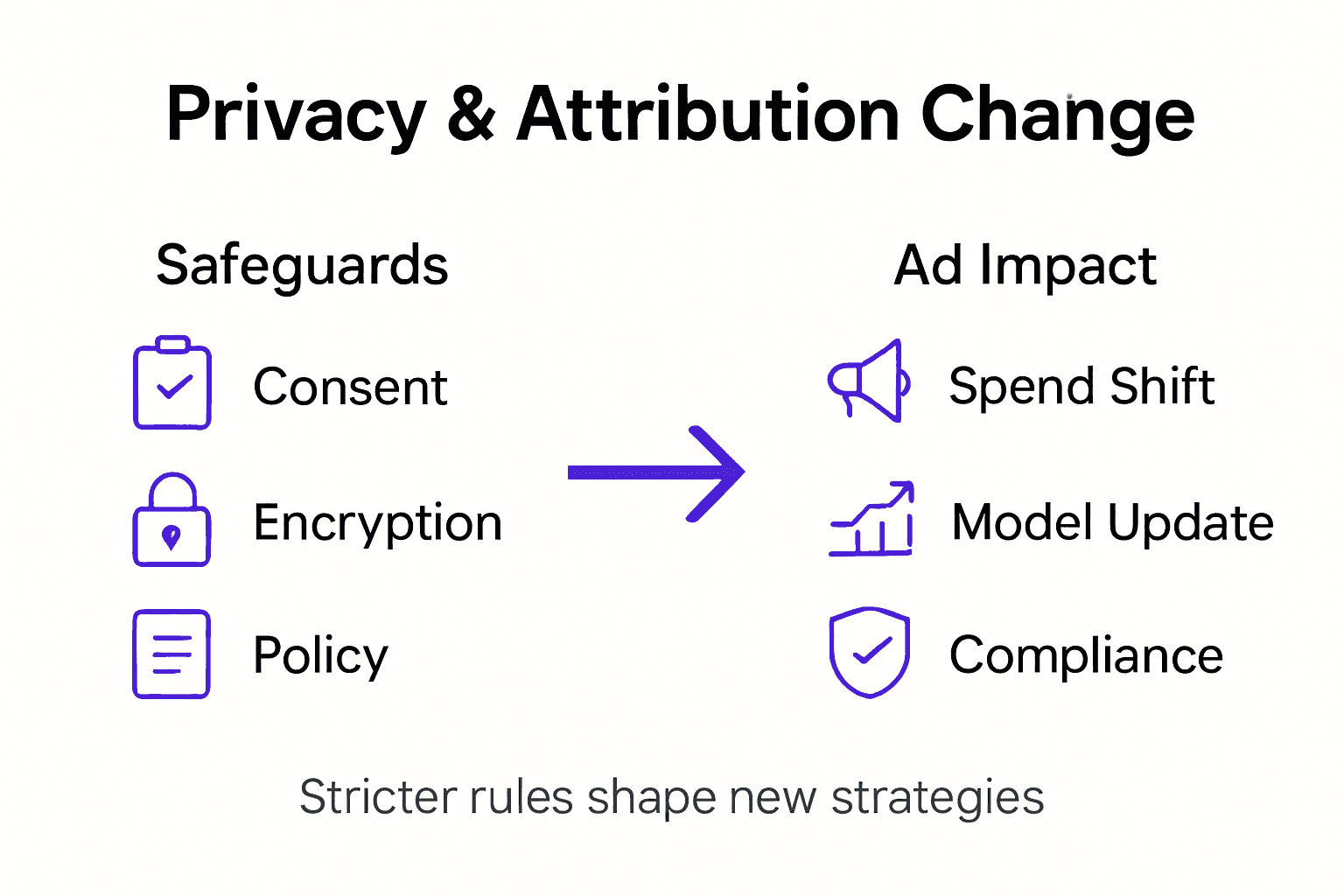
Data governance has become a paramount concern for mobile gaming advertisers navigating complex international privacy frameworks. Regulatory bodies increasingly mandate balanced approaches that protect individual privacy rights while allowing meaningful data analysis. These evolving standards require sophisticated attribution models that can extract valuable insights without compromising user personal information.
Key privacy considerations in attribution modelling include:
- Consent Management: Ensuring explicit user permission for data tracking
- Data Minimisation: Collecting only essential information for attribution
- Anonymisation Techniques: Removing personally identifiable details
- Encryption: Protecting user interaction data
- Transparent Reporting: Providing clear information about data usage
The mobile gaming industry must now develop attribution strategies that are not just analytically robust, but also legally compliant and ethically responsible. This requires a nuanced approach that balances business intelligence with user privacy protection.
Pro tip: Implement privacy-first attribution frameworks that prioritise user consent and data protection while maintaining meaningful analytical capabilities.
Below is a summary of major privacy safeguards relevant to gaming attribution:
| Safeguard | Purpose | Implementation Example |
|---|---|---|
| Consent Management | Ensures users approve data collection | Pop-up opt-in dialogues |
| Data Minimisation | Limits data to essential elements | Tracking only conversion events |
| Anonymisation Techniques | Removes identifiable user information | Randomised user IDs |
| Encryption | Secures data during transmission/storage | SSL data transfer protocols |
| Transparent Reporting | Discloses use of user data | Clear privacy policy statements |
Financial Pitfalls and Common Attribution Mistakes
User acquisition specialists face significant challenges when tracking advertising performance, with complex methodological errors frequently undermining attribution accuracy. Many mobile gaming marketers unknowingly implement over-simplified models that fail to capture the nuanced interactions between different advertising touchpoints.
Attribution modelling requires sophisticated approaches to avoid common financial pitfalls. Comprehensive performance analysis demands robust factor models and transparent reporting mechanisms that account for multiple variables and potential data inconsistencies. Gaming advertisers must develop more sophisticated tracking strategies that go beyond simplistic measurement techniques.
Common attribution mistakes in mobile gaming advertising include:
- Single-Touch Attribution: Relying exclusively on last-click or first-click models
- Ignoring Indirect Interactions: Overlooking secondary advertising touchpoints
- Insufficient Data Validation: Using incomplete or inconsistent tracking metrics
- Neglecting Conversion Paths: Failing to map comprehensive user journeys
- Overlooking Transaction Costs: Not accounting for advertising spend in attribution models
Successful attribution requires a holistic approach that considers the complex ecosystem of digital advertising interactions. User acquisition teams must develop more nuanced strategies that capture the true value of each advertising touchpoint.
Pro tip: Implement multi-touch attribution models that incorporate comprehensive data validation and account for indirect advertising interactions to improve performance tracking accuracy.
Streamline Your Playable Ad Attribution and Maximise ROI
Navigating the complexities of advertising attribution in gaming can feel overwhelming. You need precise data to understand how each playable ad interaction influences user behaviour and conversion while controlling costs. The article highlights critical challenges like multi-touch attribution, advanced tracking, and maintaining budget efficiency. Your goal is to achieve accurate performance insights without draining developer time or company resources.
PlayableMaker is designed to solve these exact pain points. Our no-code platform enables you to build interactive ads fast and budget-friendly, empowering you to implement sophisticated playable ad campaigns with ease. With tools tailored for detailed interaction tracking and seamless integration, you can optimise spend and unlock richer attribution insights without the usual complexity.
Discover how to refine your advertising strategy by exploring our Publishing Archives for expert tips and support from our Help Archives. Ready to transform your playable ad creation and attribution? Start now at PlayableMaker and take control of your campaign success today.
Frequently Asked Questions
What is advertising attribution in gaming?
Advertising attribution in gaming is an analytical approach that tracks and evaluates the effectiveness of digital advertising interactions within gaming environments, helping specialists understand consumer engagement pathways.
How do different attribution models impact playable ad performance?
Different attribution models, such as first-click, last-click, and linear attribution, each provide unique insights into user interactions, helping marketers allocate credit to various advertising touchpoints effectively.
Why is privacy a concern in advertising attribution models?
Increasing global privacy regulations require gaming advertisers to implement strategies that protect user data while still allowing for meaningful analysis of advertising effectiveness.
What common mistakes should be avoided in attribution modelling?
Common mistakes include relying solely on single-touch attribution methods, neglecting indirect interactions, and failing to map comprehensive user journeys, which can undermine the accuracy of performance tracking.
Recommended
- What is Ad Optimization? Understanding Its Importance – playablemaker.com What is Ad Optimization? Understanding Its Importance
- Master the Playable Ad Optimisation Process for Success – playablemaker.com Master the Playable Ad Optimisation Process for Success
- Google Ad Performance: Maximising Mobile Game ROI – playablemaker.com Google Ad Performance: Maximising Mobile Game ROI
- Facebook CBO: Maximising Mobile Gaming ROI – playablemaker.com Facebook CBO: Maximising Mobile Gaming ROI