
TL;DR:
- Ad engagement signals include user interactions like comments, shares, video completions, and link clicks that demonstrate creative resonance. Prioritizing active signals such as comments and shares over passive reactions enhances campaign effectiveness and informs better creative pre-qualification. Implementing signal engineering by passing mid-funnel events improves cost efficiency and helps algorithms identify high-value users more accurately.
Ad engagement signals are measurable user interactions with advertisements, including comments, shares, reactions, video completions, and link clicks, that indicate how effectively a creative resonates with its audience. For mobile marketing professionals, these signals are not simply vanity metrics. They are the primary diagnostic layer between creative output and user acquisition outcomes. Understanding their hierarchy, how platforms like Meta process them, and how to act on them separates campaigns that scale from those that stall. A 3–5% engagement rate on cold traffic is the industry benchmark for validating creative effectiveness before committing conversion budget.
What are ad engagement signals and how are they ranked?
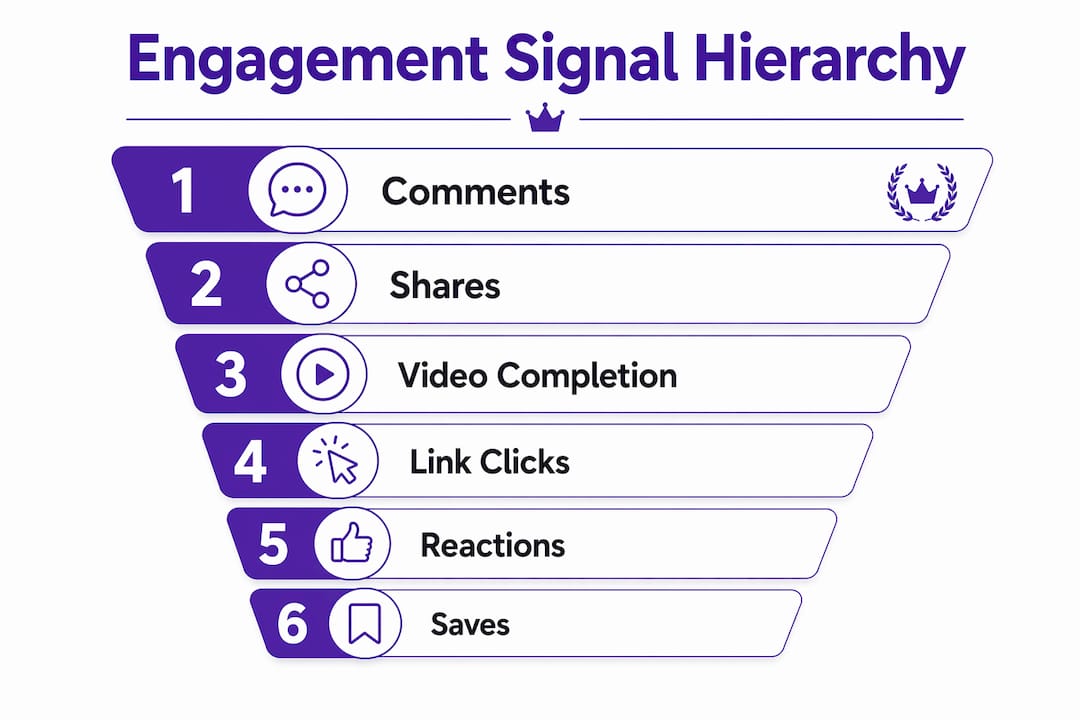
Ad engagement signals fall into a clear hierarchy based on user effort and predictive value for downstream business outcomes. Comments rank highest because they require active user input. Shares follow closely as organic multipliers that extend reach without additional spend. Both are high-intent signals that indicate genuine audience interest rather than accidental interaction.

Mid-tier signals include video completion rates and link clicks. A video completion rate above 75% is a reliable indicator of behavioural commitment, particularly for video ads. A user who watches most of a video has made a deliberate choice to stay engaged. That behaviour correlates with stronger brand recall and better downstream conversion rates.
Reactions and saves sit at the lower end of the hierarchy. They are passive, low-friction interactions that require minimal cognitive investment. They are useful as volume indicators but unreliable as standalone predictors of purchase intent or long-term value.
Meta’s introduction of engage-through attribution marks a significant shift in how platforms capture non-click social behaviours such as shares, likes, and saves. This update helps advertisers avoid miscrediting engaged traffic as organic, giving a more accurate picture of which creatives are genuinely driving downstream search and conversion activity.
| Signal Type | User Effort | Predictive Value | Best Use |
|---|---|---|---|
| Comments | High | Very high | Creative resonance validation |
| Shares | Medium-high | High | Organic reach and intent signal |
| Video completion (75%+) | Medium | High | Brand engagement and recall |
| Link clicks | Medium | Medium-high | Traffic and intent measurement |
| Reactions | Low | Low-medium | Volume and sentiment indicator |
| Saves | Low | Low-medium | Passive interest tracking |
Pro Tip: When making user acquisition decisions, weight comments and shares above all other signals. A creative with a 2% comment rate on cold traffic tells you far more than one with a 15% reaction rate.
How do engagement signals connect to campaign performance?
Engagement signals indicate creative resonance. They do not guarantee conversions. This distinction matters enormously for how you interpret your advertising engagement metrics and allocate budget.
The most common mistake is treating high engagement as proof of business impact. Incrementality testing and holdout experiments are the correct method for proving that engagement signals causally drive lift rather than simply correlate with existing demand. Without this discipline, you risk scaling creatives that perform well in engaged audiences but fail to generate net-new revenue.
Engagement signals do serve a critical pre-qualification function. Running Facebook Ads engagement campaigns with a 3–5% engagement threshold on cold traffic allows you to identify winning creatives before moving budget to conversion objectives. This approach reduces cost per lead on subsequent conversion campaigns by 25–40%. That is a material efficiency gain, not a marginal improvement.
Here are the best practices for interpreting engagement metrics effectively:
- Contextualise against audience temperature. A 4% engagement rate on cold traffic is strong. The same rate on a warm retargeting audience is underwhelming.
- Compare creatives within the same campaign. Absolute engagement rates matter less than relative performance across variants.
- Track signal-to-conversion lag. Measure how long it takes for engaged users to convert, as this informs budget pacing decisions.
- Separate active from passive signals. Report comments and shares independently from reactions to avoid inflating perceived performance.
- Use engagement data to inform creative iteration. High comment volume with negative sentiment is a warning, not a win.
Pro Tip: Never present engagement metrics in isolation to stakeholders. Always pair them with a downstream metric, such as cost per install or return on ad spend, to demonstrate real business relevance.
Practical techniques for optimising campaigns with engagement data
Signal engineering is the practice of sending a curated stream of highly predictive engagement events to ad platforms instead of relying solely on top-funnel installs. Sending 3–4 specific engagement milestones such as tutorial completions or in-app purchases improves cost per install by 30–40%. The logic is straightforward: algorithms trained on richer, more predictive signals find higher-quality users faster.
Most user acquisition teams default to sending only installs as their primary signal. This is a significant missed opportunity. Installs tell the algorithm who downloaded the app. Tutorial completions tell it who actually engaged with the product. The latter is a far stronger predictor of long-term value and retention.
Here is a sequential optimisation process you can apply to your campaigns:
- Run an engagement objective campaign on cold traffic with a minimum budget for 5–7 days. Target a 3–5% engagement rate as your creative validation threshold.
- Identify top-performing creatives based on comment rate and share rate, not total reactions.
- Move qualifying creatives to a conversion objective campaign with a tighter audience.
- Implement signal engineering by configuring your mobile measurement partner (such as AppsFlyer or Adjust) to pass tutorial completions and early in-app events alongside installs.
- Monitor signal latency. Signal batching must not exceed 24 hours to enable rapid algorithmic bid adjustments. Delays beyond this threshold degrade campaign performance measurably.
- Iterate creative based on engagement signal data every 10–14 days to prevent creative fatigue.
Balancing passive and active signals depends on your campaign goal. For brand awareness objectives, video completion rates and saves are acceptable primary metrics. For user acquisition, comments, shares, and mid-funnel in-app events are the signals worth engineering around. You can find mobile-specific engagement tactics that apply this framework directly to gaming campaigns.
Pro Tip: Set up a signal quality audit quarterly. Review which events you are sending to each ad platform and assess whether they still correlate with your current LTV cohorts. Signals that predicted value 12 months ago may no longer be reliable.
How do ad algorithms interpret engagement signals?
Ad algorithms are blind to your business goals. They optimise only for the signals they receive, which means the quality of your inputs directly determines the quality of your outputs. Feeding noisy or low-intent signals produces audiences that engage cheaply but convert poorly.
The distinction between top-funnel and mid-funnel signals is critical here. An install is a top-funnel event. It tells the algorithm that a user was willing to download. A tutorial completion is a mid-funnel event. It tells the algorithm that a user was willing to invest time in the product. Algorithms trained on mid-funnel events consistently find users with higher lifetime value because the signal itself filters for intent.
Algorithmic weighting also differs by signal type. Platforms like Meta and Google UAC assign greater weight to events that are rarer and harder to fake. A comment requires deliberate action. A reaction requires a single tap. The algorithm treats these differently when building lookalike audiences and optimising delivery. This is why audience engagement strategies that prioritise active signals tend to outperform those built on passive interaction volume.
| Signal | Algorithmic Impact | Delivery Quality | Recommended Use |
|---|---|---|---|
| Tutorial completion | Very high | Excellent | Core UA signal |
| In-app purchase | Very high | Excellent | LTV optimisation |
| Video completion (75%+) | High | Good | Creative validation |
| Link click | Medium | Moderate | Traffic campaigns |
| Reaction | Low | Variable | Volume benchmarking only |
The practical implication is that you should treat signal selection as a product decision, not a reporting decision. Choosing which events to send to Meta or Google UAC shapes who sees your ads and at what cost. Getting this wrong is expensive. Getting it right compounds over time as the algorithm builds increasingly accurate audience models from your curated data.
Key takeaways
Effective use of ad engagement signals requires a hierarchy-first approach, where active signals like comments and shares drive decisions, and signal engineering feeds algorithms the predictive events they need to find high-value users.
| Point | Details |
|---|---|
| Prioritise active signals | Comments and shares predict campaign success far better than reactions or saves. |
| Use engagement to pre-qualify creatives | A 3–5% engagement rate on cold traffic validates creative before conversion spend. |
| Practice signal engineering | Send 3–4 mid-funnel events to ad platforms to improve cost per install by 30–40%. |
| Avoid signal latency | Batch and send signals within 24 hours to maintain algorithmic bid accuracy. |
| Prove causation, not correlation | Use incrementality testing to confirm engagement signals drive real business lift. |
Why most teams are still getting this wrong
From my experience working with mobile marketing teams, the single most persistent mistake is conflating engagement volume with engagement quality. I have seen campaigns with thousands of reactions and near-zero downstream conversions celebrated as successes. The reaction count looked impressive in a dashboard. The revenue impact was negligible.
The shift that actually changes outcomes is treating engagement signals as a filtering mechanism rather than a performance goal. When I started applying engagement signal techniques as a pre-qualification layer before conversion campaigns, the change in cost efficiency was immediate and significant. Creatives that cleared the 3–5% engagement threshold on cold traffic consistently outperformed those that skipped this stage.
The other mistake I see regularly is under-investing in signal engineering. Teams spend considerable effort on creative production and almost none on what they send back to the algorithm. Yet the signal configuration is often the higher-leverage variable. A mediocre creative with excellent signal engineering frequently outperforms a brilliant creative feeding the algorithm only installs.
My honest recommendation is to run a signal audit before your next campaign cycle. Identify every event you are currently sending to Meta, Google UAC, or any other platform. Ask whether each event genuinely predicts the user behaviour you care about. If it does not, stop sending it. Algorithms trained on irrelevant signals do not improve. They drift. Using tools like Facebook Ads Manager alongside Meta’s engage-through attribution gives you the visibility to make these decisions with confidence rather than guesswork.
— Ondrej
How Playablemaker can strengthen your engagement strategy
The quality of your engagement signals depends heavily on the quality of the creative generating them. Playable and interactive ad formats consistently produce higher active engagement rates than static or standard video formats, precisely because they invite user participation rather than passive viewing. Playablemaker’s no-code platform lets you build interactive mobile ads without developer resources, which means you can test more creative variants in less time and gather richer engagement signal data across your campaigns. If you want to understand the psychological mechanics behind why these formats drive stronger signals, the Playablemaker guide on why playable ads work is a practical starting point.
FAQ
What are ad engagement signals in mobile marketing?
Ad engagement signals are measurable user interactions with an advertisement, including comments, shares, video completions, and link clicks. They indicate how strongly a creative resonates with an audience and are used to guide campaign optimisation decisions.
What is a good engagement rate for cold traffic ads?
A 3–5% engagement rate on cold traffic is the standard benchmark for validating creative effectiveness. Creatives that meet this threshold are strong candidates for conversion objective campaigns.
How do engagement signals affect ad algorithm performance?
Ad algorithms optimise only for the signals they receive, so feeding high-fidelity, mid-funnel events such as tutorial completions improves audience targeting quality. Sending only installs limits the algorithm’s ability to find high-value users.
What is signal engineering in user acquisition?
Signal engineering is the practice of selecting and sending 3–4 highly predictive engagement events to ad platforms instead of relying solely on installs. This approach can improve cost per install by 30–40% by training algorithms on stronger intent signals.
How do i avoid treating engagement as a vanity metric?
Pair every engagement metric with a downstream performance indicator such as cost per install or return on ad spend. Use incrementality testing to confirm that engagement signals are causally driving business outcomes rather than simply correlating with existing demand.
Recommended
- Engagement in ads: 25% higher CTR and 15% better retention – playablemaker.com Engagement in ads: 25% higher CTR and 15% better retention
- Mobile ad optimisation tips for UA professionals – playablemaker.com Mobile ad optimisation tips for UA professionals
- Ad engagement strategies: Top tactics for mobile game marketers – playablemaker.com Ad engagement strategies: Top tactics for mobile game marketers
- Global Smartphone Ownership—Stats and Trends: Insights and Projections for 2024-2029 – playablemaker.com Global Smartphone Ownership—Stats and Trends: Insights and Projections for 2024-2029