
TL;DR:
- Ad creative testing is a structured process that identifies which ad variants most effectively drive user acquisition in mobile gaming campaigns. It emphasizes hypothesis-driven, single-variable tests over platform-specific, independent validation to optimize campaign performance reliably. Consistently following disciplined testing protocols ensures scalable results while avoiding common pitfalls like premature conclusions and multi-variable experimentation.
Ad creative testing is a structured, repeatable process for evaluating which ad variants drive the strongest user acquisition results in mobile gaming campaigns. Done correctly, it removes guesswork from your media buying and replaces gut instinct with statistically grounded decisions. This advertisement testing guide covers every stage: prerequisites, hypothesis formation, test execution, result interpretation, and the common mistakes that quietly drain budgets. Whether you are running campaigns on Meta Ads Manager, TikTok Ads, or Unity, the same disciplined framework applies.
What prerequisites and tools do you need before testing?
Effective ad creative testing begins before a single variant goes live. You need the right analytics infrastructure, a clear understanding of your key performance indicators (KPIs), and a formal hypothesis for each test.
The core tools for mobile gaming UA teams are Meta Ads Manager, TikTok Ads Manager, and CreativeOS. Meta Ads Manager provides split testing functionality and detailed creative breakdowns. TikTok Ads Manager surfaces engagement metrics specific to short-form video behaviour. CreativeOS supports creative organisation and performance tracking across multiple campaigns. Each platform has its own attribution logic, so understanding where your data originates matters as much as the data itself.
Before launching any test, define the KPIs you will measure. The most relevant metrics for mobile gaming creatives are:
- Impressions: the number of times an ad is shown, establishing your sample size
- CTR (click-through rate): the percentage of viewers who tap or click, indicating surface-level appeal
- Hook rate: the proportion of viewers who watch the first three seconds of a video ad, signalling whether the opening moment captures attention
- CPA (cost per acquisition): the total spend divided by the number of installs or desired actions, your primary efficiency metric
- Conversion rate: the percentage of clicks that result in an install or in-app event
Hypothesis-driven testing improves objectivity and reduces emotional decision-making. Write your hypothesis before the test launches. A well-formed hypothesis reads: “Changing the opening three seconds from a gameplay clip to a character reveal will increase hook rate by 15% for our puzzle game audience on Meta.” That specificity keeps analysis honest when results arrive.
Budget allocation is the final prerequisite. Each variant needs sufficient spend to reach statistical significance. Underfunding a test produces noise, not insight.
| Tool | Primary Use | Key Strength |
|---|---|---|
| Meta Ads Manager | Split testing and creative reporting | Granular audience segmentation |
| TikTok Ads Manager | Video engagement tracking | Short-form creative diagnostics |
| CreativeOS | Creative organisation and analysis | Cross-campaign performance tracking |
| Adjust / AppsFlyer | Mobile attribution | Post-install event measurement |
How to execute the ad creative testing step by step process
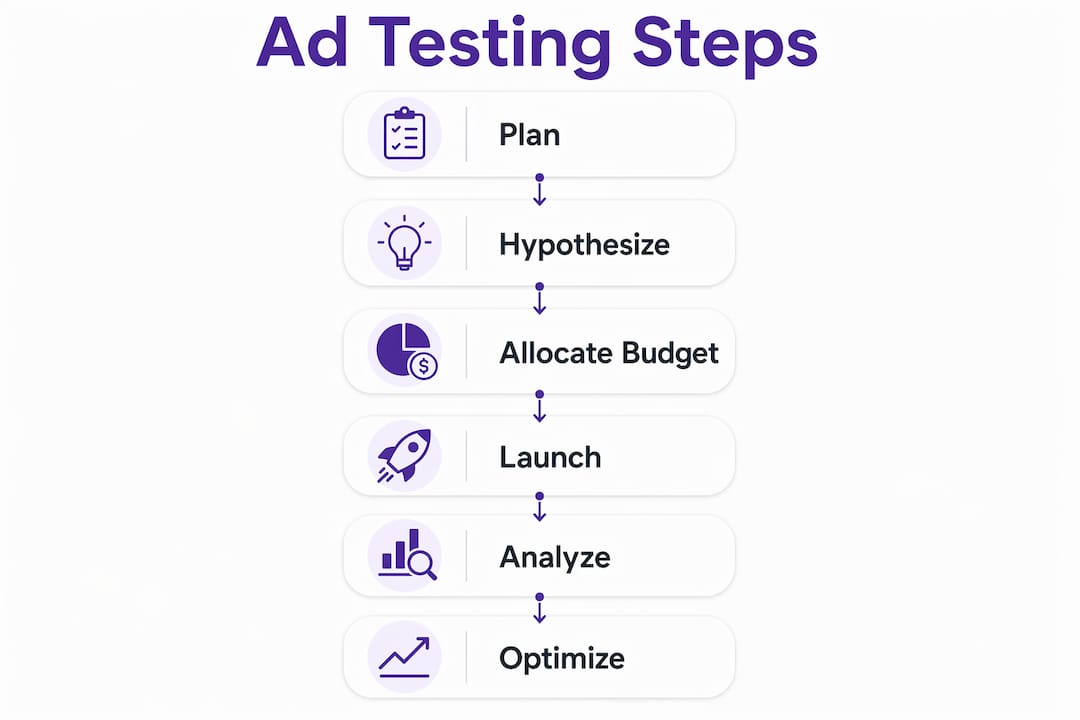
The stepwise ad testing process follows a clear sequence. Skipping steps compounds errors and makes it impossible to know which change caused which result.
- Form a hypothesis. State what you are changing, why you expect it to improve performance, and which metric will confirm or deny the result.
- Isolate one variable. Change only one element per variant. Changing multiple variables simultaneously produces ambiguous data and wastes budget. If you alter both the hook and the copy in the same variant, you cannot know which drove the result.
- Create your variants. Produce the control (your current best performer) and one or two challengers. Keep all other elements identical: format, aspect ratio, call-to-action placement, and audience targeting.
- Set equal budgets and launch simultaneously. Staggered launches introduce time-of-week bias. Both variants must compete under identical conditions.
- Define your test duration before launch. Tests require a minimum of 7 days, with 10–14 days recommended for lower-volume accounts. This window allows the platform algorithm to exit its learning phase and deliver stable data.
- Monitor without intervening. Check dashboards for delivery issues, not performance judgements. Resist the urge to pause early.
- Analyse results against your hypothesis. Compare your primary KPI first, then secondary metrics to understand the full picture.
- Document and iterate. Record the hypothesis, result, and next action. This log compounds into a competitive advantage over time.
Pro Tip: Predefine your test end date in your calendar and lock it. Checking and pausing ads within the first 48–72 hours disrupts the algorithm’s learning phase and produces conclusions based on volatile early data.
Statistical rigour is non-negotiable. Declare a winner only after reaching 90–95% confidence, with a minimum of 500 impressions for CTR tests and 100 conversions for conversion-optimised campaigns. Anything below these thresholds is directional at best.

What variables should mobile gaming marketers test first?
Not all creative elements carry equal weight. Testing button colour before you have validated your core concept is a common and costly mistake. The hierarchy of ad creative testing runs from highest to lowest impact:
- Concept testing: Does the core idea resonate? For a mobile puzzle game, this means testing a “fail state” concept against a “satisfying solve” concept. This level produces the largest performance swings.
- Format testing: Should the ad be a playable, a video, or a static image? Format shapes how users experience the creative before they read a single word of copy.
- Hook testing: Does the opening three seconds stop the scroll? For TikTok, this is often the single highest-leverage test available. A character reveal versus a gameplay challenge can shift hook rate dramatically.
- Copy testing: Does the headline or overlay text change intent? Test one copy angle at a time, such as “Play free” versus “Can you beat level 5?”
- Visual element testing: Colour palette, character design, and animation style sit here. These tests matter, but only after concept and hook are validated.
- Offer and incentive placement: Where you position a free trial badge or a “limited time” message affects conversion rate, but it is the last variable to optimise.
Platform behaviour shapes which level to prioritise. Meta rewards thumb-stopping visuals and social proof. TikTok rewards native-feeling content and audio. Creative winners on one platform rarely transfer directly to another. A gameplay video that performs well on Meta may underperform on TikTok if it lacks the pacing and audio cues that TikTok audiences expect. Test each platform independently and treat each as a separate creative environment.
For a practical checklist of formats to test across platforms, the ad testing checklist from Playablemaker covers Meta, TikTok, and Unity in detail.
How to interpret results and apply learnings
Reading test data correctly is where most teams lose the gains they worked to create. The first step is diagnosing why a creative underperformed, not just that it did.
Use a diagnostic sequence. If CPA is poor, check hook rate first. A hook rate below 25% means the opening moment failed to retain viewers. Rewriting the hook is the correct next action. If hook rate is strong but CPA remains high, the problem sits in the middle of the ad or in the offer itself. This targeted approach prevents unnecessary rewrites of elements that are already working.
Avoid premature conclusions. The algorithm’s learning phase causes volatile early results. The golden rule is to predefine your test duration and hold to it regardless of early signals. A creative that looks weak on day two may stabilise into a winner by day ten.
Pro Tip: Maintain a structured testing log. Documenting each test’s hypothesis, metrics, and outcome compounds insights across cycles and significantly accelerates future optimisation decisions.
| Metric | Signal | Decision Rule |
|---|---|---|
| Hook rate below 25% | Opening moment fails | Rewrite the first three seconds |
| Hook rate above 40% | Strong opening | Investigate mid-ad or offer elements |
| High CTR, high CPA | Click intent misaligned | Revise post-click experience or offer |
| Low impressions | Insufficient data | Extend test duration before judging |
| Stable CPA, declining volume | Creative fatigue | Begin testing a replacement variant |
Scale winners before they plateau. Creative fatigue in mobile gaming campaigns is real and predictable. Once a winning creative shows declining CTR or rising CPA over two consecutive weeks, launch a new challenger. Do not wait for performance to collapse before testing a replacement.
For a deeper look at the full A/B testing workflow for mobile games, Playablemaker’s guide covers the end-to-end process in practical detail.
What common pitfalls undermine ad creative testing?
Even experienced UA teams make the same structural errors. Recognising them in advance saves both budget and time.
- Testing multiple variables at once. This is the single most damaging mistake. If your hook, copy, and visual all change between variants, no result is interpretable. Isolate one variable per test without exception.
- Pausing tests too early. Checking results at 24 or 48 hours and acting on them is a reliable way to reach wrong conclusions. The algorithm needs time to stabilise delivery and find your audience.
- Assuming platform winners transfer universally. Platform behavioural differences demand independent testing on each channel. A Meta winner is a Meta winner. Validate it separately on TikTok or Unity before scaling.
- Running too many variants simultaneously. Budget dilution across five or six variants means none receives enough spend to reach statistical significance. Limit active tests to two or three variants per campaign at any time.
- Testing without a hypothesis. Random variation produces random learning. Every test needs a stated reason and a predicted outcome before it launches.
- Ignoring secondary metrics. A test that shows no change in CPA may still reveal a meaningful shift in hook rate or CTR. These signals inform the next hypothesis even when the primary metric is flat.
The discipline to follow a structured process consistently separates teams that compound creative learning from those that repeat the same experiments indefinitely.
Key takeaways
Effective ad creative testing requires hypothesis-driven planning, single-variable isolation, and platform-specific analysis to produce reliable, scalable results in mobile gaming campaigns.
| Point | Details |
|---|---|
| Hypothesis before every test | Write a specific, measurable hypothesis before launching any variant to keep analysis objective. |
| Isolate one variable | Change only one creative element per test to identify cause and effect with confidence. |
| Respect test duration | Run tests for a minimum of 7 days, and up to 14 days for lower-volume accounts, to exit the learning phase. |
| Diagnose with hook rate | Check hook rate first when CPA underperforms; a rate below 25% signals the opening moment needs rewriting. |
| Test platforms independently | Creative winners on Meta rarely transfer to TikTok or Unity without independent validation. |
Why concept and hook testing deserve your full attention first
Having worked across mobile gaming UA campaigns at various scales, I find the most consistent mistake is not a lack of testing. It is testing the wrong things in the wrong order. Teams spend weeks optimising button colours and CTA wording while their core concept remains unvalidated. The concept is the load-bearing wall. Everything else is decoration.
The hook is the second priority, and it is underestimated almost universally. Three seconds is not a short window. It is the entire window. On TikTok especially, a weak hook means the rest of your creative is never seen, regardless of how well-crafted it is. I have seen campaigns where fixing the hook alone reduced CPA by more than any other single change across a full quarter of testing.
My honest recommendation: commit to at least four concept-level tests before you run a single element-level test. Build your testing log from day one. The teams that treat documentation as optional are the same teams that repeat failed experiments six months later because no one recorded what was tried. Velocity matters, but disciplined velocity compounds. Random speed does not.
Playablemaker’s no-code playable ad builder makes it practical to produce concept-level variants quickly, which is the only way to maintain the testing cadence that actually moves metrics.
— Ondrej
How Playablemaker supports your creative testing workflow
Playablemaker is built for mobile gaming marketers who need to produce and test ad creative variants without depending on a development team. The no-code playable ad platform lets you build interactive ad experiences quickly, iterate on concepts without engineering overhead, and maintain the testing velocity that a disciplined stepwise process demands. For UA teams running campaigns across Meta, TikTok, and Unity, the ability to produce multiple concept-level variants in hours rather than weeks changes what is possible. If you are ready to move faster on your effective ad creative strategies, Playablemaker gives you the tools to do it without the usual cost or complexity.
FAQ
What is ad creative testing in mobile gaming?
Ad creative testing is the structured process of running controlled experiments on ad variants to identify which creative elements drive the strongest user acquisition results. It applies to all formats, including video, static, and playable ads across platforms like Meta and TikTok.
How long should an ad creative test run?
Tests require a minimum of 7 days, with 10–14 days recommended for lower-volume accounts. This duration allows the platform algorithm to exit its learning phase and deliver statistically reliable data.
How do i know when a test result is statistically valid?
A result is reliable at 90–95% confidence, with at least 500 impressions for CTR tests and 100 conversions for conversion-optimised campaigns. Declaring a winner below these thresholds risks acting on noise rather than signal.
Should i use the same winning creative across all platforms?
No. Creative winners on one platform rarely transfer directly to another. Meta, TikTok, and Unity each have distinct audience behaviours and content expectations, so each platform requires independent testing and validation.
What is hook rate and why does it matter?
Hook rate measures the proportion of viewers who watch the first three seconds of a video ad. A hook rate below 25% signals the opening moment has failed; above 40% indicates strong initial engagement. It is the first diagnostic metric to check when CPA is underperforming.
Recommended
- Why test creatives for mobile gaming user acquisition – playablemaker.com Why test creatives for mobile gaming user acquisition
- Creative Testing for Mobile Games: Step-by-Step Success – playablemaker.com Creative Testing for Mobile Games: Step-by-Step Success
- Step-by-Step Guide to A/B Testing Ads for Mobile Games – playablemaker.com Step-by-Step Guide to A/B Testing Ads for Mobile Games
- Ad A/B Testing Guide for Higher Mobile Game ROI – playablemaker.com Ad A/B Testing Guide for Higher Mobile Game ROI