
TL;DR:
- Ineffective ad creative feedback leads to wasted budgets in mobile game user acquisition. Implementing a structured, weekly testing cycle and hierarchy of variables enhances data quality and campaign performance. Leveraging AI tools and disciplined documentation accelerates learning and prevents fatigue, maximizing creative impact and efficiency.
Inefficient ad creative feedback wastes more budget than most mobile game teams realise. When creative, user acquisition, and analytics teams operate without a shared structure, feedback becomes subjective, testing stalls, and poor performers quietly drain spend. A disciplined ad creative feedback process changes that entirely. This guide walks you through the prerequisites, the weekly testing workflow, the hierarchy of creative variables to test, how to handle fatigue, and how AI tools fit into the picture — all framed around the realities of mobile game user acquisition.
Table of Contents
- Define what you need for an effective ad creative feedback process
- Establish a systematic feedback workflow for ad creative testing
- Apply a structured hierarchy to testing creative variables
- Recognise and combat ad creative fatigue
- Use AI and analytics tools for pre-launch and ongoing creative feedback
- Why a disciplined feedback system beats random volume in mobile game ads
- Discover PlayableMaker’s solutions to empower your ad creative feedback process
- Frequently asked questions
Key Takeaways
| Point | Details |
|---|---|
| Structured feedback process | A consistent weekly workflow helps identify winning ads faster and reduces wasted budget. |
| Test highest impact variables first | Start with ad concepts, followed by hooks, formats, CTAs, and finally script refinements. |
| Manage ad fatigue actively | Rotate creatives regularly and monitor performance signals to avoid rising costs from fatigue. |
| Leverage AI tools | Use AI-powered pre-launch checks and analytics to optimise creative feedback and iteration. |
| Discipline outperforms volume | Methodical testing cycles yield better long-term results than random ad launches or volume-focused strategies. |
Define what you need for an effective ad creative feedback process
Having established why ad creative feedback matters, let us clarify what you need before launching any feedback loops.
Most teams jump straight into testing without agreeing on what success looks like. This is where the process breaks down. Before a single ad variant goes live, your UA specialists, creative team, and analytics function need to sit in the same room — metaphorically or otherwise — and align on goals, platforms, and measurement standards.
Start with SMART goals. Every creative test should have a specific, measurable, achievable, relevant, and time-bound objective. “Improve CTR” is not a goal. “Increase CTR on iOS rewarded video by 15% within four weeks” is. That specificity shapes every downstream decision, from how many variations to produce to when you declare a winner.
Creative accounts for nearly half of digital ad sales impact, which means poor briefing at this stage has disproportionate consequences. Define your KPIs before briefing your creative team. Are you optimising for install rate, cost per install (CPI), day-one retention, or something further down the funnel like in-app purchase conversion? Each demands different creative choices.
Here is a checklist of prerequisites worth confirming before any feedback cycle begins:
- Shared project management tool where all creative assets, test results, and feedback notes live
- Agreed KPIs documented and visible to all stakeholders
- Clear audience segmentation per platform (iOS vs Android, geography, age bracket)
- Format requirements confirmed per channel (aspect ratios, duration limits, file sizes)
- A naming convention for ad variants so data does not get misattributed
You can also apply the structure of a comprehensive content marketing checklist to your creative briefing process. The principle of mapping each asset to a clear audience intent translates directly to ad creative.
| Prerequisite | Owner | Tool or method |
|---|---|---|
| SMART goal setting | UA lead | Shared brief document |
| KPI definition | Analytics team | Dashboard or spreadsheet |
| Audience segmentation | UA specialist | Platform targeting settings |
| Asset format requirements | Creative manager | Format specification sheet |
| Naming conventions | All teams | Agreed taxonomy document |
When these elements are in place before you begin, your A/B testing for mobile ads produces cleaner data and faster decisions.
Establish a systematic feedback workflow for ad creative testing
Now that you know what is required, let us outline the actual step-by-step workflow to run your feedback process effectively.
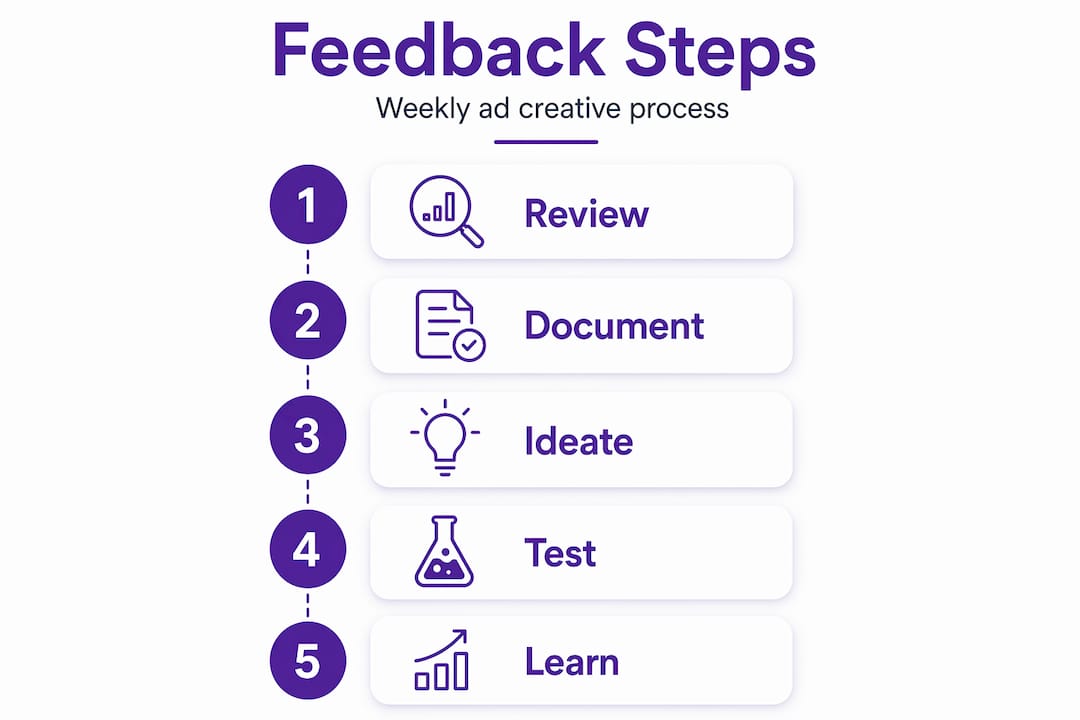
Structure your week deliberately. A weekly cycle prevents the common trap of reactive testing — where teams only pause ads when spend becomes alarming, rather than making regular, data-informed decisions. AdCreate recommends a structured weekly cycle beginning with Monday analysis, midweek production, Thursday launch, and Friday monitoring with defined thresholds for pausing underperformers after 500 or more impressions.
Here is how that translates in practice:
- Monday: Review and audit. Pull performance data from the previous week. Identify your top 20% of creatives by your primary KPI and your bottom 30% by cost efficiency. Pause the losers immediately. Document what worked and what did not, in writing, not just in memory.
- Tuesday to Wednesday: Produce new variants. Generate 10 to 15 new variations based on what Monday’s review revealed. Focus changes on one variable at a time per variant — this is the only way to attribute performance differences correctly.
- Thursday: Launch and configure tests. Push new variants live with equal budget splits. Set up A/B tests properly, ensuring no audience overlap between variants. Reference your ad testing checklist before launch to avoid common set-up errors.
- Friday: Monitor early signals. Check CTR, ThruPlay rates, and early install data. If a variant is burning spend with no signal of engagement after 500 impressions, pause it. Do not wait for Monday.
Pro Tip: Set automated rules inside your ad platform to pause any creative that exceeds a CPI threshold after a defined impression count. This removes emotion from the equation and enforces the process even when no one is actively watching.
The value of effective feedback loops is cumulative. Each week’s data informs the next week’s production. Over time, this cycle builds genuine creative intelligence about your audience rather than isolated guesses.

| Day | Activity | Output |
|---|---|---|
| Monday | Performance review and audit | Paused losers, documented learnings |
| Tuesday to Wednesday | Variant production | 10 to 15 new creative variants |
| Thursday | Launch and A/B test setup | Live tests with equal budget splits |
| Friday | Early signal monitoring | Paused poor performers, notes for Monday |
Apply a structured hierarchy to testing creative variables
With the workflow in place, let us dig into what exactly to test first to harness maximum creative impact.
Not all creative variables carry equal weight. Testing button colour before you have validated your core concept is a common and costly mistake. Concept testing produces 5 to 10 times greater performance differences compared to any other variable and must come first, before hook, format, call-to-action, or copy.
Follow this hierarchy when designing your test roadmap through your creative testing framework:
- Concept: The core idea or angle of the ad. Are you leading with a gameplay challenge, a character narrative, a problem-solution format, or social proof? This is the highest-leverage test.
- Hook: The first one to three seconds of your video. This determines whether users stop scrolling. Test radically different openings — a question, an action sequence, a surprising visual — before assuming your concept has failed.
- Format and style: Static vs video, landscape vs portrait, live action vs gameplay capture. Platform behaviour should guide this, but testing confirms it.
- CTA and offer: The specific wording and placement of your call-to-action, and whether an offer (free item, limited event) improves conversion.
- Script and copy refinements: Word-level changes to voiceover, on-screen text, and subtitles. These are the final layer of fine-tuning, not the starting point.
This hierarchy prevents wasted production effort. There is no point polishing the script of a concept that will never resonate with your audience.
Recognise and combat ad creative fatigue
Having covered what to test and when, it is vital to also manage fatigue to sustain performance over time.
Ad creative fatigue is not an abstract risk. It shows up in the data as rising frequency (how many times the same user sees your ad) alongside a falling CTR, even as total impressions remain steady. When you see that pattern, the creative has exhausted its impact with your current audience segment.
Testing fewer than five creatives per month leads to CPI increases of 20 to 40% over 90 days, driven primarily by fatigue. This is a significant and preventable cost for any UA team managing meaningful budgets.
To counter fatigue effectively:
- Set frequency caps of five to seven impressions per user per week as a starting point, adjusting by platform and audience size
- Rotate multiple headline and hook variations simultaneously rather than relying on a single winner
- Periodically rest high-performing creatives for two to four weeks, then reintroduce them to a refreshed audience
- Monitor your ad fatigue signals weekly as part of your Monday review
Pro Tip: When a winning creative begins to fatigue, do not retire the concept, retire the execution. Produce three or four new executions of the same proven concept before moving on. This preserves the strategic learning while refreshing the audience experience.
The discipline of recognising fatigue early protects both your CPI and the longer-term health of your campaigns. Teams that let fatigued creatives run unchecked often find their entire account performance degrades, not just the individual ad.
Use AI and analytics tools for pre-launch and ongoing creative feedback
Finally, leveraging AI and analytics tools can significantly enhance your feedback process for quicker, smarter decisions.
Pre-launch AI scoring is now a practical capability for teams willing to integrate it into their workflow. Rather than waiting for spend to reveal a poor creative, AI systems can assess assets before they go live, flagging potential issues with visual clarity, pacing, and hook strength. The Omnicom and Google AI system applies the ABCD framework — Attention, Branding, Connection, Direction — to evaluate creatives pre-launch, enabling early quality assessment and reducing wasted spend.
Here is how to integrate AI into your ad creative feedback process practically:
- Use AI pre-launch scoring to assess all new variants before budget allocation
- Apply the ABCD framework as a common language for your creative ad review checklist across human and AI evaluations
- Leverage AI video tools to generate rapid hook variations from a single concept, compressing production time significantly
- Use AI-generated performance predictions as one input, not the final arbiter, for launch decisions
AI excels at pattern recognition across thousands of data points simultaneously. What it cannot replicate is the contextual judgement that comes from knowing your specific game audience, your seasonal moment, or the cultural nuance of a particular market segment. The most effective teams use AI to accelerate, not replace, human creative intelligence.
Integrating AI workflows for ad creativity into your feedback loop reduces the lag between insight and action, which is one of the primary drags on campaign efficiency for most UA teams.
Why a disciplined feedback system beats random volume in mobile game ads
There is a persistent belief in mobile game UA that more ads equal more learning. It feels logical — more data points, more signals, faster conclusions. In practice, it rarely works that way.
Random volume without a structured testing protocol produces noise, not intelligence. When you launch 30 variants simultaneously without a hierarchy, without consistent naming conventions, and without a documented review cycle, the data becomes difficult to interpret. You end up knowing that something worked without understanding why it worked. And without understanding why, you cannot repeat it.
Consistent experimentation with 15 or more structured tests per year delivers 30% better results over two years compared to ad-hoc random testing. The compounding effect of methodical learning is real and significant.
Disciplined teams build what is effectively a testing machine. Every cycle produces documented learnings — what concept resonated, what hook failed, what format outperformed expectations — and those learnings feed directly into the next production brief. Over six months, the creative briefs become sharper, production becomes faster, and CPI trends downward because the team is working from accumulated evidence rather than fresh guesses each week.
Rigorous documentation is the part most teams skip. It feels like overhead. It is, in fact, the mechanism by which your structured creative testing compounds in value. Without it, each cycle starts from near zero.
The uncomfortable truth is that volume without discipline is not testing, it is spending. The teams consistently outperforming their benchmarks in mobile game user acquisition are not the ones running the most ads. They are the ones running the most purposeful tests.
Discover PlayableMaker’s solutions to empower your ad creative feedback process
Now that you understand best practices, explore how PlayableMaker can help you implement and accelerate these processes efficiently.
If your ad creative feedback process depends on rapid iteration, you need creative production that keeps pace with your testing cadence. PlayableMaker’s no-code platform lets you build interactive playable ads quickly, without dev time or inflated production costs. You can generate multiple variants in hours rather than weeks, run structured A/B tests on playable formats with integrated analytics, and make data-informed decisions faster. Understanding why playable ads convert is the first step; having a tool that lets you test and iterate on them without burning your budget is what makes the difference in practice.
Frequently asked questions
What is the ideal sample size before evaluating ad creative test results?
Aim for at least 500 to 1,000 impressions per ad variation and a minimum of 48 to 72 hours of running time before drawing conclusions, as earlier data rarely reflects stable performance patterns.
How often should I refresh creatives to avoid ad fatigue?
Refreshing creatives every two to three weeks and rotating multiple hook and headline variants simultaneously helps mitigate fatigue; top performers warrant new variants produced every fortnight to maintain cost efficiency.
Can AI replace human judgement in creative feedback?
AI is effective at pre-launch quality assessment and pattern detection, but combining human insight with AI delivers better continuous iteration because contextual and cultural nuances still require human judgement.
Why is testing the concept before other variables so important?
Concept is the highest-impact variable in any ad creative test, producing performance differences of 5 to 10 times compared to adjustments at the hook, format, or copy level, making it the correct foundation for all subsequent testing.
How can I ensure consistency across different platforms during testing?
Adapt winning concepts to each platform’s format, pacing, and audience behaviour rather than reusing assets directly; a winning TikTok ad typically requires substantial structural changes to perform well on YouTube or Facebook.
Recommended
- Campaign creative: an expert guide for user acquisition – playablemaker.com Campaign creative: an expert guide for user acquisition
- Streamline ad campaign management for mobile games – playablemaker.com Streamline ad campaign management for mobile games
- 8 Creative Sources for Ad Creative Inspiration – playablemaker.com 8 Creative Sources for Ad Creative Inspiration
- Mastering Creative Approval Workflow for Mobile Marketing – playablemaker.com Mastering Creative Approval Workflow for Mobile Marketing