
Interactive playable ads can triple engagement compared to traditional formats, yet producing them traditionally drains developer time and budgets. An ad creative stack built with no-code tools transforms this challenge, enabling user acquisition professionals to create high-performing playable ads in days rather than weeks whilst dramatically cutting costs and expanding creative capacity.
Table of Contents
- Introduction To Ad Creative Stacks
- Key Components Of An Ad Creative Stack For Playable Ads
- Why No-Code Tools Are Game Changers For Playable Ad Creation
- How Ad Creative Stacks Influence Campaign Performance
- Common Misconceptions About Ad Creative Stacks And Playable Ads
- Comparative Framework To Select Ad Creative Stack Tools
- Practical Guide To Deploy And Scale Your Ad Creative Stack
- Discover Playable Ad Solutions At PlayableMaker
Key takeaways
| Point | Details |
|---|---|
| Ad creative stacks are modular toolsets | Integrated software platforms streamline creation, management, and optimisation of digital ad creatives for mobile gaming. |
| No-code tools reduce production time | Playable ad development drops from weeks to 1-3 days, eliminating developer dependency and broadening creator accessibility. |
| Interactive formats boost campaign metrics | Playable ads built with creative stacks deliver up to 3x engagement increases and measurably improve ROI and user retention. |
| Common myths limit adoption | 60% of marketers underestimate no-code capabilities and accessibility of ad creative stacks beyond tech-heavy companies. |
| Strategic tool selection drives results | Effective stacks balance ease of use, integration, cost, and scalability with 4-7 core tools optimised for campaign needs. |
Introduction to ad creative stacks
An ad creative stack is a collection of integrated software tools and platforms that enable the efficient creation, management, and optimisation of digital ad creatives. For mobile gaming user acquisition professionals, these stacks specifically address the unique demands of producing interactive playable ads that capture attention and drive installs. Unlike broader ad tech stacks that encompass media buying, attribution, and analytics infrastructure, ad creative stacks focus exclusively on the creative production pipeline.
A typical ad creative stack contains 5-10 specialised tools working in harmony. Each tool handles distinct aspects of the creative workflow, from initial design concepts through interactive prototyping, testing, and performance optimisation. This modular approach allows teams to select best-in-class solutions for each stage whilst maintaining seamless integration across the entire production process.
The distinction matters particularly in mobile gaming, where ads gaming formats demand sophisticated interactivity that traditional static or video ads cannot deliver. Playable ads require users to experience core gameplay mechanics before installing, creating authentic engagement that significantly outperforms conventional formats. Building these experiences traditionally requires substantial developer resources, lengthy production cycles, and technical expertise that many UA teams lack.
Modern ad creative stacks solve this resource challenge by incorporating no-code platforms that democratise playable ad creation. These tools enable marketing professionals to build sophisticated interactive experiences without writing a single line of code. The result is faster iteration, reduced dependency on engineering teams, and the ability to test multiple creative variations simultaneously across campaigns.
Understanding what constitutes effective ad creative helps clarify why purpose-built stacks matter. Creative quality directly impacts campaign performance, yet quality at scale remains elusive when production bottlenecks limit output. Ad creative stacks remove these bottlenecks through automation, templating, and intelligent workflows that maintain consistency whilst accelerating production velocity.
Key components of an ad creative stack for playable ads
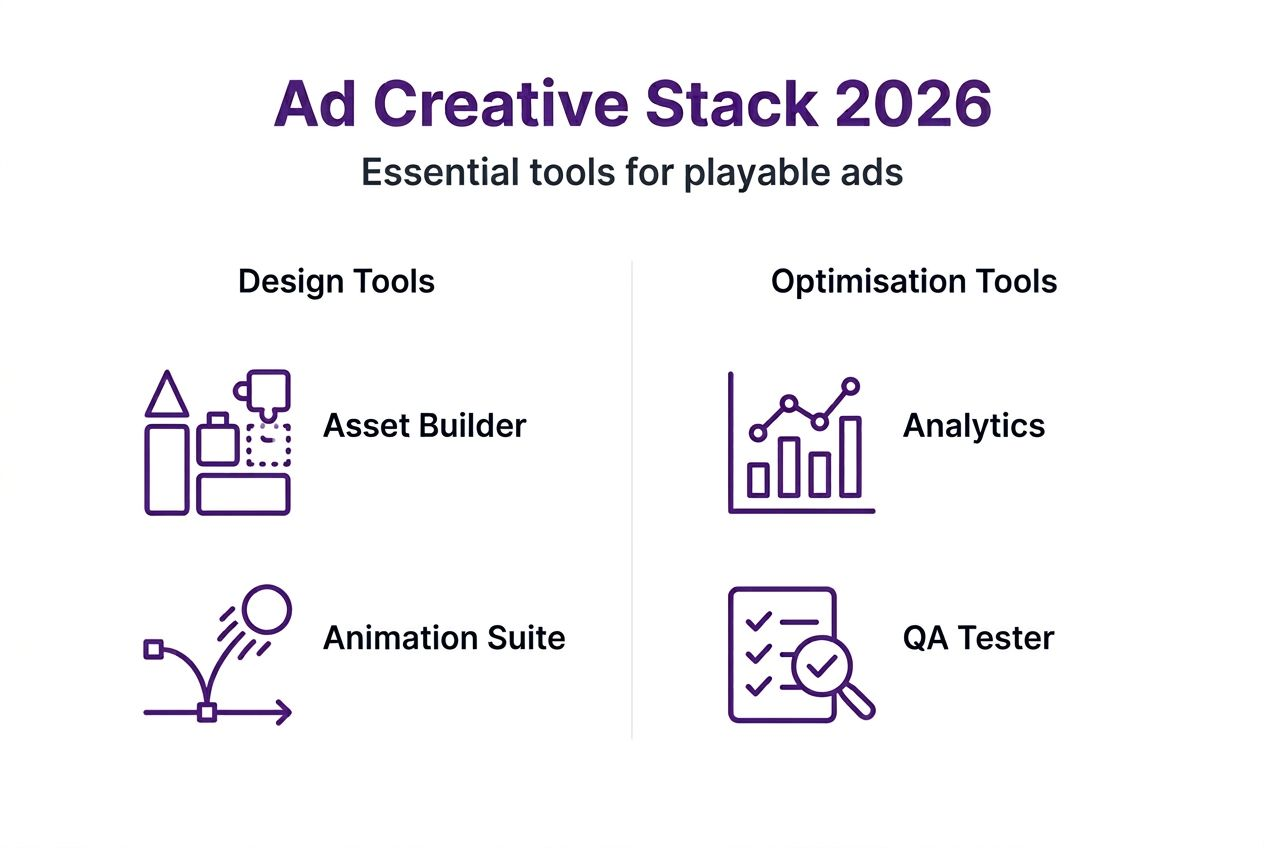
An ideal ad creative stack for mobile gaming combines tools for design, interactivity, analytics, and automated testing with low-code or no-code user interfaces. Most effective stacks integrate 4-6 core platforms that address distinct production needs without creating redundant functionality or workflow friction. Each component serves a specific purpose in transforming concepts into high-performing playable ad experiences.
Design tools form the foundation, enabling teams to create visual assets, animations, and user interface elements that match game aesthetics. Interactivity platforms then transform static designs into engaging experiences where users tap, swipe, and interact with gameplay mechanics. Analytics components track performance metrics in real time, revealing which creative variations drive the strongest response rates and user quality.
Testing and optimisation tools complete the stack by automating quality assurance across devices and platforms whilst identifying opportunities for creative improvement. Modern stacks increasingly incorporate artificial intelligence to suggest creative variations, predict performance outcomes, and automate repetitive production tasks. This automation proves particularly valuable for teams managing multiple game titles or running high-velocity testing programmes.

| Tool category | Primary function | Typical use case |
|---|---|---|
| Design platforms | Visual asset creation and animation | Building game-matched creative assets |
| Interactivity builders | No-code interactive experience creation | Developing playable ad mechanics |
| Analytics dashboards | Performance tracking and attribution | Measuring engagement and conversion |
| Testing automation | Quality assurance across devices | Ensuring consistent playability |
| Asset management | Centralised creative library | Organising and versioning creatives |
No-code and low-code platforms represent the most transformative components within modern stacks. These tools eliminate technical barriers that previously restricted playable ad creation to developers with gaming engine expertise. Marketing professionals can now directly build, test, and iterate on creative ad formats without waiting for engineering resources or navigating complex development environments.
Integration capabilities determine stack effectiveness as much as individual tool quality. The best components communicate seamlessly, passing data and assets between platforms without manual export-import cycles. This integration enables effective ad creative processes where designers, marketers, and analysts collaborate within unified workflows rather than working in isolated silos.
Why no-code tools are game changers for playable ad creation
No-code solutions reduce playable ad production time from weeks to 1-3 days and broaden creator accessibility whilst saving resources. Traditional playable ad development requires game developers proficient in engines like Unity or HTML5, creating immediate bottlenecks when marketing teams need rapid creative iteration. No-code platforms eliminate this dependency by providing visual interfaces where anyone can assemble interactive experiences through drag-and-drop components.
The time savings prove substantial and measurable. Teams that previously waited two to three weeks for developers to build a single playable ad now produce multiple variations daily. This acceleration directly impacts campaign performance because faster iteration cycles enable more creative testing, rapid response to performance data, and the ability to capitalise on trending themes before they become saturated.
Resource efficiency extends beyond time to encompass financial and human capital. Developer salaries represent significant costs, and allocating engineering talent to ad creative production diverts resources from core game development. No-code tools let marketing teams own the entire creative process, freeing developers to focus on product innovation whilst UA professionals maintain direct control over campaign creative.
Accessibility represents perhaps the most profound shift. Traditional barriers excluded talented marketers and designers from playable ad creation because they lacked coding skills. No-code platforms democratise this capability, expanding the pool of potential creators to include anyone with creative vision and marketing insight. This expanded accessibility often yields more innovative creatives because diverse perspectives generate fresh approaches.
Campaign testing velocity accelerates dramatically when production bottlenecks disappear. Teams can now run sophisticated creative experiments testing multiple gameplay mechanics, visual styles, and user flows simultaneously. This testing cadence was previously impossible due to production constraints, meaning many potentially winning creative concepts never reached market.
Pro tip: Start with template-based creation in no-code tools for playable ads to achieve quick wins, then gradually customise templates as your team builds confidence. This staged approach reduces the learning curve whilst delivering immediate value through faster production cycles.
The capabilities of modern no-code tools now rival custom-coded solutions for most playable ad use cases. Advanced platforms support complex game mechanics, physics simulations, and sophisticated animations without requiring any programming knowledge. This parity means teams no longer sacrifice creative ambition when choosing accessible tools over traditional development approaches.
How ad creative stacks influence campaign performance
Interactive playable ads built with creative stacks can improve engagement by up to 3x and significantly boost ROI and user retention. This performance advantage stems from the fundamental nature of interactive formats, which require active participation rather than passive consumption. Users who engage with playable ads demonstrate genuine interest in gameplay mechanics, resulting in higher-quality installs with stronger retention profiles.
Engagement metrics tell a compelling story. Click-through rates for playable ads consistently outperform video and static formats by substantial margins, often doubling or tripling baseline performance. More importantly, the users who click through have already experienced core gameplay, setting accurate expectations that reduce early churn. This pre-qualification effect means fewer disappointed users and lower acquisition costs per retained player.
Interactive formats transform user acquisition by letting players experience gameplay before installing, resulting in engagement rates up to 3x higher than traditional ads whilst dramatically improving day-one retention and reducing early churn.
ROI improvements manifest across multiple dimensions. Direct response metrics improve through higher conversion rates and lower cost per install. Lifetime value increases because users acquired through playable ads typically exhibit stronger engagement and monetisation patterns. The combination creates a powerful multiplier effect where both sides of the ROI equation move favourably.
User retention benefits particularly from the expectation-setting nature of playable ads. When users install after experiencing actual gameplay mechanics, they arrive with accurate understanding of what the game offers. This alignment between expectation and reality reduces the likelihood of immediate uninstalls that plague user acquisition campaigns built on misleading or overly stylised creative.
Rapid iteration enabled by ad creative stacks amplifies these performance benefits. Teams can quickly identify winning creative concepts, double down on successful mechanics, and eliminate underperforming variations before wasting significant budget. This agility proves especially valuable in competitive gaming categories where creative fatigue sets in quickly and fresh approaches provide temporary competitive advantages.
The psychological principles underlying playable ad effectiveness reveal why interactive formats consistently outperform alternatives. Active participation creates investment and ownership, triggering psychological commitment that passive viewing cannot match. Users who succeed in playable challenges feel accomplishment and curiosity about the full game experience, driving higher-quality installs.
Common misconceptions about ad creative stacks and playable ads
60% of marketers underestimated the capabilities of no-code tools and the accessibility of ad creative stacks beyond tech-heavy companies. These misconceptions create barriers that prevent teams from adopting solutions that could transform their user acquisition performance. Addressing these myths directly helps clear the path for more widespread adoption of effective ad creative approaches.
Myth one suggests only large, tech-heavy gaming studios benefit from ad creative stacks. Reality shows independent developers and small UA teams gain proportionally greater advantages because they lack the in-house developer resources that large studios possess. No-code platforms level the playing field, enabling small teams to produce playable ads with quality and velocity previously exclusive to well-resourced competitors.
The second misconception holds that playable ads always require complex coding and game development expertise. Modern no-code platforms completely invalidate this assumption. Marketing professionals with no technical background now build sophisticated playable experiences using visual interfaces and pre-built components. The learning curve proves minimal, with most users creating their first playable ad within hours of platform onboarding.
Myth three claims no-code tools limit creative freedom and force generic outputs. This concern held validity in early no-code platforms but no longer applies to current solutions. Advanced platforms offer extensive customisation options, support unique game mechanics, and enable distinctive visual styles. The constraint lies in creator imagination rather than platform capability, with misconceptions about playable ads often obscuring real possibilities.
Cost concerns represent another common barrier, with teams assuming ad creative stacks require prohibitive investment. Actual pricing models prove accessible across budget ranges, with many platforms offering scalable plans that grow with usage. The return on investment typically justifies costs within the first month through improved campaign performance and reduced dependency on expensive developer resources.
Complexity fears prevent adoption when teams imagine overwhelming learning curves and workflow disruption. Reality shows most modern platforms prioritise user experience and intuitive design. Implementation timelines measure in days rather than months, with teams often producing their first ads before completing formal training. This accessibility removes traditional barriers to entry.
Comparative framework to select ad creative stack tools
Effective ad creative stacks balance ease of use, integration, cost, and scalability, with top stacks featuring 4-7 integrated core tools. Selecting the right combination requires systematic evaluation against criteria that matter most for your specific campaign needs and team capabilities. This framework provides structure for navigating the crowded landscape of creative platforms and building a stack optimised for your objectives.
Ease of use determines how quickly teams can become productive and whether non-technical staff can contribute effectively. Evaluate onboarding processes, interface intuitiveness, and the availability of templates or starter projects that accelerate initial production. Platforms requiring extensive training or technical knowledge create bottlenecks that negate the efficiency benefits of no-code approaches.
Integration capabilities ensure smooth data flow and asset sharing across your stack components. Tools should connect naturally with your existing analytics platforms, ad networks, and asset management systems. Friction in these connections creates manual work, slows iteration cycles, and increases error rates that damage campaign performance.
| Platform | Best for | Key strength | Pricing model | Learning curve |
|---|---|---|---|---|
| PlayableMaker | Mobile gaming playables | No-code speed and gaming focus | Subscription tiers | Minimal, hours to first ad |
| CreativeOS | Multi-format campaigns | Comprehensive creative suite | Usage-based | Moderate, days to proficiency |
| AdCreative.ai | AI-assisted generation | Automated creative suggestions | Credit system | Low, AI-guided creation |
Cost structures vary significantly across platforms, from flat monthly subscriptions to usage-based pricing that scales with ad production volume. Consider total cost of ownership including training, integration efforts, and ongoing support rather than focusing solely on license fees. Hidden costs often emerge in platforms that appear inexpensive initially but require extensive customisation or support.
Scalability ensures your chosen stack can grow with campaign demands without requiring disruptive platform migrations. Evaluate whether tools support increased production volume, additional team members, and expanded campaign complexity. Platforms that work well for testing may buckle under production-scale demands, forcing costly transitions.
Support and community resources prove critical during implementation and ongoing optimisation. Strong documentation, responsive customer support, and active user communities accelerate problem-solving and capability development. These resources become especially valuable when exploring advanced features or troubleshooting edge cases.
Pro tip: Begin with a pilot project using your top two platform choices from ad creative generator comparisons to evaluate real-world performance against your specific requirements. Hands-on testing reveals practical differences that specifications and demos cannot capture, particularly around workflow fit and team adoption.
Situational recommendations help narrow choices. Small teams with limited budgets prioritise ease of use and fast time to value, making focused platforms like specialised playable ad tools ideal. Large organisations managing diverse campaigns across multiple games benefit from comprehensive suites offering broader creative format support and advanced collaboration features.
Practical guide to deploy and scale your ad creative stack
44% of marketers use 5-10 tools in their ad creative stack with continuous optimisation to adapt to audience and platform changes. Deploying and scaling an effective stack requires systematic planning, phased implementation, and ongoing refinement based on performance data. This practical guide provides actionable steps for moving from selection to production-ready creative operations.
- Assess your current state and define clear objectives for creative production volume, quality standards, and performance targets.
- Map your existing creative workflow to identify bottlenecks, dependencies, and opportunities where stack tools can deliver immediate value.
- Select initial stack components based on your framework evaluation, prioritising tools that address your most significant pain points first.
- Run a focused pilot project with a single game or campaign to validate tool performance and team adoption before broader rollout.
- Document learnings, optimise workflows, and expand stack usage progressively across additional campaigns and team members.
- Establish performance benchmarks and regular review cycles to evaluate stack effectiveness and identify optimisation opportunities.
- Scale successful processes by creating templates, best practice documentation, and training resources that accelerate team productivity.
Common pitfalls derail deployment when teams skip systematic planning in favour of rushed implementation. Selecting too many tools simultaneously creates complexity and integration challenges that slow adoption rather than accelerating it. Start focused, prove value, then expand methodically. Another frequent mistake involves insufficient change management, where teams introduce new tools without adequate training or workflow adjustment.
Integration challenges emerge when platforms cannot communicate effectively, creating manual data transfer requirements that negate efficiency gains. Prioritise tools with robust APIs and native integrations to your existing infrastructure. Test these connections during pilot phases before committing to full deployment.
Ongoing evaluation proves essential because campaign requirements, platform capabilities, and competitive landscapes evolve continuously. Establish quarterly reviews examining stack performance against key metrics including production velocity, creative performance, cost efficiency, and team satisfaction. These reviews identify opportunities to add capabilities, retire underutilised tools, or upgrade to more advanced platforms.
Metrics to track include production cycle time from concept to published ad, creative testing velocity measured in variations per week, performance metrics like engagement rate and cost per install, and team productivity indicators such as ads produced per creator. These quantitative measures reveal stack effectiveness and guide optimisation decisions.
Best practices for repurposing ad creatives within your stack maximise the value of existing assets. Build modular creative components that can be recombined into new variations, creating a library of proven elements that accelerate production. Systematic versioning and performance tagging help identify which components drive results and deserve reuse in new contexts.
Experimentation frameworks ensure your stack supports innovation rather than just efficient production of similar creatives. Allocate specific budget and production capacity to testing novel creative concepts that may fail but could identify breakthrough approaches. This disciplined experimentation prevents creative stagnation and maintains competitive advantage.
Discover playable ad solutions at PlayableMaker
Building on the frameworks and strategies outlined above, PlayableMaker offers purpose-built no-code solutions that embody the principles of effective ad creative stacks. Our platform enables mobile gaming professionals to create engaging playable ads in hours rather than weeks, without coding expertise or excessive budgets. The intuitive interface supports rapid iteration, extensive customisation, and seamless integration with major ad networks.
Explore how no-code playable ad tools can transform your user acquisition campaigns through faster production cycles and expanded creative capacity. Our approach aligns with the strategic frameworks discussed, providing the balance of ease of use, performance, and scalability that defines effective creative stacks. Discover how playable ads work and why leading mobile gaming teams choose PlayableMaker to power their creative operations.
Frequently asked questions
What is an ad creative stack in mobile gaming?
An ad creative stack comprises integrated software tools that streamline the creation, management, and optimisation of digital ad creatives, with mobile gaming stacks specifically focused on producing interactive playable ads. These modular systems typically include 4-7 core platforms covering design, interactivity, analytics, and testing functions. The stack approach enables efficient production of high-performing playable ads that showcase actual gameplay mechanics, driving stronger engagement and user quality compared to traditional ad formats.
How do no-code tools speed up playable ad creation?
No-code platforms eliminate coding requirements through visual interfaces where creators drag and drop components to build interactive experiences. This accessibility removes dependency on developer resources, reducing production timelines from weeks to 1-3 days. Teams can iterate rapidly, test multiple creative variations simultaneously, and respond quickly to performance data without waiting for engineering support.
What factors should I consider when selecting ad creative stack tools?
Evaluate ease of onboarding to ensure quick team productivity, integration capabilities with existing platforms, pricing models that align with your budget and usage patterns, and scalability to support growing campaign demands. Prioritise solutions matching your team’s technical capabilities and campaign complexity. Running pilot projects with top candidates reveals practical workflow fit better than demos or specifications alone.
Can ad creative stacks improve campaign ROI?
Interactive playable ads created with well-designed creative stacks typically deliver engagement rates up to three times higher than traditional formats, directly improving campaign ROI. Users who experience gameplay before installing arrive with accurate expectations, resulting in stronger retention profiles and higher lifetime value. Combined with lower production costs and faster iteration cycles enabled by no-code tools, ad creative stacks create substantial ROI improvements across both acquisition efficiency and user quality dimensions.
Recommended
- Playable Ad Trends 2025: Build Engaging Ads Without Coding – playablemaker.com Playable Ad Trends 2025: Build Engaging Ads Without Coding
- Master the Playable Ad Optimisation Process for Success – playablemaker.com Master the Playable Ad Optimisation Process for Success
- 7 Essential Mobile Game Ad Trends to Know for 2025 – playablemaker.com 7 Essential Mobile Game Ad Trends to Know for 2025
- Master the Dynamic Ad Creative Process for Mobile Gaming – playablemaker.com Master the Dynamic Ad Creative Process for Mobile Gaming
- Meest effectieve google ads tools – Expert Vergelijking 2025 – Duitsewebsite.nl