
TL;DR:
- Leading mobile games in 2026 retain up to 40% of players on Day 1, compared to 22% average.
- Optimizing each stage of the user acquisition funnel and aligning creative with onboarding boosts retention.
- Successful games treat creative design and onboarding as a unified system to improve long-term engagement.
Only around 22% of players return to a mobile game the day after installing it, yet the top performers in 2026 are retaining up to 40% on Day 1. That gap is not luck. It reflects a fundamental difference in how leading studios design and manage their user acquisition funnels. Most games haemorrhage users at predictable stages, and the teams running those funnels often cannot pinpoint exactly where or why. This guide breaks down the anatomy of a mobile game UA funnel, shows you how to measure it with 2026 benchmarks, identifies the most common leak points, and gives you concrete tactics to improve efficiency at every stage.
Table of Contents
- What is a user acquisition funnel in mobile gaming?
- Mapping and measuring your funnel: essential KPIs for 2026
- Diagnosing funnel leaks: why users drop off (and how to fix it)
- Optimising the funnel: strategies for sustainable game growth
- A new mindset for funnel optimisation: what experts overlook
- Take your user acquisition funnel to the next level
- Frequently asked questions
Key Takeaways
| Point | Details |
|---|---|
| Funnel clarity | Understanding each funnel stage pinpoints where user loss occurs and why. |
| Benchmark your KPIs | Compare your metrics to 2026 benchmarks to spot strengths and fix gaps. |
| Early engagement focus | The first 5–15 minutes are vital for retention — optimise onboarding and core loops here. |
| Actionable innovation | Sustained growth demands creative testing and a blend of organic and paid strategy. |
| Holistic strategy wins | Combining data, creative, and user experience yields top-performing UA funnels. |
What is a user acquisition funnel in mobile gaming?
A user acquisition funnel describes the journey a player takes from first seeing an ad to becoming a loyal, paying user. Understanding this journey is the foundation of any effective UA strategy, and it is where most teams either build a competitive advantage or quietly bleed budget.
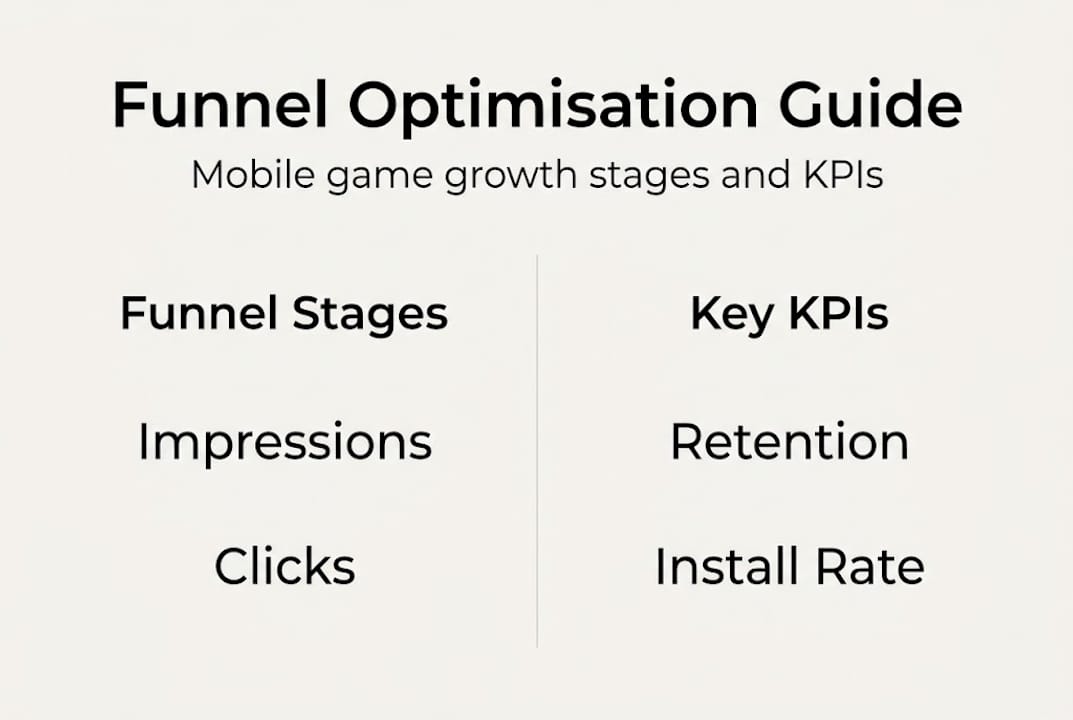
The funnel has five core stages:
- Ad impression: A potential player sees your creative across a network, social platform, or search result.
- Click: The impression generates enough interest to prompt a tap or click through to the store listing.
- Install: The player downloads and installs the game, converting from prospect to user.
- Activation: The player opens the game, completes onboarding, and reaches a meaningful first experience.
- Retention: The player returns on Day 1, Day 7, and Day 30, building habit and lifetime value.
Each stage has its own conversion rate, and losses compound as you move down. If your click-through rate is low, you overpay for every install. If your activation rate is weak, even a cheap install delivers no return. Understanding how a marketing funnel functions across these stages helps you diagnose problems before they become expensive.
The financial stakes have risen sharply. Global CPI rose 30% year-on-year in 2026, meaning every wasted install costs more than it did twelve months ago. Teams that cannot convert installs into retained players are essentially paying a premium to fill a leaking bucket.
Here is a simplified view of how each funnel stage connects to cost and value:
| Funnel stage | Primary metric | Why it matters |
|---|---|---|
| Impression | CPM | Reach and brand visibility |
| Click | CTR | Creative relevance and appeal |
| Install | CPI | Acquisition cost efficiency |
| Activation | Activation rate | Onboarding quality |
| Retention | D1, D7, D30 | Long-term value and LTV |
Optimising each stage independently is not enough. The funnel operates as a system, and a weakness in one layer undermines every layer below it.
Mapping and measuring your funnel: essential KPIs for 2026
Once you understand the funnel structure, the next step is measurement. Without reliable data at each stage, optimisation is guesswork. The key performance indicators you need to track span the full journey from impression to long-term engagement.
The essential KPIs are:
- Impressions and CPM: How broadly your creatives are reaching potential players and at what cost.
- Click-through rate (CTR): The percentage of impressions that generate a click. Low CTR signals weak creative or poor audience targeting.
- Cost per install (CPI): The total spend divided by installs. This is your primary acquisition cost signal.
- Activation rate: The share of installs who complete onboarding and reach a core gameplay moment.
- Day 1, Day 7, Day 30 retention: The percentage of users returning at each interval, reflecting engagement quality.
- Lifetime value (LTV): The projected revenue a user generates over their time in the game.
Tracking these ad performance metrics consistently is what separates reactive teams from proactive ones. You should also monitor UA costs at the campaign level to spot inefficiencies early.
The 2026 benchmarks reveal a stark performance spread. Median D1 retention sits at approximately 22%, D7 at 4%, and D30 at just 0.7%, while top-performing titles sustain significantly higher figures across all three intervals.
| KPI | Median performance | Top 10% performance |
|---|---|---|
| D1 retention | ~22% | ~40% |
| D7 retention | ~4% | ~15% |
| D30 retention | ~0.7% | ~3%+ |
| CPI | Rising (up 30% YoY) | Offset by higher LTV |
Genre plays a significant role here. Puzzle games tend to retain differently than shooters or RPGs, so benchmarking against your specific genre is essential for accurate diagnosis. Understanding user engagement patterns within your genre will sharpen your interpretation of these numbers.

Pro Tip: Do not treat D1 retention as your only north star. In casual games, D7 often predicts monetisation better. In mid-core titles, D30 is the more reliable indicator of LTV. Match your primary KPI to your genre and business model.
Diagnosing funnel leaks: why users drop off (and how to fix it)
Knowing your numbers is only useful if you can act on them. The next step is identifying exactly where your funnel loses users and understanding the mechanics behind each drop-off point.
The most common leak points are:
- Ad fatigue: Creatives that have been shown too frequently lose their impact, driving up CPM and depressing CTR. Rotating creative regularly is not optional.
- Audience mismatch: Ads reaching users outside your ideal player profile generate installs that never activate. Poor targeting inflates CPI without delivering value.
- Weak onboarding: Players who install but encounter a confusing or slow first experience leave before reaching the core gameplay loop.
- Absence of early reward: Games that delay the first meaningful reward or achievement beyond the first session lose a disproportionate share of new users.
- Technical friction: Crashes, long load times, or permission walls during onboarding create immediate abandonment.
The first 5 to 15 minutes of gameplay are the most critical window in the entire funnel. Players decide within that period whether the game is worth their time. Genre-tailored UA is equally essential here: what works for a hyper-casual title will not work for a strategy game, and applying generic UA methods across all genres is a reliable way to underperform.
“The games that retain best in 2026 are the ones that design the first session as deliberately as they design the monetisation layer. Onboarding is not a tutorial. It is your most important marketing moment.”
Pro Tip: Run a session recording or heatmap tool on your first-session flow. Identify the exact moment where the largest share of new users exits. That single moment is worth more attention than any ad creative test.
For fixes, focus on three areas. First, shorten and simplify onboarding to reach the core loop faster. Second, audit your performance metrics by traffic source to identify which channels deliver users with the weakest activation rates. Third, introduce an early win or reward within the first two minutes to create an emotional hook before the player has any reason to leave.
Optimising the funnel: strategies for sustainable game growth
With leak points identified, the focus shifts to systematic improvement. The following five tactics represent the most effective approaches for building a funnel that scales without proportionally scaling costs.
- Creative iteration at speed: Test multiple ad formats and concepts in short cycles. Do not wait for statistical significance on a single creative before moving on. Volume of learning matters as much as depth.
- Precision audience targeting: Use lookalike audiences built from your highest-LTV players, not just your largest install cohorts. Quality over quantity is the principle that protects margin as CPI rises.
- Onboarding redesign: Treat onboarding as a product problem, not a marketing problem. Collaborate with your product team to compress the time-to-fun metric and reduce friction at every step.
- Organic and paid channel mix: Relying solely on paid UA creates fragility. Building organic channels through app store optimisation, community, and content reduces your blended CPI and improves resilience.
- Re-engagement campaigns: Lapsed users who already know your game are cheaper to reactivate than acquiring new users. Segment lapsed cohorts by engagement depth and target them with relevant creative.
The top 1% of mobile games achieve D1 retention between 64% and 68%, a figure that reflects both exceptional product design and relentlessly optimised funnels. Understanding mobile UA fundamentals is the baseline; what separates elite teams is the discipline of continuous testing.
| Channel type | Typical CPI | Retention quality | Scalability |
|---|---|---|---|
| Paid UA (social) | High | Variable | High |
| Organic (ASO, community) | Low | Generally higher | Moderate |
| Hybrid approach | Moderate | Optimised | High |
A hybrid strategy, combining the scale of paid with the quality signal of organic, consistently outperforms either approach in isolation. Review your Facebook ad strategy as part of this mix, particularly for casual and mid-core titles where social creative drives significant volume.
A new mindset for funnel optimisation: what experts overlook
Most UA teams spend the majority of their time optimising individual metrics in isolation. They chase a better D1 number, then a lower CPI, then a higher CTR, treating each as a separate problem. This approach produces incremental gains but rarely produces step-change growth.
The widening retention gaps between median and top performers in 2026 suggest something more fundamental is at play. The games pulling ahead are not just running more tests. They are designing their creatives and their funnels as a unified system, where the promise made in the ad is fulfilled by the onboarding experience, which is reinforced by the core loop.
When creative and funnel are co-designed, the user arrives with accurate expectations and finds them met. That alignment is what drives retention. Treating creative as a top-of-funnel concern and onboarding as a product concern, with no shared ownership, is where most teams leave the biggest gains on the table.
Pro Tip: Bring your UA creative team into onboarding reviews. Ask them: does what we promise in our ads match what new players experience in the first session? The answer is often illuminating.
Take your user acquisition funnel to the next level
Building a funnel that genuinely converts requires more than data. It requires creative that earns attention and an experience that justifies it. Playable ads are one of the most effective tools for bridging that gap, because they let potential players experience the game before installing, which means the users who do install arrive with genuine intent. Understanding why playable ads work psychologically helps you design them to pre-qualify your best users. Explore the full range of playable ad benefits for your UA strategy, and when you are ready to act, start building your playable ads with PlayableMaker’s no-code platform, quickly and without the usual development overhead.
Frequently asked questions
What are the most important metrics for user acquisition funnels in 2026?
The essentials are cost per install, Day 1, Day 7, and Day 30 retention rates, and lifetime value, all of which reflect funnel efficiency and user quality. Tracking these together gives a far more accurate picture than any single metric in isolation.
Why do most mobile games lose users early in the acquisition funnel?
Most drop-offs occur due to weak onboarding, lack of engagement in the first 5 to 15 minutes, or poorly targeted ads that attract users outside the ideal player profile. Fixing these three areas typically produces the fastest improvements in early retention.
How can I improve my funnel efficiency if acquisition costs are rising?
With global CPI up 30% year-on-year, the most effective response is to improve conversion at every stage rather than simply spending more. Combining audience segmentation, creative tailoring, onboarding optimisation, and a hybrid organic and paid strategy delivers the strongest return on rising spend.
What makes top 1% games excel at user acquisition?
They treat creative and funnel design as a unified system rather than separate concerns, achieving D1 retention between 64% and 68% through rapid iteration, precision targeting, and onboarding that consistently delivers on the promise made in the ad.
Recommended
- What is a Marketing Funnel? Understanding Its Importance – playablemaker.com What is a Marketing Funnel? Understanding Its Importance
- Customer Acquisition Methods: Complete Mobile Gaming Guide – playablemaker.com Customer Acquisition Methods: Complete Mobile Gaming Guide
- 7-Step User Acquisition Checklist for Mobile Gaming Success – playablemaker.com 7-Step User Acquisition Checklist for Mobile Gaming Success
- 8 Key Ad Performance Metrics for Mobile Gaming Success – playablemaker.com 8 Key Ad Performance Metrics for Mobile Gaming Success