
TL;DR:
- Playable ads engage users through interactive experiences that predict post-install quality more effectively than CTR. Fast iteration and proper measurement frameworks are crucial for maximizing their impact across the UA funnel. Building scalable, compliant playables benefits from no-code tools that support rapid testing and consistent engagement signals.
Most user acquisition teams evaluate playable ads the same way they judge a banner. They check the click-through rate, declare a winner, and move on. This is a significant measurement error. The role of playables in UA is fundamentally different from any other ad format, because the interaction happens before the click, not after. Playable ads, more precisely described as interactive HTML5 mini-experiences embedded within ad placements, generate engagement signals that predict post-install quality far better than CTR ever could. This guide explains what those signals are, how to capture them, and how to build a production workflow that actually scales.
Key takeaways
| Point | Details |
|---|---|
| CTR misleads on playables | Engagement rate, completion rate, and post-install retention are the metrics that genuinely reflect playable ad quality. |
| Pre-qualification drives retention | Playables filter for motivated users before install, reducing bounce rates by 40 to 60% compared to video ads. |
| Production velocity matters | Faster iteration cycles directly improve CPI and ROAS; releasing more variants accelerates learning and winner identification. |
| Platform constraints protect signals | Responsive design and input-delay requirements preserve the engagement data UA teams rely on for scaling decisions. |
| Playables belong across the funnel | From awareness through to conversion, interactive ads improve brand recall and user quality at every stage. |
What playable ads are and how they function in UA
A playable ad is an interactive HTML5 mini-game or experience embedded directly in an ad placement. The user taps, swipes, drags, or completes a short challenge inside the ad itself, before any install prompt appears. This makes the format categorically different from video or static ads, where the user is a passive observer until they choose to click.

The structural distinction matters enormously for user acquisition. When someone finishes a 20-second playable and then taps to install, that install carries a fundamentally different quality signal than a click on a video end-card. The user has already demonstrated motor engagement, tolerance for the game loop, and willingness to spend time. Platforms like Meta and Google prioritise interactive ads with high engagement signals, which also reduces cost-per-click in auction environments.
The adoption of playables has spread well beyond mobile gaming. Retail, fintech, and e-learning brands now use interactive ad formats to demonstrate product value before a download or sign-up. The mechanic of “try before you commit” transfers across categories, though the implementation differs significantly from a game-style playable.
Several properties distinguish playables from other formats in a UA context:
- Immediate interaction. Effective playable design removes all menus and tutorials. No input delays between load and first interaction maximise authentic engagement from the first second.
- Pre-qualification. Users who complete a playable are self-selecting for interest. This produces install cohorts with measurably better Day 1 and Day 7 retention.
- Production complexity. Unlike a static banner or a video, a playable requires code, assets, and interactive logic. This has historically made iteration slow and expensive. Tools that automate parts of this pipeline, such as Unity Playworks and purpose-built no-code platforms, are directly addressing this constraint.
- Cross-platform deployment. A single playable concept often requires multiple builds for Meta, Google, and ironSource, each with platform-specific file size and interaction requirements.
Understanding these properties sets the groundwork for choosing the right metrics and the right production approach.
Metrics and testing approaches for playable ads
The most common mistake UA teams make is applying video KPIs to playables. CTR overstates quality for interactive formats because auto-click behaviours in some templates inflate the number without reflecting genuine user interest. A playable with a 12% CTR but a 25% completion rate is almost always weaker than one with a 7% CTR and a 68% completion rate, when you look downstream at Day 7 retention.
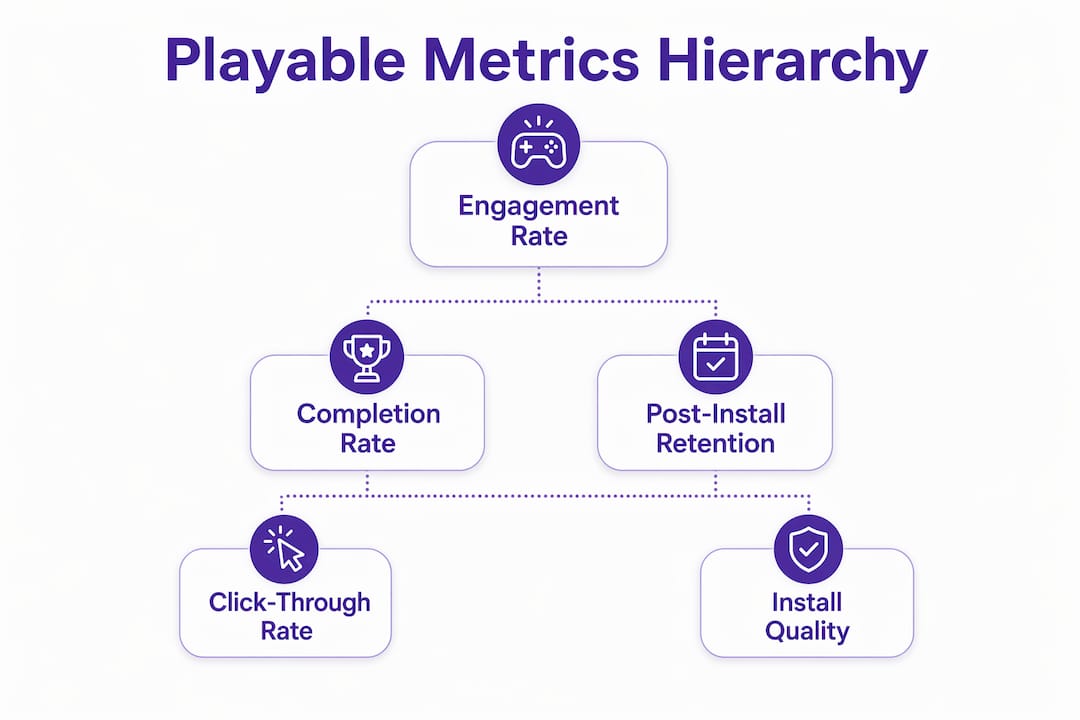
The metrics that genuinely reflect playable effectiveness in a UA context form a hierarchy. Engagement rate measures whether users interact at all after the ad loads. Completion rate measures how many users reach the end-card. Replay rate indicates how compelling the loop is. CPI lift over end-card compares installs driven by the playable versus those driven purely by the end-card, isolating the interactive element’s contribution. Finally, post-install retention at D1 and D7 tells you whether the pre-qualification effect is real for that specific creative.
Segwise’s 2026 research recommends treating playable testing more like a soft-launch product evaluation than a creative A/B test. This framing is practically useful. It shifts the question from “which ad got more clicks?” to “which interactive experience produced users who are still active a week after install?”
Common pitfalls in playable KPI selection include:
- Scaling spend on high-CTR playables without checking completion or retention data
- Ignoring replay rate as a proxy for loop quality
- Failing to segment post-install cohorts by creative variant, which makes it impossible to attribute retention differences to specific playable designs
- Using the same reporting dashboard as video campaigns, where the relevant columns simply do not exist
Pro Tip: Set up a dedicated playable reporting view that includes completion rate and D7 retention from day one. Retrofitting this into an existing video-focused dashboard mid-campaign is possible but time-consuming, and you will likely make one poor scaling decision before the data catches up.
Methodologically, running a minimum of three to five variants per concept before drawing conclusions gives algorithms enough signal to optimise and gives your team enough data to identify structural patterns rather than noise.
Production speed and iteration density
The impact of playables on UA performance is not just a function of creative quality. It is also a function of how many variants you can test, and how quickly. A team producing one playable per month will always lag behind a team producing five. The faster team identifies winners sooner, abandons losers sooner, and exploits seasonal timing windows that the slower team misses entirely.
The Playberry case study is instructive here. By integrating Code Maestro’s automation tooling into their Unity builds, they achieved:
- A production cycle reduction from seven days per variant to one day per variant.
- A 5x increase in production output without proportional increases in engineering or art headcount.
- Install lifts of 18 to 25% and CPI improvements of 10 to 18% attributable to faster iteration and winner identification.
- ROAS gains of 8 to 15% from spending more budget on proven winners, earlier.
The mechanism behind these results is straightforward. When you can test more variants in the same time window, you expose your campaigns to a wider hypothesis space. Some of those hypotheses will be wrong, but you find out quickly and cheaply. The ones that work get budget faster.
Unity Playworks approaches this from the engine side, enabling teams to build playable assets that share logic with the actual game, reducing the fidelity gap between ad and product while accelerating creative production.
Seasonal and event-driven playable scheduling is an underused tactic. If your team can produce a thematic reskin in one day rather than one week, you can react to cultural moments and platform trends in real time. This is a structural UA advantage that compounds over time.
Pro Tip: Build a library of modular playable templates with swappable visual themes rather than producing every variant from scratch. This is the operational model that allows production velocity to scale without proportional cost increases.
Platform requirements and design constraints
The effectiveness of interactive ads for UA depends partly on whether the playable actually works correctly across devices. Platform requirements are not bureaucratic hurdles. They are the conditions that preserve the reliability of the engagement data you are using to make spend decisions.
Google’s 2026 YouTube Gaming specifications illustrate what robust platform compliance looks like in practice:
| Requirement | Specification | UA impact |
|---|---|---|
| Aspect ratio support | Must function across multiple ratios | Prevents drop-off on non-standard devices |
| Input type support | Touch and mouse, with no input delays | Preserves engagement signal authenticity |
| Orientation locking | Not permitted | Ensures usability across device orientations |
| Game state on resize | Must be maintained, not reset | Prevents forced exits corrupting completion data |
| UI error tolerance | No disruptive errors permitted | Maintains experience integrity throughout |
A playable that resets game state when a user rotates their phone will generate a completion rate that understates actual interest. A playable with input delays will generate an engagement rate that understates quality. Both scenarios lead to bad scaling decisions because the data does not reflect the user’s genuine response to the format.
Responsive design across aspect ratios is not a nice-to-have. It is a prerequisite for the engagement signals to be worth anything analytically. UA strategists who ignore this end up optimising against corrupted data, which compounds errors rather than resolving them.
Playables in the modern UA funnel
The strategic role of interactive content in user acquisition extends across the entire funnel, not just the conversion stage. At the awareness level, a well-designed playable delivers 36% better brand recall than equivalent video formats, which matters for any app operating in a competitive category. At the consideration stage, the hands-on interaction creates a product understanding that passive formats cannot achieve. At conversion, the pre-qualification effect reduces post-install churn and improves the quality of cohorts entering your retention funnel.
| Funnel stage | Video ad contribution | Playable ad contribution |
|---|---|---|
| Awareness | Broad reach, passive viewing | Broad reach, active engagement and recall |
| Consideration | Product demonstration | Hands-on product experience |
| Conversion | Click to install | Pre-qualified install from interactive engagement |
| Retention | No direct influence | Higher D1/D7 retention from pre-qualification |
The UA funnel integration of playables works best when the format is treated as complementary to video rather than a replacement. Video builds awareness efficiently. Playables convert that awareness into higher-quality installs. Running both formats in tandem, with shared audience data, produces better outcomes than either format alone.
Platform algorithms also respond to the engagement differential. When a playable consistently outperforms video on interaction time and completion, Meta and Google’s auction systems reward those creatives with more favourable placement and lower effective CPMs. This is a compounding benefit that accumulates over campaign lifetime.
My perspective on playable strategy in 2026
I’ve spent considerable time analysing how UA teams deploy playables, and the pattern I see most often is this: the format is treated as a premium video. The team builds something polished, launches it, checks the CTR, and moves on. The actual value of the format is left entirely on the table.
What I’ve learned is that playables are not a creative format. They are a measurement instrument. The engagement signals they generate are more predictive of user quality than anything a video campaign produces, but only if you set up your reporting to capture those signals from the start.
The teams that use playables most effectively are not the ones with the highest production budgets. They are the ones with the fastest iteration cycles and the clearest hierarchy of metrics. Five competent variants tested in a week will outperform one polished variant tested over a month, because the learning compounds faster.
I’ve also observed that platform design requirements tend to be treated as compliance overhead rather than strategic inputs. When you understand why orientation locking is prohibited or why game state must persist on resize, you make better design decisions, not just compliant ones. The constraints exist to protect engagement data integrity, and that data is your competitive advantage.
My recommendation for any UA team scaling playables in 2026 is to fix the measurement framework before increasing spend. The format will not deliver its potential if you are optimising against the wrong signals.
— Ondrej
How Playablemaker helps you build and scale playables
Building playable ads has traditionally required developer time, significant budget, and lengthy production cycles. Playablemaker’s no-code platform changes that directly. You can create, test, and iterate playable ad variants without writing a single line of code, which means your UA team can run the kind of high-velocity testing that the Playberry results demonstrate, without the engineering overhead.
Playablemaker supports the platform requirements and responsive design standards discussed in this article, so the engagement signals your campaigns generate are reliable and scalable. If you want to understand more about why playables work psychologically, or if you are looking for a deeper explanation of the format itself, the Playablemaker resource library covers both. Start exploring the platform today and see how quickly your first playable can go from concept to live campaign.
FAQ
What is the role of playables in UA?
Playable ads serve as an interactive pre-qualification mechanism in user acquisition funnels. They filter for users who are genuinely interested before install, producing cohorts with measurably better post-install retention.
Why is CTR a poor metric for playable ads?
CTR overstates quality in playable campaigns because auto-click behaviours can inflate the figure without reflecting genuine user engagement. Completion rate and D7 retention are more reliable indicators.
How do playables improve post-install retention?
By requiring active interaction before the install prompt, playables filter out passive users. Data shows that post-install retention improves by 30 to 50% compared to video ad cohorts.
How many playable variants should a UA team test?
A minimum of three to five variants per concept is recommended before drawing conclusions. Faster production pipelines allow teams to test more hypotheses in less time, which accelerates winner identification and budget efficiency.
Do playable ads work outside mobile gaming?
Yes. Retail, fintech, and e-learning brands use interactive ads for UA to demonstrate product value before a download or sign-up, applying the same pre-qualification logic that works for game apps.
Recommended
- Ad creation guide for UA teams in mobile gaming – playablemaker.com Ad creation guide for UA teams in mobile gaming
- Ad tech trends 2026: create playable ads fast and affordably – playablemaker.com Ad tech trends 2026: create playable ads fast and affordably
- Maximizing User Acquisition with Playable Ads: A Strategic Guide – playablemaker.com Maximizing User Acquisition with Playable Ads: A Strategic Guide
- 7 Ways to Spark Playable Ad Inspiration for Mobile Games – playablemaker.com 7 Ways to Spark Playable Ad Inspiration for Mobile Games