TL;DR:
- Optimizing landing page speed, design, and creative variety is essential for improving mobile ad performance and reducing costs.
- Managing Meta’s learning phase and aligning install velocity with product updates foster sustainable growth and better rankings.
Poorly optimised mobile ads bleed budget quietly. You might have strong creatives and precise targeting, yet still watch cost-per-install climb because a landing page takes four seconds to load, or a Meta ad set never exits the learning phase. These are the kinds of common mobile ad pitfalls that cost user acquisition teams real money every week. This article covers mobile ad optimisation tips across four core areas: landing page speed, mobile-first design, Meta Advantage+ campaign mechanics, and sustainable install velocity. Each section is built for practitioners, not beginners.
Table of Contents
- Key takeaways
- 1. Mobile ad optimisation tips: start with landing page speed
- 2. Mobile-first design and usability for ad landing pages
- 3. Mastering Meta Advantage+ for mobile ad performance
- 4. Sustainable install velocity and engagement signals
- 5. Comparing mobile ad optimisation tactics at a glance
- My perspective on mobile ad optimisation in 2026
- Playable ads: the mobile ad format built for engagement
- FAQ
Key takeaways
| Point | Details |
|---|---|
| Speed directly affects spend | Pages loading over three seconds lose more than half of mobile visitors before conversion even begins. |
| Design for thumbs, not cursors | Single-column layouts, 48px tap targets, and sticky CTAs measurably improve mobile engagement and form completions. |
| Respect the Meta learning phase | Ad sets need 50 optimisation events per week to stabilise; frequent edits reset progress and inflate CPA. |
| Quality installs over raw volume | Unnatural install bursts trigger algorithmic penalties; aligning velocity with product updates produces sustainable rankings. |
| Creative variety feeds AI optimisation | Uploading 10 to 15 qualitatively different assets per campaign gives Meta’s AI the signal range it needs to perform. |
1. Mobile ad optimisation tips: start with landing page speed
Speed is where most mobile ad budgets quietly collapse. Every extra second of load time costs roughly 7% of conversions, and pages that take five or more seconds load convert at approximately one-fifth the rate of two-second pages. For a UA team spending £10,000 per month on Meta, a three-second landing page is not a technical inconvenience. It is a structural budget drain.
The benchmark to target is Largest Contentful Paint under two seconds on mobile. That requires attention at several layers:
- Convert hero images and product visuals to WebP or AVIF format. Both compress significantly better than JPEG or PNG without visible quality loss.
- Apply lazy loading to all below-the-fold images. Lazy loading image-heavy pages can reduce initial load time by 50%, which translates directly to lower bounce rates.
- Minify and combine CSS files. Render-blocking stylesheets delay the first paint and should be loaded asynchronously where possible.
- Use a content delivery network with edge nodes close to your primary user geographies. If your mobile gaming audience is concentrated in Southeast Asia or Western Europe, your origin server location matters considerably.
Pro Tip: Defer non-critical scripts such as chat widgets, third-party analytics, and retargeting pixels. Each script can add between 0.3 and 1.5 seconds on a mobile network connection. Load them after the main content renders, not before.
Font loading is an often overlooked factor. Use "font-display: swap` to prevent invisible text during load, and limit custom typefaces to two weights maximum. The combined effect of these changes on ROAS can be substantial once 53% of mobile users who would have abandoned your page at three seconds begin staying long enough to convert.
2. Mobile-first design and usability for ad landing pages
Speed gets users to your page. Design determines whether they act. Most landing pages built on desktop templates fail on mobile not because they look bad, but because they were never designed for how people actually hold and use their phones.
A single-column, vertically stacked layout is the foundation. It removes horizontal scrolling, reduces cognitive load, and keeps the user’s attention moving toward the CTA. Mobile-first designs with this structure consistently outperform desktop-adapted pages on conversion rate.
Typography and tap targets deserve specific attention:
- Body text should be at least 16px. Smaller text forces users to pinch and zoom, which disrupts the conversion flow.
- Tap targets for buttons and links should be a minimum of 48px in height. Smaller targets cause mis-taps, which generate frustration and exits.
- Place your primary CTA in the “easy zone,” which is the lower-centre of the screen where thumbs rest naturally. Reserve the top of the screen for navigation only.
Form design carries disproportionate impact on conversions. Using correct input types such as inputmode="numeric" for phone fields or type="email" for email fields triggers the appropriate keyboard automatically, reducing typing effort by up to 80%. Add autocomplete attributes to every field you can. Every removed friction point compounds into measurable lift.
Social proof elements, trust badges, and brief testimonials placed just above the CTA reinforce the decision at the moment of commitment. A sticky CTA button that remains visible as the user scrolls captures users who are convinced mid-page rather than waiting for them to scroll to the bottom.
3. Mastering Meta Advantage+ for mobile ad performance
Meta’s AI-driven campaigns are now the standard for mobile gaming user acquisition at scale, but they only deliver results when you understand the mechanics beneath them. The learning phase is the most consequential and most misunderstood part of the system.
An ad set enters the learning phase when it is first created or when it receives a significant edit. To exit it, the ad set needs approximately 50 optimisation events per week. For Purchase campaigns, that threshold drops to around 10 events. Until those thresholds are met, performance is unstable and delivery costs are higher than they will be post-optimisation.
The practical implication for budget-setting is direct. The minimum daily budget should equal your target CPA multiplied by 50, divided by seven days. If your target CPA is £20, you need a minimum daily budget of roughly £143 to give the system a realistic chance of exiting the learning phase in a reasonable timeframe.
Here is how to manage the learning phase without disrupting it:
- Avoid editing budgets by more than 20 to 30% at a time. Larger changes reset the learning phase entirely.
- Do not swap out creatives within an ad set once the phase has begun. Add new creatives through duplication if you need to test.
- Consolidate ad sets where possible. Multiple low-volume ad sets split the event data and each one individually may never exit learning.
- Use Advantage+ Placements rather than manual placement selection. Automated placement delivery consistently outperforms manual setups when event volume is sufficient.
Pro Tip: Advantage+ Creative allows Meta to adjust your assets automatically, including cropping, brightness, and adding text overlays. Review what it changes periodically. If the AI is consistently modifying the same element, that is a signal your original asset may not be performing optimally on specific placements.
Creative diversity is not optional for Meta’s AI to optimise effectively. Upload 10 to 15 assets per campaign, and make them qualitatively different. Different hooks, different visual styles, different narrative angles. Minor colour variations of the same creative do not count as diversity from the algorithm’s perspective.
4. Sustainable install velocity and engagement signals
There is a persistent misconception in mobile gaming UA that faster installs always mean better results. The reality is more nuanced, and ignoring it produces campaigns that perform well for a few weeks before collapsing in efficiency.
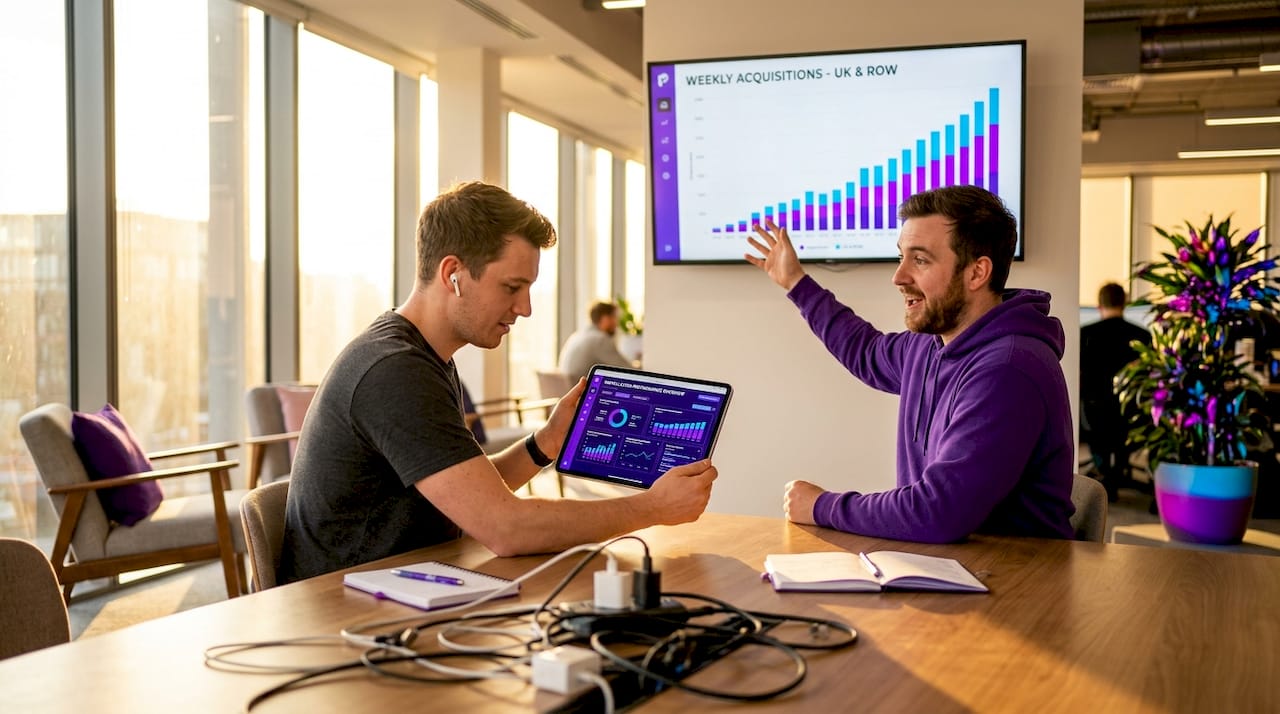
Unnatural install bursts trigger algorithmic penalties on both Google Play and App Store. The platforms detect patterns that do not match organic behaviour, and the result is suppressed organic ranking precisely when paid campaigns should be amplifying it. There is no single “magic velocity” number. What matters is that install pace feels credible relative to the app’s history and any product events occurring alongside it.
Aligning paid install campaigns with product updates, new content releases, or feature launches creates what practitioners call “credible momentum.” The velocity appears organic because it is timed with genuine product signals, and retention metrics tend to be stronger because users are arriving at moments of heightened product quality.
Retention-focused campaigns yield higher ROAS than volume-focused ones because Meta’s algorithms prioritise retention and engagement signals over raw download volume when optimising for long-term value.
The practical shift this requires is planning installs as an ongoing rhythm rather than periodic bursts. A steady 500 installs per day produces better algorithmic standing than 3,500 in a single weekend, even if the total volume is identical. Beyond rankings, consistent engagement data gives Meta’s optimisation system a richer signal set to work with, which directly improves ad delivery quality over time.
5. Comparing mobile ad optimisation tactics at a glance
Different optimisation levers serve different campaign stages. The table below helps you assess which tactics deserve priority based on your current situation.
| Tactic | Primary metric impact | Ease of implementation | Best used during |
|---|---|---|---|
| Landing page speed (WebP, lazy load, CDN) | Conversion rate, bounce rate | Medium: requires dev support | Pre-launch and ongoing |
| Mobile-first design and UX | Conversion rate, time on page | Low to medium: design iteration | Before scaling spend |
| Meta Advantage+ learning phase management | CPA, ROAS stability | Low: process and discipline | Launch and scale phases |
| Creative diversity (10 to 15 assets) | Reach, CPA, ad fatigue | Medium: creative production | Sustained scaling |
| Install velocity alignment | Organic ranking, retention | Medium: requires planning | Growth and sustain phases |
Pro Tip: Sequence these tactics rather than tackling them simultaneously. Fix landing page speed first, then address design, then build your Meta creative library. Trying to optimise everything at once makes it harder to attribute what is actually driving improvement.
The mobile ad best practices that produce consistent results share a common trait. They address the full funnel, from initial creative impression through to post-install retention, rather than focusing exclusively on click-through rates or install volume. Understanding what ad optimisation actually means at a system level changes how you prioritise these levers considerably.
My perspective on mobile ad optimisation in 2026
I’ve watched the conversation in mobile gaming UA shift significantly over the past two years, and the most important change is this: the best-performing teams have stopped thinking about optimisation at the ad level and started thinking about it at the system level. That shift in framing changes everything.
In my experience, the biggest ROAS improvements I’ve seen come not from a new creative format or a clever audience segment, but from fixing a three-second landing page load time or properly structuring a Meta campaign to exit the learning phase cleanly. These are unglamorous fixes. They do not make for interesting post-mortems, but they compound.
What I’ve also found is that creative variety is genuinely misunderstood. Most teams interpret it as producing more volume. The real requirement is producing more angles: different emotional hooks, different social proof framing, different gameplay moments. Meta’s AI cannot optimise toward diverse user segments when all your assets are variations of the same message.
The one thing I’d urge caution around is chasing every new AI feature Meta releases without mastering the fundamentals first. Perceived speed and instant load experiences correlate with retention and session depth. No campaign-level tweak compensates for a product or landing page that feels slow. Get the foundations right, and the AI tools become genuinely powerful. Skip them, and those same tools will optimise toward mediocrity more efficiently than ever.
— Ondrej
Playable ads: the mobile ad format built for engagement
If the goal is improving mobile ad performance at the creative layer, playable ads are worth serious attention. They sit at the intersection of interactivity and psychology, giving users a genuine taste of the product before they install. The psychological principles behind playable ads, particularly the commitment effect and active engagement, produce click-through and conversion rates that passive video formats rarely match.
For Meta Advantage+ campaigns specifically, playable ads function as high-quality creative assets that give the algorithm meaningful interaction data, not just views. Playablemaker’s no-code platform lets UA teams build and iterate these assets without developer resources, which means you can produce the creative diversity Meta’s AI actually needs without stretching production budgets. Explore the benefits for mobile marketers or learn more about Facebook user acquisition strategies that incorporate interactive formats.
FAQ
How much does landing page speed affect mobile ad conversions?
Significantly. Pages loading over three seconds see 53% of mobile visitors abandon them, and five-second pages convert at roughly one-fifth the rate of two-second pages.
What is the Meta learning phase and why does it matter?
The learning phase is a period during which Meta’s AI calibrates delivery for a new or edited ad set. It requires 50 optimisation events per week to exit, and performance is unstable until that threshold is reached.
How many creatives should I upload to a Meta Advantage+ campaign?
Upload 10 to 15 qualitatively different assets. Single creatives per ad set cause rapid fatigue and rising CPA, while diverse formats give the algorithm meaningful signal variety.
Does install velocity affect app store rankings?
Yes. Unnatural install bursts can trigger algorithmic penalties, suppressing organic ranking. Aligning install pace with product updates produces more sustainable ranking outcomes.
Why do retention metrics matter for paid mobile campaigns?
Meta’s algorithms use retention and engagement as optimisation signals. Retention-focused campaigns consistently deliver higher ROAS than pure volume campaigns because the platform rewards quality user acquisition over raw install counts.
Recommended
- 8 Mobile Ad Best Practices for Successful Campaigns – playablemaker.com 8 Mobile Ad Best Practices for Successful Campaigns
- Why mobile ads fail: common pitfalls and how to fix them – playablemaker.com Why mobile ads fail: common pitfalls and how to fix them
- Boost ad UX in mobile gaming with no-code tools – playablemaker.com Boost ad UX in mobile gaming with no-code tools
- What is Ad Optimization? Understanding Its Importance – playablemaker.com What is Ad Optimization? Understanding Its Importance