Mobile game marketers face a brutal reality in 2026. Privacy restrictions have slashed granular audience data by over 50%, competitive user acquisition costs skyrocket, and traditional ad production burns precious budget. Yet savvy marketers leveraging no-code interactive ad tools and smart audience analysis are cutting acquisition costs by up to 20% while accelerating campaign velocity. This guide shows you how to harness data-driven segmentation and budget-friendly playable ads to win users efficiently.
Table of Contents
- Understanding Mobile Ad Audience Analysis
- Leveraging No-Code Solutions For Interactive Ad Creation
- Audience Analysis Insights By Ad Format And Game Genre
- Common Misconceptions In Mobile Ad Audience Analysis
- Applying Audience Analysis To Optimize User Acquisition
- Conclusion And Next Steps
- Unlock Your Mobile Game’s Growth With PlayableMaker
Key Takeaways
| Point | Details |
|---|---|
| No-code playable ads reduce production time and costs by up to 50% | Fast iteration without developer dependency speeds campaign launches and testing cycles. |
| Data-driven audience segmentation can increase user lifetime value by 20% | Combining behavioral and psychographic data improves targeting precision and engagement. |
| Privacy changes require shifting from granular data to aggregate and behavioral insights | Over 50% reduction in personal data access demands new segmentation approaches focused on patterns. |
| Video ads dominate mobile gaming ad formats, with length and style varying by game genre | 74% of mobile game ads are video; optimal length ranges from 10 seconds for social casino to 46 seconds for RPGs. |
| Rapid creative iteration with monthly refresh cycles is critical for competitive edge | 82.5% of advertisers release new creatives monthly to maintain engagement and performance. |
Understanding Mobile Ad Audience Analysis
Audience analysis in mobile gaming means collecting and interpreting player data to build targeted ad campaigns that drive installs and engagement. You work with three core data types. Demographic data covers age, location, and device type. Behavioral data tracks gameplay patterns, session length, in-app purchases, and engagement frequency. Psychographic data reveals motivations, preferences, and gaming interests that drive player decisions.
Data-driven segmentation transforms raw audience information into actionable targeting strategies. When you segment users by behavior and psychology rather than just demographics, behavioral and psychographic segmentation significantly improve engagement and reduce wasted ad spend compared to demographics alone. This precision targeting increases ad reach efficiency by 30% or more because you’re speaking directly to what motivates each player segment.
Privacy regulations like GDPR and iOS ATT have fundamentally changed the game. Granular personal data access has dropped by over 50%, forcing marketers to pivot toward aggregate behavioral insights and privacy-safe signals. You can no longer rely on detailed user profiles. Instead, you analyze patterns across cohorts, track engagement behaviors within your own games, and use contextual signals to understand audience preferences without invading privacy.
Key segmentation approaches for mobile gaming:
- Behavioral clustering groups players by gameplay style, spending habits, and engagement frequency
- Genre affinity segments target users based on demonstrated preferences for puzzle, strategy, RPG, or casual games
- Lifecycle stage separates new players, active users, and lapsed players for tailored messaging
- Value-based tiers focus acquisition spend on high-lifetime-value user profiles
Pro Tip: Start with two or three simple behavioral segments rather than over-complicating your targeting structure. Test which segments respond best to your creatives, then refine from there. Too many micro-segments early on dilutes your testing budget and slows learning.
Leveraging No-Code Solutions for Interactive Ad Creation
Traditional playable ad production requires developers, weeks of iteration, and budgets often exceeding $10,000 per creative. Your dev team builds custom code, tests across devices, troubleshoots bugs, and integrates tracking. Each revision cycle takes days. By the time your ad launches, market conditions and competitor creatives have shifted.

No-code platforms flip this model entirely. Marketing teams create interactive ads using drag-and-drop interfaces, pre-built templates, and AI-powered design assistants. You iterate in hours instead of weeks. No-code playable ad tools reduce costs by 30 to 50% and eliminate developer bottlenecks, letting you respond to campaign data in real time.
Speed matters because 82.5% of mobile game advertisers release new creatives monthly, with 58.1% of those being entirely new concepts rather than variations. This monthly refresh cycle keeps ads fresh and prevents creative fatigue. If your production pipeline can’t match that velocity, you fall behind competitors who test and optimize faster.
For teams with budgets under $500K, creative volume increases 20 to 40% annually by relying on fast, cost-effective ad production methods. No-code tools make this volume achievable without expanding headcount or sacrificing quality.
Key benefits of no-code interactive ad platforms:
- Marketing team autonomy eliminates dependency on developer schedules and technical resources
- Budget-friendly pricing models enable more creative tests within fixed acquisition budgets
- Frequent A/B testing accelerates learning about which interactive ad benefits resonate with your segments
- Rapid iteration cycles align ad production velocity with weekly or bi-weekly campaign planning
- Template libraries and playable ad techniques provide best practice starting points
You also gain flexibility to experiment with popular mobile gaming ad formats across different networks and placements without rebuilding from scratch each time.
Pro Tip: Align your no-code ad production calendar with your campaign planning cycles. If you refresh campaigns bi-weekly, schedule creative builds one week ahead so you always have new variants ready to test against current champions.
Audience Analysis Insights by Ad Format and Game Genre
Video creatives make up 74.1% of mobile gaming ads, dominating the format landscape. Short videos under 30 seconds prevail because engagement behavior varies dramatically by genre and audience patience thresholds. Understanding these preferences helps you tailor creative length, pacing, and end card styles to match what each game genre audience expects.
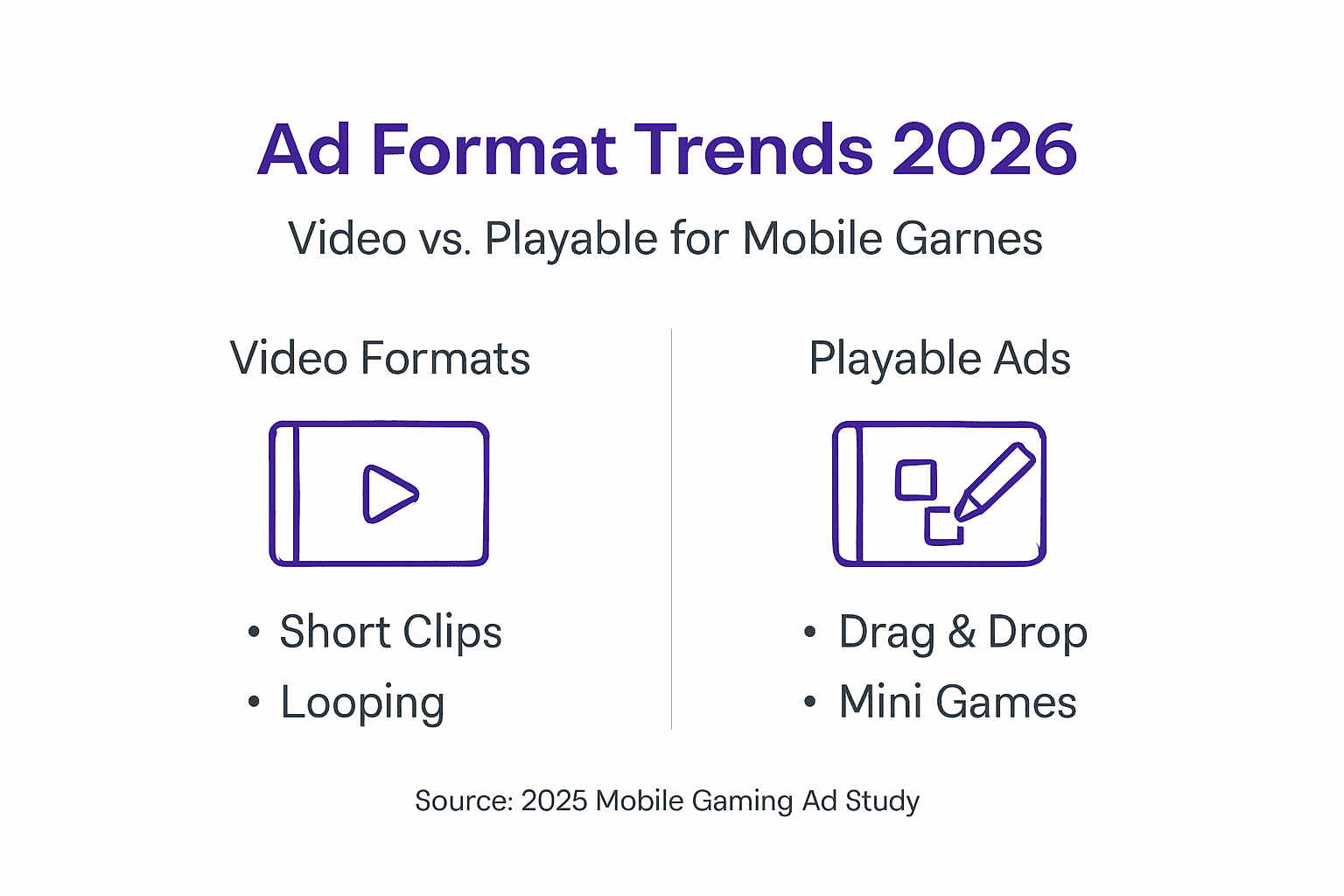
Social casino ads perform best at 10 seconds with static end cards; RPGs favor 46-second looping videos. This difference reflects audience mindset. Social casino players want instant gratification and quick decision points. RPG fans expect rich worlds and narrative hooks that need more time to establish.
| Game Genre | Optimal Video Length | Preferred End Card Style | Interactive Element |
|---|---|---|---|
| Social Casino | 10 seconds | Static with clear CTA | Spin wheel or card flip |
| Match-3 Puzzle | 15-20 seconds | Animated with gameplay hint | Swipe to match demo |
| RPG/Strategy | 30-46 seconds | Looping video or character showcase | Choose weapon or path |
| Casual/Hypercasual | 8-15 seconds | Minimal with immediate play | Tap to try mechanic |
| Shooter | 20-30 seconds | Action sequence or challenge | Aim and shoot interaction |
Genre-specific tactics for interactive ads:
- Puzzle games benefit from playable tutorials that let users solve one level as the ad experience
- Strategy games need world-building visuals and decision points that preview depth and progression
- Casual titles perform best with simple, intuitive mechanics shown in under 10 seconds
- RPGs require character customization hooks or narrative choices that hint at personalization
When you analyze mobile game ad examples across genres, patterns emerge. Top performers match video length and interactivity to audience expectations established by successful games in that category. Trying to force a 45-second narrative ad onto a hypercasual audience wastes budget. Conversely, giving RPG fans only 10 seconds shortchanges the rich experience they crave.
Tailoring your approach based on these insights is core to how to make engaging game ads that convert rather than annoy. Test within the proven ranges for your genre, then optimize based on your specific audience data.
Common Misconceptions in Mobile Ad Audience Analysis
Three persistent myths undermine mobile game marketers’ audience targeting effectiveness and waste acquisition budgets.
-
Demographic targeting alone delivers strong results. Many marketers still build campaigns around age and location without layering behavioral or psychographic data. This oversimplification reduces performance because two 25-year-old players in the same city might have completely different gaming motivations, spending patterns, and genre preferences. Behavioral and psychographic segmentation improve engagement and reduce wasted spend compared to demographics alone by 30% or more.
-
More segmentation always means better targeting. Splitting audiences into dozens of micro-segments sounds sophisticated but often backfires. Each additional segment fragments your testing budget, slows statistical significance, and increases campaign management complexity. You end up with too little data per segment to make confident optimization decisions. Diminishing returns kick in fast beyond four to six well-defined segments for most mobile game campaigns.
-
Playable ads cost too much time and money for frequent testing. This belief stems from traditional dev-heavy production models. Marketers assume interactive ads require weeks and five-figure budgets, so they avoid testing them. In reality, no-code platforms have collapsed those barriers. You can now create and launch playable ads in hours for a fraction of traditional costs, making frequent iteration practical even on modest budgets.
Understanding why these misconceptions persist helps you avoid them. The first myth lingers because demographic data is easiest to access and understand. The second appeals to our desire for precision and control. The third reflects outdated information about production complexity before no-code tools matured.
Pro Tip: Balance segmentation granularity with campaign practicalities by asking whether each segment justifies separate creative and budget allocation. If two segments would receive nearly identical ads and targeting, merge them. Save granularity for segments where creative messaging or game features should differ meaningfully.
Avoiding these audience targeting myths frees budget and attention for strategies that actually move acquisition metrics.
Applying Audience Analysis to Optimize User Acquisition
Translating audience insights into improved acquisition performance requires systematic execution across six key steps.
-
Collect core audience data from multiple sources. Aggregate anonymized behavioral data from your existing games, combine with network-provided aggregate insights, and layer in psychographic signals from surveys or engagement patterns. Build a foundational understanding of who your players are and what motivates them.
-
Segment audiences into three to five actionable groups. Use behavioral clustering and value-based tiers to create segments large enough for statistical testing but distinct enough to warrant different creative approaches. Name segments based on behaviors, not just demographics, so your team intuitively understands how to message each group.
-
Create tailored no-code interactive ads for each segment. Design playable ad experiences that speak to each segment’s motivations and preferences. Use templates and A/B testing techniques to produce multiple variants quickly. Match creative length and style to genre best practices from your audience analysis.
-
Launch campaigns with clear measurement frameworks. Set up tracking to measure segment-level performance across install rate, cost per install, day 1 retention, and early monetization signals. Establish baseline metrics before optimization so you can quantify improvements.
-
Measure performance and identify winning patterns. Analyze which creative elements, messaging angles, and interactive mechanics drive the strongest results within each segment. Look for cross-segment patterns that suggest broader creative principles you can apply.
-
Iterate creatives based on test results. Refresh underperforming ads, scale winning variants, and continuously test new concepts. Use your no-code platform to maintain the monthly creative refresh cycle that keeps mobile ads’ role in user acquisition effective over time.
Full-funnel orchestration amplifies these efforts. Extend your audience analysis beyond initial install to retargeting, re-engagement, and cross-promotion campaigns. Users who didn’t convert on first exposure often respond to different creative angles or formats later.
A data-driven acquisition strategy improves user lifetime value by up to 20% through precise segmentation and full-funnel orchestration. This improvement compounds over time as you refine targeting and creative based on expanding data.
| Metric | Baseline (No Segmentation) | With Audience Analysis | Improvement |
|---|---|---|---|
| Cost Per Install | $2.50 | $2.00 | 20% reduction |
| Click-Through Rate | 1.8% | 2.7% | 50% increase |
| Day 1 Retention | 35% | 42% | 20% increase |
| User Lifetime Value | $4.20 | $5.04 | 20% increase |
| Return on Ad Spend | 140% | 210% | 50% improvement |
Continuous creative iteration enabled by no-code tools keeps your acquisition engine running efficiently. Markets shift, competitors evolve, and player preferences change. Your production velocity must match that pace.
Conclusion and Next Steps
No-code interactive ad platforms and data-driven audience analysis form a powerful combination for mobile game marketers in 2026. You gain 30 to 50% cost and time savings from eliminating developer dependencies while accelerating creative iteration to match the industry’s monthly refresh standard. Precise behavioral and psychographic segmentation drives up to 20% increases in user lifetime value by focusing acquisition spend on high-value player profiles with tailored messaging.
Privacy constraints that reduced granular data access by over 50% demand this shift toward aggregate behavioral insights and rapid creative testing. You can no longer rely on detailed personal profiles, but you can build highly effective campaigns using pattern recognition and fast iteration cycles.
Practical first steps to implement these strategies:
- Start collecting and organizing behavioral data from your existing player base to identify core segments
- Choose two or three distinct audience segments based on gameplay patterns or value potential
- Use a no-code platform to create simple playable ads targeting each segment’s motivations
- Run small budget tests comparing segmented targeting against your current broad approach
- Measure segment-level performance and refine based on which creative elements drive strongest results
- Establish a monthly creative refresh calendar to maintain competitive velocity
Even modest improvements in targeting precision and creative relevance compound dramatically over multiple campaigns and quarters. The marketers who master audience analysis and no-code ad production velocity today build sustainable acquisition advantages that persist as competition intensifies.
Unlock Your Mobile Game’s Growth with PlayableMaker
PlayableMaker’s no-code platform empowers your marketing team to create and iterate interactive ads without waiting on developers or burning budget. Our AI-powered drag-and-drop playable ad builder lets you launch campaigns faster while testing more creative variants across your audience segments.
We built playable ads explained around psychology-based design approaches that maximize user engagement and acquisition efficiency. Your team gains the velocity to match the monthly creative refresh cycles driving competitive mobile gaming user acquisition in 2026. Explore how PlayableMaker accelerates your path from audience insight to high-performing campaign.
FAQ
What is mobile ad audience analysis in mobile gaming?
It’s the process of collecting and segmenting player data to tailor mobile game ad campaigns, improving engagement and installs. Audience analysis combines demographic, behavioral, and psychographic information to understand what motivates players and how to reach them efficiently. Marketers use these insights to create targeted campaigns that reduce wasted spend and increase user lifetime value by focusing on high-potential segments.
This systematic ad audience targeting explanation helps you move beyond broad demographic assumptions toward precision targeting based on actual player behaviors and preferences.
How do no-code tools improve mobile ad audience targeting?
They allow rapid creation and iteration of ads tailored to audience segments without developer delays. No-code platforms enable marketers to test multiple creatives across segments, optimizing engagement and reducing costs by 30 to 50% compared to traditional production. You gain autonomy to respond to campaign data in real time, launching new variants within hours instead of waiting weeks for development cycles.
This velocity advantage directly supports the monthly creative refresh standard that keeps no-code interactive ads advantages competitive in 2026’s fast-moving mobile gaming market.
What data sources are best for mobile ad audience segmentation?
Combine demographic, behavioral, and psychographic data from aggregated sources for richest segmentation. Use gameplay patterns, spending habits, session frequency, and engagement behavior rather than granular personal information. Privacy restrictions require using aggregate and behavioral data rather than granular personal data, so focus on pattern recognition across cohorts.
Network-provided aggregate insights, first-party game analytics, and contextual signals offer privacy-safe audience segmentation data that supports effective targeting without violating regulations.
What are practical first steps to start audience analysis with no-code ads?
Begin by collecting core audience data and segmenting into actionable groups based on behavior or value potential. Use no-code tools to create playable ads targeting each segment with tailored messaging and mechanics. Run small A/B tests comparing segmented approaches against your current targeting to measure lift in key metrics like install rate and retention.
Iterate creatives based on test results, scaling winners and refreshing underperformers monthly. This systematic approach to starting no-code ad testing builds momentum while keeping initial investment manageable as you learn what works for your specific audience.
Recommended
- Global Smartphone Ownership—Stats and Trends: Insights and Projections for 2024-2029 – playablemaker.com Global Smartphone Ownership—Stats and Trends: Insights and Projections for 2024-2029
- Understanding Ad Audience Targeting in Mobile Gaming – playablemaker.com Understanding Ad Audience Targeting in Mobile Gaming
- Master Mobile Ad Trend Analysis 2025 for Playable Ads Success – playablemaker.com Master Mobile Ad Trend Analysis 2025 for Playable Ads Success
- 7 Essential Mobile Game Ad Trends to Know for 2025 – playablemaker.com 7 Essential Mobile Game Ad Trends to Know for 2025