Between 2023 and 2024, playable ad adoption more than doubled from 4% to 7% of mobile game advertisers globally. This explosive growth reflects a fundamental shift in user acquisition strategy. This article traces playable ads from experimental formats to essential marketing tools, explaining their evolution, performance advantages, production innovations, and strategic applications for mobile gaming marketers in 2026.
Table of Contents
- The Origins And Early History Of Playable Ads
- Growth And Mainstreaming Of Playable Ads
- Performance Advantages Of Playable Ads
- Adapting To Privacy And Regulatory Changes
- Common Misconceptions About Playable Ads
- Cost And Efficiency Innovations In Playable Ads Production
- Future Trends And Innovations In Playable Ads
- Summary And Strategic Application For Mobile Game Marketers
- Unlock Playable Ads Success With Playablemaker
Key Takeaways
| Point | Details |
|---|---|
| Rapid adoption growth | Playable ads grew from 4% to 7% of advertisers in one year, with over 30,000 daily creatives produced by 2024. |
| Superior engagement metrics | They achieve 30-40% higher click-through rates and up to 700% better conversion than traditional video ads. |
| No-code production revolution | Template-driven platforms enable cost-effective, scalable playable ad creation without programming skills. |
| Privacy-first marketing alignment | Playable ads thrive under tracking restrictions by prioritising creative engagement over data dependencies. |
| AI-driven future innovations | Emerging technologies like AI asset generation and immersive formats will enhance playable ad effectiveness. |
The Origins and Early History of Playable Ads
Playable ads didn’t emerge overnight. They began in the early 2010s as virtualised interactive demos embedded within standard advertising units. Early adopters experimented with letting users try simplified game mechanics before committing to an install.
These initial formats faced technical limitations. Mobile devices lacked the processing power for complex interactions. Advertisers struggled with file size restrictions and limited distribution channels.
By the mid-2010s, programmatic bidding infrastructure matured. This enabled better targeting for playable ad impressions. Social platforms noticed the engagement potential.
Late in the decade, major networks like Snapchat and Facebook adopted playable ad formats officially. This institutional backing accelerated mainstream acceptance. Advertisers could now distribute interactive demos at scale through established channels.
Key milestones shaped the evolution of playable ads:
- Early 2010s: Experimental virtualised app demos within ads
- Mid-2010s: Programmatic bidding improves playable ad targeting
- Late 2010s: Major social platforms launch official playable ad products
- Early 2020s: HTML5 standardisation enables cross-platform compatibility
- 2024-2026: No-code tools democratise production for all marketers
This progression transformed playables from niche experiments into core user acquisition channels. Understanding this history clarifies why they outperform traditional formats today. Examples of early playable ads show how far the format has evolved.
Growth and Mainstreaming of Playable Ads
The numbers tell a compelling story. Between 2023 and 2024, adoption rose from 4% to 7% with over 30,000 playable creatives produced daily by 2024. This 75% year-over-year growth signals fundamental market validation.
Casual and arcade genres dominate playable ad usage. These categories align perfectly with the format’s quick-demo strengths. Users can grasp core mechanics within 15-30 seconds of interaction.
Longer playable ad campaigns increased notably in sports and social gaming during 2024. Extended campaign durations indicate deeper advertiser commitment. Marketers aren’t just testing playables anymore. They’re building entire UA strategies around them.
Genre adoption patterns reveal strategic alignment:
| Genre Category | Playable Ad Usage | Average Campaign Length |
|---|---|---|
| Casual/Puzzle | Very High | 4-6 weeks |
| Arcade | High | 3-5 weeks |
| Sports | Growing | 6-8 weeks |
| Social Casino | Growing | 5-7 weeks |
| Strategy | Moderate | 3-4 weeks |
This data confirms playable ads have moved beyond early-adopter status. They’re now standard practice for performance-focused mobile gaming marketers. Common playable ads misconceptions about complexity and cost no longer hold up against production volume reality.
Platform distribution expanded significantly. Major ad networks report playable inventory growing faster than any other mobile format. This supply increase reflects advertiser demand and proven ROI.
The playable ad creative production data shows sophisticated iteration cycles. Top advertisers test dozens of variations monthly. This rapid testing wouldn’t be economical without production efficiency gains we’ll explore shortly.
Performance Advantages of Playable Ads
Why do playable ads outperform traditional video creatives? The answer lies in psychology and measurable metrics. Playable ads deliver 30-40% higher click-through rates in casual gaming, with a psychological ‘try before you buy’ effect boosting installs and retention.
Users who interact with playable ads self-select for genuine interest. They’ve already experienced core gameplay. This reduces post-install disappointment and improves Day 1 retention significantly.
The performance gap widens at conversion. Playable ads boost conversion rates up to 700% higher than video ads whilst improving long-term user retention. These aren’t marginal gains. They’re transformative improvements in user acquisition efficiency.
Let’s examine the psychology behind playable ads. Interactive engagement triggers multiple cognitive mechanisms:
- Active participation creates stronger memory encoding than passive viewing
- Immediate feedback loops satisfy curiosity and build anticipation
- Skill demonstration provides ego gratification when users succeed
- Loss aversion kicks in when gameplay interrupts, motivating install completion
These psychological levers work together synergistically. Users don’t just see your game. They experience it firsthand.
Lifetime value improvements matter equally. Higher-quality users acquired through playables demonstrate better monetisation patterns. They understand game mechanics before installing, leading to faster progression and increased willingness to spend.
“Playable ads fundamentally change the acquisition funnel by moving the qualification step before the install, not after. This results in higher-quality users who already know they enjoy the core loop.”
Performance advantages extend beyond install metrics. Playables reduce wasted spend on users unlikely to engage. They filter effectively whilst scaling reach through compelling creative rather than broader targeting.

Adapting to Privacy and Regulatory Changes
Apple’s App Tracking Transparency fundamentally altered mobile user acquisition. Granular audience targeting diminished overnight. Attribution became probabilistic rather than deterministic. Traditional UA levers weakened considerably.
Privacy regulations limit granular tracking, forcing UA strategies to rely on creative engagement, where playable ads have become critical. This shift elevated creative quality from nice-to-have to mission-critical.
Playable ads thrive in privacy-restricted environments because they don’t depend on extensive user data. Their effectiveness stems from inherent engagement, not targeting precision. A compelling interactive demo works regardless of tracking capabilities.
Key advantages in the privacy-first era:
- Engagement quality replaces targeting precision as the primary performance driver
- First-party interaction data provides valuable signals within privacy bounds
- Creative iteration becomes more important than audience segmentation
- Self-selection through gameplay reduces reliance on historical behavioural data
Marketers accelerated playable ad adoption specifically because of ATT impacts. When traditional channels suffered, playables maintained performance. This reliability during industry disruption cemented their strategic importance.
Pro Tip: Focus your playable ad testing on core mechanic variations rather than audience segments. In privacy-limited environments, creative resonance matters more than demographic targeting.
The regulatory landscape continues evolving. GDPR, CCPA, and emerging frameworks worldwide restrict data usage further. Playable ads represent a sustainable approach aligned with long-term privacy trends. Understanding user acquisition under privacy regulations helps marketers navigate these ongoing changes strategically.
Common Misconceptions About Playable Ads
Several myths prevent marketers from adopting playable ads. Let’s address them directly with evidence.
Myth: Playable ads require prohibitively expensive development resources and lengthy production timelines. Fact: Playable ads generate up to 700% higher conversion rates whilst no-code platforms drastically reduce both cost and complexity.
Myth: You need a dedicated development team to create playable ads at scale. Fact: Modern no-code playable ad creation tools empower marketers to build ads independently without writing code.
Myth: Playable ads don’t significantly outperform video creatives in actual campaign performance. Fact: Real-world data shows 30-40% CTR improvements and substantially better user retention consistently across genres.
Myth: Playables only work for casual games with simple mechanics. Fact: Strategy, RPG, and mid-core titles successfully use playables by focusing on core satisfying loops rather than full complexity.
Addressing these playable ads myths removes adoption barriers. The reality contradicts outdated assumptions:
- Production costs dropped 80% with template-based workflows
- Time from concept to live campaign reduced from weeks to days
- Performance improvements justify investment across all viable genres
- Scalability matches or exceeds traditional video ad production
Pro Tip: Start with template-based playables for your top-performing video ad concepts. This low-risk approach lets you validate performance improvements before investing in custom interactive mechanics.
The cost-benefit calculation has fundamentally shifted. What once required specialised agencies and five-figure budgets now works with internal teams and modest monthly subscriptions. This democratisation drives the adoption surge we’re witnessing.
Cost and Efficiency Innovations in Playable Ads Production
No-code solutions and template reuse drastically reduced playable ad production time and cost whilst enhancing scalability and iteration speed. This innovation removed the primary barrier to playable ad adoption.
Template-driven platforms let marketers customise pre-built interactive mechanics. You select a template matching your game genre, swap in your assets, and adjust parameters. No coding required.
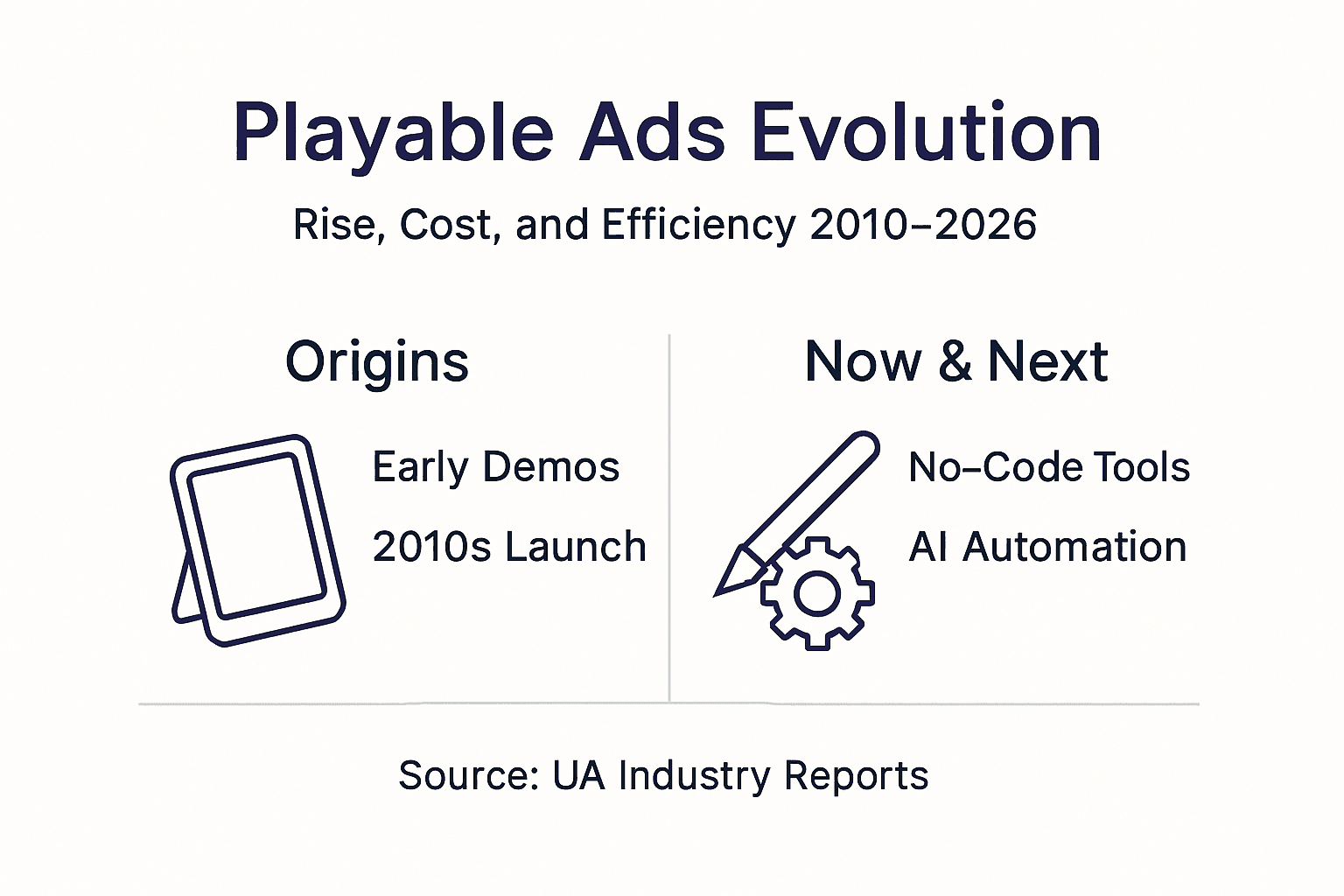
The efficiency gains are dramatic:
| Production Approach | Average Time | Typical Cost | Iteration Speed | Technical Skills |
|---|---|---|---|---|
| Traditional Coding | 2-4 weeks | £5,000-£15,000 | Slow (days per change) | Advanced development |
| Agency Services | 1-2 weeks | £3,000-£8,000 | Moderate (1-2 days) | None (outsourced) |
| No-Code Platforms | 2-4 hours | £200-£500 | Fast (minutes) | Basic marketing skills |
These numbers explain why daily creative production exceeded 30,000 globally. Speed and affordability enable continuous testing. Marketers iterate rapidly based on performance data.
No-code playable ad tools typically offer drag-and-drop interfaces. You see changes in real-time preview. Export handles technical requirements automatically for each ad network.
Playable ad templates cover common mechanics like match-3, runner, puzzle, and simulation. This variety suits most mobile gaming genres. Custom options exist for unique requirements.
Cost structure shifted from project-based to subscription-based. Marketers pay monthly fees rather than per-creative costs. This predictability improves budget planning and encourages experimentation.
The PlayableMaker platform exemplifies this approach. Marketers build unlimited playables within their subscription tier. Testing multiple concepts becomes economically viable.
Production democratisation accelerated innovation. Small studios compete creatively with major publishers. User acquisition success depends more on creative quality than production budgets.
Future Trends and Innovations in Playable Ads
Artificial intelligence is transforming playable ad creation. AI-driven asset generation automates background creation, character design, and animation. What previously required graphic designers now happens through text prompts.
Immersive formats are emerging rapidly. 360-degree playables let users explore game environments more naturally. Augmented reality integration brings gameplay into physical spaces through smartphone cameras.
Cloud streaming technology enables richer playable experiences. File size restrictions ease when processing happens server-side. This allows more complex mechanics within the playable format.
Key trends shaping playable ads in 2026 and beyond:
- AI-powered creative generation reduces production time by 60-80%
- Cross-platform experiences maintain progress across devices seamlessly
- Personalisation engines adjust difficulty and content to user behaviour
- Voice interaction adds new engagement layers beyond touch input
- Blockchain integration enables reward-based playables with transferable value
No-code platforms continue evolving. AI enhancements suggest optimal mechanic choices based on genre and target audience. Automated A/B testing identifies winning variations without manual intervention.
Future trends in playable ads point toward increasingly sophisticated experiences created with decreasing effort. The gap between simple demos and full game quality narrows continuously.
Playable ad no-code trends show platforms adding AI creative assistants, predictive performance scoring, and automated optimisation. These capabilities amplify marketer effectiveness.
Creative ad format innovations extend beyond traditional boundaries. Hybrid formats combine video storytelling with interactive moments. Multi-step playables guide users through progressive challenges.
Marketers should monitor these developments closely. Early adoption of emerging formats provides competitive advantages. The playable ad landscape in 2028 will differ substantially from today.
Summary and Strategic Application for Mobile Game Marketers
Playable ads evolved from experimental formats to essential user acquisition tools through measurable performance advantages. Their 30-40% CTR improvements and up to 700% conversion gains justify strategic investment.
Privacy regulations make creative engagement more important than ever. Playables excel precisely because they don’t depend on granular tracking. This alignment with privacy-first marketing ensures long-term viability.
No-code platforms removed production barriers. Marketers now create playable ads in hours rather than weeks, at fraction of previous costs. This accessibility democratises sophisticated UA tactics.
Strategic implementation recommendations:
- Start with template-based playables for proven video ad concepts
- Test core mechanic variations across your top-performing titles
- Iterate rapidly based on performance data, launching new versions weekly
- Segment by genre rather than audience due to privacy limitations
- Monitor emerging AI and immersive technologies for competitive edge
Genre-specific approaches matter. Casual games benefit from quick, satisfying mechanic demos. Strategy titles should showcase compelling decision moments. Match playable complexity to user attention spans.
Continuous creative iteration drives sustained success. Top performers test dozens of playable variations monthly. This experimentation culture separates leaders from followers in mobile UA.
The playable ads strategy landscape will continue evolving. Marketers who build internal expertise now position themselves for long-term competitive advantage.
Unlock Playable Ads Success with PlayableMaker
Ready to transform your user acquisition with playable ads? PlayableMaker empowers marketers to create engaging interactive ads without coding skills. Our template-driven platform lets you build, test, and launch playables in hours, not weeks.
Leverage AI-enhanced workflows and proven templates to reduce production costs by 80% whilst improving campaign performance. Join thousands of mobile game marketers scaling quality installs through playable ads.
Our no-code playable ad tools handle technical complexity automatically, letting you focus on creative strategy. Understanding the psychology of playable ads helps you craft more effective experiences.
Visit PlayableMaker today to start your free trial and revolutionise your mobile UA strategy in 2026.
Frequently Asked Questions
What are playable ads in mobile gaming?
Playable ads are interactive advertisements that let users try simplified versions of games before installing. They transform passive viewing into active gameplay, allowing potential players to experience core mechanics within 15-30 seconds. This try-before-you-buy approach significantly increases engagement and install motivation compared to traditional video ads.
How do playable ads improve user acquisition metrics?
By enabling direct interaction, playable ads increase user motivation to install whilst filtering for genuinely interested players. Mobile games typically see 30-40% higher click-through rates and substantially better long-term retention. The self-selection effect means installed users already know they enjoy the gameplay, resulting in higher lifetime value and reduced churn.
Are playable ads expensive or difficult to produce?
No-code platforms let marketers create playable ads without programming skills, reducing production costs by up to 80%. Template-driven workflows cut creation time from weeks to hours whilst maintaining quality. This efficiency makes playable ads accessible to UA teams of all sizes, enabling rapid iteration and continuous testing without prohibitive budgets.
How do privacy regulations affect playable ad strategies?
Limitations like Apple’s App Tracking Transparency reduce targeting precision, shifting emphasis to creative engagement quality. Playable ads excel in privacy-restricted environments because their effectiveness stems from inherent interactivity rather than user data dependencies. This makes them a sustainable, privacy-aligned user acquisition channel that maintains performance despite evolving regulations.
Recommended
- 7 Essential Mobile Game Ad Trends to Know for 2025 – playablemaker.com 7 Essential Mobile Game Ad Trends to Know for 2025
- Master Mobile Ad Trend Analysis 2025 for Playable Ads Success – playablemaker.com Master Mobile Ad Trend Analysis 2025 for Playable Ads Success
- 2025 SocialPeta & Newsbreak Mobile Game Report: 9M+ Monthly Advertisers & the Rise of Weekly Creative Iteration – playablemaker.com 2025 SocialPeta & Newsbreak Mobile Game Report: 9M+ Monthly Advertisers & the Rise of Weekly Creative Iteration
- Introduction to Playable Ads in Mobile Game Marketing – playablemaker.com Introduction to Playable Ads in Mobile Game Marketing