TL;DR:
- In-ad gameplay is an interactive, self-contained ad experience lasting around 15 to 20 seconds, emphasizing user opt-in gestures. It features a clear three-part structure: an instructional cue, a brief gameplay slice, and a conversion-focused end card with CTA. This format offers higher-quality conversions and better brand recall compared to traditional passive ads, transforming user engagement through direct experience.
In-ad gameplay is defined as a playable, interactive gaming experience embedded directly inside an ad unit, where users engage through core mobile gestures such as tap, swipe, drag, and tilt to trigger a call to action. The industry term for this format is the playable ad, and understanding the definition of in-ad gameplay is the foundation for any mobile marketer or UX designer seeking to improve campaign performance. Platforms including Microsoft Advertising and Hookin describe these units as interactive HTML5 ads with simplified gameplay mechanics, while Publift classifies them as a distinct interactive ad format within the broader mobile advertising taxonomy. Unlike passive video or static banners, in-ad gameplay invites opt-in participation, making the user an active participant rather than a passive viewer.
What is the definition of in-ad gameplay?
In-ad gameplay refers specifically to interactivity inside the ad unit itself, not interactivity within a surrounding game environment. The user encounters a self-contained, gamified experience that runs entirely within the ad container, typically lasting 15 to 20 seconds. This distinguishes it from formats where advertising is placed around or within existing game content.

The format relies on three structural pillars: an instructional cue that orients the user, a short gameplay slice that delivers the core brand experience, and an end card with a CTA that converts engagement into a measurable action such as an app install. Each pillar serves a precise function. The instructional cue removes friction, the gameplay slice communicates product value through direct experience, and the end card captures intent at the moment of highest engagement.
Microsoft Advertising emphasises that these units should be opt-in and player-first, meaning the user chooses to interact rather than being forced into it. This opt-in model is not merely a design preference. It is the mechanism that separates genuinely interested users from passive audiences, which directly affects downstream metrics like retention and lifetime value.
How does in-ad gameplay differ from in-game advertising and advergames?
The distinction matters because marketers frequently conflate three related but structurally different formats. A systematic academic review published in Springer differentiates advergames and in-game advertising as separate categories, situating in-ad gameplay as an interactive but distinct ad format with its own design logic and measurement framework.
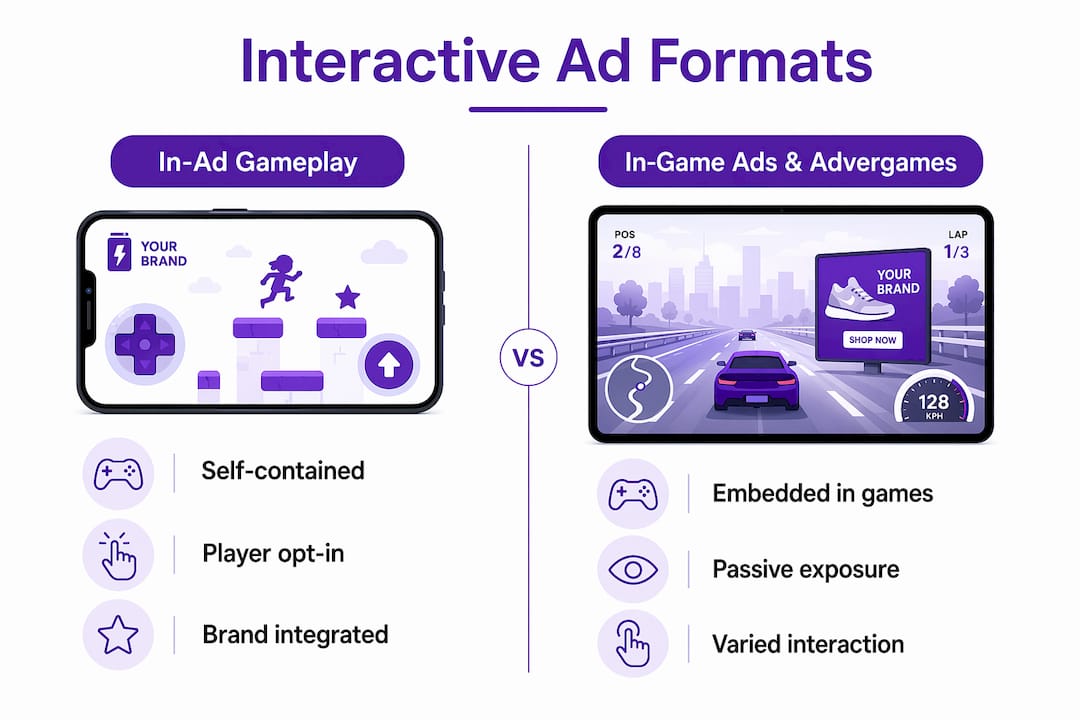
The table below clarifies the core differences:
| Format | Definition | Brand integration | User interaction |
|---|---|---|---|
| In-game advertising | Ads placed within an existing game (banners, billboards, interstitials) | Passive placement inside game world | Minimal or none |
| Advergame | A full branded game created specifically for marketing purposes | Brand is the entire game experience | Full gameplay session |
| In-ad gameplay (playable ad) | A self-contained interactive ad unit with a brief gameplay slice | Brand experience delivered inside the ad | Active, opt-in, gesture-based |
In-game advertising examples include virtual billboards in racing titles or sponsored item drops in battle royale games. These placements reach players but do not require interaction. Advergames, by contrast, demand significant production investment and ask users to seek out and download a branded experience. In-ad gameplay occupies the middle ground: it delivers an interactive brand experience without requiring the user to leave their current context or commit to a full session.
The Springer review also notes that consumer resistance is a meaningful variable across all three formats. In-ad gameplay addresses this directly through its opt-in structure, reducing the perception of intrusion that undermines passive ad formats. For UX designers, this means the format’s effectiveness is partly structural, not just creative.
What are the essential components and UX design principles of in-ad gameplay?
Effective in-ad gameplay units share a consistent anatomy. Understanding each component helps UX designers make deliberate decisions rather than defaulting to convention.
- Instructional cue. A brief visual or textual prompt (typically “tap to play” or an animated hand gesture) that communicates the interaction mechanic within the first two seconds. Without this, users abandon the unit before engaging.
- Gameplay slice. The core interactive segment, optimised for 15 to 20 seconds of engagement. This slice should represent the most satisfying or distinctive mechanic of the advertised product, not a tutorial of the full game.
- End card and CTA screen. The conversion layer. This screen appears after gameplay concludes and presents the primary action, most commonly an install button or a lead capture prompt. Microsoft notes that interactive end cards function as branded extensions that sustain engagement beyond the gameplay moment.
The opt-in, player-first design philosophy is not optional. It is the condition under which the format performs. Forcing interaction or obscuring the skip option undermines trust and inflates engagement metrics without improving conversion quality.
Timing is a critical UX variable. A gameplay slice that runs beyond 20 seconds risks abandonment before the end card appears. One that concludes in under 10 seconds may not deliver sufficient brand comprehension. The 15 to 20 second window is the result of observed completion rate data, not arbitrary convention.
Pro Tip: Avoid replicating the full game’s onboarding flow inside the ad unit. The gameplay slice should feel immediately satisfying, not instructional. Users who feel competent within the first five seconds are significantly more likely to reach the end card.
Seamless integration also means the ad’s visual language should match the advertised product. Mismatches between ad aesthetics and app store screenshots create cognitive dissonance that reduces install intent even after a positive gameplay experience.
How is in-ad gameplay implemented technically in mobile ad campaigns?
The technical production of in-ad gameplay units differs substantially from standard game development. The ad-safe game loop requires strict simplification: limited state management, a single core mechanic, and a hard time limit enforced programmatically. Reusing full game code is not viable because ad network environments impose file size constraints, typically under 2MB for HTML5 playables, and prohibit external asset calls.
The table below summarises the key technical steps and common challenges:
| Step | Description | Common challenge |
|---|---|---|
| Scoping the mechanic | Identify one core interaction that represents the game | Avoiding feature creep from the full game |
| HTML5 build | Develop the unit using HTML5, CSS, and JavaScript | Maintaining performance within file size limits |
| State management | Implement a simplified game loop with defined start, play, and end states | Preventing infinite loops or unresponsive end states |
| CTA trigger | Link the end card action to a single measurable event | Ensuring SDK compliance across ad networks |
| Network submission | Package and submit to ad networks (Meta, Google UAC, IronSource) | Format and size requirements vary by network |
HTML5 is the dominant technical standard for playable ads because it runs natively in mobile browsers and within ad network SDKs without requiring a separate runtime. Frameworks such as Phaser and PixiJS are commonly used for rendering, though many studios write lightweight custom engines to stay within file size limits.
The end card CTA trigger deserves particular attention. Ad networks including Meta Audience Network and Google UAC require that the install or conversion action fires through their SDK’s designated method. CTA compliance is not just a measurement concern. It determines whether the campaign receives correct attribution and whether the ad unit is approved for distribution at all.
Pro Tip: Build the end card CTA trigger as the first technical element, not the last. Confirming SDK compliance before investing in gameplay production prevents costly rebuilds at the submission stage.
Developer and advertiser collaboration is most effective when the creative brief specifies the single mechanic, the target file size, and the network submission requirements before any code is written. Ambiguity at the briefing stage is the primary cause of production delays in playable ad campaigns.
What practical benefits do mobile marketers and UX designers gain from in-ad gameplay?
The benefits of playable ads for mobile marketers extend well beyond novelty. The format addresses a structural problem in user acquisition: information asymmetry. Users cannot assess whether they will enjoy a game from a video or banner alone. In-ad gameplay resolves this by letting users experience the core mechanic before committing to an install.
The practical advantages for marketers and designers include:
- Higher conversion quality. Playable ads achieve install-per-playable conversion rates of 10 to 12 percent compared to 3 to 4 percent for standard video ads. Users who install after completing a gameplay slice have already demonstrated intent and competence, which correlates with higher day-one retention.
- Improved brand recall. Active user participation in an ad experience produces stronger memory encoding than passive viewing. This is consistent with established principles of experiential learning: doing produces stronger recall than watching.
- Pre-qualification of users. The interactive engagement model filters out users who would install impulsively and churn quickly. The result is a higher-quality user cohort with better lifetime value metrics.
- Dual revenue function. For publishers, in-ad gameplay units can serve both as a monetisation tool within their own app and as a user acquisition channel for other titles. This dual function makes the format particularly attractive for mobile game studios managing both supply and demand.
- UX alignment. Because the format is native to the gaming context, it feels less disruptive than interstitial video. Users in a gaming session are already in an interactive mindset, which reduces the psychological friction of encountering an interactive ad.
For UX designers, the format also provides a feedback mechanism that static ads cannot. Completion rates, interaction depth, and drop-off points within the gameplay slice all generate data that informs both ad optimisation and broader product design decisions. Exploring creative ad concepts that leverage this data loop is one of the more underutilised advantages of the format.
Key takeaways
In-ad gameplay is the most conversion-efficient interactive ad format available to mobile marketers because it pre-qualifies users through direct experience of the core product mechanic before any install commitment is made.
| Point | Details |
|---|---|
| Core definition | In-ad gameplay is a self-contained interactive ad unit using mobile gestures to deliver a brief gameplay experience. |
| Three-part structure | Every effective unit contains an instructional cue, a gameplay slice of 15 to 20 seconds, and an end card CTA. |
| Distinct from in-game ads | Unlike in-game advertising or advergames, in-ad gameplay is contained within the ad unit itself, not integrated into a surrounding game. |
| Conversion advantage | Playable ads convert at 10 to 12 percent IPP versus 3 to 4 percent for video, driven by user pre-qualification. |
| Technical constraint | HTML5 builds must respect file size limits and SDK CTA compliance rules before creative production begins. |
Why the industry still underestimates in-ad gameplay
Having worked closely with mobile game marketers and UX designers across multiple campaign cycles, I find that the format is consistently misunderstood in one specific way: teams treat the gameplay slice as a miniature version of the game rather than as a standalone persuasion mechanism. These are fundamentally different briefs. A miniature game tries to replicate the full experience. A persuasion mechanism identifies the single moment in the game that produces the strongest emotional response and delivers only that.
The marketers who see the best results from in-ad gameplay are those who treat the 15 to 20 second window as a creative constraint, not a limitation. They ask: “What is the one interaction that will make someone feel the appeal of this game immediately?” That question produces better units than any technical optimisation.
I am also watching the shift toward no-code production tools with genuine interest. The barrier to creating playable ads has historically been developer time and budget, which pushed the format toward larger studios. As no-code platforms reduce that barrier, the format will become accessible to mid-market and independent developers who have the most to gain from its conversion efficiency. The risk is that accessibility leads to volume without quality. The player-first design principle is not a feature of the tool. It is a discipline that marketers and designers need to carry into every brief, regardless of how the unit is built.
Metrics beyond click-through rate matter here too. Completion rate, interaction depth, and post-install day-seven retention are the numbers that reveal whether an in-ad gameplay unit is genuinely working. Click rates can be gamed by poor UX. Retention cannot.
— Ondrej
Build your in-ad gameplay units without the usual overhead
Creating playable ads has traditionally required developer time, significant budget, and lengthy production cycles. Playablemaker is built specifically to remove those barriers. The no-code playable builder lets marketers and designers produce interactive ad units through a drag-and-drop interface, without writing a single line of code. For teams who want to understand the psychological principles that make these units perform, Playablemaker’s resource on why playable ads work covers the evidence in depth. If you are ready to move from understanding the format to producing it, Playablemaker is the practical next step.
FAQ
What is in-ad gameplay in simple terms?
In-ad gameplay is an interactive ad format where users play a brief, simplified version of a game directly inside the ad unit using touch gestures. The experience typically lasts 15 to 20 seconds and ends with a call-to-action screen.
How does in-ad gameplay differ from in-game advertising?
In-game advertising places ads within an existing game environment, such as billboards or interstitials, without requiring user interaction. In-ad gameplay is a self-contained interactive unit where the user actively engages with gameplay mechanics inside the ad itself.
What are the three components of a playable ad?
A playable ad consists of an instructional cue that prompts interaction, a short gameplay slice delivering the core brand experience, and an end card CTA screen that converts engagement into a measurable action such as an app install.
Why do playable ads convert better than video ads?
Playable ads pre-qualify users by letting them experience the product before installing. This produces higher IPP conversion rates of 10 to 12 percent compared to 3 to 4 percent for video, because only genuinely interested users reach the end card.
What technical format do in-ad gameplay units use?
In-ad gameplay units are built in HTML5 and must comply with ad network file size limits and SDK CTA trigger requirements. The simplified game loop uses limited state management and a single core mechanic to maintain performance within these constraints.
Recommended
- What is an in-game ad and how to create engaging campaigns – playablemaker.com What is an in-game ad and how to create engaging campaigns
- Ad Gamification: Engaging Users Without Overspending – playablemaker.com Ad Gamification: Engaging Users Without Overspending
- Lessons from Game Mechanics: How to Make Ads More Fun – playablemaker.com Lessons from Game Mechanics: How to Make Ads More Fun
- Ads in Game: Everything You Need to Know – playablemaker.com Ads in Game: Everything You Need to Know