Every mobile gaming startup faces the dilemma of rising acquisition costs and shrinking budgets. With average cost per install now around £3.89 on iOS and £3.50 on Android, according to industry benchmarks, finding affordable ways to acquire players is more urgent than ever. Understanding the complete picture of Customer Acquisition Cost, including creative production and team salaries, helps you avoid budget pitfalls and make smarter decisions. This guide shows how no-code acquisition solutions can cut costs while keeping growth sustainable for global studios.
Table of Contents
- Defining Customer Acquisition Cost In Gaming
- Key Components Affecting Overall Cost
- Calculation Methods And Benchmarks For 2026
- Budget-Smart Strategies For Mobile Startups
- Comparing Traditional And No-Code Acquisition Tools
Key Takeaways
| Point | Details |
|---|---|
| Understanding CAC is Crucial | Accurate Customer Acquisition Cost calculation informs budgeting and highlights effective channels versus those wasting resources. |
| Differentiate Between Blended and New CAC | Knowing the distinction helps evaluate overall strategy effectiveness and target specific advertising approaches. |
| Incorporate All Cost Components | Ensure all expenses, including creative production and team salaries, are factored into CAC for true cost insights. |
| Use No-Code Tools for Efficiency | No-code acquisition tools allow for faster campaign launches and real-time metric tracking, reducing operational costs for startups. |
Defining Customer Acquisition Cost in Gaming
Customer Acquisition Cost, or CAC, represents the total amount of money your studio spends to bring one new player into your game. This includes everything: paid advertising, creative production, salaries of your marketing team, promotional events, and associated overhead. It’s the foundational metric that tells you whether your acquisition strategy is actually profitable or burning cash.
When calculating CAC, you’re essentially dividing your total marketing spend by the number of new players acquired during a specific period. Sounds simple, but the devil lives in the details. The calculation separates into two distinct approaches that serve different purposes. Blended CAC captures all your sales and marketing costs spent on both new users and existing player expansions, giving you a complete picture of acquisition investment. New CAC, by contrast, focuses solely on costs from paid channels dedicated to new installations, helping you measure efficiency on specific campaigns.
Why does this distinction matter to you as a user acquisition specialist? Because understanding customer acquisition cost components directly impacts your budgeting decisions. When you know precisely what you’re spending to acquire players, you can identify which channels waste money and which ones deliver genuine returns. A player acquired through a costly influencer partnership costs differently than one acquired through organic referrals or paid social advertising.
The metric becomes even more critical when you consider how CAC relates to overall player value. If your average player generates £5 in lifetime value but costs £8 to acquire, you’ve identified a fundamental problem. Your acquisition channels are unsustainable. Conversely, if your CAC sits at £2 and lifetime value reaches £15, you’ve found something worth scaling.
Calculating CAC accurately requires tracking not just the obvious ad spend, but also the hidden costs. Your creative team spent weeks building assets. Your developers spent time setting up tracking and analytics. Your operations manager coordinated campaigns. These human resource costs get absorbed into your total marketing budget and directly affect your true CAC.
Pro tip: Track your CAC by channel separately so you can quickly identify which acquisition methods deliver the lowest cost per new player, then allocate your limited budget towards those proven winners.
Key Components Affecting Overall Cost
Your total CAC doesn’t materialise from a single line item on a spreadsheet. It’s built from multiple moving parts, each one pulling resources from your budget. Understanding what actually drives these costs is how you stop throwing money at ineffective channels.
Advertising spend forms the most visible component of your CAC. Whether you’re running campaigns on Facebook, TikTok, Google, or any other platform, every pound spent on ads directly contributes to your acquisition cost. But here’s what catches most studios off guard: creative production costs run parallel to this. Your designers, animators, and copywriters spent weeks building those eye-catching assets. Your advertising creative production isn’t free, and these expenses must be factored into your true cost per acquisition.

Your UA team doesn’t work for nothing. Whether you employ them full-time or contract specialists, salaries and contractor fees become part of your acquisition costs. Add technology licences into the mix—analytics platforms, attribution tools, automation software—and you’re looking at ongoing expenses that support your entire acquisition operation. These aren’t optional luxuries. They’re essential infrastructure for running campaigns effectively.
Reengagement campaigns deserve special attention here. You’ve acquired a player, but they’ve gone dormant. Now you’re spending additional budget to bring them back. This spending affects your blended CAC because you’re reinvesting in players you’ve already acquired, not purely chasing new installations.
Where things get truly strategic is targeting user cohorts with different acquisition costs. High-LTV users cost more upfront to acquire—you might find them through premium placements or influencer partnerships—but they generate substantially more revenue long-term. Lower-value users cost less to acquire through performance networks, but they might churn quickly. Your acquisition strategy should reflect which users genuinely matter to your game’s profitability.
Pro tip: Segment your CAC calculations by user source and track lifetime value alongside acquisition costs to identify which channels bring players who actually stick around and spend money.
Here is a summary of the primary components influencing Customer Acquisition Cost (CAC) in gaming studios:
| CAC Component | Typical Cost Driver | Measurement Frequency | Strategic Impact |
|---|---|---|---|
| Advertising Spend | Paid channels and platforms | Campaign or monthly | Directly affects user acquisition |
| Creative Production | Asset design and content creation | Per campaign | Influences engagement and branding |
| Team Salaries | UA staff, freelancers, contractors | Monthly | Drives strategic and execution power |
| Tech Licences | Analytics and attribution tools | Annually or monthly | Enables precise tracking and targeting |
| Reengagement Campaigns | Bringing back inactive players | Ongoing | Improves lifetime value and retention |
Calculation Methods and Benchmarks for 2026
Calculating your CAC doesn’t require complex algorithms. The formula remains straightforward: divide your total sales and marketing spend by the number of new customers acquired during a specific period. Yet within this simplicity lies crucial decision-making. You need to decide whether you’re measuring Blended CAC (total costs across all acquisition efforts) or New CAC (costs from paid channels only). This distinction dramatically changes how you interpret your numbers and plan your budget.
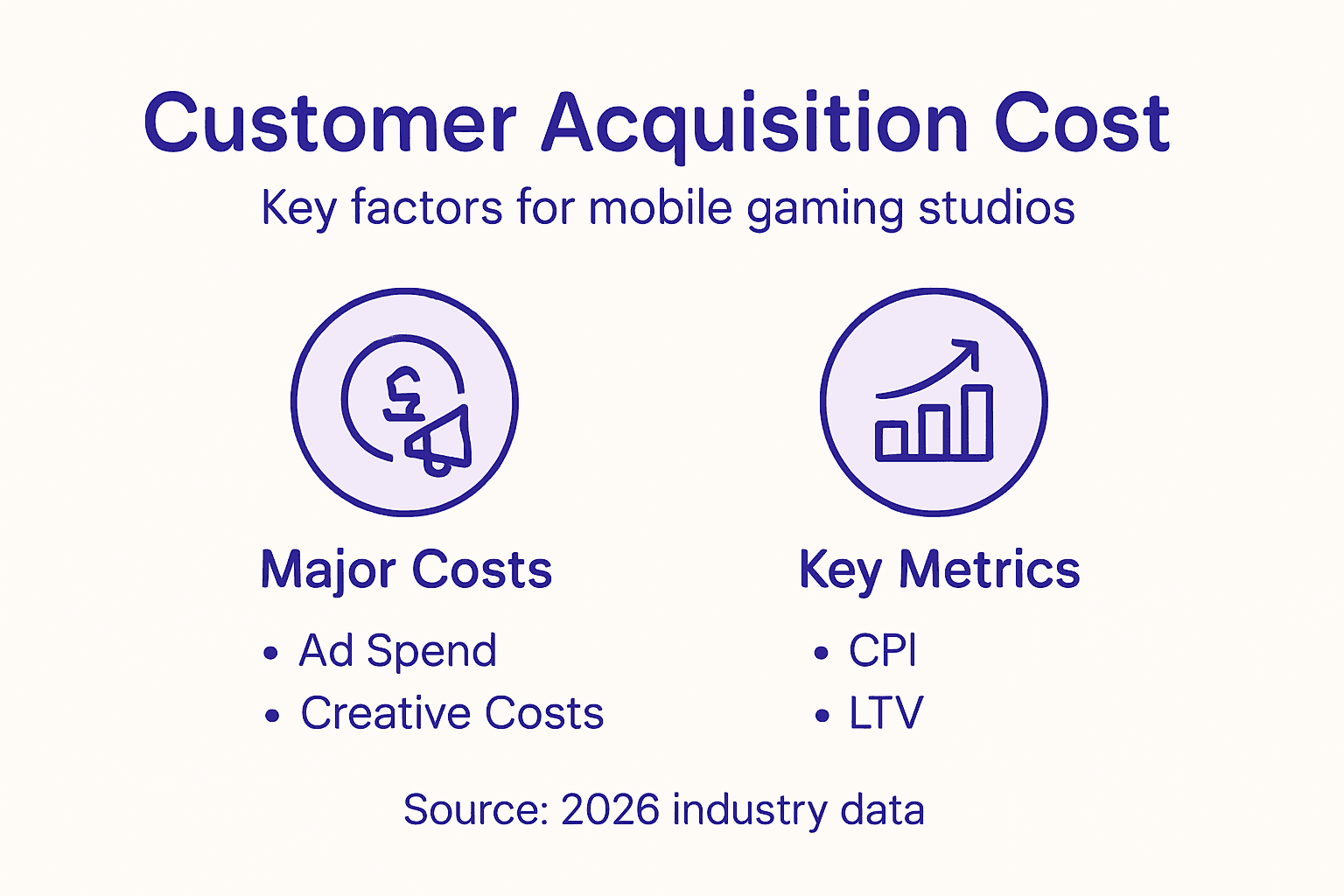
For 2026, the landscape has shifted considerably. Mobile game cost per install benchmarks now reflect the reality of privacy restrictions. Apple’s App Tracking Transparency has fundamentally altered attribution and targeting capabilities. Your iOS campaigns are facing higher costs, averaging around £3.89 per install, whilst Android remains slightly more affordable at approximately £3.50 per install. These aren’t arbitrary figures. They represent what studios are actually paying across the market.
Platform-specific benchmarks matter enormously. Facebook and Google Ads typically cost between £1.14 and £4.19 per install depending on your game genre, target audience, and campaign optimisation. A hyper-casual game targeting broad demographics costs far less than a premium strategy title targeting hardcore gamers. Your specific game falls somewhere on this spectrum, and understanding where helps you set realistic budget expectations.
Privacy changes have forced studios away from relying solely on paid acquisition. The shift toward blended approaches combining paid channels with organic growth, cross-promotion, and community-driven acquisition has become essential. You can’t optimise what you can’t measure precisely. Attribution tools have become increasingly important—and expensive—because they fill gaps created by Apple’s privacy policies.
When planning your 2026 budget, assume costs will remain elevated or increase further. Economic pressures and competitive bidding on ad networks push CPIs upward. Build your projections using conservative estimates rather than optimistic ones. Test campaigns on multiple platforms before committing significant budget.
Pro tip: Calculate your CAC monthly and compare it against your actual player lifetime value to catch underperforming campaigns early, before they drain your entire annual budget.
Budget-Smart Strategies for Mobile Startups
Your startup doesn’t have unlimited marketing funds. Every pound spent needs to drive measurable results. The most successful mobile gaming studios don’t rely on a single acquisition channel—they build a balanced portfolio combining paid and organic strategies that work together to reduce overall CAC.
Start by understanding your ideal player. Who actually plays your game? What demographics, interests, and behaviours define them? Once you’ve identified this audience precisely, you can target them efficiently across multiple channels instead of casting a wide net and hoping for hits. Narrow targeting reduces wasted spend on players who’ll never engage with your game.
Combine paid and organic acquisition. Paid advertising gets visibility fast, but organic strategies provide sustainable, lower-cost growth. App Store Optimisation (ASO) costs almost nothing once implemented correctly. Community building through Discord, Reddit, or social media creates word-of-mouth momentum. Influencer partnerships with micro-influencers cost far less than major celebrities whilst often delivering better engagement. Optimising creative assets through A/B testing helps you understand which ads resonate most, allowing you to stop funding underperformers immediately.
Data drives smart decisions. Track which acquisition sources bring high-LTV players versus low-value installations. If TikTok ads cost £2 per install but players spend nothing, whilst Facebook ads cost £3 per install but generate £8 lifetime value, your budget priorities should shift dramatically. Use behaviour data and predictive analytics to focus spending on user segments most likely to become your best customers.
Optimise your conversion funnel relentlessly. A compelling app store listing converts more visitors into downloaders without increasing your ad spend. Poor screenshots, confusing descriptions, or weak positioning waste all the money you’ve invested in driving traffic. Your store page is part of your acquisition strategy, not separate from it.
Pro tip: Start with a small test budget across three different channels, measure which delivers the lowest CAC for high-LTV players, then allocate 70 per cent of future spending to that winner whilst continuously testing new approaches with the remaining 30 per cent.
Comparing Traditional and No-Code Acquisition Tools
Traditional acquisition tools built your mobile gaming industry. They’re powerful, comprehensive, and capable of handling enterprise-scale campaigns. Yet they carry substantial baggage. These systems require deep technical expertise, complex API integrations, custom development work, and significant infrastructure investment. Your team spends weeks implementing integrations whilst your competitors launch campaigns.
Manual data handling plagues traditional platforms. You’re exporting spreadsheets, combining data from multiple sources, writing custom scripts to bridge incompatible systems. Each manual step introduces delays and potential errors. Your team spends more time moving data around than actually optimising campaigns. Meanwhile, your CAC grows because decision-making slows down.
No-code acquisition tools eliminate these friction points. Drag-and-drop interfaces and pre-built templates let you build and launch campaigns in hours rather than weeks. No API documentation to decipher. No backend developers required. Your UA specialist can connect data sources, set up automated reporting, and adjust campaigns without waiting for technical support. The time savings alone reduces your operational costs significantly.
Automated analytics form the core advantage. Traditional tools often require manual reporting setup. No-code platforms automatically aggregate data from all your acquisition channels, calculate metrics like CAC and LTV in real time, and alert you when campaigns underperform. You spot problems immediately instead of discovering them during monthly reviews. This speed translates directly into lower acquisition costs because you stop funding losers faster.
The cost difference proves dramatic for startups. Traditional enterprise platforms charge thousands monthly plus implementation fees. No-code solutions often cost nothing or require minimal monthly investment. Your budget stretches further because money flows toward actual user acquisition instead of software licensing and technical overhead.
Traditional tools excel at scale and customisation. No-code tools excel at speed and affordability. For most startups, speed matters more. Get campaigns live quickly, measure results immediately, optimise ruthlessly. Scale later when your CAC economics prove sustainable.
Below is a comparison of traditional versus no-code acquisition tools for gaming startups:
| Feature | Traditional Tools | No-Code Tools |
|---|---|---|
| Setup Time | Several weeks to months | A few hours or days |
| Technical Expertise | Requires developers and IT skills | Usable by non-technical staff |
| Upfront Cost | High fees and integration costs | Low to minimal initial investment |
| Flexibility | Highly customisable | Fast adjustments, less customisation |
| Data Handling | Manual exports, scripting needed | Automatic aggregation and reporting |
| Suitability for Startups | Less ideal due to costs/time | Well-suited for rapid iteration |
Pro tip: Start with no-code tools to validate your acquisition channels and prove your game’s unit economics, then migrate to traditional platforms only once you’ve established repeatable, profitable channels worth scaling.
Master Your Customer Acquisition Cost with Playable Ads Made Easy
Understanding and optimising your Customer Acquisition Cost is essential in making your mobile game profitable. The article highlights the challenges studios face with high creative production costs and lengthy development times that inflate CAC. If you are struggling with slow, expensive ad creation slowing down your campaigns and increasing your acquisition costs PlayableMaker offers the perfect solution.
Our no-code platform lets you build engaging playable adverts quickly and budget-friendly without draining your marketing resources. Cut down on creative production overhead and launch interactive ads that truly resonate with your target audience. With PlayableMaker you will streamline your ad creation process and reduce your CAC by focusing spend on ads that perform.
Take control over your acquisition strategy today by visiting PlayableMaker and experience why easy, fast, no-code playable ads are the key to smarter, more cost-effective user acquisition. Don’t let costly development slow your growth discover how to build playable ads fast and start winning the battle for high-LTV players now.
Frequently Asked Questions
What is Customer Acquisition Cost (CAC) in mobile gaming?
Customer Acquisition Cost (CAC) is the total amount a gaming studio spends to acquire one new player. This includes expenses related to advertising, creative production, marketing team salaries, and promotional events.
How do I calculate my Customer Acquisition Cost?
To calculate your CAC, divide your total sales and marketing expenses by the number of new customers acquired during a specified period. You can measure either blended CAC or new CAC, depending on whether you want to include all acquisition efforts or focus solely on costs from paid channels.
Why is it important to track CAC in mobile gaming?
Tracking CAC is crucial because it helps you assess the effectiveness of your acquisition strategies. Understanding the cost of acquiring players allows you to identify which channels provide the best return on investment and optimise your marketing budget accordingly.
How do creative production costs affect CAC?
Creative production costs involve expenses related to designing marketing assets like ads and promotional materials. These costs are essential to factor into your overall CAC since they impact the effectiveness of your campaigns and overall player acquisition efforts.
Recommended
- Customer Acquisition and Retention – Winning Mobile Game Players – playablemaker.com Customer Acquisition and Retention – Winning Mobile Game Players
- Customer Acquisition Cost Marketing Explained: Maximising ROI – playablemaker.com Customer Acquisition Cost Marketing Explained: Maximising ROI
- Customer Acquisition Methods: Complete Mobile Gaming Guide – playablemaker.com Customer Acquisition Methods: Complete Mobile Gaming Guide
- Understanding What is User Acquisition in Mobile Gaming – playablemaker.com Understanding What is User Acquisition in Mobile Gaming