
TL;DR:
- Campaign creative is a structured system that aligns campaign objectives and audience insights with actual ad materials to enhance performance. It involves strategy, asset production, platform adaptation, and ongoing testing, distinguishing it from one-off asset creation. Effective campaign creative and rapid iteration drive measurable gains in user acquisition quality, retention, and return on ad spend.
Many mobile gaming marketers treat campaign creative as a synonym for “ad assets” and move on. That conflation is quietly costing them. Campaign creative is not simply the banner you upload or the video you export. It is the structured system connecting your campaign objectives and audience insights to the actual ad materials that players see, interact with, and respond to. Understanding this distinction is where measurable gains in cost per install, retention, and return on ad spend begin. This guide exists to close that gap, offering a precise, practical breakdown of what campaign creative really means and how to use it as a genuine performance lever.
Table of Contents
- What is campaign creative? Breaking down the essentials
- How campaign creative works in mobile game user acquisition
- Supplying and optimising creative assets for ad platforms
- Quality control: Aligning creative, expectations, and retention metrics
- Why creative testing trumps targeting: Funding a creative flywheel
- The uncomfortable truth about campaign creative for mobile UA
- Take your campaign creative to the next level
- Frequently asked questions
Key Takeaways
| Point | Details |
|---|---|
| Real meaning of campaign creative | Campaign creative is a cohesive strategy and asset system crafted to meet audience and campaign goals. |
| Frequent refresh needed | Refreshing creative assets regularly is essential to avoid creative fatigue and maintain UA effectiveness. |
| Creative testing is key | With limited targeting options, ongoing creative testing and iteration drive the strongest UA results. |
| Quality beats first impressions | Campaign creative must match the true user experience or it will damage retention and monetisation. |
| Process over tech | A disciplined, repeatable process for creative velocity outweighs reliance on the latest tools or trends. |
What is campaign creative? Breaking down the essentials
With the misconceptions out of the way, let us clarify exactly what campaign creative entails and what differentiates it from ordinary ad production.
In mobile game user acquisition and broader marketing, campaign creative is the strategy and execution that turns campaign objectives and audience insights into the actual renderable ad materials users encounter. This definition is deliberately two-part. Strategy without execution is theory. Execution without strategy is noise.
Campaign creative therefore includes the following components working in concert:
- Audience and objective alignment: Who is the creative speaking to, and what action should it drive?
- Asset production: The visual, audio, copy, and interactive elements that make up the ad itself.
- Platform adaptation: Reformatting and resizing assets to meet the technical requirements and cultural expectations of each ad network.
- Call-to-action design: The specific language, placement, and mechanics that prompt the desired player behaviour.
- Refresh and testing schedules: The planned cadence for introducing new creative to maintain performance.
This stands in clear contrast to one-off asset production, where a team delivers a finished video or banner without a system for measurement, iteration, or platform-specific optimisation. The table below illustrates the practical differences.
| Dimension | Campaign creative system | One-off asset production |
|---|---|---|
| Driven by | Objectives, KPIs, audience data | Intuition, brand guidelines alone |
| Output | Multiple tested variations | Single deliverable |
| Platform fit | Adapted per network specs | Often generic |
| Lifespan | Refreshed regularly | Replaced reactively |
| Measurability | Built-in testing and iteration | Assessed retrospectively |
“Creative strategy is not a phase of a campaign. It is the campaign itself. Every asset you ship is either confirming or contradicting a hypothesis about your audience.”
Thinking about creative ad formats through this lens transforms them from production tasks into testable scientific instruments. Each format, whether a rewarded video, a playable, or a static image, becomes a variable in a controlled experiment rather than a finished product delivered and forgotten. Aligning every output with consistent branding principles also ensures that the performance signals you gather are clean and attributable to creative decisions rather than brand inconsistency.
How campaign creative works in mobile game user acquisition
Now that the core of campaign creative is defined, the next step is to see how it operates within high-performing user acquisition workflows.
For mobile game UA, campaign creative functions as a testable asset system built around three pillars: hooks that capture attention in the first two seconds, gameplay truth that sets accurate expectations, and platform-native formats that meet users where they are. Each pillar is modular, which is precisely what allows teams to iterate rapidly without rebuilding everything from scratch.

Creative fatigue is the central operational challenge. It occurs when a specific audience has seen a creative enough times that its effectiveness measurably declines, typically visible as falling click-through rates and rising CPIs. High-frequency mobile environments accelerate fatigue significantly. A creative that performs well on launch may begin deteriorating within days on some networks, particularly those with smaller audience pools or high impression frequency caps.
The typical creative testing loop looks like this:
- Ideation: Generate creative concepts grounded in gameplay moments, meta trends, or audience pain points.
- Production: Build modular variations, typically three to five per concept, with differences in hook, copy, or format.
- Launch and measure: Run new variations against incumbent creatives, tracking IPM (installs per thousand impressions), CPI, and early retention.
- Analyse and decide: Identify winning variables and retire underperforming assets promptly.
- Scale winners and iterate losers: Double spending on validated creatives while feeding learnings back into the next ideation cycle.
- Schedule refresh: Based on fatigue signals, plan the next batch before performance drops, not after.
Studying examples of mobile game ads across genres reveals that the most resilient performers cycle through hook variations while keeping core gameplay truth intact. They do not reinvent the wheel with each refresh; they swap tyres.
Understanding creative fatigue in ads at a mechanical level also helps teams preempt performance drops rather than react to them. Setting frequency-based alerts in your campaign dashboard is a simple tactic that can preserve efficiency without constant manual monitoring.
Pro Tip: Keep creative variations lightweight. Change one meaningful element at a time, such as the opening hook, the background setting, or the CTA phrasing. This preserves the cleanliness of your test data and accelerates the time between hypothesis and validated learning.
Supplying and optimising creative assets for ad platforms
With an understanding of asset systems, it is crucial to examine how platforms leverage supplied creative and where marketers can make efficiency gains.
Ad platforms, whether Google’s Performance Max, Meta’s Advantage+ Creative, or network SDKs for mobile games, are designed to combine uploaded assets into many permutations. This asset-plus-configuration approach means that the more high-quality assets you supply, the more combinations the platform’s machine learning can test. Fewer assets mean fewer combinations, less learning, and constrained performance.
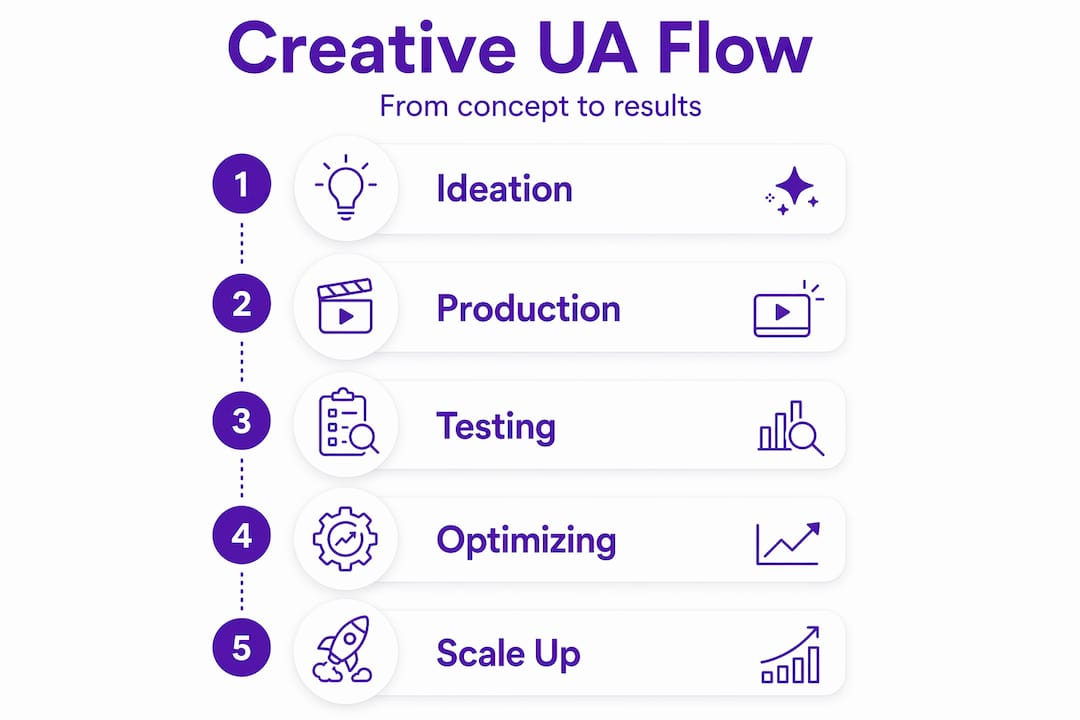
Creative velocity is the rate at which a team can move from concept to platform-ready asset. It is not a buzzword. It is a genuine operational constraint that determines how much of the platform’s automation potential you actually unlock. Creative velocity is limited less by ad operations and more by your ability to supply accurate, recent, on-brand assets alongside matching landing-page visuals and copy.
The must-haves for effective asset supply include:
- On-brand consistency: Colours, typography, and character representations must remain coherent across all assets so that the platform’s combinations do not produce jarring mismatches.
- Platform readiness: Each asset must meet the dimensional, file size, and duration specifications of the target network. Non-compliant assets are rejected or compressed, degrading quality automatically.
- Regular updates: Stale assets prevent the platform’s algorithms from finding new high-performing combinations. Freshness is a signal the platform rewards.
- Variety in creative angle: Different hooks, different gameplay moments, and different emotional tones give the platform genuine options rather than minor duplicates.
- Accurate metadata: Headline, description, and CTA text must remain aligned with the visual content to avoid internal contradictions that erode trust.
Teams that understand popular ad formats in mobile gaming can prioritise asset types that their target networks weight most heavily in their optimisation algorithms. Playables and rewarded videos, for instance, carry heavier quality signals on many mobile networks than static images, making them worth the additional production investment when volume allows.
Pro Tip: Always synchronise creative updates with your app store listing and landing page assets. A disconnect between the ad a user sees and the store page they land on creates a trust gap that can visibly suppress conversion rates and harm downstream quality metrics.
Keeping creatives and landing pages current in parallel is a discipline that many teams deprioritise under pressure. The platforms notice, even if the team does not, in the form of quality scores and relevance ratings that quietly reduce impression share.
Quality control: Aligning creative, expectations, and retention metrics
While asset supply is technical, quality control is strategic, ensuring that what your creative promises aligns with what players actually receive.
A common mistake in mobile game UA is optimising creative purely for top-funnel metrics. A video that dramatises gameplay, exaggerates rewards, or shows mechanics that do not exist in the current build may deliver impressive CPI numbers in the first reporting window. The true cost appears later, in day-one and day-seven retention, in payer conversion rates, and in negative app store reviews.
Creative that mismatches the player experience can improve top-funnel metrics while harming retention and payer quality. Validating with post-click KPIs such as early retention and monetisation events is not optional if your goal is sustainable growth. It is the only mechanism that catches misleading creative before it poisons your downstream economics.
Red flags that your creative is misaligned with gameplay include:
- D1 retention significantly below benchmark despite strong install volume, suggesting the onboarding experience is not delivering what the ad implied.
- Low session depth in first 24 hours, indicating players are arriving with incorrect expectations about game pacing or difficulty.
- Elevated refund or uninstall rate within 48 hours, a reliable signal that the creative narrative diverged from reality.
- Low payer conversion from high-volume cohorts, often caused by attracting players motivated by a mechanic or reward that does not feature prominently in the actual economy.
- Negative review spikes mentioning “not like the ad”, one of the clearest direct signals available.
“CPI alone tells you nothing about whether you acquired a player or a churner. The creative that drives the install sets the expectation for every moment that follows.”
Reviewing ad experience types for user acquisition with an eye on post-click alignment helps teams choose formats that naturally set accurate expectations. Playable ads, for instance, give prospective players a genuine taste of the core loop, which tends to produce lower install volume but meaningfully higher quality cohorts.
Why creative testing trumps targeting: Funding a creative flywheel
Assuming quality is aligned, the next evolution in UA strategy is moving creative testing to the centre of your growth roadmap.
The targeting landscape for mobile gaming has changed structurally. Privacy regulations, IDFA deprecation on iOS, and the gradual erosion of granular attribution have all reduced the precision with which advertisers can rely on audience targeting as the primary performance lever. In this environment, creative is the primary performance driver as targeting precision tightens and privacy limits reduce attribution signal.
The creative flywheel is the operational structure that sustains this advantage. Here is how to build and fund one:
- Establish a creative hypothesis backlog. Maintain a prioritised list of testable concepts grounded in player psychology, genre conventions, and competitor analysis.
- Allocate production budget separately from media budget. Teams that do not ringfence creative production spend inevitably deprioritise it under media pressure.
- Run structured A/B and multivariate tests. Do not allow creative decisions to be made by committee or gut feel when data is accessible.
- Define a retirement threshold. Set a clear performance floor below which creatives are pulled automatically rather than manually reviewed.
- Feed learnings back into ideation. Every retiring creative carries information about what did not resonate. That data should shape the next batch directly.
- Scale validated creative quickly. Delay between validation and scaling is lost efficiency. Build approval and trafficking processes that move at the speed of learning.
Innovative playable ads are particularly well-suited to flywheel approaches because they generate engagement signals beyond simple view-through or click-through, providing richer data for iteration. The creative testing over targeting argument is not a theoretical position; it is increasingly the practical reality for UA teams operating in privacy-constrained environments.
Pro Tip: Budget time and resources for creative iteration as a fixed line item, not an afterthought. Teams that treat creative production as elastic spending are the same teams that hit creative walls mid-campaign and scramble to fill the gap reactively.
The uncomfortable truth about campaign creative for mobile UA
After unpacking the what and how, the real challenge emerges: sustaining creative momentum is rarer and more impactful than chasing the trend of the month.
Most mobile gaming UA teams invest significant effort in bidding strategies, audience segmentation, and attribution configuration. These are all legitimate disciplines. But many of those same teams ship two or three creatives per month and then wonder why their campaigns plateau. The bottleneck is rarely the media buying. It is almost always the creative pipeline.
Managing creative velocity is an organisational challenge, not a technical one. The tools exist. The formats are known. What breaks down is the internal process: too many approval layers, unclear ownership, production dependencies on developers who have competing priorities, and a cultural tendency to treat each creative as a polished final product rather than a testable hypothesis.
Teams that out-iterate the market win. This is not an abstraction. When one team is testing twelve creative variants per month and another is testing three, the faster team accumulates proportionally more validated learning and compounds that advantage over time. Targeting parity and budget parity do not overcome that gap.
AI-powered ideation can accelerate parts of the creative process, particularly concept generation and copy variation. But the discipline of running a structured creative flywheel, honouring retirement thresholds, feeding learnings back into the backlog, and treating every asset as a scientific instrument rather than a deliverable, that discipline is human and organisational. No tool installs it automatically.
Take your campaign creative to the next level
If this guide has clarified one thing, it is that creative velocity is the practical constraint separating average UA performance from exceptional results. The good news is that tooling has evolved to match that need. PlayableMaker is built specifically for mobile game UA teams who need to move fast without leaning on developers or breaking their production budget. Understanding why playable ads are so effective gives you the strategic rationale; the PlayableMaker builder tool gives you the means to act on it immediately. For teams operating under real budget constraints, the budget-friendly playable ad guide offers a structured pathway to launching interactive creative without the traditional cost overhead.
Frequently asked questions
What exactly does ‘campaign creative’ include?
Campaign creative covers both the strategic layer and the actual ad assets, including visuals, copy, CTAs, and interactive elements, all designed around specific campaign objectives and audience insights rather than produced in isolation.
How often should mobile game UA teams refresh campaign creative?
Teams should refresh creative frequently, typically every one to two weeks, or as soon as performance signals indicate decline, to manage creative fatigue and maintain the quality of incoming install cohorts.
Why does creative testing outperform audience targeting now?
With tighter privacy restrictions and reduced attribution signal, creative is the primary driver of UA performance, making the ability to iterate and validate creative quickly more valuable than targeting precision.
What KPIs should be tracked for campaign creative success?
Track top-funnel metrics such as CPI and IPM alongside post-install quality indicators including early retention and monetisation events to avoid scaling creatives that harm downstream player quality.
What’s the risk of campaign creative not matching gameplay?
Misaligned creative can inflate install volume in the short term while damaging retention and payer quality, producing cohorts that churn quickly and never convert to revenue.
Recommended
- 7 Essential Steps for a Winning UA Campaign Checklist – playablemaker.com 7 Essential Steps for a Winning UA Campaign Checklist
- Master User Acquisition Ad Strategies for Mobile Games – playablemaker.com Master User Acquisition Ad Strategies for Mobile Games
- 8 Creative Sources for Ad Creative Inspiration – playablemaker.com 8 Creative Sources for Ad Creative Inspiration
- Master Mobile Gaming Ad Strategies for Effective User Acquisition – playablemaker.com Master Mobile Gaming Ad Strategies for Effective User Acquisition