Nearly one in ten Facebook ad clicks actually results in a conversion, yet many british and global mobile gaming companies struggle to hit even this average. When every penny counts and competition intensifies, understanding why some campaigns succeed while others stall becomes crucial. This guide gives user acquisition managers the practical insights needed to analyze, optimize, and outpace industry standards, using cost-efficient no-code solutions.
Table of Contents
- Defining Average Conversion Rate For Facebook Ads
- Major Types Of Facebook Ad Formats
- Factors Influencing Conversion Rates Globally
- Common Mistakes Lowering Ad Performance
- No-Code Playable Ads For Better Conversion
Key Takeaways
| Point | Details |
|---|---|
| Understanding Conversion Rate | The average conversion rate for Facebook ads is about 8.95%, with variations by industry. Mobile gaming marketers should focus on tracking and improving this dynamic metric. |
| Ad Format Selection | Choosing the right Facebook ad format is crucial for campaign success. Each format serves distinct objectives, and testing multiple options can enhance engagement. |
| Avoiding Common Mistakes | Align campaign objectives with business goals and refine audience targeting to improve performance. Regularly refreshing creative assets helps prevent ad fatigue. |
| Utilising Playable Ads | No-code playable ads offer interactive experiences that enhance user acquisition. They allow potential players to engage before committing to downloads, reducing costs and improving conversion rates. |
Defining Average Conversion Rate for Facebook Ads
A Facebook ad conversion rate represents the percentage of people who complete a specific desired action after interacting with an advertisement. When advertisers design campaigns for mobile gaming user acquisition, understanding this metric becomes critical for measuring marketing effectiveness. Across various industries, the average conversion rate for Facebook ads sits at approximately 8.95% in 2025, demonstrating the complex landscape of digital advertising performance.
Calculating the conversion rate involves a straightforward formula: dividing the total number of conversions by the total number of ad interactions, then multiplying by 100. For mobile gaming companies, conversions might include app installations, in-app purchases, or player sign-ups. Different sectors experience dramatically varied conversion rates, with Fitness (14.29%), Education (13.58%), and Employment (11.73%) achieving higher performance compared to Technology (2.31%) and Retail (3.26%).
The nuances of conversion rates extend beyond simple numerical calculations. Campaign objectives, audience targeting precision, ad creative quality, and landing page design all contribute significantly to conversion performance. Mobile gaming marketers must recognise that a conversion rate is not just a static number, but a dynamic metric reflecting the comprehensive effectiveness of their advertising strategy.
Pro tip: When analysing your Facebook ad conversion rates, compare your performance against industry benchmarks while focusing on continuous incremental improvements rather than absolute percentages.
Here is a summary of average Facebook ad conversion rates by industry for easy comparison:
| Industry | Average Conversion Rate | Typical Conversion Goal |
|---|---|---|
| Fitness | 14.29% | Membership sign-up, app install |
| Education | 13.58% | Course enrolment, registration |
| Employment | 11.73% | Job application, profile setup |
| Retail | 3.26% | Product sale, checkout |
| Technology | 2.31% | Demo request, app install |
Major Types of Facebook Ad Formats
Mobile gaming marketers have access to a diverse array of Facebook ad formats designed to capture user attention and drive specific campaign objectives. Facebook offers multiple ad formats ranging from static images to interactive video experiences, each tailored to different marketing goals and audience engagement strategies. These formats include Image Ads, Video Ads, Carousel Ads, Collection Ads, Stories Ads, and Messenger Ads, providing advertisers with flexible tools to communicate their brand message.
The primary ad formats can be categorised by their visual and interactive characteristics. Image Ads feature single static photographs with accompanying text, ideal for straightforward product presentations. Video Ads enable motion content up to 241 minutes, allowing more dynamic storytelling and user engagement. Carousel Ads permit multiple scrollable images or videos within a single advertisement, perfect for showcasing product ranges or highlighting different game features. Stories Ads leverage full-screen vertical content, creating immersive experiences that capture user attention in mobile environments.
Selecting the appropriate ad format requires careful consideration of campaign objectives, target audience preferences, and content quality. Mobile gaming companies must analyse their specific marketing goals, whether seeking app installations, player registrations, or in-app purchases, and match these objectives with the most suitable ad format. Technical aspects such as image resolution, video captions, and interactive elements play crucial roles in determining campaign effectiveness and user engagement rates.
Pro tip: Experiment with multiple ad formats in your initial campaign to determine which resonates most effectively with your mobile gaming audience, tracking performance metrics to refine your advertising strategy.
The following table compares key Facebook ad formats and their main strengths for mobile gaming campaigns:
| Ad Format | User Experience | Ideal Campaign Objective |
|---|---|---|
| Image | Static, clear visuals | Quick awareness, product teaser |
| Video | Dynamic storytelling | Engagement, feature demonstration |
| Carousel | Multi-image or video | Highlight variety, product range |
| Stories | Full-screen, immersive | Fast engagement, brand recall |
| Collection | Integrated, shoppable | Direct purchases, browse options |
| Messenger | Direct interaction | Lead generation, user queries |
Factors Influencing Conversion Rates Globally
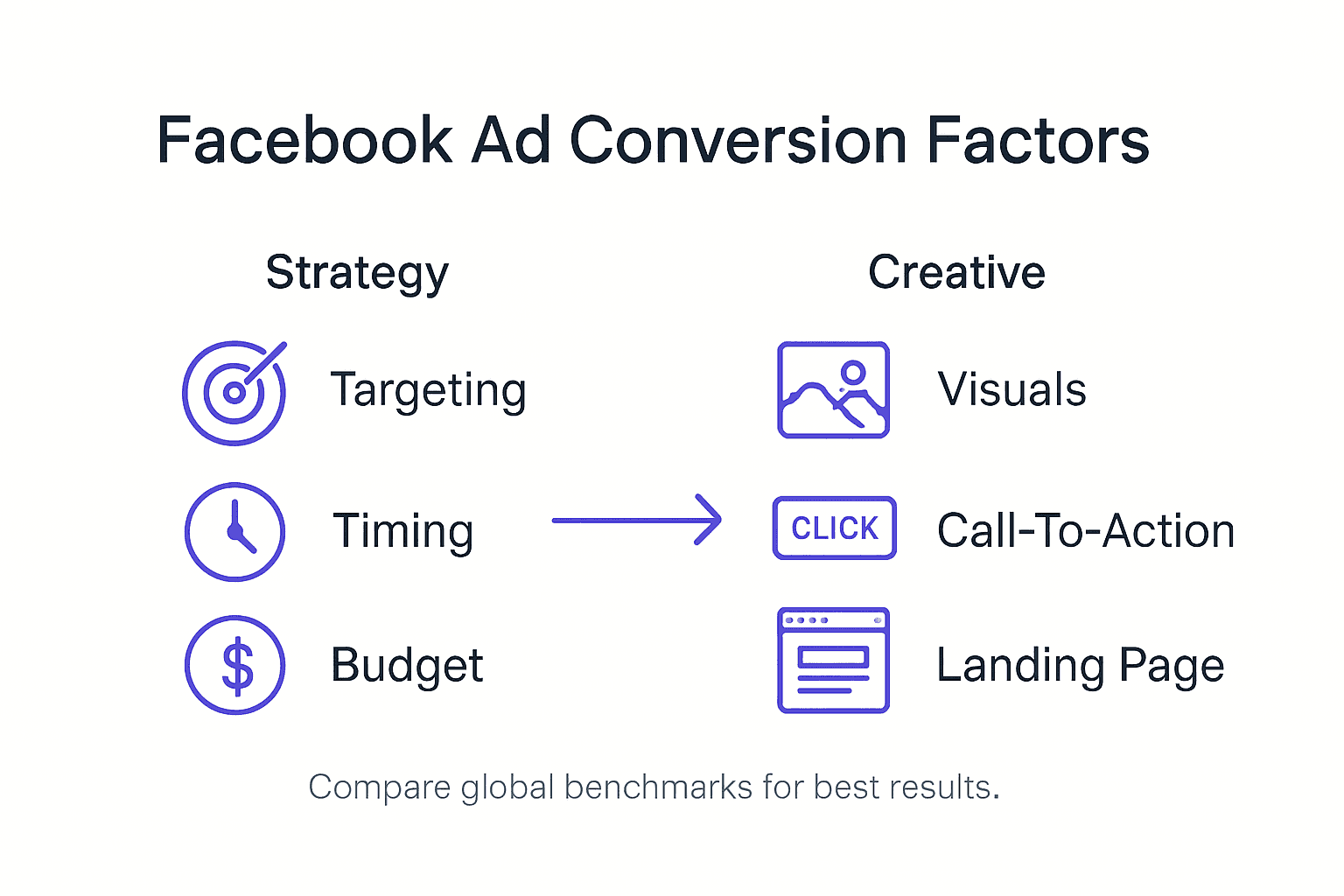
Global Facebook ad conversion rates are shaped by a complex interplay of strategic and creative factors that extend far beyond simple targeting mechanisms. Conversion performance depends critically on precise audience targeting, ad relevance, and nuanced understanding of consumer behaviour, with significant variations observed across different international markets and industry sectors.
Key determinants of conversion rates include audience targeting precision, ad creative quality, and landing page experience. Mobile gaming marketers must recognise that emotional resonance plays a substantial role in driving user engagement. Industries with strong emotional appeal, such as fitness and education, typically demonstrate higher conversion rates compared to more technical sectors like technology and travel. Factors such as market competition, product pricing, visual aesthetics, and content relevance collectively influence the likelihood of users completing desired actions.

The global landscape of Facebook advertising requires a sophisticated, data-driven approach to conversion optimisation. Different geographical regions exhibit unique consumer behaviours, technological adoption rates, and cultural preferences that directly impact advertising effectiveness. Successful campaigns demand continuous testing, dynamic content adaptation, and granular performance analysis. Mobile gaming companies must develop adaptive strategies that can rapidly respond to shifting market dynamics, leveraging advanced analytics to refine targeting parameters and creative approaches.
Pro tip: Implement a systematic A/B testing strategy across different ad formats, targeting options, and creative variations to systematically improve your conversion performance and understand nuanced audience preferences.
Common Mistakes Lowering Ad Performance
Mobile gaming marketers frequently encounter performance-limiting errors that can dramatically reduce their Facebook ad effectiveness. Several critical mistakes consistently undermine campaign success, ranging from strategic misalignments to technical oversights, which can significantly increase advertising costs and diminish return on investment.
One primary mistake involves selecting inappropriate campaign objectives that misalign with actual business goals. Mobile gaming companies often choose traffic-generation campaigns when conversion-focused objectives would serve them better. Audience targeting represents another crucial area of potential failure, with many advertisers creating overly broad or poorly segmented audience profiles that reduce ad relevance. Technical errors such as incorrect conversion event tracking, premature manual placement selections, and neglecting audience warming stages can further compromise campaign performance. Marketers must understand that Meta’s machine-learning algorithms require stable budgets and consistent data signals to optimise advertising delivery effectively.
Creative assets play an equally critical role in ad performance degradation. Stale, repetitive, or low-quality visual content can trigger ad fatigue, causing audience disengagement and reduced conversion rates. Mobile gaming marketers should implement systematic rotation of creative elements, maintain visual diversity, and continuously test different visual approaches. Successful campaigns demand a dynamic approach that adapts to changing audience preferences, leverages data-driven insights, and maintains a fresh, engaging visual narrative that resonates with target user segments.
Pro tip: Develop a quarterly creative refresh strategy that systematically tests new visual concepts, ensuring your ad creatives remain engaging and prevent audience saturation.
No-Code Playable Ads for Better Conversion
Playable ads represent a revolutionary approach to mobile gaming user acquisition, offering interactive experiences that dramatically transform traditional advertising strategies. Facebook Playable Ads provide users with a unique try-before-you-download experience, enabling potential players to engage directly with a mini-version of a game before making an installation commitment, effectively reducing acquisition costs and improving overall campaign performance.
The core mechanism of no-code playable ads involves creating lightweight, interactive HTML5 demonstrations that allow immediate user interaction. These ads typically comprise three critical components: a compelling lead-in video, an immersive interactive demo, and a persistent call-to-action. Mobile gaming marketers can leverage this format to provide potential users with a genuine preview of gameplay mechanics, user experience, and core entertainment value. By enabling direct interaction, playable ads facilitate a more transparent and engaging user acquisition process, allowing players to self-qualify their interest before downloading.
Technical considerations are paramount when developing no-code playable ads for optimal conversion. The interactive demo must load quickly, provide a seamless user experience, and effectively communicate the game’s core value proposition within seconds. Successful implementations focus on highlighting the most engaging gameplay elements, creating intuitive interactions, and maintaining visual fidelity that accurately represents the actual gaming experience. Mobile gaming companies must carefully balance technical complexity with accessibility, ensuring that the playable ad serves as an authentic, compelling representation of their product.
Pro tip: Develop multiple variations of your playable ad, focusing on different gameplay moments or core mechanics to discover which interactive preview most effectively drives user acquisition and conversion.
Boost Your Facebook Ad Conversion Rates with Easy No-Code Playable Ads
Understanding that average Facebook ad conversion rates vary widely and recognising the challenge of creating engaging ads without draining development time or budget are key. The article highlights how interactive formats like playable ads can dramatically improve user engagement and conversion by offering immersive previews of your game. But traditional playable ad production often demands extensive resources and technical skills that many mobile gaming marketers lack.
That is exactly where PlayableMaker comes in. We provide a no-code, fast, and budget-friendly solution to build eye-catching playable ads without relying on dev teams or complex workflows. If you want to avoid common pitfalls like ad fatigue and poor creative impact mentioned in the article, our platform empowers you to create multiple ad variations quickly and optimise your campaigns effectively. Explore helpful resources in our Help Archives to get started smoothly and learn best practices. Take control of your ad performance today with innovative tools from PlayableMaker Publishing Archives and see how simple it can be to convert clicks into loyal players.
Frequently Asked Questions
What is the average conversion rate for Facebook ads?
The average conversion rate for Facebook ads is approximately 8.95% across various industries as of 2025.
How is the conversion rate for Facebook ads calculated?
The conversion rate is calculated by dividing the total number of conversions by the total number of ad interactions and then multiplying by 100.
What factors can influence Facebook ad conversion rates?
Key factors that influence conversion rates include audience targeting precision, ad creative quality, landing page experience, and emotional resonance with the target audience.
What types of Facebook ad formats are available for marketers?
Facebook offers several ad formats including Image Ads, Video Ads, Carousel Ads, Stories Ads, Collection Ads, and Messenger Ads, each serving different marketing objectives.
Recommended
- Complete Guide to FB Ad Metrics for Mobile Gaming – playablemaker.com Complete Guide to FB Ad Metrics for Mobile Gaming
- What Is a Good Facebook Ad CTR? Complete Guide – playablemaker.com What Is a Good Facebook Ad CTR? Complete Guide
- Understanding Conversion Rate in Advertising: A Complete Guide – playablemaker.com Understanding Conversion Rate in Advertising: A Complete Guide
- Facebook Ad Performance: Complete Guide for Mobile Gaming – playablemaker.com Facebook Ad Performance: Complete Guide for Mobile Gaming