
TL;DR:
- Creative fatigue in mobile game ads occurs rapidly, necessitating frequent creative refreshes to sustain performance. Structuring teams, leveraging data, and prioritizing formats like playable ads can significantly lower costs and boost engagement. Using AI to scale proven creative frameworks, not generate random variations, ensures sustainable growth and maximized campaign effectiveness.
Creative fatigue hits mobile game ads faster than nearly any other advertising category. For UA teams, this means a creative concept that performs brilliantly in week one can become invisible noise by week three. This ad creation guide for UA teams addresses that core challenge directly, covering the preparation, execution, and optimisation frameworks that separate high-performing campaigns from wasted spend. From structuring your team and tools to selecting the right formats and leveraging AI correctly, every section is built around what actually moves the needle for mobile game installs.
Table of Contents
- Key takeaways
- Ad creation guide for UA teams: foundations first
- Step-by-step process for producing winning creatives
- Optimising ad creative performance with data and AI
- Ad format strategy for mobile game UA
- Common challenges and how to resolve them
- My perspective on what actually works in UA ad creation
- How Playablemaker supports your creative velocity
- FAQ
Key takeaways
| Point | Details |
|---|---|
| Hook quality is everything | The first 1 to 3 seconds of any ad determine whether a user engages or scrolls past. |
| Creative velocity beats hero ads | Producing 20 new concepts per month consistently outperforms relying on a single polished creative. |
| Playable ads reduce CPA | Interactive formats pre-qualify users before install, driving measurably lower cost per acquisition. |
| AI works best on proven frameworks | Use AI to scale creative concepts that already perform, not to generate random variations at volume. |
| Data must guide format decisions | Monitor hook rate, IPM, and CPI within 7 to 10 days to decide what to scale and what to cut. |
Ad creation guide for UA teams: foundations first
Before a single creative is produced, the structural groundwork matters enormously. Teams that skip this phase produce ads that look polished but fail to connect with the right audience at the right moment.
Clear team roles. Effective team-based ad development requires distinct ownership across three functions: creative production, performance analysis, and audience research. When a single person tries to own all three, each suffers. Designating a creative strategist who owns brief development and a data analyst who owns performance interpretation creates a feedback loop that improves each production sprint.
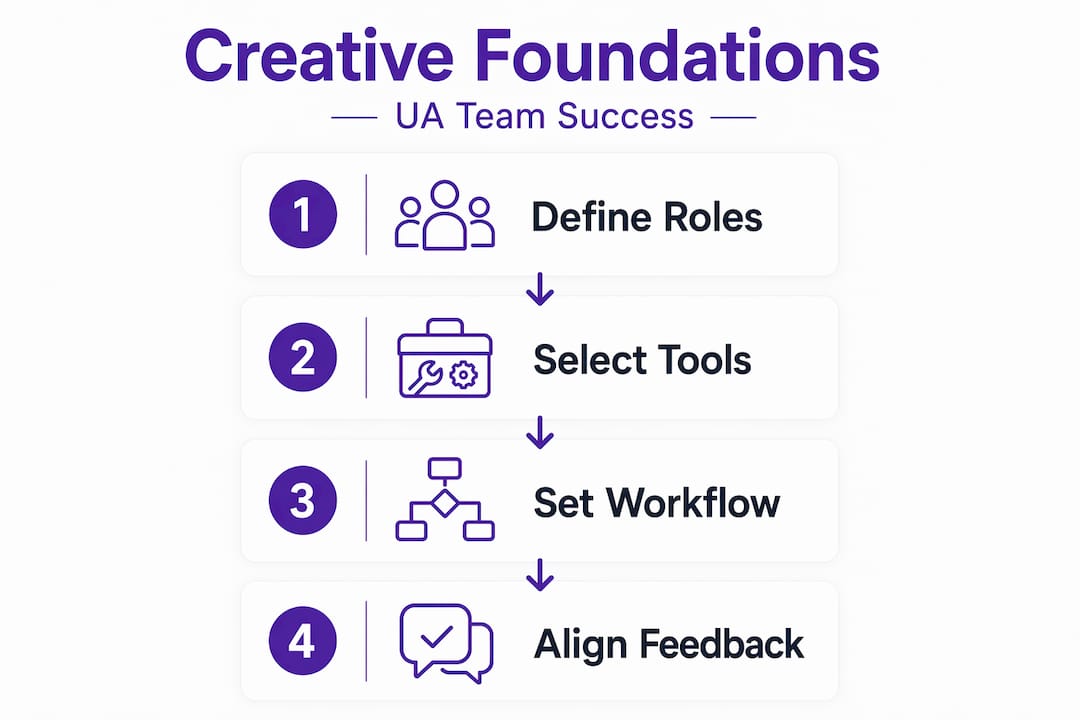
The right tools. For creative production, your team needs access to a video editor, a motion design tool for animated assets, and a platform for playable ad creation. For campaign management, structured dashboards that track creative-level performance across networks are non-negotiable. Without creative-level data, scaling decisions become guesswork.
Competitive research as a starting point. Before developing concepts, audit what is already working in your genre. Creative intelligence platforms show which ad formats and hooks competitors are running at scale, which indicates what the algorithm is rewarding. This is not about copying. It is about understanding the benchmark your ad needs to beat.
Key data inputs before production begins:
- Audience segmentation data broken down by device type, age bracket, and prior game genre engagement
- Format performance benchmarks for your primary platforms (Meta, Unity Ads, AppLovin, Google UAC)
- Historical creative performance from previous campaigns, specifically hook rate and D1 retention correlation
- Genre-specific install intent signals from prior ASA campaigns, including converting keyword data from discovery campaigns
Pro Tip: Run a 60-day discovery campaign on Apple Search Ads before scaling on Meta. The keyword intent data you gather informs which emotional triggers and gameplay moments to feature in your creatives.
Step-by-step process for producing winning creatives
With the groundwork in place, a repeatable production process becomes the engine of your UA creative output. Here is how high-performing teams structure it.
-
Write genre-specific creative briefs. A brief for a casual puzzle game looks nothing like one for a midcore RPG. The brief must specify the core game loop to showcase, the emotional trigger to target (frustration, curiosity, satisfaction), the hook format, the call to action, and the target platform and aspect ratio. Vague briefs produce generic ads.
-
Develop 5 to 10 distinct hook concepts per sprint. Testing multiple hooks per sprint prevents the creative fatigue that kills campaigns. Each hook should test a different entry point: failure state, aspirational outcome, social proof, challenge mechanic, or curiosity gap. Do not test minor variations of the same hook and call it testing.
-
Adapt winning hooks across formats. Once a hook concept validates in a 15-second video, translate it into a playable ad, a static banner, and a carousel format. Each platform rewards different formats, and a single validated concept can power an entire week of inventory if adapted correctly. Adjust aspect ratios for Reels (9:16), feed placements (1:1 or 4:5), and landscape interstitials (16:9).
-
Build a creative velocity system with scheduled refreshes. Creative velocity systems that target 20 new concepts per month give teams a structured cadence. Schedule creative reviews every 7 to 10 days. If hook rate drops below your benchmark, rotate the creative out immediately. Do not wait for CPI to spike before acting.
-
Establish scaling criteria before you launch. Define what “winning” looks like in advance. For example: any creative achieving an IPM above your category average within 72 hours of launch gets a budget increase of 30%. This removes subjective decision-making and speeds up the scaling process.
Pro Tip: Repurpose high-performing creatives by changing the opening three seconds while keeping the core gameplay footage intact. This extends asset life without a full production rebuild. Explore creative repurposing strategies to maximise your existing library.
Optimising ad creative performance with data and AI
Data without structure produces noise. The goal of performance optimisation is to build a system that surfaces the right signals quickly enough to act on them.
The metrics that matter most for mobile game UA are:
- Hook rate: the percentage of viewers who watch beyond the first three seconds. This is your first filter for creative quality.
- Install per mille (IPM): installs per 1,000 impressions. This combines hook quality and conversion power into a single efficiency metric.
- Cost per install (CPI): the absolute cost benchmark. Track this at creative level, not just campaign level.
- Day-1 and Day-7 retention correlated to creative source: this tells you whether your ads are attracting genuinely interested users or impulse installers who churn immediately.
For apps with low in-app purchase rates, a two-phase optimisation approach is worth adopting. Optimise for mid-funnel events first, such as tutorial completion or level three reach, before switching to purchase-based optimisation. Jumping straight to purchase optimisation with thin data starves the algorithm and produces erratic results.
AI is increasingly present in UA workflows, and its application matters greatly. The most effective use is to scale proven creative frameworks rather than generate random variations from scratch. Treat your best-performing ad as a “creative skeleton,” then use AI tools to produce variations in background, character skin, colour palette, or copy. This preserves what works whilst generating the volume needed to combat fatigue. Teams that use AI as a digital lottery, generating hundreds of untested variations, waste budget on assets that share none of the structural qualities of their winners.

Automated creative tagging is another underused method. Tag every asset with attributes such as hook type, visual style, gameplay mechanic shown, and voiceover presence. Over time, this data reveals patterns. You may discover that ads featuring a failure state in the first two seconds consistently outperform satisfaction hooks in your genre, a finding that directly shapes every future brief.
Ad format strategy for mobile game UA
Different formats serve different roles in a UA funnel. Choosing the right one for each stage and platform significantly affects both engagement and cost efficiency.
| Format | Best use case | Key advantage |
|---|---|---|
| 15-second video | Top-of-funnel awareness and broad prospecting | 20 to 30% higher engagement vs longer video formats |
| Playable ad | Mid-funnel and re-engagement | Pre-qualifies users; 28% lower CPA on Meta vs video |
| UGC or influencer-style | Social proof and authenticity-led campaigns | Reduces scepticism; performs well in casual and hyper-casual genres |
| Static or carousel | Retargeting and supplementary placements | Low production cost; efficient for testing visual concepts quickly |
A few principles that guide format selection effectively:
- Playable ads are particularly powerful for puzzle, casual, and midcore games where the core mechanic is simple enough to demonstrate in 30 seconds. For narrative-heavy RPGs, short video with a strong emotional hook often converts better.
- UGC-style content should not be manufactured to look genuine. Audiences recognise the difference. Work with actual players or micro-influencers who have authentic reactions to the game.
- Platform algorithm requirements shift. Meta rewards structured campaign tiers with separate prospecting, quality (AEO), and value (VO) optimisation layers. Feeding each tier with format-appropriate creatives improves ROAS across the board.
Pro Tip: For platforms that support it, test a playable ad against a video ad using the same hook. The conversion data from this head-to-head comparison tells you whether your game’s mechanics are strong enough to be shown directly, which is information no survey or focus group can provide.
Common challenges and how to resolve them
Even well-structured UA teams run into predictable obstacles. Recognising them early prevents small problems from becoming expensive ones.
Creative fatigue is permanent, not periodic. Gaming ads fatigue faster than any other advertising category. Treat this as a structural constraint, not an occasional setback. Build your production calendar around it from the outset.
Budget adjustments on Meta can reset learning. Changing campaign budgets by more than 20% daily forces the algorithm back into the learning phase, degrading performance for several days. Make incremental adjustments and allow the algorithm to stabilise before evaluating results.
Over-fragmentation of ad sets reduces statistical confidence. When budget is spread across too many ad sets, none accumulates enough data for the algorithm to optimise effectively. Consolidate ad sets around clear optimisation objectives and resist the urge to create a separate ad set for every creative variation.
Under-testing is as damaging as over-spending. Teams that launch two or three creatives per campaign and wait for a “winner” often see creative fatigue before they have enough data to make decisions. Launching 5 to 10 hook concepts per sprint provides the statistical breadth needed to identify patterns, not just outliers.
“The teams that scale fastest are not the ones with the biggest budgets. They are the ones with the most structured creative processes and the discipline to act on data within days, not weeks.”
My perspective on what actually works in UA ad creation
I have watched teams spend six figures on polished studio productions that a 90-second screen recording outperforms in every measurable way. The authenticity of raw gameplay footage is not just a stylistic preference. It works because it sets accurate expectations, and users who install based on accurate expectations actually play the game.
The prevailing belief that production quality signals trustworthiness is understandable but often wrong in mobile gaming. Players are not looking for cinematic experiences in a 15-second ad. They are looking for a reason to believe the game will be fun. Showing them real gameplay, even imperfect gameplay, does that more effectively than any polished creative I have seen.
My other strong conviction is about creative velocity. I have seen teams treat a single high-performing ad as a solved problem, cutting production while scaling spend on that one asset. Fatigue arrives faster than anyone expects, and by the time CPI climbs, it is too late to have replacements ready. The discipline of producing new concepts every single sprint, even when performance is strong, is what separates teams that scale sustainably from those that spike and crash.
On AI: the most effective use I have found is feeding proven creative structures into AI workflows to generate variation volume. Random generation produces random results. Structure produces scalable output.
— Ondrej
How Playablemaker supports your creative velocity
Building a creative velocity system is straightforward in theory but demanding in practice, particularly when playable ads are involved. Traditional playable ad development requires developer time, substantial budget, and production cycles that rarely fit a weekly sprint cadence. Playablemaker removes that constraint entirely.
With Playablemaker’s no-code drag-and-drop builder, UA teams can produce and iterate playable ads without writing a single line of code. The platform is designed specifically for teams that need to move quickly, test frequently, and keep costs manageable. Playable ads are the gold standard for many gaming categories precisely because they pre-qualify users before install. The psychology behind this is well-documented: interactive engagement builds intent in ways passive video simply cannot match. You can explore why playable ads perform so well and how those principles apply directly to your campaigns. Playablemaker is built to make that performance accessible for every team, at every budget level.
FAQ
What is creative fatigue and why does it matter for UA teams?
Creative fatigue occurs when an ad’s performance declines as audiences become overfamiliar with it. In mobile gaming, this happens faster than in any other advertising category, making regular creative refresh a structural necessity rather than an occasional task.
How many ad concepts should a UA team test per sprint?
Testing 5 to 10 distinct hook concepts per sprint is the recommended approach. This range provides enough variation to identify genuine patterns rather than reacting to single-creative anomalies.
Why do playable ads perform better than standard video ads for mobile games?
Playable ads allow users to experience core game mechanics before installing, which attracts higher-intent users. Research shows playable ads deliver up to 28% lower CPA compared to video on Meta platforms.
How should UA teams use AI in ad creation?
AI performs best when used to generate variations of proven creative frameworks rather than creating content from scratch. Successful teams build “creative skeletons” from top performers and use AI to scale variations in visual style, copy, and presentation.
What metrics should UA teams prioritise when evaluating ad creative performance?
Hook rate, IPM (install per mille), CPI, and early retention metrics such as Day-1 and Day-7 are the primary indicators. Reviewing these at creative level within 7 to 10 days of launch informs scaling and rotation decisions before budget is wasted on underperforming assets.
Recommended
- Mobile ad formats for gaming UA: complete list 2026 – playablemaker.com Mobile ad formats for gaming UA: complete list 2026
- Top mobile ad platforms for gaming user acquisition – playablemaker.com Top mobile ad platforms for gaming user acquisition
- How to Repurpose Ad Creatives for Mobile Gaming Success – playablemaker.com How to Repurpose Ad Creatives for Mobile Gaming Success
- Mobile Ad Glossary: 60% CPI Spend Drives Gaming Growth – playablemaker.com Mobile Ad Glossary: 60% CPI Spend Drives Gaming Growth