TL;DR:
- Cost per install (CPI) is the average cost paid for each app installation, calculated by dividing total ad spend by total attributed installs. However, CPI should be paired with downstream metrics like retention and LTV because a low CPI does not guarantee user quality or profitability; campaigns must balance cost with user value to ensure long-term success. Effective CPI management involves setting benchmarks based on your own monetisation data, monitoring both attributed and blended CPI, and optimizing creatives and targeting to improve install quality.
Cost per install (CPI) is the average amount an advertiser pays for each app installation acquired through a paid campaign, calculated as total ad spend divided by total attributed installs. If you spend £5,000 and generate 2,000 installs, your CPI is £2.50. Simple arithmetic, but the interpretation behind that number is where most user acquisition professionals either gain an edge or make costly mistakes. This guide covers the cost per install definition in full, including how to calculate CPI, what drives benchmark variation, and how to pair it with post-install metrics to make decisions that actually improve profitability.
What is cost per install and how is it calculated?
Cost per install is the foundational CPI advertising metric in mobile user acquisition. The formula is: CPI = total ad spend ÷ total installs within the same measurement period. That straightforward calculation, however, conceals a set of important variants that experienced UA teams track simultaneously.

Three distinct CPI calculation methods exist, and confusing them is one of the most common sources of cross-channel misinterpretation. Attributed CPI, blended CPI, and effective CPI each serve a different analytical purpose, and teams that track only one risk making budget decisions on incomplete data.
Privacy changes such as Apple’s SKAdNetwork have further complicated attribution. Platform-reported install counts and mobile measurement partner (MMP) data frequently diverge, meaning the CPI figure your ad network reports may not match what your MMP records. Experienced teams track attributed CPI for channel-level optimisation and blended CPI for overall budget sanity checks.
Pro Tip: Always agree internally on which CPI definition and measurement window you are using before sharing results across teams. A blended CPI figure presented alongside an attributed CPI figure from a different source will produce contradictory conclusions and erode trust in your data.
| CPI variant | Definition | Primary use case |
|---|---|---|
| Attributed CPI | Spend divided by installs credited to a specific channel via an MMP | Channel-level optimisation and bid management |
| Blended CPI | Total spend divided by all installs, including organic | Overall budget efficiency and sanity checking |
| Effective CPI (eCPI) | Spend divided by installs after adjusting for post-install quality signals | Balancing volume with downstream user value |
What factors affect cost per install benchmarks?
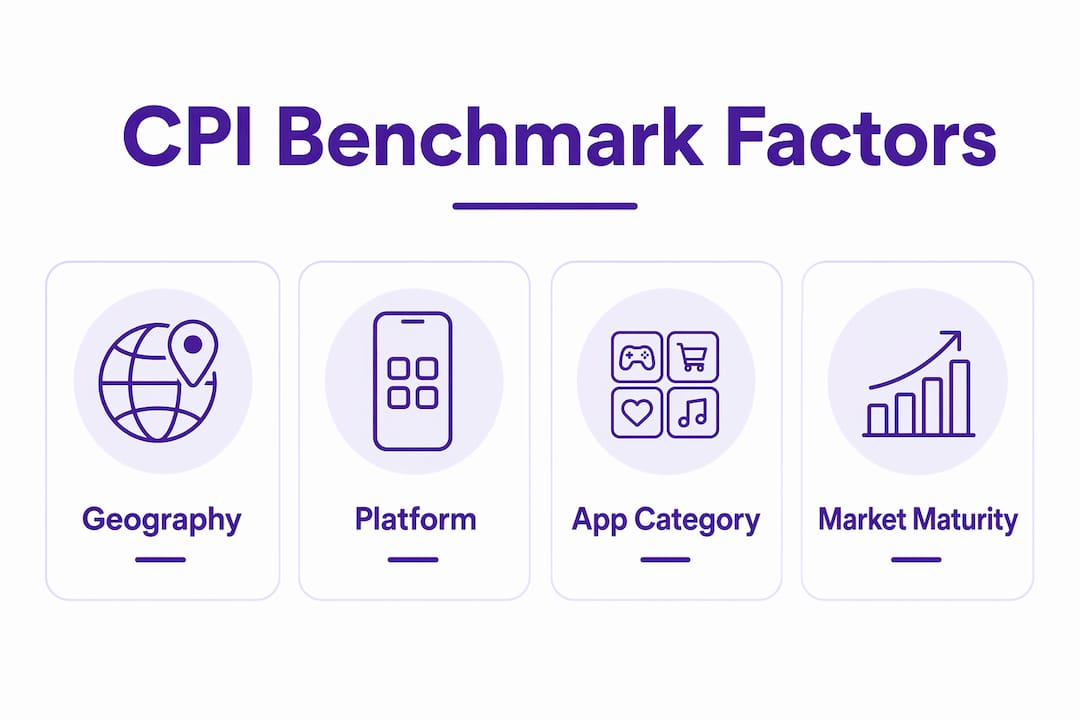
CPI benchmarks vary dramatically by geography, platform, and app category. The global average CPI sits at $2.24, but that figure masks enormous regional disparity. US iOS campaigns average $2.37 per install, while the same metric in Brazil drops to $0.22 and in China to $0.98. Android globally averages $0.44. These differences reflect market maturity, advertiser competition density, and the purchasing power of local user bases.
Platform differences matter beyond geography. iOS users in mature markets command higher CPIs because they historically show stronger in-app purchase behaviour and higher lifetime values. Android’s broader global reach and lower average CPIs make it attractive for volume-focused campaigns, particularly in emerging markets. Neither platform is universally superior. The right choice depends on where your monetisation model performs best.
App category is another significant driver of what affects cost per install. Gaming apps in competitive sub-genres such as casual puzzle or hyper-casual typically see lower CPIs due to broad audience targeting, while finance and subscription apps face higher CPIs because their audiences are narrower and the downstream revenue potential justifies the premium. A “good” CPI is therefore always relative to the category, geography, and monetisation model in play.
Pro Tip: Use CPI benchmarks by category and region as a calibration tool, not a target. Your actual CPI ceiling should be derived from your own LTV data and payback period requirements, not from an industry average.
| Region / Platform | Average CPI (USD) |
|---|---|
| US (iOS) | $2.37 |
| Global (Android) | $0.44 |
| China | $0.98 |
| Brazil | $0.22 |
| Global average | $2.24 |
Why CPI alone does not measure user quality
An install is not an active user. CPI alone is insufficient as a measure of campaign success because it captures only the top of the acquisition funnel. A user who installs your app and never opens it contributes a CPI figure but zero revenue, zero retention, and zero long-term value.
CPI is correctly understood as a leading indicator, not a measure of user value or profitability. The metrics that actually determine whether a campaign is working sit downstream of the install event. UA professionals who understand this distinction build more durable campaigns.
The post-install metrics that matter most alongside CPI include:
- Activation rate: The percentage of users who complete a meaningful first action after installing, such as account creation or tutorial completion. A low activation rate against a low CPI signals poor creative-to-product fit.
- Day 1, Day 7, and Day 30 retention: Retention curves reveal whether acquired users find ongoing value. High-volume, low-CPI campaigns that produce poor Day 7 retention are destroying budget, not saving it.
- Lifetime value (LTV): The total revenue attributable to a user over their relationship with the app. LTV divided by CPI gives you a payback ratio. A ratio below 1.0 means you are losing money on every install.
- Return on ad spend (ROAS): Directly ties ad expenditure to revenue generated, providing a profitability view that CPI cannot offer on its own.
Focusing only on lowering CPI often leads to acquiring low-quality installs that harm retention and revenue. Incentivised install networks, for example, can produce very low CPIs while delivering users who never engage beyond the install event. The downstream damage to cohort quality frequently outweighs the apparent cost saving.
How to optimise campaigns using cost per install data
Optimising around CPI requires a structured approach that balances cost efficiency with user quality. The following steps reflect how experienced UA teams use CPI data in practice.
-
Set CPI targets from LTV, not from benchmarks. Calculate the maximum CPI you can afford by working backwards from your average LTV and target payback period. If your LTV is £8.00 and you require a 3-month payback, your CPI ceiling is not an industry average. It is a function of your own monetisation data.
-
Monitor attributed CPI and blended CPI simultaneously. Attributed CPI tells you which channels are performing. Blended CPI tells you whether your overall acquisition economics are healthy. A widening gap between the two often signals organic cannibalisation or attribution fraud.
-
Test creatives systematically to reduce CPI. Ad creative is one of the most controllable levers in CPI optimisation for mobile gaming campaigns. A/B testing ad formats, messaging angles, and visual styles directly affects click-through rate and conversion rate, both of which feed into your effective CPI.
-
Refine audience targeting to improve install quality. Broad targeting may lower CPI but raise post-install churn. Lookalike audiences built from your highest-LTV users typically produce better downstream metrics, even if the CPI is modestly higher.
-
Review CPI by creative, channel, and geo weekly. CPI is a volatile metric. Auction dynamics, seasonal competition, and creative fatigue all shift it. Weekly reviews allow you to reallocate budget before underperforming channels drain your acquisition budget.
-
Pair CPI with ad performance metrics for a complete picture. CPI in isolation is a cost signal. Combined with activation rate, ROAS, and retention, it becomes a decision-making framework.
Pro Tip: When a channel shows a sudden CPI drop, investigate before celebrating. Unexpected CPI decreases can indicate a targeting drift toward lower-intent audiences, creative fatigue causing a shift in who clicks, or attribution anomalies. A lower CPI that correlates with a drop in Day 7 retention is a warning sign, not a win.
Key takeaways
Effective CPI management requires pairing the cost metric with post-install quality signals, because a low CPI without strong retention and LTV is a budget drain disguised as efficiency.
| Point | Details |
|---|---|
| CPI formula | Total ad spend divided by total installs; variants include attributed, blended, and effective CPI. |
| Benchmark context | Global average CPI is $2.24, but figures range from $0.22 in Brazil to $2.37 on US iOS. |
| CPI limitations | An install does not equal an active user; activation rate, retention, and LTV must be tracked alongside CPI. |
| Optimisation approach | Set CPI ceilings from your own LTV data and monitor both attributed and blended CPI for a complete view. |
| Creative impact | Ad format and creative testing directly influence CPI; mobile ad best practices reduce cost while improving install quality. |
CPI in practice: what the number actually tells you
I have reviewed enough UA dashboards to know that CPI is the metric most teams understand least, despite being the one they report most often. The number looks clean and objective. It is neither.
The most common mistake I see is treating a falling CPI as proof that a campaign is improving. It is proof only that installs are getting cheaper. Whether those installs are worth anything is a separate question entirely, and one that requires looking at cohort data that most teams check too infrequently.
The second issue is definitional inconsistency. When a growth lead reports CPI to a finance team, and the finance team compares it to a blended figure from a different source, the conversation breaks down immediately. Clear internal alignment on CPI definitions and measurement windows is not a technical nicety. It is the foundation of credible reporting.
My practical recommendation is to build a simple dashboard that shows attributed CPI, blended CPI, and Day 7 retention side by side for every active channel. When those three numbers move in the same direction, you have a genuine signal. When they diverge, you have a question worth investigating before adjusting spend. CPI is a useful compass, but only when you know which version you are reading and what the terrain around it looks like.
— Ondrej
How playable ads can reduce your CPI
If you are looking for a creative format that directly addresses both CPI and install quality, playable ads are worth serious consideration. Playable ads improve CPI and engagement by giving users an interactive preview of the app before they install, which means the users who do install have already self-selected based on genuine interest. That pre-qualification effect tends to produce better post-install metrics alongside a competitive CPI.
Playablemaker builds no-code playable ad creation tools designed for UA teams who want the format’s benefits without the development overhead. You can explore playable ad formats and build interactive creatives quickly, without pulling engineering resource or inflating your production budget. For teams optimising CPI while maintaining install quality, it is a practical starting point.
FAQ
What is the cost per install definition in mobile marketing?
Cost per install (CPI) is the average advertising cost paid for each app installation, calculated by dividing total ad spend by total installs in a given period. It is the primary cost metric in mobile user acquisition campaigns.
How do I calculate CPI for my app campaigns?
Divide your total ad spend by the number of installs attributed to that spend during the same period. For example, £5,000 spent generating 2,000 installs produces a CPI of £2.50.
What is a good cost per install benchmark?
A good CPI depends on your app category, geography, and monetisation model. The global average CPI is $2.24, but US iOS campaigns average $2.37 while Android globally averages $0.44. Your CPI ceiling should be set by your own LTV data.
What is the difference between CPI and CPA in mobile advertising?
CPI measures the cost of acquiring an install specifically. CPA (cost per action) measures the cost of a defined post-install action such as registration, purchase, or subscription. CPA is a more precise measure of user quality than CPI.
Why does my attributed CPI differ from my blended CPI?
Attributed CPI counts only installs credited to paid channels via an MMP, while blended CPI includes all installs, organic and paid. A gap between the two often reflects organic uplift driven by paid activity, or attribution discrepancies between platform and MMP data.
Recommended
- 8 Key Ad Performance Metrics for Mobile Gaming Success – playablemaker.com 8 Key Ad Performance Metrics for Mobile Gaming Success
- Ad creation guide for UA teams in mobile gaming – playablemaker.com Ad creation guide for UA teams in mobile gaming
- Ad CTR explained: boost mobile game ad performance – playablemaker.com Ad CTR explained: boost mobile game ad performance
- How creatives influence CPI in mobile gaming campaigns – playablemaker.com How creatives influence CPI in mobile gaming campaigns