Over 90 percent of top mobile apps use AB testing to improve user engagement and boost results. Mobile marketers face constant pressure to increase conversions and keep users coming back, but small changes are not always easy to evaluate. AB testing provides a clear, data-driven way to compare options and measure what truly works, helping brands optimize every part of the user journey for measurable growth.
Table of Contents
- Defining AB Testing In Mobile Marketing
- AB Test Types And Methodologies
- How AB Testing Works Step-By-Step
- Critical Benefits And Common Pitfalls
- Best Practices For AB Tests In Gaming
Key Takeaways
| Point | Details |
|---|---|
| AB Testing Fundamentals | AB Testing is a systematic methodology that compares two digital asset variants to determine which performs better in mobile marketing contexts. |
| Methodologies Overview | Various AB testing methodologies, such as classic AB, multivariate, and adaptive designs, offer flexibility in optimizing marketing strategies. |
| Benefits and Pitfalls | AB Testing enables data-driven decision making but may encounter issues like self-selection bias and device heterogeneity that impact results. |
| Best Practices in Gaming | Effective gaming AB tests should include clear hypotheses, control over variables, and adaptive techniques to enhance user engagement and conversion. |
Defining AB Testing in Mobile Marketing
AB Testing is a systematic user research methodology designed to compare two variations of a digital asset to determine which performs more effectively. According to Wikipedia, this user-experience research method involves a randomized experiment with two variants, A and B, to identify which version delivers superior results in mobile marketing.
In mobile marketing contexts, AB testing serves as a powerful optimization technique. Researchers present alternate versions of mobile applications, advertisements, or interfaces to different user segments, carefully measuring how each variant impacts user behavior and engagement. As highlighted by International Journal of Scientific Research, this method helps marketing professionals refine digital experiences and improve conversion rates.
The core mechanics of AB testing involve several strategic components:

- Variant Creation: Developing two distinct versions (A and B) with a single, targeted difference
- Randomized User Segmentation: Distributing users randomly across test variants
- Performance Measurement: Tracking key performance indicators (KPIs) like click-through rates, user retention, or conversion metrics
- Statistical Analysis: Evaluating which variant statistically outperforms the other
Mobile marketing professionals leverage guide on AB testing ads to systematically improve their advertising strategies. By testing elements like ad creatives, messaging, visuals, and call-to-action buttons, teams can make data-driven decisions that incrementally enhance their marketing effectiveness.
AB Test Types and Methodologies
AB Testing encompasses several sophisticated methodological approaches that mobile marketers can leverage to optimize their digital strategies. At its core, traditional AB testing compares two distinct variants, but more advanced techniques have emerged to provide deeper insights into user behavior and performance optimization.
According to ArXiv, Adaptive Experimental Design (AED) methods represent a cutting-edge approach to testing. These innovative methodologies dynamically allocate traffic to different variants based on their real-time performance, enabling more efficient experimentation and reducing overall testing costs compared to traditional AB/N testing frameworks.
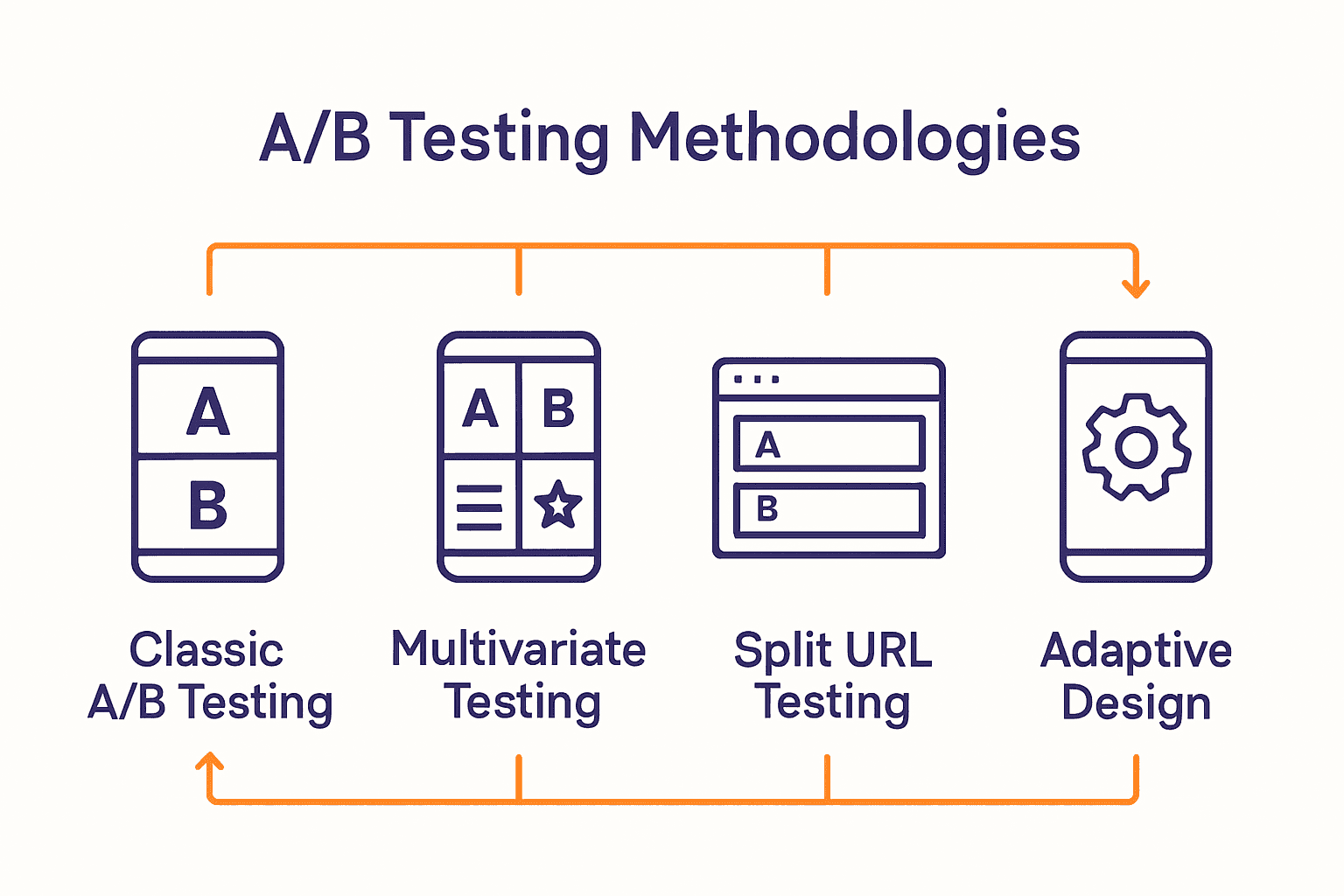
The primary AB testing methodologies include:
Here’s a comparison of major AB testing methodologies in mobile marketing:
| Methodology | Core Approach | Best Use Case | Key Limitation |
|---|---|---|---|
| Classic AB Testing | Two variants, single change | Isolating impact of one variable | Limited to simple changes |
| Multivariate Testing | Multiple variables altered simultaneously | Understanding element interactions | Requires larger sample size |
| Split URL Testing | Entirely different page/layout | Full redesigns or major style changes | Hard to attribute effects to single element |
| Multipage Testing | Multiple linked pages analysed | User journey across several screens | Complex setup and tracking |
| Adaptive Design | Dynamic allocation by performance | Rapid optimisation and cost reduction | Statistically more complex |
- Classic AB Testing: Comparing two variants (A and B) with a single variable changed
- Multivariate Testing: As noted by Wikipedia, this approach tests multiple variables simultaneously, allowing marketers to understand complex interactions between different design elements
- Split URL Testing: Comparing entirely different webpage or landing page designs
- Multipage Testing: Evaluating user experience across multiple connected pages or screens
Mobile marketing professionals can explore the foundations of AB testing to select the most appropriate methodology for their specific objectives. The key is choosing a testing approach that provides statistically significant insights while maintaining efficiency and minimizing resource expenditure.
How AB Testing Works Step-by-Step
AB Testing is a methodical process that allows mobile marketing professionals to make data-driven decisions by systematically comparing different versions of digital assets. According to MBA School, the fundamental approach involves creating two distinct versions of a webpage or application with a specific targeted variation.
As outlined by International Journal of Scientific Research, the core empirical methodology involves presenting alternate digital asset versions to different user segments and meticulously measuring their behavioral responses. This approach transforms subjective design choices into objective, quantifiable insights.
The comprehensive AB testing process typically follows these strategic steps:
- Hypothesis Formation: Identify a specific element to test and predict potential performance improvements
- Variant Creation: Develop two distinct versions (A and B) with a single controlled variable
- Audience Segmentation: Randomly divide target audience into statistically equivalent groups
- Traffic Allocation: Distribute users evenly across test variants
- Data Collection: Track key performance indicators like conversion rates, click-through rates, and user engagement
- Statistical Analysis: Evaluate results to determine which variant statistically outperforms the other
- Implementation: Deploy the winning variant and continuously iterate
Mobile marketing teams can learn more about testing strategies to refine their experimental approaches and maximize digital asset performance through systematic, data-driven optimization.
Critical Benefits and Common Pitfalls
AB Testing offers mobile marketing professionals a powerful tool for data-driven decision making, but it’s not without its complexities. According to ArXiv, while the methodology allows for evaluating new ideas and making informed choices, practitioners must navigate potential challenges inherent in mobile app performance testing.
Researchers have identified several critical considerations that can significantly impact testing reliability. ArXiv highlights the challenge of network interference, where test outcomes can be unexpectedly influenced by interactions among users, requiring sophisticated approaches to characterize and mitigate these complex social network structures.
Key benefits and potential pitfalls of AB testing include:
Benefits:
- Objective, data-driven decision making
- Reduced risk in implementing new features
- Quantifiable performance improvements
- Continuous optimization of user experience
Common Pitfalls:
- Self-Selection Bias: Users’ post-treatment engagement can skew results
- Device Heterogeneity: Variations across mobile devices can introduce unexpected variables
- Statistical Significance Challenges: Ensuring robust and reliable test outcomes
- Interpretation Errors: Misunderstanding or over-interpreting test results
Mobile marketing teams can explore comprehensive testing strategies to develop more nuanced and effective experimental approaches that account for these potential challenges and maximize the value of their AB testing efforts.
Best Practices for AB Tests in Gaming
AB Testing in mobile gaming requires a strategic approach that goes beyond simple comparative analysis. According to ArXiv, modern gaming marketing demands adaptive experimental design methods that dynamically allocate traffic across test variants, enabling more efficient and responsive testing strategies.
Cutting-edge research suggests transformative approaches to optimization. ArXiv highlights the potential of integrating reinforcement learning and large language models to automate and personalize AB tests, generating content variants and selecting versions in real-time based on nuanced user interactions.
Key best practices for effective gaming AB tests include:
Test Design Principles:
- Define clear, measurable hypotheses before starting
- Isolate single variables for precise insights
- Ensure statistically significant sample sizes
- Control for external variables and user segments
Advanced Testing Techniques:
- Implement multi-armed bandit testing strategies
- Use machine learning for predictive variant selection
- Create granular user segmentation
- Continuously monitor and adjust test parameters
- Balance exploration of new ideas with exploitation of proven strategies
Mobile gaming teams can explore advanced ad performance metrics to refine their testing approaches and unlock deeper insights into player engagement and conversion dynamics.
Unlock the Full Potential of Your Mobile Marketing AB Tests
The article highlights the challenge of running effective AB tests in mobile marketing, especially when it comes to creating multiple ad variants quickly without exhausting resources or budget. You want to conduct precise experiments with measurable insights but often face obstacles like development time, complicated designs, and high costs. Key concepts like randomised user segmentation and adaptive design demand that your ads remain flexible, easy to modify and impactful.
PlayableMaker offers the perfect no-code solution to these challenges. Build playable, interactive ads fast without draining your developers or your budget. You can swiftly create multiple ad versions for your AB tests to optimise engagement and conversion rates. Our platform empowers you to experiment across creative elements with ease and confidence, turning AB testing from a complex process into a seamless advantage.
Ready to accelerate your AB testing and boost campaign performance now Visit PlayableMaker to start creating your no-code playable ads today and learn why AB testing ads in mobile games becomes easier with smart, budget-friendly tools. Don’t wait to make your next ad experiment your best one Explore our solutions and see how easy powerful mobile marketing can be.
Frequently Asked Questions
What is an AB test in mobile marketing?
AB testing is a systematic user research method that compares two versions of a digital asset (A and B) to determine which performs better in terms of user engagement and conversion rates.
What are the main components of an AB test?
The main components of an AB test include variant creation, randomized user segmentation, performance measurement using key performance indicators (KPIs), and statistical analysis to evaluate results.
What types of AB testing methodologies are available for mobile marketing?
Common AB testing methodologies include Classic AB Testing, Multivariate Testing, Split URL Testing, Multipage Testing, and Adaptive Design, each suitable for different testing scenarios and objectives.
How can AB testing improve mobile marketing strategies?
AB testing helps mobile marketers make data-driven decisions, reduces risks in feature implementation, quantifies performance improvements, and enables continuous optimization of user experiences.
Recommended
- What Is AB Testing? Complete Guide for Mobile Gaming – playablemaker.com What Is AB Testing? Complete Guide for Mobile Gaming
- The Foundation and Basics of AB Testing in Mobile App Marketing – playablemaker.com The Foundation and Basics of AB Testing in Mobile App Marketing
- Step-by-Step Guide to A/B Testing Ads for Mobile Games – playablemaker.com Step-by-Step Guide to A/B Testing Ads for Mobile Games
- 8 Mobile Ad Best Practices for Successful Campaigns – playablemaker.com 8 Mobile Ad Best Practices for Successful Campaigns
- AB Testing App Strategies for Marketers and Growth Teams 2025